





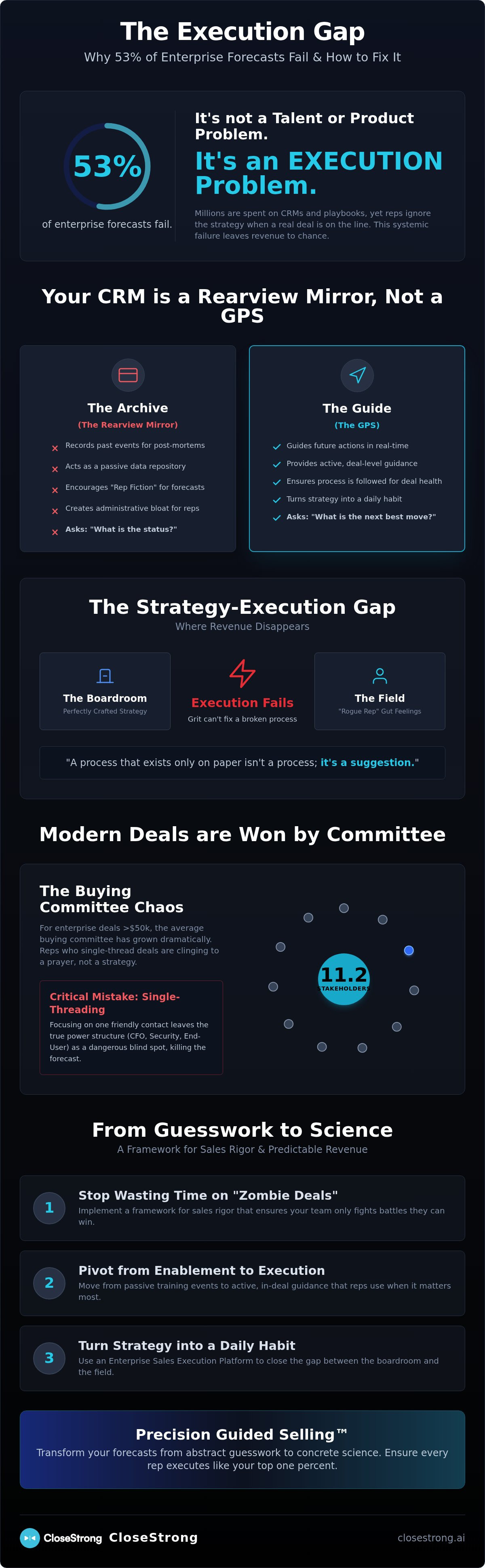
Why do 53 percent of enterprise forecasts fail? It isn't a talent problem. It isn't a product problem. It is an execution problem. You have spent millions on a CRM and months on a corporate playbook, yet your reps still ignore the strategy when a real deal is on the line. These common B2B sales proc...
Why do 53 percent of enterprise forecasts fail? It isn't a talent problem. It isn't a product problem. It is an execution problem. You have spent millions on a CRM and months on a corporate playbook, yet your reps still ignore the strategy when a real deal is on the line. These common B2B sales process mistakes are not just minor hiccups. They are systemic failures that leave your revenue to chance. You're frustrated by inconsistent performance across the team and tired of hearing "it's in the bag" right before a deal slips into next quarter.
We agree that the status quo is broken. A process that exists only on paper isn't a process; it's a suggestion. This article promises to help you stop blaming your reps and start fixing the execution gap that is killing your enterprise forecasts. You will learn why traditional CRM falls short and how an Enterprise Sales Execution Platform provides the visibility you actually need. We're moving past gut feelings and into a world of Precision Guided Selling™ where every rep executes like your top one percent.
• Your CRM is a rearview mirror, not a GPS. Learn why recording deal history is useless if you aren't actively guiding the next move in real time.
• Stop letting strategy die in the field. We expose the common B2B sales process mistakes that allow "rogue reps" to ignore your playbook when the pressure hits.
• Training is not execution. Understand why over-trained teams still fail and how to pivot from passive enablement to active deal-level guidance.
• Stop wasting time on "zombie deals." Implement a framework for sales rigor that ensures your team only fights the battles they can actually win.
• Transform your forecasts from guesswork to science by using an Enterprise Sales Execution Platform to turn your best strategy into every rep's daily habit.
Your CRM is a digital filing cabinet. It is not a sales process. Most leaders mistake pipeline visibility for deal control. They see a deal at "Stage 4" and assume it's on track. It isn't. Seeing a deal in a pipeline is just observation. Influencing that deal is execution. This is one of the most common B2B sales process mistakes: treating a database like a coach. Your CRM records history. It does not guide the future.
CRMs are great at counting things. They count leads, they count calls, and they count emails. But they cannot count the quality of a conversation or the strength of a champion. Your reps spend hours on data entry to satisfy managers, not to win buyers. This creates a culture of "rep fiction." If a manager demands a clean forecast, the rep provides a clean forecast. It doesn't mean the deal is healthy. It just means the data entry is complete. You aren't managing sales; you're managing a creative writing project.
Traditional CRMs are passive repositories. They are archives of what happened last Tuesday. When you run a deal review, you are usually performing a post-mortem. You're looking at why a deal died instead of saving the ones currently on life support. A real sales process focuses on the future. It moves the conversation from "What is the status?" to "What is the next best move?" Even if your team is trained in a Solution Selling Methodology, the CRM won't ensure they actually follow it. It just records whether they claimed to. We need a guide, not an historian.
Visibility should never come at the cost of performance. High performers hate administrative bloat. They want to sell, not type. When you force your best people to act as data entry clerks, you create CRM avoidance. This behavior hides the most common B2B sales process mistakes until it is too late to fix them. You end up managing a forecast rather than managing a deal. Visibility without guidance is just watching a train wreck in slow motion. You can see the collision coming on your dashboard, but you have no way to steer the engine. You don't need more data points. You need better execution on the points that actually matter.
Corporate strategy is a boardroom hallucination. You spend months crafting the perfect go-to-market plan, only to watch it die in a rep's inbox. Strategy is theoretical. Execution is visceral. When a rep is staring down a high-stakes enterprise deal, they don't reach for a 500-page PDF. They reach for what worked last time. This "Rogue Rep" syndrome isn't a personality flaw; it's a survival mechanism. It is also one of the most common B2B sales process mistakes in the enterprise world. You're trying to solve a precision problem with "grit." Grit doesn't close complex deals. Rigor does.
The gap between the boardroom and the field is where revenue disappears. Most leaders assume that because they've "enabled" the team with a new methodology, the team will use it. They won't. Sales enablement often fails because it focuses on "what to know" rather than "what to do right now." If your strategy doesn't show up in the rep's daily behavior, it doesn't exist. It's just shelfware. You don't need more training. You need a way to ensure the training actually happens when the camera is off and the deal is on the line.
Most sales playbooks are too long to read and too heavy to use. There is a massive binary between knowing a methodology and executing it under fire. You can't expect a rep to memorize every branch of a discovery tree while navigating a tense procurement call. To truly scale sales strategy execution, you must move the guidance from the training room to the live deal. Training is an event. Execution is a habit. When strategy stays in the classroom, your forecast stays in the clouds.
Enterprise deals are messy. Research shows that for deals over $50,000, the average buying committee has grown to 11.2 stakeholders. "Staying in touch" isn't a strategy. It's a prayer. Reps often default to single-threading, clinging to one friendly champion while the actual power structure remains a mystery. This is another of the common B2B sales process mistakes that kills forecasts. The CFO, the security lead, and the end-user all have different agendas. If your rep isn't mapping these stakeholders, the deal is already slipping. Beyond just aligning sales and marketing at a high level, you need alignment at the deal level. You must map the power, not just the org chart. If you're tired of seeing "sure things" vanish, it's time to bridge the gap with precision-guided rigor. Strategic failure is optional. Execution is the only way out.
Your tech stack is lying to you. You have spent millions on "intelligence," yet your reps are still guessing. Enablement tells them how to sell. Execution ensures they actually do it. This is one of the most common B2B sales process mistakes: assuming that having information is the same as applying it. Information is passive. Application is active. Most teams are over-trained but under-executing because their tools record history rather than guiding behavior. You have a knowledge problem masquerading as a technology problem.
Conversation Intelligence tools are excellent for post-game analysis. They show you exactly where the rep fumbled the ball. But by the time the manager listens to that recording, the buyer has already moved on. The damage is done. You are analyzing an autopsy instead of performing a surgery. Revenue Intelligence is no better. It gives you a "health score" that acts as a thermometer. Knowing a patient has a fever doesn't cure the infection. You need the medicine. You need the cure. You need active guidance while the deal is still breathing.
A green health score in your CRM doesn't mean a deal is safe. It just means the symptoms look okay. This is the "Dashboard Delusion." Most sales deal health software monitors symptoms rather than causes. You see the "what," but you never get the "how." You don't need reactive reporting that tells you a deal slipped after the quarter ended. You need proactive, real-time deal guidance that tells a rep exactly how to turn a "maybe" into a "yes" before the buyer goes dark.
The stack of the future rejects the "more is better" philosophy. Legacy engagement platforms solved for volume, but volume without rigor is just noise. The missing layer is execution. These sales execution tools for enterprise bridge the gap between having a plan and actually doing the work. We are shifting from "Intelligence," which is passive, to "Guidance," which is active. It is the difference between a paper map and a GPS that steers the car. Precision Guided Selling™ is that GPS. It turns your boardroom strategy into every rep's daily behavior, ensuring that the common B2B sales process mistakes of the past don't haunt your future forecasts.
Rigor is not a dirty word. It isn't about micromanagement. It isn't about more meetings. It is about execution. One of the most common B2B sales process mistakes is the "Qualification Trap." Reps stay in deals they have no chance of winning because they confuse activity with progress. They hope. Hope is not a strategy. You need a system that forces the hard truth early. Rigor is not about "more work"; it is about "better work" on the right deals. It is the difference between a busy pipeline and a winning one.
Deal-level drift happens when the strategy in the boardroom never reaches the rep's desk. You think you have a process, but your reps are actually winging it. They're single-threading. They're skipping discovery steps. They're ignoring the playbook. This isn't because they're lazy. It's because they lack a guidance system that adapts to the specific nuances of a complex B2B workflow. We don't need more observation. We need more meaningful deal-level interactions.
Stop using generic "Stages" like Discovery or Proposal. Those are labels, not actions. You need Strategic Milestones. Identify the specific actions that correlate with closed-won outcomes in your organization. Is it a signed technical brief? Is it a meeting with the CFO? Define your Ideal Deal Execution with a concrete metric: "Every enterprise deal must engage at least three stakeholders from the buying committee by day 45 to maintain a 70 percent win probability." If it isn't measured, it isn't happening. If it isn't specific, it isn't strategy.
Tasks are boring. Guidance is empowering. Most complex B2B sales software just reminds you to send an email. That's a glorified to-do list. You need a GPS. Precision Guided Selling™ keeps reps on the "golden path" to closing by providing real-time, deal-specific prompts. It reduces "Rep Rogue Behavior" by showing them exactly what to do next based on the unique health of that specific deal. Instead of a generic nudge, the rep gets a strategic instruction: "The champion hasn't opened the mutual action plan in 48 hours; verify the security lead's concerns." This is how you scale excellence across the entire team. Stop guessing and start guiding. Eliminate deal-level drift today.
Strategy is a boardroom dream. Reality is a rep in a high-stakes Zoom call. CloseStrong is the only enterprise sales execution platform that bridges that distance. It turns your best strategy into every rep’s daily behavior. This isn't about training. It's about execution. Custom, high-quality deal guidance ensures your top-tier strategy actually makes it to the field. You've spent enough on planning. It is time to spend on doing.
Most common B2B sales process mistakes stem from a failure to guide. You give your team a map and hope they find the destination. They don't. They get lost in the weeds of complex buying committees and procurement hurdles. Precision Guided Selling™ is the GPS that steers them back to the golden path. It isn't just software. It's a new way of winning. It's the difference between watching a deal slip and forcing a deal to close. The bottom line is simple: Stop guessing and start guiding.
The era of the "gut feel" forecast is dead. Sales management is about looking back at what went wrong. Sales execution leadership is about ensuring things go right. The most successful CROs in 2026 are prioritizing execution over enablement. They know that precision guided selling software eliminates the "gut feel" that poisons enterprise forecasts. It replaces "I think" with "I know." It replaces "maybe" with "closed-won." You don't need a better guess. You need a better process.
When you stop guessing, forecast accuracy skyrockets. Win rates follow. This isn't a coincidence. It is the result of applying rigor to every interaction. You are no longer at the mercy of a rep's intuition. You are in control of the execution. You aren't just observing the pipeline; you are influencing the outcome of every single deal.
Ask yourself a hard question. Do you have a process problem, or an execution problem? If your playbook is perfect but your numbers are down, you have an execution problem. Your strategy is failing at the deal level. You don't need to rip out your CRM to fix it. You need to layer in precision guidance. This isn't a total overhaul; it's a strategic upgrade.
Implementation isn't a six-month ordeal. It's a pivot toward results. Start by identifying the drift in your current deals. Look for the gaps where the playbook is ignored. Then, close them with real-time support. Stop guessing. Start guiding. See how CloseStrong guides your team to a close.
The boardroom strategy is only as good as the rep's next move. We've exposed how common B2B sales process mistakes, like treating your CRM as a coach or mistaking visibility for control, are quietly sabotaging your revenue. You don't need another training workshop. You need a system that ensures your playbook is actually used when a deal is on the line. It's the difference between a database that records failure and a platform that drives success. Stop accepting rogue behavior as a cost of doing business. It's time to demand more from your tech stack and your team.
Precision Guided Selling™ technology bridges the gap between what you planned and what your team actually does. It's time to eliminate forecast variance with custom deal-level guidance that scales your best strategy across every rep. Stop managing the rearview mirror and start steering the car toward the close. Your forecast should be a definitive result, not a desperate hope. You've built the engine; now it's time to drive. Success is waiting on the other side of the execution gap.
Stop guessing and start closing with CloseStrong’s Enterprise Sales Execution Platform.
The most frequent error is confusing observation with execution. Leaders often think that seeing a deal in a CRM pipeline is the same as influencing its outcome. This is one of the most common B2B sales process mistakes because it treats a database like a coach. You end up recording history instead of guiding the future. Real success requires deal-level rigor that forces reps to follow the strategy rather than winging it when pressure hits.
Deals slip because of single-threading and a lack of stakeholder mapping. In complex B2B environments, buying committees now average 11.2 people for deals over $50,000. If your rep is only talking to one "champion" while ignoring the CFO or security lead, the deal is dead on arrival. Last-minute slips aren't bad luck; they are the predictable result of poor execution and unverified assumptions about the internal power structure.
A CRM is a passive digital filing cabinet. It records what happened in the past to satisfy management reporting. An Enterprise Sales Execution Platform is an active guidance system. It tells the rep exactly what to do next. While the CRM focuses on administrative data entry, an execution platform focuses on behavior. It bridges the gap between corporate strategy and individual deal reality, ensuring every rep executes like a top performer.
No. Enablement tools focus on "what to know," but they don't ensure "what to do." You can train your team for months, but they will still ignore the playbook during a live call if they aren't guided in real time. Training is an event; execution is a habit. Enablement provides the knowledge, but an execution platform provides the rigor required to turn that knowledge into revenue. You don't need more training; you need more action.
Precision Guided Selling™ is a technology that provides custom, high-quality deal guidance to sales reps. It acts like a GPS for every deal, offering real-time prompts based on the specific health and context of the opportunity. Instead of generic reminders, reps receive strategic instructions on the next best move. It eliminates "gut feel" and ensures that your best strategy is executed consistently across the entire team, regardless of individual experience levels.
Reps ignore playbooks because they are usually too long, too theoretical, and too far removed from the daily grind. When a rep is under pressure, they default to what is comfortable, not what is in a 500-page PDF. This "Rogue Rep" syndrome happens because there is no mechanism to translate boardroom strategy into actionable, deal-specific steps. Guidance must be built into the live workflow, not hidden away in a static manual.
You improve forecast accuracy by eliminating "rep fiction" and focusing on data-driven execution. Stop basing your numbers on gut feelings or CRM stage labels. Instead, use an Enterprise Sales Execution Platform to verify deal health through strategic milestones. When you have full visibility into deal-level behavior, you can eliminate forecast variance. This allows you to predict revenue growth with scientific precision rather than relying on optimistic guesswork from the field.
The execution gap is the distance between corporate strategy and individual rep behavior. It's where your best plans go to die. Most companies have a defined process, but very few have a way to ensure it is actually followed in the field. This gap is the primary cause of inconsistent performance and failed forecasts. Closing it requires moving away from passive observation and toward active, precision-guided deal execution that mirrors your top performers.


