



Veteran reps don’t reject discipline. They reject a process that slows a live deal without helping them make a better call. That’s the real challenge in convincing veteran reps to follow a process: each step has to earn its place in the deal, not just satisfy a manager’s dashboard. If seasoned selle...
Veteran reps don’t reject discipline. They reject a process that slows a live deal without helping them make a better call. That’s the real challenge in convincing veteran reps to follow a process: each step has to earn its place in the deal, not just satisfy a manager’s dashboard. If seasoned sellers see another layer of admin, they’ll work around it, and they may have good reason.
Experienced reps bring judgment, customer knowledge, and hard-won instincts. A rigid rollout can make those strengths feel unwelcome, while too little structure leaves managers guessing whether a rep is exercising autonomy or missing a critical deal move. The answer isn’t to micromanage or abandon consistency. It’s to make the process useful where the work happens.
This article explains how to earn rep buy-in by tying shared standards to real deal decisions, involving reps in making the process practical, and measuring meaningful actions instead of box-checking. It also looks at how deal-specific guidance can connect company strategy to individual execution while leaving room for experienced sellers to use their edge.
• Separate healthy rep autonomy from inconsistent execution by defining the essential deal decisions everyone must address.
• Before pushing harder, identify whether resistance points to a flawed process, a capability gap, competing incentives, or deliberate non-adoption.
• Make convincing veteran reps to follow a process easier by protecting sellers’ freedom in how they work while setting clear standards for deal outcomes.
• Build buy-in through a practical rollout: involve reps, explain the purpose, pilot on a live deal, review evidence, and refine.
• Use deal-level guidance to help reps decide what to do next, connecting company strategy to execution without reducing the process to box-checking.
Experienced reps have built their own ways of qualifying buyers, building trust, and moving complex opportunities forward. Those habits may be effective. A new process that treats them as if they have nothing to teach can feel less like support and more like a forced reset.
The real tension is between shared execution standards and personal judgment. Leaders need enough consistency to understand deal health, spot risks, and put company strategy into practice. Reps need room to respond to the customer in front of them, not follow steps that don’t fit. If a process includes irrelevant questions, duplicates information already entered elsewhere, or fails to explain how a step improves a deal decision, it starts to look like overhead. Calling it “best practice” won’t fix a design problem.
Process adoption means consistently using useful deal decisions, not mechanically completing every required field. That distinction gets to the heart of Sales process engineering: designing a process to make sales work more effective and efficient. A step earns its place when it helps a rep decide what to do, what to validate, or where a deal is exposed. For a closer look at how strategy can connect to execution, explore this enterprise sales execution platform guide.
A leader may intend “let’s make execution more consistent.” A rep may hear “we don’t trust your judgment,” “you have to sell our way,” or “your hard-won expertise no longer counts.” That gap is where resistance takes root. Imagine a rep advancing a complex enterprise deal with several stakeholders. A new checklist asks for information already captured elsewhere, but offers no prompt to test who can approve the purchase. The rep sees bureaucracy; the leader sees a completed step. Neither gets the deal insight they need.
Autonomy is valuable when it lets reps adapt their approach to a buyer while preserving sound deal judgment. One seller may build consensus through a financial case; another may start with operational risk. The tactics can differ. But if each rep uses a different standard for qualification, commitment, or decision access, managers can’t compare opportunities reliably, and risks may stay hidden until late. The goal in convincing veteran reps to follow a process isn’t to erase personal habits. It’s to make essential deal decisions visible and consistent while leaving room for each seller’s strengths.
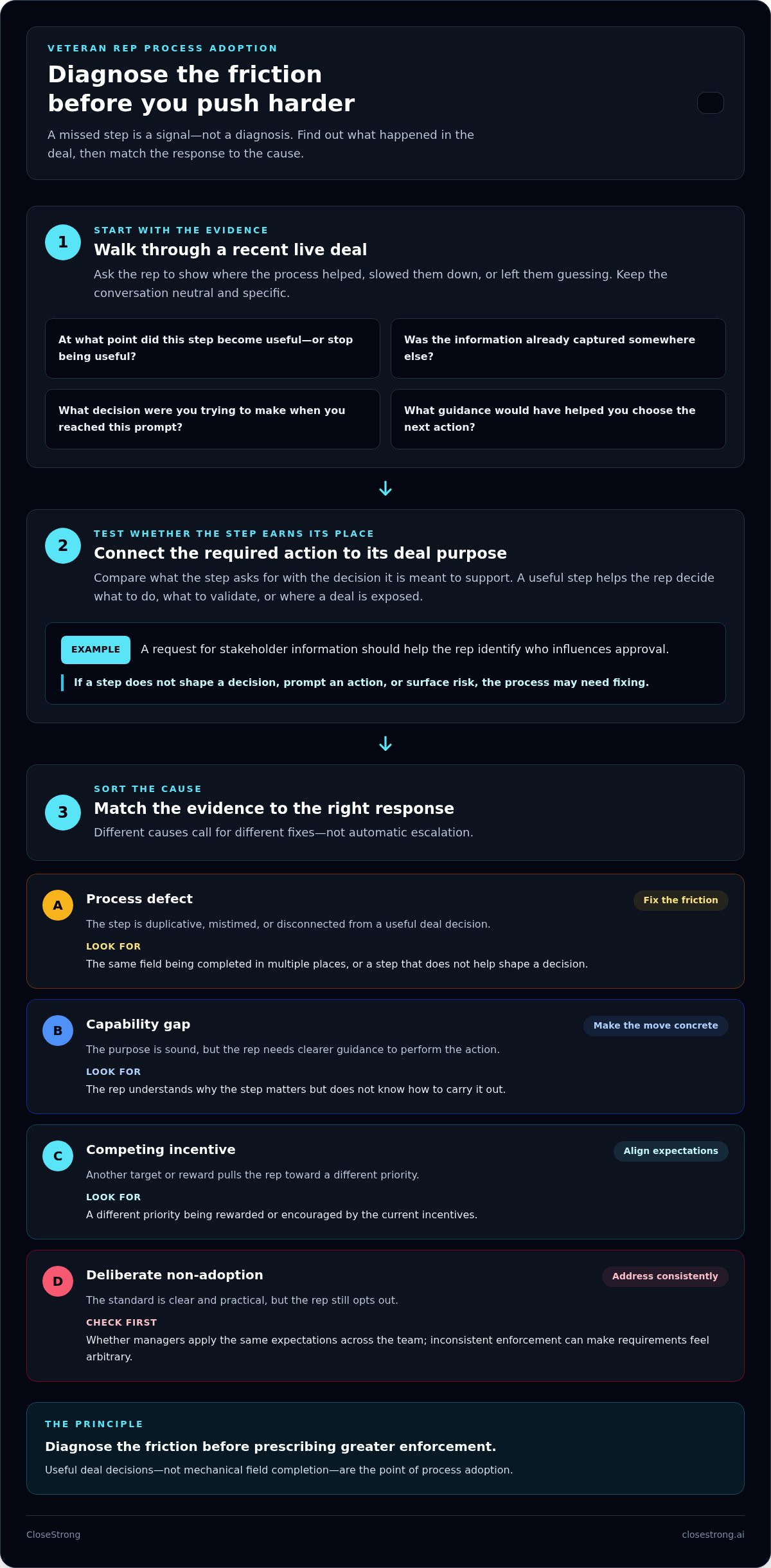
A missed step is a signal, not a diagnosis. If a rep skips part of the process, don’t jump straight to “bad attitude” or increase enforcement. First find out what happened in the deal. The step may be redundant, the rep may not know how to use it, incentives may reward a different action, or the rep may be choosing not to follow a clear standard. Each cause calls for a different response.
Diagnose the friction before prescribing greater enforcement. Compare the required action with its intended deal decision and business purpose. If a step asks for stakeholder information, for example, does it help the rep identify who influences approval? If it doesn’t shape a decision, prompt an action, or surface risk, the process may need fixing.
Skip the abstract debate about whether the process is “good.” Ask the rep to walk through a recent opportunity and show where a step helped, slowed them down, or left them guessing. Keep your questions neutral and specific:
• At what point did this step become useful, or stop being useful?
• Was the information already captured somewhere else?
• What decision were you trying to make when you reached this prompt?
• What guidance would have helped you choose the next action?
Listen for patterns. If reps repeatedly complete the same field in multiple places, that points to process friction. If they can’t explain what a step is meant to reveal, its purpose may be unclear. If they understand the purpose but don’t know how to carry out the action, that may be a capability gap rather than a design flaw.
Look closely at what the rep objects to. Is it one badly timed step, the process as a whole, or the visibility that comes with documenting deal progress? Those are different complaints. Check whether managers apply the same expectations across the team, too. Inconsistent enforcement can make process requirements feel arbitrary, especially if some sellers are routinely excused while others are challenged.
Use the evidence to sort the issue before deciding what to change:
The step is duplicative, mistimed, or disconnected from a useful deal decision. Fix or remove the friction.
The purpose is sound, but the rep needs clearer guidance to perform the action. Make the expected move concrete.
Another target or reward pulls the rep toward a different priority. Align expectations instead of blaming the process alone.
The standard is clear and practical, but the rep still opts out. Address the behavior directly and consistently.
That diagnosis makes convincing veteran reps to follow a process more grounded and fair. You’re not lowering the bar; you’re making sure it measures useful execution, then holding everyone to it. Deal-level guidance can connect process steps to the decisions reps need to make. CloseStrong’s deal guidance brings that support closer to live execution.
Consistency doesn’t mean every seller must run the same conversation in the same order. It means the team shares a clear view of what must be understood before a deal advances. Rigid step enforcement focuses on completing prescribed actions. Principle-led guardrails explain the purpose behind them, allow sensible adaptation, and keep attention on deal impact.
That distinction matters when convincing veteran reps to follow a process. If a rep can demonstrate that the right buyer evidence is in place, the exact questions or meeting sequence may not matter. But if a deal moves forward without evidence to support a critical decision, personal confidence isn’t a substitute for a shared standard. Set expectations around decisions and proof, not identical scripts.
Start by identifying the deal decisions your strategy depends on. Your team might need a shared way to assess whether a business problem is understood, whether relevant stakeholders are engaged, or whether there’s evidence for a proposed next step. These are examples, not universal rules. Validate each proposed standard against your sales strategy, buyer environment, and deal types.
For every guardrail, make the business purpose explicit. Ask: What risk does this help reveal? What decision should the evidence support? What would justify advancing, pausing, or changing course? If leaders can’t answer those questions, the requirement may be activity for activity’s sake. Clear criteria give managers a better basis for comparing deals and give reps a reason to capture the information.
Preserve flexibility in the tactics used to reach the shared outcome. A rep may change the language used to explore a business issue, adjust the order of conversations, or engage stakeholders through different routes. Those choices can reflect customer context and the seller’s strengths. Personal style isn’t a problem if the essential decision and supporting evidence remain clear.
Make that boundary visible. The process can define what the team needs to know without dictating every word a rep says or every meeting they schedule. For example, the standard could require a clear understanding of the customer’s decision criteria, while leaving the rep to uncover those criteria through a workshop, an executive conversation, or a series of targeted questions. Managers can then review what’s known and what remains uncertain, rather than whether a seller followed a script.
A useful test is to sort each process element into two groups:
Deal decisions, evidence, and advancement criteria that support the organization’s strategy.
Rep-specific language, sequencing, and stakeholder engagement that can vary while still meeting those guardrails.
This balance helps turn process from a leash into a common frame for judgment. It also makes sales strategy execution more practical: leaders can connect strategic priorities to deal-level expectations without forcing every rep into an identical style. Keep the standards purposeful, and let experienced sellers choose the route that fits the deal.
A process rollout shouldn’t begin with a mandate and end with a compliance report. Give experienced reps a chance to shape how the process works, then test it against live deal conditions before making it the team standard. This turns convincing veteran reps to follow a process from a persuasion exercise into a practical test: does it help them make better-informed moves?
Ask experienced sellers to walk through steps that feel ambiguous, mistimed, or disconnected from a real deal decision. Their job isn’t to veto shared expectations; it’s to expose where the guidance falls short in practice. Close the loop by showing what changed, what stayed, and why. Feedback earns trust when reps can see it had a consequence.
Use a rollout with clear stages:
Bring a mix of experienced sellers into the review. Ask them to flag unclear prompts, duplicate work, and moments when they need more decision support.
For each required action, explain which deal decision it supports and how it connects to the team’s sales strategy.
Test the process with a defined set of opportunities before extending expectations across the team. Live deals reveal friction that a slide deck can’t.
Look at whether the guidance helped reps identify risks, assess next steps, or make decisions with stronger evidence. Don’t mistake activity counts for useful execution.
Fix confusing or duplicative steps, share practical lessons, and make the revised expectations clear before broader rollout.
Choose deals that give the team a meaningful test, then review them with the reps involved. Ask what guidance changed their thinking, what information was missing, and what they did next. Use those answers to improve the process before scaling it. Keep the pilot focused on decision quality and practical usefulness, not on catching people out or rewarding the neatest paperwork.
Managers have a role after launch, too. In deal reviews, coach toward the next useful action. Asking “What evidence would help you confirm the buyer’s decision criteria?” is more productive than asking whether every field is complete. Reinforce sound decisions and address missing execution directly. That’s how a process becomes part of the work rather than a separate reporting ritual.
Precision Guided Selling™ connects execution support to the deal itself. CloseStrong’s platform helps sales representatives put company strategy into practice deal by deal, with custom, high-quality guidance through the closing process. Explore CloseStrong’s Precision Guided Selling™.
A process earns a place in a veteran rep’s workflow when it helps answer the question, “What should I do next in this deal?” Recording that a meeting happened isn’t the same as helping a seller assess what the meeting revealed, what remains uncertain, or what action could move the opportunity forward. Activity records show what occurred. Useful guidance helps a rep make sense of what it means.
That difference matters when convincing veteran reps to follow a process. Experienced sellers already have judgment. They don’t need another layer of generic instructions; they need guidance that connects company strategy to the decision in front of them. For enterprise teams, sales execution software should support action across individual deals, not simply record activity.
Strategy often loses force when it stays at the company level. A priority such as engaging the right decision-makers becomes useful to a rep when it translates into deal-level questions: Who will evaluate the proposal? Who can approve it? What evidence supports that understanding? Guidance can help a seller work through those questions without dictating the exact language or sequence of customer conversations.
CloseStrong’s Precision Guided Selling™ is a platform approach to putting company strategy into practice deal by deal. It guides sales representatives through the closing process with custom, high-quality deal guidance. The aim isn’t to replace a rep’s instincts or make every deal identical. It’s to connect strategic intent with the decisions reps need to make as each opportunity unfolds.
An enterprise sales execution platform may fit teams that have a strategy but struggle to make it consistent in individual opportunities. Consider the gap between what leaders expect and what sellers can use in a live deal. Are reps clear on the decisions that matter? Can they apply company priorities to a specific opportunity? Does guidance help them identify a next move, rather than simply document activity after the fact?
Those questions help distinguish execution support from tools or initiatives that solve a different problem. The goal isn’t to add more steps for their own sake. It’s to make strategy actionable where deals are being worked, while leaving experienced reps room to apply their judgment. When guidance supports the closing process, consistency can come from shared deal decisions rather than identical selling styles.
If your team needs a clearer bridge between company strategy and individual deal execution, see how CloseStrong guides deal execution.
Your next move doesn’t need to be another process announcement. Pick a live opportunity and ask: what decision would help this rep move forward with more clarity? That question shifts the conversation from enforcing steps to improving execution, while giving experienced sellers a practical reason to engage.
That’s the standard for convincing veteran reps to follow a process: it should sharpen deal decisions without flattening the judgment they’ve built through selling. CloseStrong’s Precision Guided Selling™ uses custom deal guidance to connect company strategy with individual deal execution and guide representatives through the closing process.
Ready to make process support useful where deals actually move? See how CloseStrong guides deal execution. Give your team a clearer path to apply strategy, keep their edge, and make each next move count.
Experienced reps often resist when a process seems disconnected from how their buyers make decisions or asks them to document information they already know. They may also worry that a prescribed sequence will weaken a customer relationship they’ve built carefully. Look for when resistance appears: after a new approval requirement, during a buyer-specific exception, or when a rep can’t explain what a step helps them decide. That context points to the real issue.
Show how the process helps with a real selling problem, then give reps a meaningful role in testing it. For example, ask an experienced seller to use one deal to identify where guidance would have helped them prepare for a decision-maker conversation. Follow up by explaining what changed based on their input. For convincing veteran reps to follow a process, visible usefulness and credible follow-through matter more than a launch presentation alone.
Require shared standards for the deal information and decisions your team needs, but don’t demand identical selling behavior in every conversation. A rep working with a committee may need a different sequence of conversations than one dealing with a single buyer. Set a clear baseline, then define how reps should document meaningful exceptions. Managers can assess whether the deal meets the standard without treating every departure from the usual route as a failure.
Compare the same step across multiple deals and reps. If several sellers struggle to complete it at the same point, or can’t connect it to a useful decision, inspect the process design. If the step works for peers but one rep repeatedly avoids it without a deal-based reason, address the behavior directly. A short review of a live opportunity can reveal whether the problem is unclear instructions, poor timing, missing skills, or non-adoption.
Yes. A process can set the outcomes and evidence expected while leaving sellers free to choose their language and approach. One rep might learn a prospect’s priorities through a structured discovery meeting; another might uncover them over several conversations. If both can show what the buyer values and how that shapes the opportunity, the difference in style isn’t a process failure. Make the expected result clear, and avoid prescribing tactics without a business reason.
Measure whether the process improves the quality of deal decisions, not just whether reps complete fields. In a review, check whether the opportunity has credible evidence for its next milestone, whether key risks are surfaced, and whether the planned action follows from what the buyer has said or done. Pair those observations with rep feedback on usefulness. Completion data can flag a concern, but it can’t explain whether the process is helping sellers execute.


