




A playbook that reps have to interpret mid-deal isn’t a playbook. It’s paperwork. The right enterprise sales playbook template helps sellers make better decisions as opportunities shift, buying groups grow, and new risks surface.If your current guide feels too generic, you’re not imagining it. A lis...
A playbook that reps have to interpret mid-deal isn’t a playbook. It’s paperwork. The right enterprise sales playbook template helps sellers make better decisions as opportunities shift, buying groups grow, and new risks surface.
If your current guide feels too generic, you’re not imagining it. A list of stages and best practices won’t tell a rep what to do when a champion goes quiet or stakeholders disagree. So what should an enterprise sales playbook template include to earn a place in real deals? Clear guidance, practical prompts, and decision points that connect company strategy to the next move in an individual opportunity.
This guide gives you a practical structure to build one, from qualification and stakeholder mapping to deal progression, risks, and next steps. You’ll see how to create consistency without scripting every seller interaction, and how to keep the playbook focused on action rather than shelf appeal. Documenting strategy is only the start. Reps also need relevant guidance they can apply as a deal changes. A sales execution platform can help carry that strategy into daily deal work.
• Build an enterprise sales playbook template around real deal decisions, not just stage descriptions and process documentation.
• Use practical prompts to capture account context, ideal customer fit, buying-group roles, and business priorities.
• Make guidance easy to find and adaptable to deal context, so reps can apply shared principles without following rigid scripts.
• Shape the playbook around business outcomes and recurring deal challenges, using input from sales leaders, reps, and customer-facing teams.
• Turn the finished playbook into deal-level guidance that helps sellers decide what to do next in a specific opportunity.
A sales strategy can be clear in a leadership presentation and still disappear inside a live opportunity. A rep may know the official stages but not what evidence should justify moving forward, which stakeholder needs attention, or how to respond when the buyer’s priorities change. That gap is where deals lose direction.
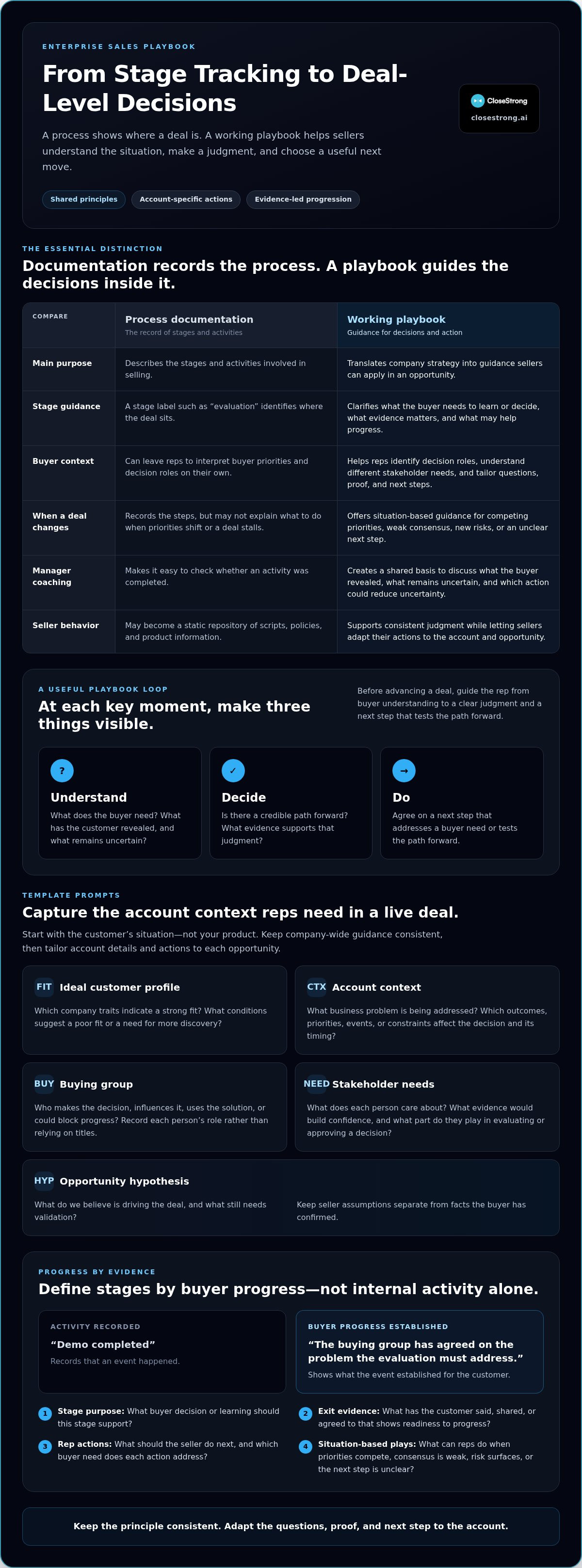
A sales process describes the stages and activities involved in selling. A useful playbook builds on the sales process by translating company strategy into guidance reps can use to make decisions and take action. It connects expectations to real situations: what to learn in discovery, how to test whether a problem matters, and what to do when a deal stalls.
Definition: An enterprise sales playbook is a practical guide to the decisions, behaviors, and actions sellers should apply across a sales motion, with room to adapt those actions to the account and opportunity.
That definition matters because process documentation alone tends to tell reps where they are, not what to do next. A stage label such as “evaluation” doesn’t explain how to understand the customer’s decision criteria, coordinate internal experts, or confirm that the right people are involved.
Enterprise deals involve multiple stakeholders, extended decision paths, and account-specific priorities. One contact may care about operational impact; another may focus on financial justification, security, or implementation risk. A single script can’t address every concern, and repeating the same pitch to each person won’t create a shared case for change.
The playbook should set reusable company guidance, such as how to qualify business impact or identify decision roles. Reps then tailor their questions, proof, and next steps to the opportunity. The principle stays consistent; the action changes with the account.
At key moments, reps need three things: what to understand, what to decide, and what to do. Before advancing a deal, for example, they may need to understand the buyer’s priority, decide whether the opportunity has a credible path forward, and agree on a next step that tests that path. The playbook makes those expectations visible.
It also gives managers a shared basis for coaching. Instead of asking only whether a rep completed an activity, a manager can discuss the thinking behind it: What did the buyer reveal? What remains uncertain? Which action would reduce that uncertainty? That’s guidance, not a script. It supports consistent judgment without forcing every seller to use identical words.
A static repository stores scripts, policies, and product information. A working playbook helps reps use relevant information to make a sound move in a specific deal. The distinction is simple: process documentation records the steps; a playbook helps sellers navigate the decisions inside them.
A useful template doesn’t just collect sales materials. It tells a rep what to look for in an account, what evidence matters, and which move may help the buyer progress. Use the sections below as a working outline. Keep company-wide guidance consistent, then tailor account details and actions to each opportunity.
Start with the customer’s situation, not your product. Capture enough context to make the rest of the playbook useful in a live deal.
Which company traits indicate a strong fit? What conditions suggest the opportunity is a poor fit or needs more discovery?
What business problem is the customer addressing? What outcomes matter, what priorities shape the decision, and what events or constraints affect timing?
Who makes the decision, influences it, uses the solution, or could block progress? Record each person’s role rather than assuming titles tell the whole story.
What does each person care about? What evidence would build confidence, and what part do they play in evaluating or approving a decision?
What do we believe is driving the deal, and what still needs validation? Keep seller assumptions separate from facts the buyer has confirmed.
For example, a finance stakeholder may need a credible business case, while an operational leader wants to understand workflow impact. The playbook should help the rep capture both needs and plan how the buying group can evaluate the decision together.
Define stages by buyer progress and observable evidence, not by internal activity alone. “Demo completed” records an event. “The buying group has agreed on the problem the evaluation must address” shows what the event established.
What buyer decision or learning should this stage support?
What has the customer said, shared, or agreed to that shows the opportunity is ready to progress?
What should the seller do next, and what buyer need does each action address?
What can reps do when discovery reveals competing priorities, consensus is weak, risk surfaces, or the next step is unclear?
Write plays as practical options, not mandatory scripts. For consensus building, a play might help the rep compare stakeholder priorities and identify an unresolved concern before proposing a joint discussion. For risk, it might prompt the seller to clarify the concern, its impact, and who needs to help address it.
Keep approved company messaging and validated proof points distinct from opportunity-level hypotheses. Reps should be able to see which claims are established, which customer outcomes are supported, and what still needs discovery. Then capture the next step, its owner, and the buyer outcome it is meant to advance.
This separation helps sellers avoid presenting an assumption as a promise or treating generic messaging as a customer-specific business case. An enterprise sales execution platform can help carry company strategy into individual opportunities through deal-level guidance.
Reps don’t ignore a playbook because they dislike consistency. They ignore it when the guidance is hard to find, too vague to act on, or disconnected from the deal in front of them. A long document organized around internal departments may be complete, but completeness alone doesn’t make it useful in a customer conversation.
Trust erodes when examples no longer reflect how buyers make decisions, instructions say “build alignment” without showing what to do, or useful guidance is buried beneath policies and product material. The fix isn’t another round of formatting. It’s designing the enterprise sales playbook template around situations sellers actually face, then keeping its guidance current and clear.
Organize content around the rep’s question, not the org chart. “A stakeholder challenges the business case” is easier to act on than a page filed under a department name. Give each section a clear owner who can review it as sales motions and customer needs change.
Name the deal moment or decision the guidance supports.
State the next useful action, then explain why it matters to the buyer.
Show how a rep might respond when a champion lacks access to decision-makers or stakeholders disagree on priorities.
Separate approved messaging and validated evidence from illustrative examples that need adapting.
For instance, “confirm the decision process” is too broad on its own. A more useful prompt asks what steps remain, who participates, and what the buyer needs to resolve at each step. The rep can find the guidance, understand its purpose, and choose a relevant action.
Consistency doesn’t require identical conversations. Set non-negotiable principles, such as validating the customer’s business problem before presenting a solution, then give sellers room to adapt their questions and evidence to each account. Replace word-for-word scripts with decision criteria and prompts that encourage sound judgment.
Define the evidence or behavior expected, such as confirming the buyer’s priority in their own terms.
Allow reps to adjust the conversation for a stakeholder’s role, concerns, and decision influence.
Ask what the rep learned, what remains uncertain, and why the planned action fits this deal.
Managers can use shared standards to coach without penalizing a rep for taking a different path when account context calls for it. A sales execution platform can help carry strategy into individual opportunities through practical deal guidance. CloseStrong’s enterprise sales execution platform is built around that connection. Teams looking to bring company strategy into deal-level execution can explore CloseStrong’s Precision Guided Selling™.
Don’t start by polishing a document. Start with the business outcome the sales team needs to deliver and the execution problems getting in its way. The first version should solve a real selling challenge, not attempt to capture everything the company knows about sales.
Choose one sales motion or recurring deal challenge, then review successful and stalled opportunities related to it. Look for actions that helped, assumptions that went untested, and points where progress broke down. Turn repeatable patterns into guidance with a clear purpose and an observable seller action. Keep company standards separate from choices that depend on the account.
Define the business outcome the playbook should support. Identify where execution falls short, such as inconsistent qualification or difficulty building agreement across stakeholders.
Ask sales leaders, reps, and customer-facing teams what situations recur, what buyer signals matter, and where existing guidance fails. Compare perspectives rather than treating one person’s preferred approach as a universal rule.
Examine a focused set of won, lost, stalled, or reshaped deals. Separate confirmed buyer evidence from seller interpretation, then note which actions were repeatable and which depended on unique account conditions.
State the situation it addresses, the principle or outcome it supports, what the rep should understand, and a practical action to consider. Include decision criteria, but leave room for account-specific tactics.
Put the guidance into use in relevant active opportunities. Ask reps where it was clear, missing, mistimed, or hard to apply. Compare intended actions with observed deal behavior, and record what the evidence does and doesn’t show. Don’t claim the play caused a deal outcome based on a small pilot.
A pilot is a test of usefulness, not a launch announcement. Collect feedback while reps are applying the guidance, then refine the wording, timing, or examples based on what they encounter. Keep reusable standards stable, but revise tactics when account context calls for a different move. This turns the playbook into an execution aid rather than another document to maintain.
Set review triggers so updates respond to evidence rather than calendar reminders alone. Revisit guidance when company strategy or the sales process changes, buyer patterns shift, or deal reviews reveal a recurring friction point. Track whether reps can find and apply the guidance, and whether it supports the intended behavior. Those observations can inform decisions, but don’t treat correlation as proof of impact.
For a deeper look at carrying company priorities into individual opportunities, explore scaling sales strategy execution. To put that connection into practice, see how CloseStrong’s deal guidance helps bring sales strategy into enterprise opportunities.
An enterprise sales playbook template gives a team the structure for shared guidance. A finished playbook makes that guidance usable across the sales motion. Deal-level guidance takes the next step: it helps apply company strategy to the facts, people, and decisions in a specific opportunity. These are connected layers, not competing approaches.
A reference document can explain the standard. By itself, it can’t tell a rep how that standard applies when an account’s priorities shift or stakeholders disagree. The difference is practical: one helps sellers find the company’s approach; the other connects that approach to the opportunity they’re working now.
| Guidance type | Purpose | Seller action |
|---|---|---|
| Static reference | Capture shared process, principles, messaging, and resources. | Find the relevant guidance and use it to plan a sales activity. |
| Deal-level guidance | Apply company strategy to the context and decisions in a specific opportunity. | Assess the account’s situation, consider what is known or unresolved, and choose a relevant next move. |
A playbook is the right tool for defining shared principles, stage expectations, and repeatable sales guidance. It gives sellers and managers a common reference. But when an opportunity changes, general guidance may not answer the immediate question: what does this buyer need to decide, and what should the rep do next? More complex, changing deals can call for guidance tailored to deal context, without treating any suggested action as a guarantee of a particular outcome.
The handoff from strategy to execution is where the distinction matters. A company may set a principle, such as connecting the solution to a buyer’s business priorities. In an active opportunity, the rep still needs to interpret what those priorities are, whose perspective is missing, and what evidence could help the buying group evaluate the decision. Deal-level guidance helps translate the principle into relevant questions and actions without scripting every conversation.
CloseStrong provides an enterprise sales execution platform using Precision Guided Selling™ and custom deal guidance to connect company strategy with individual opportunities. Precision Guided Selling software shows how that approach can bring strategy into active deal work.
A playbook sets direction. Deal-level guidance helps sellers apply it as an opportunity unfolds. If your team is ready to connect its strategy to the decisions reps face in active deals, explore CloseStrong and its approach to deal guidance.
Your next step isn’t to add more pages. Choose one live sales challenge and ask whether your guidance helps a rep make a clearer decision in that moment. That’s the test of whether your enterprise sales playbook template can move beyond documentation and support action as opportunities evolve.
As your team applies the guidance, keep learning from the gap between the strategy you set and the choices reps face in active deals. CloseStrong’s enterprise sales execution platform uses Precision Guided Selling™ and custom deal guidance to help connect those two levels.
Explore CloseStrong’s approach to deal-level guidance and consider how your strategy can show up in the work sellers do every day. A playbook that helps reps act with clarity is a stronger foundation for consistent execution. Build it, test it, and keep making it useful.
An enterprise sales playbook template is a reusable framework for organizing the information and guidance a sales team needs to work complex opportunities. It gives the team a starting structure rather than prescribing every answer. Sellers can use it to record account-specific facts, identify unanswered questions, and plan actions, while leaders use it to clarify expectations across the sales motion. Adapt the template to the company’s sales approach and the decisions reps face.
An enterprise sales playbook should include information that helps sellers prepare, act, and learn from opportunities. Alongside account and stage guidance, consider adding a glossary of internal terms, examples of strong discovery notes, rules for escalating deal risks, and a clear owner for each section. These details reduce guesswork. For instance, reps should know who can resolve a pricing or product question instead of searching through unrelated materials.
There’s no ideal page count. The playbook should be long enough to answer the questions reps encounter and short enough for them to find guidance quickly. Separate essential direction from deeper reference material, and use clear labels so sellers can scan for the situation they’re handling. If users regularly ask where to find an answer, shorten or reorganize the content. A concise core guide with optional supporting detail is often easier to use than one oversized document.
One shared playbook can establish company-wide principles, but a single version may not fit every team’s selling context. A team serving a distinct industry, account size, or buying motion may need additional examples or specific guidance. Keep common expectations together, then provide clearly labeled variations where customer needs or sales responsibilities differ. This avoids maintaining entirely separate playbooks while helping reps avoid applying guidance that doesn’t fit their opportunities.
Review the playbook on a planned schedule and whenever a meaningful change makes its guidance unreliable. Triggers include a shift in company priorities, changes to the sales process, new buyer objections, or repeated confusion in deal reviews. Assign an owner to check affected sections, gather input from users, and communicate what changed. A review doesn’t always require a rewrite. Sometimes one outdated example or unclear instruction is the real problem.
A cross-functional group should shape the playbook, with a clear owner responsible for the final version. Sales leaders can define strategic expectations, while frontline reps bring examples of real deal friction and useful actions. Customer-facing colleagues, such as account managers or solution specialists, can surface buyer questions that sellers may miss. Involve these groups early, but avoid turning authorship into a committee exercise. One accountable editor can resolve conflicting advice and keep the guide coherent.
Look beyond whether reps opened the document. Check whether they can find relevant guidance, use it in deal plans, and explain how it informed a decision or customer interaction. Managers can sample opportunity reviews for evidence of the expected behaviors, then ask reps which guidance helped or got in the way. Track these signals alongside deal outcomes, but don’t assume that playbook use alone caused a win or loss.


