




87% of enterprises missed their revenue targets in 2025. That isn't a rounding error; it's a systemic failure. Most sales leaders aren't forecasting. They're wishing. You've invested in a CRM and "intelligence" tools, yet your end-of-quarter still feels like a high-stakes gamble. You're tired of "gu...
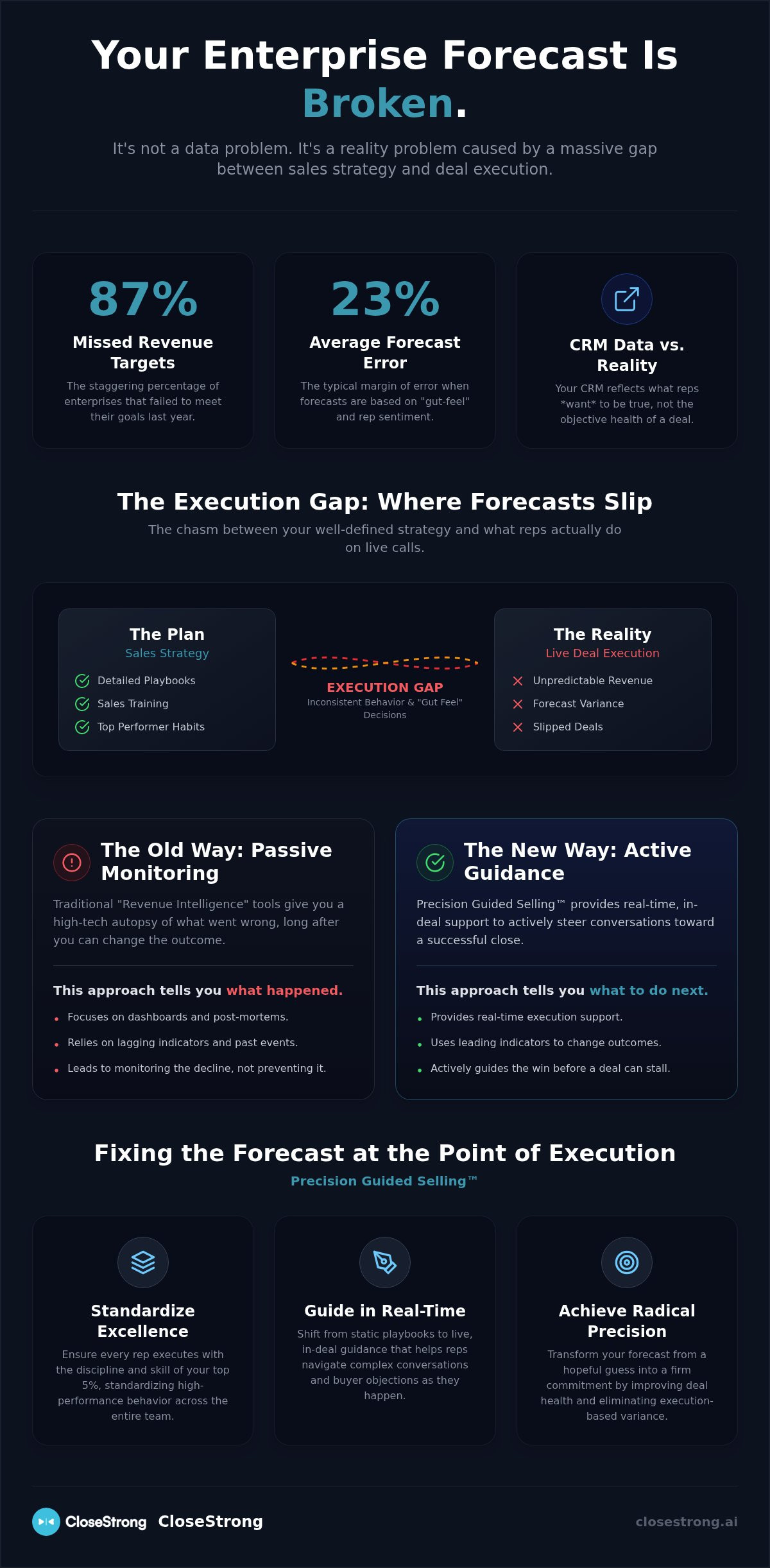
87% of enterprises missed their revenue targets in 2025. That isn't a rounding error; it's a systemic failure. Most sales leaders aren't forecasting. They're wishing. You've invested in a CRM and "intelligence" tools, yet your end-of-quarter still feels like a high-stakes gamble. You're tired of "gut-feel" guesses that miss the mark by 23% on average because you don't know how to improve deal health in enterprise sales at scale. It's not a lack of data. It's a lack of truth.
You know the frustration of watching committed deals slip because of inconsistent rep behavior and zero visibility into actual execution. We're going to fix that. This guide breaks down how to achieve radical precision by closing the execution gap at the deal level. We're moving past the post-mortems and the spreadsheet fiction. You'll learn why traditional forecasting is a broken relic and how Precision Guided Selling™ turns individual intuition into standardized, predictable revenue growth. It's time to stop monitoring the decline and start guiding the win.
• Stop trusting CRM data that reflects rep sentiment instead of reality and learn to treat your forecast as a firm commitment rather than a hopeful guess.
• Identify the "Execution Gap" where your best sales strategies die and discover how to bridge the space between a static playbook and a live deal.
• Learn exactly how to improve deal health in enterprise sales by shifting from passive conversation "autopsies" to active, real-time guidance that changes outcomes.
• Implement Precision Guided Selling™ to standardize high-performance behavior across your entire team, ensuring predictable revenue and the elimination of forecast variance.
Your CRM isn't a source of truth. It's a graveyard of intent. While traditional demand forecasting methods rely on historical data and market trends, enterprise sales forecasting relies on something far more volatile: rep sentiment. Let's be blunt. Sales forecast accuracy isn't a statistical "maybe" or a hopeful guess. It is a firm commitment based on verified, objective deal health. If your forecast is consistently off by 10% or more, you don't have a data problem. You have a reality problem.
Most reps suffer from "Happy Ears." They overestimate the probability of a win to avoid management scrutiny or to keep a "dead" deal in the pipeline for another week. This creates a lag-time trap. By the time you realize a deal is stalling, it's already too late to save the quarter. You're looking at data that reflects feelings from last Tuesday, not the reality of the buyer's silence today. Learning how to improve deal health in enterprise sales starts with admitting that your current visibility is an illusion.
Why do smart reps provide bad data? Fear. When managers apply pressure without providing execution support, reps prioritize survival over honesty. They sugarcoat risks because "I don't know" is treated as a failure rather than a diagnostic starting point. This turns your pipeline stages into subjective fiction. One rep's "Negotiation" is another rep's "First Draft Sent." Without objective criteria, your forecast is built on a foundation of sand. It's not a lack of effort. It's a lack of integrity in the process.
Standard visibility tools tell you what happened. They don't tell you what to do. Moving toward radical precision requires a shift from "gut feel" to evidence-based rigor. This is where sales deal health software becomes critical. You need to see the actual signals of engagement, not just the check-boxes a rep clicked five minutes before a pipeline review. Knowing how to improve deal health in enterprise sales means identifying real risk before it becomes a post-mortem. Visibility alone doesn't create accuracy; execution does. You don't need more dashboards. You need better truth.
Your forecast doesn't fail because of bad math. It fails because of bad execution. The Execution Gap is the chasm between your high-level sales strategy and the gritty reality of what happens on a live call. You've built the playbooks. You've conducted the training. Yet, when the pressure is on, your reps revert to "gut feel" and old habits. This isn't a minor glitch. It is the primary driver of forecast variance.
Static playbooks are the enemy of dynamic deals. A PDF doesn't help a rep navigate a surprise procurement hurdle at 4:00 PM on a Friday. When execution is left to chance, you end up with the "Rogue Rep" problem. Inconsistent behavior leads to unpredictable revenue. If five different reps handle the same competitive threat in five different ways, your forecast isn't a data point. It's a roll of the dice. Closing this gap is the only way to move from guessing to guiding.
For most CROs, scaling sales strategy execution is the ultimate challenge. Traditional enablement is often a "spray and pray" model. It provides content but fails to drive deal-level behavior. This creates a massive misalignment between the boardroom's expectations and the sales floor's reality. Strategy is what you plan to do; execution is what actually happens. If those two things don't match, your forecast is already dead. You don't need more "enablement" libraries. You need real-time alignment that ensures every rep executes like your top 5%.
Deals rarely die at the finish line. They bleed out in the middle of the funnel. This is execution leakage, the silent killer of enterprise quotas. It happens when a rep misses a critical discovery question or fails to multi-thread the account early enough. There is a massive difference between knowing the effective ways to increase sales and actually applying them under fire. If you want to know how to improve deal health in enterprise sales, you must stop looking at the outcome and start looking at the leakage. Guidance must happen before the mistake occurs, not during the autopsy. To see how this works in practice, you should explore an execution-first approach to deal management.
Visibility is the biggest lie in sales tech. For years, leaders have been told that if they just had more "insights," their forecast would magically align. This is the autopsy problem. Traditional revenue intelligence tells you exactly why a deal died three weeks after the funeral. It's interesting data, but it's useless for how to improve deal health in enterprise sales while the deal is still breathing. You don't need a better view of the wreckage. You need a way to prevent the crash.
Conversation intelligence tools are necessary, but they are insufficient. Recording a call and analyzing sentiment doesn't change the rep's behavior during the next call. It's passive monitoring masquerading as a solution. If you're serious about reducing sales forecasting errors, you must move beyond the rear-view mirror. Revenue intelligence focuses on the "what." Sales execution platforms focus on the "how." One describes the problem. The other solves it.
More dashboards rarely lead to more clarity. They usually lead to analysis paralysis. This is the "Observer Effect" in sales: simply watching your team doesn't actually improve their performance. In fact, it often just teaches them how to "play to the metrics" instead of closing deals. Modern complex B2B sales software must do more than track activity. It has to drive the right activity. If your tech stack only tells you that a rep didn't mention the "economic buyer," it's too late. You need a system that ensures they never forget to ask in the first place.
Stop asking "What happened?" and start asking "What do I do next?". The gap between these two questions is where your revenue lives. Real-time guidance removes the burden of memory from the rep and replaces it with a path to success. By using precision guided selling software, you can intervene mid-deal with custom guidance based on verified health signals. This eliminates the "I forgot" excuse. It turns every rep into a high-performer by providing the right prompt at the right moment. This isn't just visibility. It's control. It is the only way to ensure that "committed" actually means "closed."
Forecast accuracy isn't a gift from the sales gods. It's a result of structural discipline. To master how to improve deal health in enterprise sales, you must replace rep intuition with institutional knowledge. Stop looking at the scoreboard and start looking at the mechanics of the game. If you want a forecast that actually lands, you have to guide the behavior that creates the revenue. It's not about tracking calls; it's about guiding outcomes.
Turn your high-level playbook into actionable, deal-level guidance that exists where the work happens.
Use triggers that fire during the sales cycle to ensure critical steps aren't missed when the pressure is on.
A deal isn't "strong" because a rep feels good; it's strong because a mutual action plan is signed and the economic buyer is verified.
Actively steer reps back to the proven path the moment they start to drift into rogue behavior.
If the execution is flawed, the forecast is a lie. Predict future health by measuring adherence to the process today.
Playbooks are often where great strategies go to die. They're too long, too static, and too far away from the actual deal. You need to break those complex documents down into "next-best-action" prompts that appear exactly when a rep needs them. Custom deal guidance ensures that a rep isn't just following a generic list, but is navigating the specific nuances of a high-value account. Real-time guidance reduces the cognitive load on reps by automating the "what's next" so they can focus entirely on the "how" of the human connection.
Most managers track activity. High performers track adherence. It doesn't matter how many emails were sent if none of them moved the deal toward a verified milestone. By using sales execution tools for enterprise, you create a single source of truth that isn't based on rep opinion. Execution data is the only data that matters for forecast accuracy because it's the only data that reflects reality. Stop managing by the numbers and start managing by the behaviors that drive them. Build a more predictable pipeline by mastering deal-level execution.
Precision is the difference between a deal that closes and a deal that "slips." You've tried the monitoring tools. You've sat through the post-mortems. Now, it's time to actually change the outcome at the moment of impact. The Enterprise Sales Execution Platform is the final piece of the modern sales stack. It doesn't just watch your reps; it guides them. This isn't another layer of management. It is a layer of precision that turns strategy into revenue.
Understanding how to improve deal health in enterprise sales isn't about reading more reports. It is about enforcing the right behaviors in real time. CloseStrong takes your high-level strategy and injects it directly into the sales cycle. We provide custom, high-quality deal guidance that ensures every rep follows the winning playbook. This is the "no-nonsense" path to predictable revenue. By focusing on execution at the deal level, you eliminate the variance that plagues traditional forecasting. You stop managing by hope and start managing by mechanics.
General advice is worse than useless in a $500k enterprise deal; it's dangerous. You don't need a rep who "tries their best." You need a rep who executes with the surgical accuracy of your top 1%. CloseStrong bridges that gap by providing real-time prompts and objective execution milestones. We ensure every deal moves forward based on facts, not feelings. This ripple effect transforms the entire organization. When execution is standardized, the forecast becomes a reflection of reality, not a work of fiction. Better execution leads to higher win rates, shorter cycles, and a complete elimination of the "Happy Ears" epidemic we discussed earlier.
Imagine a world where you actually trust the numbers in your CRM. That isn't a dream; it is the inevitable outcome of Precision Guided Selling™. When you stop guessing and start guiding, the chaos disappears. You gain the peace of mind that comes from knowing exactly where every deal stands and exactly what needs to happen to close it. The path to predictable revenue is clear. Stop accepting forecast variance as a cost of doing business. It's time to demand more from your tech stack and your team. Getting started is simple: align your strategy with your execution and let the data speak for itself. Stop guessing. Start guiding. For sales leaders who have achieved predictable growth and are now managing significant capital gains, Cornerstone Real Estate Investment Services provides the expertise needed to navigate 1031 tax-deferred exchanges and DST properties.
Forecasting isn't a math problem. It's an execution problem. You've spent years staring at dashboards that tell you why you lost, but those autopsies won't save next quarter. Real precision requires a shift from passive monitoring to active guidance. It requires closing the gap between the strategy in your head and the behavior on the sales floor. Stop trusting CRM data that reflects feelings instead of facts. Start enforcing the mechanics of the win.
You now have the blueprint for how to improve deal health in enterprise sales by moving beyond the "Happy Ears" epidemic and subjective pipeline updates. With Precision Guided Selling™ technology and custom deal-level guidance, you can finally build a forecast that is a commitment, not a guess. This is the modern CRO's path to predictable growth. It's time to stop managing the wreckage and start leading the execution. Built for the modern CRO, our Enterprise Sales Execution Platform ensures your strategy actually reaches the deal level.
See how CloseStrong eliminates the execution gap.
The status quo is a gamble you don't have to take. Step into the room as the only adult with a plan that actually works. You've got this.
You improve accuracy by shifting from prediction to prescription. Stop asking reps how they feel about a deal and start measuring whether they've completed the critical execution steps that lead to a win. High-performing teams focus on how to improve deal health in enterprise sales by enforcing a standardized playbook. When you verify behavior instead of trusting intuition, you eliminate the variance that plagues manual forecasts.
The primary culprit is rep subjectivity, often called Happy Ears. Reps are naturally optimistic and frequently overestimate deal health to avoid management scrutiny or to keep a dead deal in the pipeline. This creates a data set based on hope rather than reality. Without objective verification, your forecast is just a collection of professional guesses. You don't have a math problem; you have a data integrity problem.
Software only helps if it moves from monitoring to intervention. Most tools just show you the wreckage after a deal fails. A true Enterprise Sales Execution Platform improves accuracy by guiding reps through the closing process with precision. It replaces passive dashboards with active prompts. If the software doesn't change what the rep does on a call, it isn't improving your forecast; it's just documenting your failure. Focus on behavior, not just data.
Revenue intelligence is a rearview mirror; sales execution is the steering wheel. Revenue intelligence tools tell you what happened on a call after it is over. They provide an autopsy. Sales execution platforms provide real-time guidance while the deal is still breathing. You don't need more visibility into your losses. You need a system that intervenes to ensure you win. One describes the problem; the other solves it.
You stop the fiction by removing the incentive to lie. Replace subjective deal stages with objective, verifiable milestones. Don't let a rep move a deal to Negotiation unless a mutual action plan is signed. When you mandate evidence-based updates, you learn how to improve deal health in enterprise sales through rigor rather than pressure. If the evidence isn't in the system, the deal doesn't exist in the forecast.
CRM data is almost never enough because it is a lagging indicator of rep memory. It reflects what a rep chose to type in, usually minutes before a pipeline review. It doesn't capture the silent killers like stalled stage velocity or lack of multi-threading. To build an accurate forecast, you need real-time execution data that tracks whether the winning strategy is actually being followed at the deal level. Reality beats sentiment.
Stop looking at activity counts and start looking at strategic adherence. Key metrics include engagement with the true economic buyer, time spent in a single stage, and completion of custom deal-level guidance prompts. A deal with high activity but zero executive engagement is a red flag. True health is measured by the buyer's actions, not the rep's effort. If the buyer isn't moving, the deal isn't healthy.
It eliminates variance by standardizing performance across the entire team. Precision Guided Selling™ ensures that every rep, not just your top performers, follows the proven path to a close. By providing real-time prompts and steering reps back to the playbook when they drift, it creates a repeatable outcome. When execution is consistent, revenue becomes predictable. You move from guessing at the numbers to guiding the results. Precision creates trust.


