




Shorten the cycle before the proposal, not after it. The practical answer to how to reduce sales cycle length is to qualify earlier: validate budget and decision authority within the first two sales calls, then agree on clear next steps with the buyer. This helps keep weak-fit deals from clogging th...
Shorten the cycle before the proposal, not after it. The practical answer to how to reduce sales cycle length is to qualify earlier: validate budget and decision authority within the first two sales calls, then agree on clear next steps with the buyer. This helps keep weak-fit deals from clogging the pipeline and surfaces real buying barriers while there’s still time to act.
It’s frustrating when a promising opportunity drifts through meeting after meeting, then stalls over a missing decision-maker, a budget concern, or an unresolved objection. More activity won’t fix a qualification problem. Better questions, asked sooner, can.
This article breaks down what shapes sales cycle length, how to front-load discovery and qualification, and how sales and marketing can keep buyer expectations aligned. You’ll also learn how to calculate cycle length, spot bottlenecks in your process, and measure whether changes are actually moving deals forward. No guesswork. Just a clearer way to find where time is lost and what to do next.
• Compare time spent in each sales stage to pinpoint where qualified deals stall, then target the bottleneck instead of speeding up every step.
• Use early discovery to test budget, decision authority, buying priorities, and potential objections before investing in a proposal.
• Align sales and marketing around shared definitions of a qualified lead and consistent buyer messaging to protect momentum.
• Measure cycle length alongside stage conversion, win rate, and pipeline velocity to see whether process changes improve outcomes.
• Calculate elapsed time consistently from the same starting and ending points so you can compare results and track progress accurately.
A sales cycle is the sequence of steps a potential customer takes from first contact through purchase. It often includes prospecting, discovery, qualification, evaluation, proposal, approval, and contract. Each stage should advance a buyer decision. When opportunities sit idle between steps, the sales process loses time and revenue.
Delays usually have a cause: unclear qualification, missing stakeholders, slow demos, unanswered objections, or procurement reviews that start too late. For example, a buyer may finish a demo but still need finance approval. Track when each opportunity enters and exits every stage, then compare closed-won deals. The longest stage is a clue; repeated stalls point to a bottleneck.
There’s no single cycle length for every sale. Smaller, simpler purchases may close in 30 days or less, while B2B decisions can take several months or longer. RAIN Group found that 43% of sales leaders reported longer sales cycle times. Deal complexity, purchase value, and the number of stakeholders all shape the timeline.
Set stage-specific targets, then investigate misses instead of pushing every deal faster. A demo and evaluation stage may target 14–21 days, while contracting in complex mid-market and enterprise sales may target 5–7 days. If a contract stage regularly runs longer, identify whether legal review, security approval, or vendor onboarding is holding it up. One example in the sales process is 40% of deals stalling after the first demo.
What sales automation and CRM tools help reduce cycle time, and what do they cost? Automation can streamline follow-ups, meeting notes, data entry, and reporting, while CRM workflows can trigger timely follow-up. Costs vary by seats, features, integrations, and implementation, so compare the quote with the time the tools could save.
How can faster proposals, quotes, and contracts shorten the sales cycle? Prepare accurate proposal materials from discovery notes, agree on scope before drafting, and send contract documents as soon as the buyer is ready. Clear terms and fewer handoffs reduce avoidable waiting.
How can sales teams use buyer enablement and content to speed up decisions? Share relevant case studies, product guidance, and internal decision materials that help stakeholders evaluate the offer and explain it to colleagues. Match each asset to the buyer’s stage and open questions.
How can businesses reduce approval and procurement delays without increasing risk? Start security, legal, and procurement reviews early, provide complete documentation, and keep the buyer’s approval owners involved. Preserve required checks; remove waiting and rework, not safeguards.
What are the risks of shortening the sales cycle too aggressively? Rushing qualification can overlook poor fit, budget gaps, or missing decision-makers, creating late-stage stalls or weak deals. Faster isn’t better if buyers lack the information or approval needed to commit.
Qualification belongs before the demo calendar fills, not after a proposal is drafted. A prospect can show strong engagement and still lack budget, authority, urgency, or a workable buying process. Test those conditions early. A practical answer to how to reduce sales cycle length is to find these gaps before reps invest in late-stage work. Otherwise, forecasts treat curiosity as a real opportunity, and reps spend time pushing deals that cannot move forward.
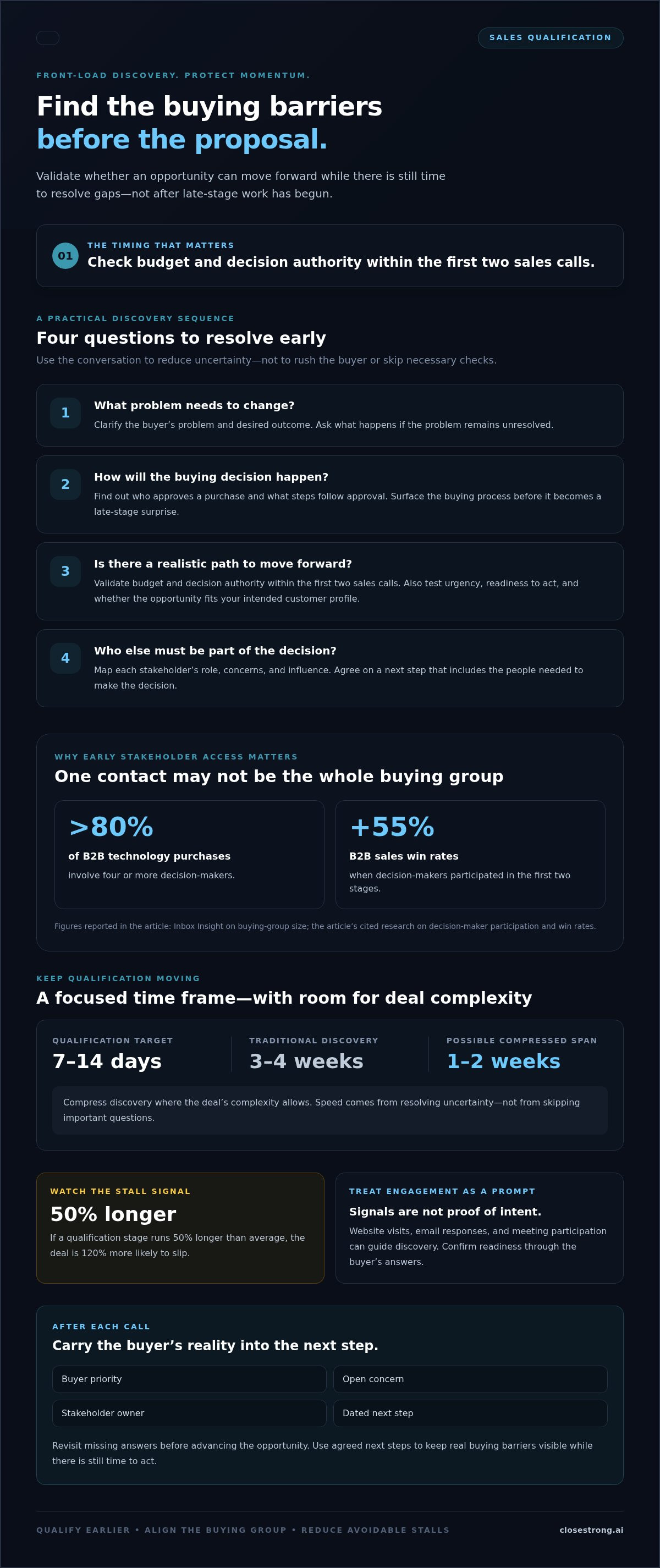
Use discovery to map the buyer’s problem, desired outcome, decision process, and readiness to act. Ask what happens if the problem remains unresolved, who approves a purchase, and what steps follow approval. Validate budget and decision authority within the first two sales calls. That gives the rep a sound basis for prioritization, rather than a hunch built from email opens.
Bring the buying group into the conversation early. More than 80% of B2B technology purchases involve four or more decision-makers, according to Inbox Insight. A single enthusiastic contact may not represent finance, security, procurement, or the final approver. Map each stakeholder’s role, concerns, and influence, then agree on a next step that includes the people needed to make the decision.
The timing matters. B2B sales win rates rose 55 percent when decision-makers participated in the first two stages. Set a discovery and qualification target of 7–14 days, and compress a traditional 3–4 weeks of discovery into 1–2 weeks where the deal’s complexity allows. Keep the questions focused; speed comes from resolving uncertainty, not skipping it.
How can lead qualification reduce sales cycle length? It identifies poor-fit or unready prospects before they consume late-stage effort, while directing qualified opportunities toward the right next action. If a qualification stage runs 50 percent longer than average, the deal is 120 percent more likely to slip.
Prioritize using evidence that reflects readiness: fit with the intended customer profile, a business problem the buyer recognizes, access to decision-makers, and agreed next steps. Lead-scoring platforms can organize engagement signals such as website visits, email responses, and meeting participation. Treat those signals as prompts for discovery, not proof of buying intent. HubSpot research found that sales rated 7% of marketing leads as high quality, a reason to align scoring with what sales sees in real conversations.
After each call, record the buyer’s priority, open concern, stakeholder owner, and dated next step. Revisit missing answers before advancing the opportunity. Teams considering how to reduce sales cycle length should make sure qualification findings carry forward into execution. An enterprise sales execution platform can provide structured deal guidance to support that consistency.
Misalignment can start before a sales rep calls. Marketing promises a fast implementation, while sales describes a lengthy rollout. The buyer hears two stories and pauses to reconcile them. Shared messaging keeps the pipeline moving by making ads, landing pages, webinars, and sales conversations reinforce the same outcomes, limits, and next steps.
Start with a shared definition of a qualified lead. Marketing can document the campaign, content viewed, and problem the prospect described. Sales can add fit, urgency, stakeholders involved, and the buyer’s next decision. Review examples together, such as a webinar registrant who asks about integration but has no active project. Agree whether that engagement calls for follow-up or continued nurturing.
Build a feedback loop around real conversations. In a weekly pipeline review, sales can flag objections that repeatedly follow a particular campaign. Marketing can then improve the relevant content, such as publishing an implementation guide when buyers repeatedly ask about deployment. Sales should confirm that the new asset answers the objection, rather than simply adding another link to an email.
Early objection handling is a team responsibility. If buyers raise security, budget, or internal approval concerns, record the exact concern and the stage where it surfaced. Marketing can prepare accurate, reusable explanations; sales can involve the right internal stakeholder before the concern becomes a late-stage blocker. For example, share security documentation when the buyer starts evaluating risk, not after procurement requests it.
Make the handoff specific. A marketing lead should arrive with context, not just a name and a score. Include the campaign promise, the buyer’s stated interest, and any content engagement that suggests a priority. The sales rep can open with that context, check whether it still matters, and agree on a useful next step. That prevents a generic pitch from undoing the trust marketing built.
Use shared measures to spot disconnects. Compare lead-to-opportunity conversion, reasons leads are rejected, common objections, and the time between handoff and the first meaningful sales conversation. If one campaign brings volume but few viable opportunities, revise its targeting or promise. If qualified buyers respond but stall after a particular message, review the sales talk track and supporting content.
Alignment isn’t a meeting on the calendar. It’s a working agreement: consistent claims, clear handoffs, and fast feedback from the people hearing buyers directly. When marketing and sales update that agreement as objections change, they reduce confusion without pressuring prospects into premature decisions.
Sales cycle length measures elapsed time from a defined starting event to a completed purchase. For one team, that might mean first meaningful sales contact to signed contract. For another, it may begin when a lead becomes an opportunity. Either boundary can work, but changing the definition mid-report makes comparisons unreliable.
Benchmarks only help when you compare like with like. Optif.ai reported a median B2B SaaS sales cycle of 84 days across 939 companies. Ebsta and Pavilion reported an average B2B new-business sales cycle of 91 days in 2025, compared with 52 days for expansion sales. These figures describe different measures and deal types, not a universal target.
To calculate an average, choose the same start and finish events for every opportunity. Record the elapsed days for each closed deal, then divide the total by the number of deals included. Keep closed-won and closed-lost opportunities separate if you want to know how long successful deals take. Also label the date range, segment, and metric version so future reports follow the same rules.
One average can hide the real story. A few unusually long enterprise deals can push it up, while the median shows the midpoint deal. Compare both when the pipeline includes different deal sizes or sales motions. Then break results down by stage, lead source, and new business versus expansion. This shows whether a change affected the whole sales process or just one group.
Cycle length matters because it connects sales activity to capacity and revenue timing. If deals advance faster without weakening fit or win rates, representatives can handle opportunities more efficiently. A sales-cycle reduction of 25% can increase revenue per sales representative by 30–35%, according to the stated business-impact benchmark. Treat this as a relationship to test against your own results, not a forecast.
Pair cycle-time metrics with average deal size, win rate, pipeline velocity, and stage conversion. A shorter cycle alongside falling win rates may signal rushed qualification, not better execution. A longer average with stable conversion may reflect a shift toward more complex deals. Read the metrics together before changing targets.
For a useful comparison, preserve a baseline, document any process change, and measure the same opportunity groups afterward. If the team changes its start event or reporting window, mark that as a new version. Consistent definitions turn cycle length from a vanity number into a decision tool for capacity, forecasting, and process improvement.
A useful cycle-time calculation starts with consistent dates, not a clever dashboard. Choose the same start event for every opportunity, such as first sales contact or opportunity creation, and the same finish event, such as a signed contract. Then subtract the start date from the finish date. Record elapsed calendar days consistently across the reporting period.
For example, a deal that takes 90 days and then closes in 75 days has shortened by 15 days. Divide the 15-day reduction by the original 90-day timeline, then multiply by 100. That gives a 17% reduction. The calculation compares the change with the original cycle, rather than simply reporting fewer days.
Calculate both the average and median when reviewing results. Add the elapsed days for the included opportunities and divide by their count to find the average. Sort those same durations to find the median. The average can be pulled upward by a single unusually long deal; the median shows the midpoint. Label the measure used in each report.
Define the opportunity group before calculating. Compare new-business deals with new-business deals, and keep expansion opportunities separate. If the pipeline mixes segments or deal types, a change in its composition can make the average look faster or slower without any process improvement. Keep the start event, finish event, reporting window, and inclusion rules fixed.
Then calculate cycle time by stage. Use each opportunity’s entry and exit dates to find where buyers wait, and compare those durations across closed deals. If total cycle time falls but one stage grows, the delay may have moved rather than disappeared. Pair the timeline with stage conversion and win rate to see whether a shorter duration also supports sound outcomes.
Set a baseline before changing the sales process. Document the current calculation, choose the specific change, and measure the same opportunity groups afterward. A new lead-generation campaign, for example, can change the mix of buyers entering the pipeline. Separate that effect from changes to discovery, approvals, or contract handling before judging the result.
Finally, report the reduction in days and percentage. A percentage makes changes easier to compare across different starting timelines; elapsed days show the practical time saved. Use the same formula for each review, and keep calculation notes with the report. For a structured approach to advancing opportunities, explore deal execution guidance that connects deal actions to buyer progress.
CloseStrong helps sales teams put company strategy into action across active deals. Its Enterprise Sales Execution Platform uses Precision Guided Selling™ to guide representatives through the closing process, with custom, high-quality deal guidance shaped around the deal in front of them.
Turn to CloseStrong when your team has a defined sales process but struggles to apply it consistently across opportunities. Instead of treating every deal alike, reps get deal guidance to focus on buyer priorities, next steps, and execution. The platform helps teams carry strategy through the pipeline and act on it in each deal.
To discuss your sales execution needs, contact CloseStrong or visit closestrong.ai.
Faster selling isn’t about pushing every buyer toward a decision. It’s about making the next action clear, useful, and grounded in what the buyer needs. That takes discipline: choose one friction point to address, give the team a consistent approach, and learn from live deals. Small process changes are easier to evaluate when applied consistently.
If you’re deciding how to reduce sales cycle length, make the next step practical. Identify where execution breaks down between company strategy and the actions reps take on individual deals. Then focus there, rather than adding activity that doesn’t resolve the underlying issue.
CloseStrong’s Enterprise Sales Execution Platform brings Precision Guided Selling™ and custom high-quality deal guidance to sales execution. If you’re ready to examine how deal guidance could support your team’s approach, talk with CloseStrong. A clearer path through each deal starts with a focused conversation. Keep challenging the delays, keep improving the process, and give your next opportunity a stronger path forward.
The sales cycle is the buyer’s path from first contact to purchase. The time and progress between those events affect revenue timing, forecasting, and how teams allocate attention. For example, a sales leader can distinguish an active opportunity from one sitting idle by reviewing its last buyer action and next agreed decision. That makes pipeline discussions more useful than relying on optimism alone.
More people and functions are shaping purchase decisions, making agreement harder to coordinate. A typical B2B buying decision involves 13 internal stakeholders and nine outside influencers. Each may bring different priorities, reviews, or concerns. For example, a department may support a solution while security or finance still needs evidence. Buyers also need to share information internally, so unclear value or unresolved questions can slow consensus even when the main contact is engaged.
Tracking cycle time helps leaders see whether deals are progressing or merely accumulating activity. It also supports staffing and forecasting decisions. If a team’s average changes, examine whether the cause is a different deal mix, a process shift, or a stage where work is waiting. Pair cycle time with win rate and stage conversion, so faster closes don’t disguise lost deals or premature qualification.
A sales cycle is the sequence of buyer steps from initial contact through purchase; its length is the elapsed time between defined start and finish events. To measure it consistently, use the same events for every opportunity and subtract the start date from the close date. Decide how to treat reopened or paused opportunities, then document the rule. Otherwise, two reports can show different results for the same sales activity.
Look for repeated waiting points, not just the stage with the longest duration. Review opportunity histories for gaps between a completed action and the next buyer commitment. For example, if demos finish promptly but proposals wait for internal approval, the blockage may be unclear scope or missing decision criteria. Compare patterns across opportunities and record the reason for each delay. A recurring reason signals a process issue worth addressing.
Prepare a short agenda, then ask buyers to explain the problem, its business effect, and how they’ll judge a solution. The 70/30 sales rule recommends spending 70% of the conversation listening and 30% talking. Use follow-up questions to clarify vague answers, such as what “faster reporting” would change in the buyer’s work. Close by recapping the need and confirming the buyer’s next step in their own words.
Keep a baseline and compare the same types of opportunities before and after a process change. Separate results by segment, deal source, and new business or expansion, so shifts in pipeline mix don’t look like improvement. Track cycle duration alongside win rate, deal size, and stage conversion. For example, if a new handoff process shortens cycle time but lowers conversion, review lead quality and handoff context before expanding it.
Automation can streamline follow-ups, meeting notes, data entry, forecasting, and reporting, while CRM workflows can trigger timely follow-up. Costs vary by seats, features, integrations, and implementation, so compare the quote with the time the tools could save.


