





Your expensive revenue intelligence platform isn't closing deals. It is just watching them die in high definition. You have the recordings, the "clean" data, and the fancy pipeline views, yet your forecast variance still feels like a coin flip. This is the brutal reality of revenue intelligence vs s...
Your expensive revenue intelligence platform isn't closing deals. It is just watching them die in high definition. You have the recordings, the "clean" data, and the fancy pipeline views, yet your forecast variance still feels like a coin flip. This is the brutal reality of revenue intelligence vs sales execution. Visibility is not victory. Knowing a deal is stalling does not save it. Intelligence is the autopsy. Execution is the cure.
You are likely frustrated by revenue leakage and reps who treat the corporate playbook like a suggestion. We get it. More data rarely leads to more deals. It just leads to more meetings about why you missed your quarterly number. This article will show you how to stop watching your pipeline leak and start controlling it. We are going to explore why intelligence is just the diagnosis and how to pivot toward a strategy that ensures predictable growth, strategic alignment on every deal, and the total elimination of the gap between strategy and execution.
• Stop confusing visibility with victory. Intelligence identifies the leak; execution is the plug.
• Understand that revenue intelligence vs sales execution is the difference between diagnosing a failure and preventing one.
• Close the execution gap by moving your strategy out of unread PDFs and into the heat of the deal.
• Trade manager-centric dashboards for rep-centric guidance that actually changes behavior on the ground.
• Discover how Precision Guided Selling™ bridges the divide between corporate strategy and predictable revenue.
Most CROs in 2026 are watching their revenue burn in 4K resolution. They have the dashboards. They have the call recordings. They have "clean" data that tells them exactly how and why they missed their quarterly targets. This is the visibility trap. Revenue intelligence is a map. It shows you the terrain and identifies the pitfalls, but it isn't the car, the driver, or the fuel. You can stare at a map all day; it won't move you an inch closer to your destination.
To understand the disconnect, we have to look at what these tools actually do. Revenue intelligence is the post-hoc analysis of sales interactions and data. It is a specialized branch of Business Intelligence that records the past to predict the future. The problem? It stops short of changing the present. This creates a dangerous, false sense of security for sales leadership. Leaders feel in control because they can see the problems, yet the problems persist. Visibility is not victory. It is just an autopsy performed in real-time. When you weigh the merits of revenue intelligence vs sales execution, you are choosing between knowing you are failing and actually winning.
Knowing a deal is "at risk" because a champion hasn't responded in ten days is useful. It is also ten days too late. In complex enterprise sales, the cost of signal-to-action latency is terminal. By the time an intelligence platform flags a lack of multi-threading or a missed discovery step, the momentum is gone. The competitor is already entrenched. We define the 'Rearview Mirror' problem as the gap between data capture and rep behavior change. If your tech stack only tells you what went wrong after the rep has already moved on, you aren't managing a sales team. You are managing a museum of missed opportunities.
In fast-moving sectors like real estate, overcoming this lag requires immediate access to actionable data; for example, agents often explore Expired Pro to identify and pursue opportunities the moment they stall in the market.
Reps don't need more insights. They need fewer distractions. Most intelligence tools flood reps with "at-risk" alerts and "suggested actions" that feel like digital nagging. This is alert saturation. It creates noise, not clarity. There is a massive structural difference between an automated alert and a strategic directive. An alert says "this deal is cold." A strategic directive says "execute the executive alignment play now because the CFO just joined the buying committee." Revenue intelligence vs sales execution comes down to this: one adds to the noise, while the other provides the signal. Your reps are ignoring your current tech stack because it doesn't help them win. It just gives them more homework.
Your sales stack is broken because it prioritizes observation over operation. We have been sold the lie that if we just record enough calls and roll up enough forecasts, revenue will magically follow. It won't. There is a fundamental, binary contrast between these two worlds. Intelligence watches the game; Execution calls the plays. One is a spectator sport. The other is the engine of the win.
The missing layer in most organizations is the bridge between strategy and the actual deal. CRMs are great at storing data. BI tools are great at visualizing it. But neither can force process adherence. They are passive systems of record. They don't care if your rep skips discovery or forgets to map the buying committee. They just record the failure. When analyzing revenue intelligence vs sales execution, the distinction is clear: execution requires a bottom-up approach to rep behavior, focusing on what happens inside the deal rather than top-down reporting that only summarizes the damage after the fact.
Revenue intelligence functions as your historical record. It excels at call recording, forecast roll-ups, and relationship scoring. These tools identify patterns. They tell you that deals tend to stall after the second demo or that your win rate drops when the CTO isn't involved. This is necessary, but it is insufficient for enterprise growth. Identifying a pattern of failure doesn't stop the next failure. It relies on identifying patterns rather than creating them. If you want to change the outcome, you have to change the behavior in the moment, not analyze it three weeks later.
Sales execution is the "How to Win" layer. It is about real-time guidance, strategy enforcement, and deal-level rigor. The goal is simple. You want every rep to execute like your top 1% on every single deal. While intelligence platforms are busy scoring relationships, an execution platform is busy guiding them. It operationalizes your playbook by giving reps specific, strategic directives based on the unique mechanics of the deal they are working on right now.
This is where the divide becomes clear. You don't need another dashboard to tell you that you're missing your numbers. You need a system that ensures your team is doing the work required to hit them. If you are ready to move beyond passive observation, you should look into how an Enterprise Sales Execution Platform can transform your strategy into reality. It is the difference between having a map and having a driver who knows every shortcut to the finish line.
Your corporate strategy is a ghost. It lives in a PDF that no one reads and a slide deck from the last kickoff that everyone forgot by Tuesday. Execution is the only thing that is real. In the debate of revenue intelligence vs sales execution, the winner is decided by what actually happens on the call, not what was planned in the boardroom. If your strategy isn't present in the moment of the deal, it doesn't exist.
Every enterprise team suffers from the "Rogue Rep" phenomenon. These aren't your underperformers. Usually, they are your most experienced veterans. They ignore your new methodology or your "strategic initiatives" because they view them as administrative tax. They have seen playbooks come and go. If a strategy doesn't help them win a specific, high-stakes deal right now, they will dump it. This isn't a personnel problem. It is a delivery problem. Traditional sales enablement is too passive to help. It provides training and content, but it stays in the library while the rep is in the trenches. The hard truth is simple. Your strategy is only as good as the individual rep's next move.
Enterprise deals are messy. They are non-linear, politically charged, and prone to sudden shifts in momentum. A "standard process" is a fantasy that crumbles the moment a new stakeholder enters the room or a competitor drops a low-ball bid. One-size-fits-all coaching fails here because every deal has its own unique gravity. We define the Execution Gap as the distance between the boardroom's intent and the rep's action. If your intelligence tools are just recording the fact that the gap exists, they aren't helping you close it. They are just documenting your decline.
Stop trying to "fix" your forecast. The forecast is just a thermometer. It tells you the temperature; it doesn't change the weather. If your forecast variance feels like a coin flip, it is because the execution feeding it is inconsistent. You don't have a data problem. You have a behavior problem. Execution platforms eliminate forecast variance at the source by forcing rigor into the deal itself. This is the fundamental shift from "predicting" outcomes to "manufacturing" them. When you control the execution, the forecast takes care of itself. You stop guessing if a deal will close and start ensuring that it does by guiding the specific steps that lead to a win.
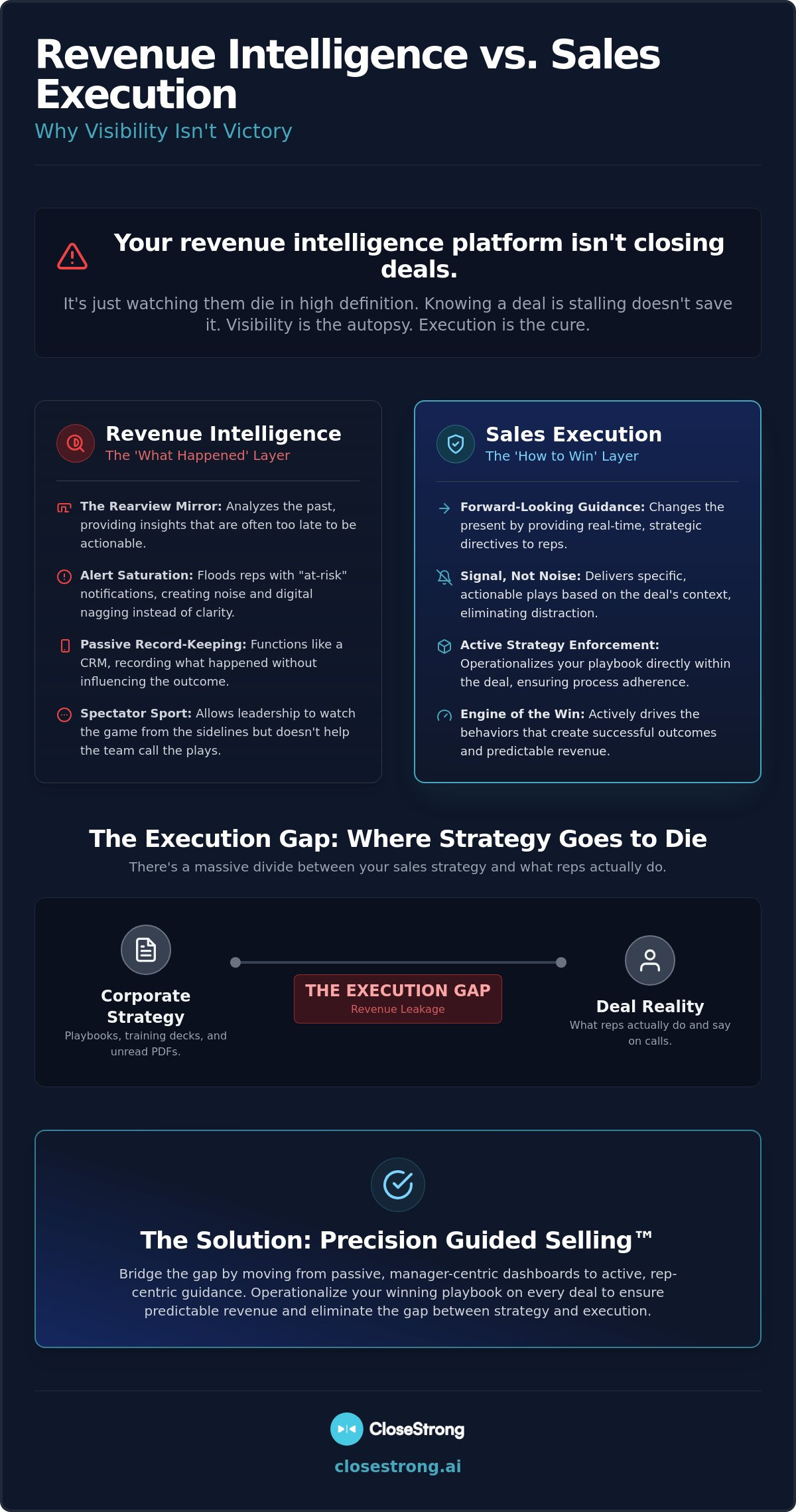
Dashboards are a management crutch. They provide a comfortable illusion of control while the reps are out there guessing. If your tech stack is designed to help you report better rather than help them sell better, you have failed. Dashboards are for managers; guidance is for makers. This is the structural heart of the revenue intelligence vs sales execution debate. One is a scoreboard. The other is the playbook being whispered into the quarterback's ear during the huddle. You don't win games by staring at the scoreboard. You win by running the right plays.
A true Sales Execution Platform is built on three pillars: Rigor, Guidance, and Alignment. First, Rigor. You need a baseline of non-negotiable standards. Second, Guidance. You need deal-specific instructions that change based on buyer behavior. Third, Alignment. You need the boardroom strategy to be visible in the rep's daily workflow. This isn't about coaching after the fact. It is about guiding in the moment. You don't scale complex sales by looking at more charts. You scale by providing custom, high-quality deal guidance that makes your average rep perform like a veteran. It turns the "what" of your data into the "how" of your victory.
Rigor is the antidote to hope-based selling. Most reps "hope" the champion has power. They "hope" the budget is approved. Hope is not a strategy. It is a liability. You need automated guardrails that enforce your methodology without slowing down the deal cycle. If a discovery step is missed, the system should flag it immediately. Not in a weekly 1:1. Not after the deal is lost. Right now. This level of rigor ensures that every deal in your pipeline is built on a solid foundation rather than a shaky assumption.
Your sales playbook shouldn't be a static document. It should be a live, interactive guidance system. Real-time strategy implementation means turning your unique competitive advantages into contextual prompts. If a competitor is mentioned, the rep gets the specific talk track to neutralize them. If a new stakeholder is identified, the rep gets the executive alignment play. This is the right move at the right time. It ensures that your strategy isn't just an idea. It is the reality of every deal. Every rep becomes an extension of your best strategic thinking.
Ready to stop reporting on failure and start architecting success? See how a Sales Execution Platform turns your strategy into a precision-guided weapon.
Guesswork is the silent killer of the enterprise pipeline. You've spent years investing in tools that tell you what happened. Now, it's time for a platform that tells you what to do. Precision Guided Selling™ is the end of the "maybe" deal. It's the end of the "I think we're good" forecast. CloseStrong doesn't just watch your reps; it guides them through the specific mechanics of every high-stakes interaction. This is the final word on revenue intelligence vs sales execution. Intelligence is the diagnosis. Execution is the cure.
The post-hoc era of sales is over. Leaders are tired of autopsies. They want results. By 2026, the industry has realized that visibility is a commodity, but execution is a competitive edge. CloseStrong provides the bridge that ensures your boardroom strategy actually makes it into the rep's next meeting. We don't just identify the Execution Gap. We close it. We turn your "rearview mirror" data into a precision navigation system.
Our platform doesn't dump more data on your team. It delivers custom deal guidance that reps actually value because it helps them win. We prioritize quality over quantity. In a market cluttered with tech bloat, CloseStrong provides the strategic implementation your enterprise demands. We move past the noise of alert saturation to provide actionable, deal-level rigor.
We use proprietary technology to guide reps through the closing process with surgical accuracy.
We provide high-quality, deal-level instructions that reflect your unique competitive advantage.
We ensure every move made in the trenches aligns with the goals set in the boardroom.
The result is simple. More deals closed. Better outcomes. Less chaos. You stop managing by exception and start managing for excellence. Your reps stop being "rogues" and start being the high-performing extensions of your strategy that you hired them to be.
Stop being a spectator to your own pipeline. You don't need a better view of the car crash; you need a driver who knows how to steer. The move from Revenue Intelligence to Revenue Execution starts with a choice to prioritize behavior over reporting. You have the data. Now, get the results. It's time to stop watching your pipeline leak and start controlling it. The debate over revenue intelligence vs sales execution is settled. Only one of them actually pays the bills.
Ready to bridge the gap? See how CloseStrong executes.
The debate over revenue intelligence vs sales execution is over. You can continue to invest in "visibility" tools that record your decline in high definition, or you can pivot to a platform that actually changes the outcome of your deals. Visibility is just the autopsy. Execution is the cure. You've seen the data. You know where the leaks are. Now, it's time to act.
You need to move past the management crutch of dashboards and into the reality of the deal. By implementing enterprise-grade deal guidance and no-nonsense sales rigor, you ensure that your corporate strategy isn't a ghost in a PDF. It becomes the living reality of every call. Precision Guided Selling™ technology bridges the divide by giving your reps the strategic navigation they need to win in the moment. You don't need more insights. You need more closed-won business.
Stop watching. Start winning. Get a Precision Guided Selling™ demo.
The path to predictable revenue is clear. Take the wheel and lead your team to the results they deserve.
As you build this path, remember that the right talent is the engine of execution; many professionals now use an AI resume tailor for tech jobs to ensure their skills are perfectly positioned for these high-performance environments.
Revenue intelligence is a spectator sport; sales execution is the game itself. Intelligence records what happened by analyzing calls and data. Execution dictates what happens next by guiding the rep's actions. The core of revenue intelligence vs sales execution is the difference between an autopsy and a cure. One tells you why you lost. The other tells your reps how to win. You need the data from intelligence, but you need the action of execution to move the needle.
Not exactly. These tools serve different masters. Intelligence tools are built for managers who want to report on the past. Execution platforms are built for reps who need to win the present. You don't throw away your map just because you bought a better engine. You keep the intelligence for the historical context, but you rely on the execution layer to actually drive the revenue results you are currently missing.
Precision Guided Selling™ is the proprietary technology behind CloseStrong that eliminates sales guesswork. It provides reps with custom deal guidance in real-time. Instead of a static playbook, reps get strategic directives based on the specific mechanics of the deal they are working on right now. It bridges the gap between high-level corporate strategy and the gritty reality of individual deal-level execution. It turns your strategy into an operational reality.
Accuracy is a byproduct of behavior, not better spreadsheets. Most forecasts are off because the underlying deal data is a lie or a guess. Sales execution platforms enforce rigor at every stage of the deal. When your reps are guided to follow a proven process, the data becomes reliable. You stop predicting outcomes based on hope and start manufacturing them through consistent, high-quality execution. Rigor at the deal level creates certainty at the board level.
Intelligence identifies the problem, but it doesn't provide the solution. Knowing a deal is "at risk" because a champion went dark is a diagnosis. It isn't a cure. By the time your dashboard flags the risk, the momentum is usually gone. Deals fail because visibility creates a false sense of security. Leaders see the problem and assume it is being handled, but without execution guidance, the rep is still just guessing.
Yes, and the difference is speed. Sales enablement is a library of content and training. It is passive. Sales execution is an active guidance system. Enablement tells you what to do in a classroom. Execution tells you what to do in the heat of the deal. One focuses on learning; the other focuses on winning. You can't train your way out of a behavior problem. You have to execute your way out of it.
Stop positioning it as a management tool. Reps don't want more oversight; they want more commissions. If your strategy is presented as a way to help them navigate complex deals and close larger checks, they will adopt it. The key is providing value to the rep first. If the guidance helps them win a deal they would have otherwise lost, the pushback disappears. Make them better, not just busier.
A true platform must include real-time guidance, strategy enforcement, and deal-level rigor. It shouldn't just be a list of tasks. It needs to provide contextual, strategic prompts that change based on the buyer's actions. It must bridge the divide between your corporate methodology and the rep's daily workflow. If it doesn't provide custom deal guidance that actually changes behavior, it is just another dashboard. Look for tools that prioritize the rep's next move.


