




An ROI dashboard full of clicks, logins, and completed playbooks can still hide a losing investment. The ROI of guided selling platforms is not proved by activity or a vendor’s generic uplift claim. It is proved by what changes in real deals and whether those changes contribute to revenue. If you’re...
An ROI dashboard full of clicks, logins, and completed playbooks can still hide a losing investment. The ROI of guided selling platforms is not proved by activity or a vendor’s generic uplift claim. It is proved by what changes in real deals and whether those changes contribute to revenue.
If you’re weighing a platform, the challenge is familiar: enterprise sales cycles are long, buying decisions involve multiple stakeholders, and several forces can affect a deal at once. That makes attribution difficult. Add software, implementation, and adoption costs, and a headline win-rate improvement is not enough to make the business case.
This article shows you how to build a transparent ROI model from your own baseline data, track leading indicators that connect guidance use to deal outcomes, and account for the full investment. It also explains why deal-level execution matters: CloseStrong’s Precision Guided Selling™ is designed to bridge corporate strategy and execution on individual deals. The goal is not to prove the platform was used. It is to assess whether it helped your team execute strategy where revenue is won or lost.
• Measure the ROI of guided selling platforms through financial outcomes you can reasonably attribute, not logins or playbook completions alone.
• Track whether deal-specific guidance leads to rep actions and observable changes in deal outcomes. Adoption is a signal, not proof of value.
• Build your ROI calculation around attributable benefits and the full cost of software, implementation, and adoption.
• Establish a baseline, compare similar cohorts where feasible, and document differences before linking results to the platform.
• Assess whether guidance helps translate company strategy into execution on individual deals, the focus of CloseStrong’s Precision Guided Selling™.
The ROI of guided selling platforms is the financial benefit a company can reasonably attribute to guided selling, weighed against the full cost of adopting and operating it. The key word is attribute. Revenue that rises after launch is not automatically revenue the platform caused.
Realized ROI is the attributable financial value produced and measured against actual costs; projected business-case value is an estimate of what may happen if expected changes occur. Keep these claims separate. A forecast can help frame an investment decision, but it is not proof of a return.
Guidance use and process adherence matter, but they are leading indicators, not financial outcomes. They show whether sellers are engaging with guidance and applying the intended approach. On their own, they do not show that deals were won, closed faster, or became more profitable. For a foundational overview of what guided selling involves, consider how recommendations support sellers and buyers, then measure whether that support changes commercial results.
Start with the business objective, then choose an outcome that tests it. If the goal is to win more qualified opportunities, track win rate among comparable deals. If the goal is to move complex opportunities forward, examine progression through defined stages. If delays are costly, measure sales-cycle duration. If growth depends on larger or stronger deals, look at realized deal value, including the value of closed business.
These measures answer different questions. Faster progression is not valuable by itself if deals stall later. Higher realized value may reflect a change in customer mix rather than better execution. Before rollout, define the outcome and the deals that count. Platform logins, guidance views, and completed steps can help explain adoption, but treating them as proof of financial return is a category error.
Enterprise sales are not a single, repeatable checkout flow. Deal size, sales-cycle length, customer segment, buying committee, and baseline performance can differ sharply across teams and markets. An improvement reported for a high-volume digital purchase journey will not automatically predict results for a complex B2B opportunity with multiple stakeholders and a longer decision process.
Vendor-published uplift figures can provide context about what a specific program or measurement approach reported. They are not a forecast for your organization. Before using a benchmark in a business case, examine whether its sales model, starting performance, audience, and outcome definition resemble yours. If they do not, the figure may be interesting, but it will not establish your likely return.
Ecommerce conversion rate measures the share of visitors who complete a purchase. In enterprise sales, conversion alone misses deal value, progression, duration, and the path to a realized outcome. Treating those measures as interchangeable muddies the case. Build from your own baseline and link each metric to a clear business objective. The question is not whether a platform looks active, but whether deal outcomes moved in a way the evidence can support.
Guided selling can influence deal economics through a chain of execution, not a magic button. Company strategy sets the direction. Deal-specific guidance translates that direction into choices for a particular opportunity. A rep applies the guidance in a live interaction. The team then observes whether deal behavior or outcomes changed.
Guidance creates an ROI hypothesis, not proof by itself. The hypothesis might be that clearer direction helps sellers engage the right stakeholders or agree on stronger next steps. Evidence comes later: did those actions occur, did the deal progress, and did a commercial result follow? Keep each link in the chain visible. Otherwise, a favorable outcome can be credited to the platform without showing how it contributed.
Strategy is often expressed at a high level: focus on a customer need, qualify the opportunity carefully, or pursue a particular deal approach. Custom guidance can make that strategy relevant to an individual deal by clarifying what the seller should consider or do in that context. CloseStrong’s Precision Guided Selling™ is designed to bridge company strategy and individual deal execution. Learn how Precision Guided Selling software connects execution to enablement.
That is different from simply making content available or delivering training. Content access tells a rep where information lives. Training can explain a method. Deal guidance connects the company’s chosen approach to the opportunity in front of the seller. For measurement, define the intended action before launch. For example, if strategy calls for understanding the buying group, specify what evidence would show that the rep engaged relevant stakeholders. Do not assume that viewing a resource means the strategy reached the deal.
Once the intended actions are clear, track observable signals that can be connected to deal progress. Depending on the strategy, these might include:
• Whether an opportunity progresses through a defined stage.
• Whether the seller engages the stakeholders relevant to the decision.
• Whether agreed next steps are completed and recorded.
These are leading indicators. They help show whether guidance was applied, but they are not revenue by themselves. A stakeholder meeting may be a useful sign of engagement, yet it does not prove that the opportunity will close or that guidance caused it to advance. Review these signals alongside later outcomes, such as closed-won deals, realized deal value, or sales-cycle duration, and account for other factors that could influence results.
That is the practical bridge between seller behavior and the ROI of guided selling platforms: test whether the behavior the guidance is meant to influence changes, then examine whether commercial outcomes move consistently. A deal-health view is most useful when it supports scrutiny of execution, not just a score. Teams assessing how strategy can reach individual opportunities can also explore CloseStrong’s deal guidance approach.
A credible ROI comparison starts with a consistent formula and inputs your finance and sales teams can trace. Use:
ROI = (net attributable benefit − total costs) ÷ total costs
Here, net attributable benefit means the financial benefit reasonably linked to the platform, after excluding gains that would likely have happened anyway. Define the measurement period before calculating. For every result, record the assumptions, time window, and data source. A percentage without that context is just a polished guess.
Count the full cost of putting the platform into use, not just the subscription. Include implementation and integration work, ongoing administration, and internal effort spent on adoption. That effort can include time from sales, operations, technology, and leadership teams. Use your own labor and contract records rather than an industry price range.
Separate one-time setup costs from recurring operating costs. Then compare like with like: if the benefit window spans a year, include costs incurred over that same period, while clearly identifying any setup expense that occurred earlier. This makes comparisons between options more honest and prevents a low first-year estimate from hiding ongoing work.
Start with baseline data and documented assumptions. If you estimate a benefit from improved deal outcomes, show how the baseline, eligible deals, and attribution method support that estimate. Do not add the value of a win-rate change to the same revenue increase if both describe the same closed deals. That counts one gain twice.
Label each result by evidence level:
Based on assumptions for a future rollout.
Measured after rollout, but not isolated from other influences.
Supported by a comparison designed to assess the platform’s contribution.
This discipline turns the ROI of guided selling platforms into a decision tool. It shows what you counted, what you excluded, and how strong the evidence is, instead of letting an attractive percentage do all the talking.
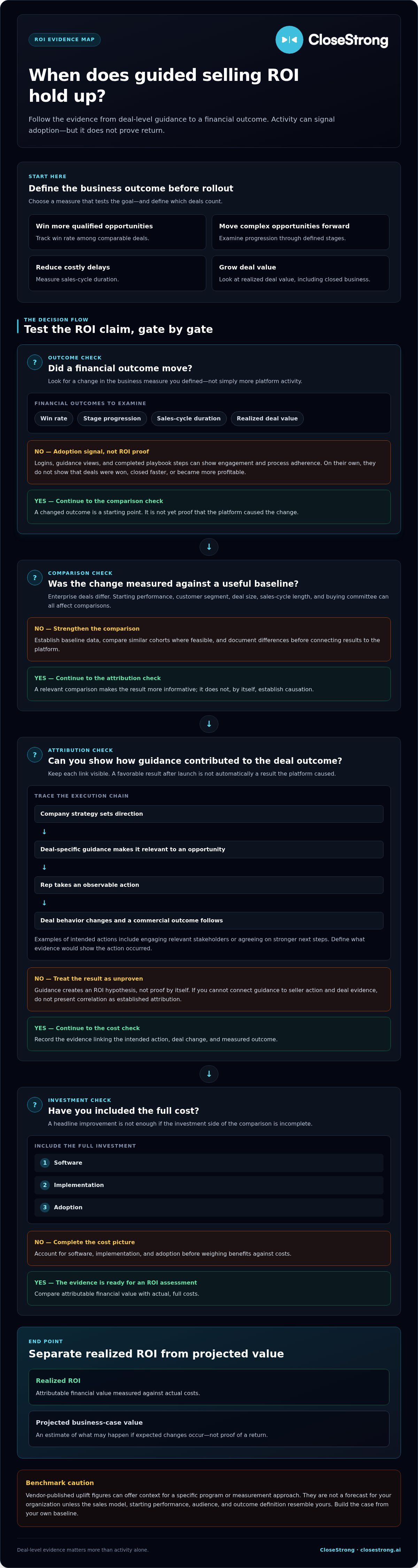
A platform rollout and a rise in sales performance happening at the same time do not prove that one caused the other. Measured improvement is not automatically platform-attributed impact. To make the ROI of guided selling platforms defensible, plan the evaluation before launch, compare relevant groups, and record what else changed during the measurement period.
Use a clear sequence. Keep the steps consistent, even when the findings are not what you hoped for.
Record current performance for the outcomes the rollout is intended to influence, using a defined time window.
Specify which teams, sellers, or opportunities are included, and why they are suitable for evaluation.
Document when guidance becomes available to each group and what changes in the sales process at the same time.
Where feasible, compare with a similar group or deal cohort that has not received the same rollout during the measurement window.
Examine adoption, deal behavior, and commercial outcomes alongside changes that could affect performance.
State whether the evidence supports expansion, adjustment, further measurement, or stopping, and explain why.
Choose the metrics and measurement window before rollout begins. Document historical performance, cohort definitions, data sources, and known gaps. Compare opportunities that are alike in relevant ways, such as segment, deal type, or stage at entry, rather than placing unlike teams side by side and calling the result a test.
Perfect matches may not exist. Record unavoidable differences and how they limit interpretation. If one group handles larger opportunities or has a different mix of experienced sellers, a performance gap could reflect those factors rather than the guidance. Transparent limitations make the conclusion more credible, not less.
Monitor whether sellers use the guidance and apply it to active opportunities. If adoption varies between teams, investigate workflow friction, inconsistent management expectations, or differences in how the rollout was introduced. Low use may explain why intended actions did not change; high use still does not establish financial impact. Treat adoption as context for interpreting outcomes.
Also log changes that can muddy the comparison: pricing or compensation changes, market shifts, territory realignments, and changes in sales-team composition. Note when each occurred and which cohorts they affected. This helps distinguish platform exposure from other plausible explanations. Evaluate an enterprise sales execution platform against how company direction translates into deal-level execution, not just whether a rollout went live.
Keep the final readout direct: what changed, for whom, over what period, and what alternative explanations remain? That protects the business case from overclaiming. To explore how CloseStrong connects company strategy with execution on individual deals, explore CloseStrong’s sales execution platform.
The decision is not whether guided selling sounds useful. It is whether guidance changes how your team executes strategy on individual deals, and whether you can observe a meaningful change in outcomes. Keep the standard clear: define the business objective, identify the behavior the guidance should influence, and assess the evidence against your own baseline. A promising adoption signal may justify a closer look, but it does not guarantee a financial return.
CloseStrong’s enterprise sales execution platform uses Precision Guided Selling™ and custom, high-quality deal guidance to help teams bring company strategy into individual opportunities. That strategy-to-deal focus makes execution the central question: can sellers apply the company’s direction to the deal in front of them? The platform does not replace the need to measure outcomes or establish what can reasonably be attributed to the investment.
CloseStrong is an enterprise sales execution platform built around Precision Guided Selling™. Its focus is custom guidance for individual deals, with the purpose of bridging company strategy and deal execution. That gives sales leaders a practical lens for evaluation: examine whether strategic priorities show up in deal-level decisions and actions, then assess relevant outcomes. The value case should rest on evidence from your sales environment, not a promised result.
Before assessing impact, define the outcome, baseline, adoption signal, and review period. Specify which deals are in scope and what observable behavior would indicate that guidance was applied. Then state how you will compare results, what assumptions you are making, and what other changes could affect performance. This discipline helps separate an observed shift from an attributable return.
Use a short evaluation brief to keep the decision grounded:
Name the commercial outcome the initiative is meant to support.
Record the starting performance and the data source.
Define what meaningful use of guidance looks like on active deals.
Set the measurement window and note other changes that could influence results.
Then interpret the evidence in layers. Did the intended deal behavior change? Did relevant commercial outcomes also move? Can the comparison reasonably isolate the platform’s contribution, or are other explanations still in play? Document gaps rather than smoothing them over. That turns a before-and-after chart into a decision leaders can revisit and improve as execution evolves. For a related perspective on scaling sales strategy execution, focus on how enterprise plans translate into action where deals are pursued.
The ROI of guided selling platforms is ultimately an organization-specific question. CloseStrong’s strategy-to-deal approach gives teams a clear basis for examining it, without substituting a generic uplift claim for their own evidence. Explore CloseStrong's approach to guided selling and evaluate it against your objectives, baseline, and deal execution priorities.
Turn your measurement plan into a practical test: choose the strategic priority your team needs to execute, identify the deals where it matters, and decide what evidence would justify continuing or changing course. Keep the standard honest. A useful business case makes room for uncertainty instead of dressing assumptions up as results.
CloseStrong’s enterprise sales execution platform uses Precision Guided Selling™ to provide custom deal guidance, connecting company strategy with execution on individual opportunities. Assess that approach against your objectives and baseline. The ROI of guided selling platforms is not a universal promise; it is a question your organization can answer with disciplined measurement and a clear view of deal execution.
Ready to examine how strategy can translate into action on individual deals? Explore how CloseStrong connects sales strategy to deal execution. Start with the business outcome you want to influence and build a case your team can stand behind.
The ROI of a guided selling platform is the financial return attributable to using it, considered against the costs of adopting and operating it. A useful assessment separates realized results from forecasted value. For example, a projected benefit based on expected improvement is a planning assumption; closed-deal results observed after rollout are measured evidence. Neither should be presented as platform-caused impact unless the evaluation supports that conclusion.
Compare the financial benefit you can reasonably link to the software with its total costs, then express the net return relative to those costs. Use a consistent measurement period and define which deals count before reviewing results. For example, if you assess a sales team, do not mix in unrelated segments halfway through the analysis. Keep the calculation’s data sources and assumptions visible so another stakeholder can reproduce it.
Choose metrics that match the business objective. A team focused on improving opportunity quality might examine qualification completeness and progression through relevant stages; a team focused on commercial results might track closed-won outcomes and realized deal value. You can also examine whether reps apply guidance at key deal moments. Segment results by deal type or customer group where useful, so aggregate numbers do not hide meaningful differences.
There is no reliable universal timeline. The answer depends in part on how long your sales cycle runs, how quickly sellers adopt guidance, and how many relevant opportunities reach a measurable outcome. A short review may reveal whether reps are applying guidance, but not whether it affected closed revenue. Set a review window that fits your deal cycle and keep monitoring opportunities that have not matured yet.
It may support better win rates if guidance helps sellers execute an effective deal strategy, but improvement is not automatic. Win rates can also shift because of changes in market demand, pricing, competition, or opportunity mix. To assess the effect, compare similar opportunities and examine whether the intended seller behaviors changed alongside results. Treat a higher win rate as evidence to investigate, not proof of impact on its own.
You can strengthen the case by comparing similar deal groups, with one receiving guidance and another serving as a comparison where practical. Keep the groups and outcome definitions consistent, and record changes that might affect results, such as territory assignments or team turnover. If a fair comparison is not possible, describe the findings as observed changes and state the limits. Clear caveats are stronger than overstated certainty.
Yes. Ecommerce often measures a defined purchase journey through metrics such as conversion or average order value. Enterprise B2B involves opportunities with greater deal variation, multiple decision-makers, and longer paths to a purchase. A conversion lift in online retail therefore does not predict enterprise returns. B2B teams should use measures that reflect their sales process, such as opportunity progression, realized deal value, and outcomes over a suitable period.
Include more than the software subscription. Account for implementation, integration work, ongoing administration, and internal time spent preparing teams to use the platform. Separate one-time setup effort from recurring expenses, and use your organization’s actual records and labor assumptions. Keep the scope consistent: if you count benefits across multiple teams, include the related rollout and operating costs for those same teams.


