





A CRM can show you exactly where an enterprise deal stands and still leave reps guessing what to do next. That’s why sales execution software compared to CRM isn’t a contest over which system wins. It’s a question of whether your team needs a record of the deal, guidance for how to move it, or both....
A CRM can show you exactly where an enterprise deal stands and still leave reps guessing what to do next. That’s why sales execution software compared to CRM isn’t a contest over which system wins. It’s a question of whether your team needs a record of the deal, guidance for how to move it, or both.
It’s reasonable to expect your CRM to do more than store contact details and pipeline updates. But “sales execution software” can mean different things across vendors, and overlapping features can blur the line. The practical test is whether your team needs clearer, more consistent guidance on complex deal decisions, not simply another place to capture activity.
This article explains the roles of CRM and sales execution software, how they can work together, and how to choose based on the execution gap you need to address. For enterprise teams, CloseStrong’s Precision Guided Selling™ provides an execution layer that connects company strategy with guidance on individual deals.
• “Sales execution software” can describe different tools, so compare the job a solution does rather than relying on its label.
• Use CRM to organize customer, account, and opportunity records. Assess whether reps also need guidance applying strategy to individual deals.
• Separate data-visibility gaps from rep-guidance gaps before deciding whether your team needs one system or complementary tools.
• Use a four-step decision process: identify the execution gap, map current tools, define ownership, and set evaluation criteria.
• See how sales execution software compared to CRM differs, and where CloseStrong’s Precision Guided Selling™ fits as deal-level strategy guidance, not a CRM replacement.
The phrase “sales execution software” can mean different things. One vendor may use it for field-team routing, another for outbound email automation, and another for tools that help enterprise reps manage complex opportunities. So sales execution software compared to CRM is not a useful comparison until you identify the job each system is meant to do.
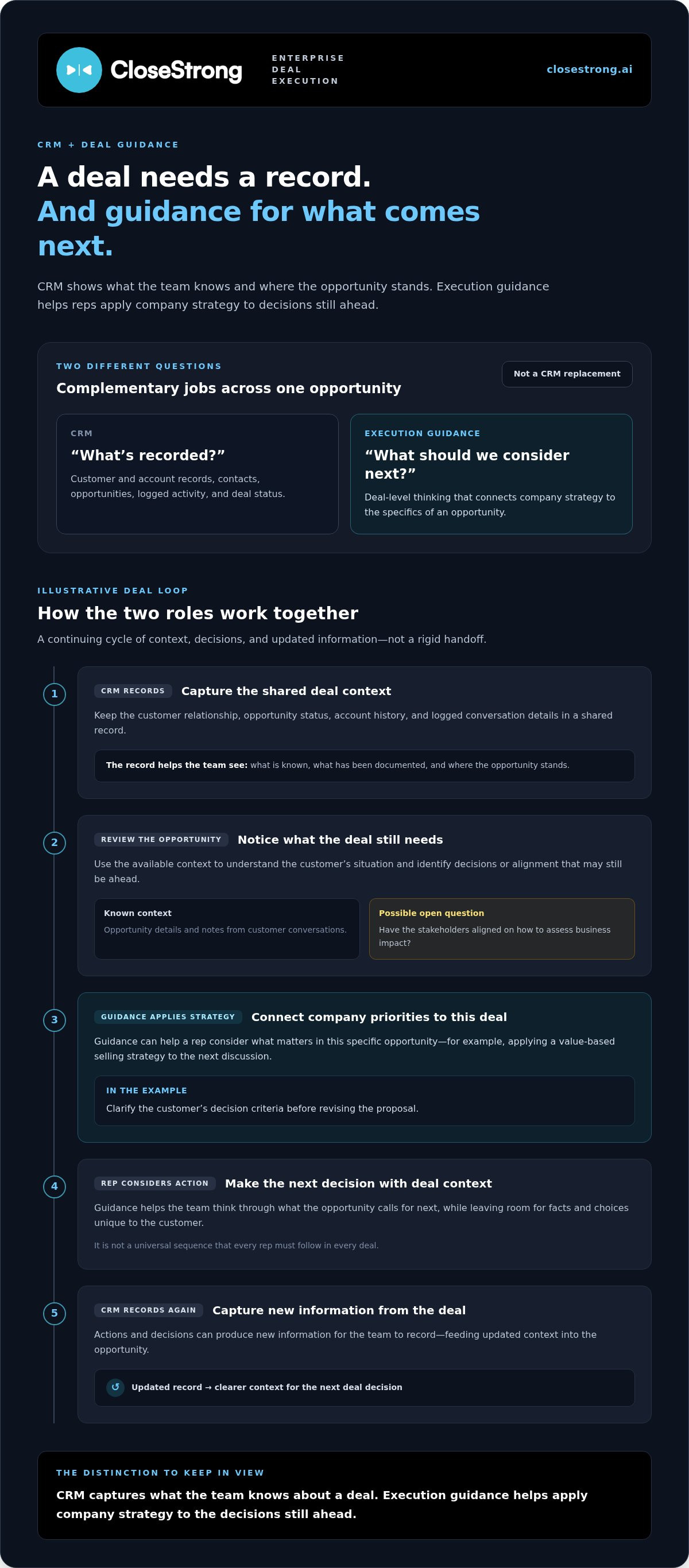
CRM captures deal information; execution guidance helps shape deal actions. Both can support a sales team, but they address different needs.
A CRM provides a shared place to organize customer and account records, contacts, opportunities, and logged activity. Teams use this information to review account history, see what is in the pipeline, and create reports for planning and management. The value is visibility: people can work from a record of the relationship and its status instead of relying on scattered notes.
That record helps leaders see where opportunities stand and what information has been captured. But a record of a deal is not automatically a guide to the decisions reps should make within it. CRM products differ in their features and workflows, so focus on the role your team needs rather than assuming every platform works the same way. For an overview of the broader category, see Customer relationship management (CRM).
In complex B2B selling, execution guidance helps reps apply company strategy to the specifics of an opportunity. It can connect a broad priority, such as building alignment around business value, to relevant questions and actions in a particular deal. The goal is not simply to record that a meeting happened, but to help the team think through what the opportunity calls for next.
That differs from tools centered on field routing or automated outbound email. Those tools can support particular sales activities, but they do not define every use of “sales execution.” For enterprise teams, the key question is whether software helps reps put strategy into practice during deal work, rather than merely organizing activity or automating outreach.
For example, a CRM might hold the account history, opportunity status, and notes from customer conversations. Deal guidance can help a rep use that context to consider which stakeholders still need alignment, what business rationale the buyer needs, or what decision should happen before the opportunity advances. Useful guidance depends on the company’s strategy and the deal, rather than a one-size-fits-all sequence.
That gap between company strategy and actions inside individual opportunities is central to complex B2B sales software. CloseStrong’s enterprise sales execution platform uses Precision Guided Selling™ and custom deal guidance to help teams bring company strategy into deal-level execution. It complements CRM’s recordkeeping role rather than replacing it.
A complex opportunity does not move forward just because its CRM record is complete. The record helps people see what is known; deal guidance helps a rep consider how to act on that information. These roles can work alongside each other, but they answer different questions throughout an opportunity.
An account and opportunity record gives the team a shared view of the customer relationship, deal status, and information people have logged. As conversations and other activity are recorded, colleagues can refer to that history instead of piecing it together from separate notes. The details available and the way teams capture them vary by CRM and company practice.
This information can support pipeline reviews and reporting. A manager might review the recorded status, recent activity, and known risks to understand what the team has documented and where more visibility is needed. But a CRM record can only support the decisions people make from it. Its presence alone does not guarantee an accurate forecast or consistent rep behavior.
Execution guidance addresses a different question: given the company’s strategy, what should the rep consider in this particular opportunity? It can help translate broad priorities into relevant deal-level thinking while leaving room for the facts and choices unique to the customer. It is not a universal sequence that every rep must follow in every deal.
CRM captures what the team knows about a deal; execution guidance helps apply company strategy to the decisions still ahead. Actions and decisions can produce new information for the team to record, so the relationship is a continuing loop rather than a rigid handoff from one system to another. A useful view of how sales operations tools and CRM can play distinct, complementary roles appears in Sales Operations Software vs CRM Systems: A Revenue Operations Perspective.
Illustrative example: A large customer is evaluating a proposal, but the buying group has not agreed on how to assess its business impact. The CRM might contain the opportunity details and notes from prior conversations. Deal guidance could help the rep apply the company’s value-based selling strategy to the next discussion, perhaps by clarifying the customer’s decision criteria before revising the proposal. This is an example, not a prescribed workflow.
For leaders, the distinction matters. CRM visibility helps answer, “What’s recorded, and where does the opportunity stand?” Execution guidance helps answer, “Are reps applying our strategy to the deal in front of them?” Confusing those questions can lead teams to add more reporting when the real gap is guidance, or to seek behavioral change when the underlying information is incomplete.
This is the practical difference behind sales execution software compared to CRM: one supports shared deal information, while the other helps connect strategy to deal decisions. An enterprise sales execution platform can help bridge company strategy and opportunity-level execution. CloseStrong’s Precision Guided Selling™ and custom deal guidance are built around that role. Explore CloseStrong’s approach to enterprise deal guidance to see how it fits alongside CRM recordkeeping.
A feature checklist can make two systems look interchangeable. Both might contain contact details or reflect sales activity, but that overlap does not show whether they solve the same problem. When comparing sales execution software to CRM, compare the work each tool supports: maintaining a dependable view of customer and opportunity information, or helping reps apply company strategy to complex deals.
| Comparison point | CRM | Sales execution guidance |
|---|---|---|
| Primary job | Organize customer and opportunity records | Support strategy execution within deals |
| Information handled | Accounts, contacts, opportunities, and recorded activity | Company strategy and deal-specific context |
| User action | Capture, update, and review information | Consider and apply relevant guidance during deal work |
| Management question | What’s recorded, and where does the pipeline stand? | Are reps applying strategy to the deals they’re working? |
Use the table to diagnose the gap, not rank the categories. A system can include overlapping data or activity features without taking on the other system’s central job. More dashboards may improve visibility, but they do not necessarily help a rep decide how to advance a complicated opportunity. Likewise, deal guidance does not replace the need for organized customer records.
If the team’s main challenge is keeping account, contact, and opportunity information organized, start there. A CRM may be enough when selling is relatively straightforward and reps can move opportunities forward using existing processes. Not every team needs a separate execution layer. Adding one without a clear gap can create complexity instead of solving a real problem.
A separate layer may be useful when deals are complex and the company’s strategy needs to show up consistently in individual reps’ decisions. Look for a guidance gap: managers can see activity, yet reps still struggle to apply strategic priorities to the opportunity in front of them. The answer may be deal guidance, not another dashboard or a larger activity log.
Make the distinction concrete. If leaders cannot tell which accounts or opportunities exist, investigate information capture and visibility first. If they can see the pipeline but lack confidence that reps are applying the intended strategy to complex deals, assess the execution gap. The tools can support each other, but only when each has a clear role and the team knows what problem it is meant to address.
This role-based approach keeps the buying decision grounded in the work, not the software label. Precision Guided Selling software is one approach to connecting company strategy with execution on individual deals. CloseStrong’s enterprise sales execution platform provides custom deal guidance for that purpose, alongside rather than in place of CRM recordkeeping.
Do not start with a vendor shortlist. Start with friction your team can point to. A visibility problem and a deal-guidance problem need different fixes, and buying software before naming the gap can leave the real issue untouched. Use this four-step process to decide whether CRM is enough, an execution layer is needed, or both have distinct jobs.
Look at real work, not broad complaints like “we need better sales execution.” Are records missing or hard to find? Do reps have the information but struggle to apply company strategy in complex opportunities? Is the strategy itself unclear? These are separate problems. Identify the specific behavior a tool should support, such as capturing opportunity updates consistently or helping reps apply strategic guidance during deal work.
Name observable friction. Managers may spend reviews piecing together account context from scattered records, or reps may describe different approaches to similar deal decisions. Separate missing information from inconsistent actions and unclear guidance.
List where customer and opportunity context lives, how teams record activity, and what guidance reps use during deal work. Look for duplicate entry, disconnected information, and steps that rely on people remembering what to do.
Decide which system or process is responsible for maintaining shared deal information, and who owns the strategy reps are expected to apply. Clear ownership reduces conflicting records and prevents guidance from becoming a document nobody uses.
Describe what the solution must help a rep or leader do in a real opportunity. Include how it will fit with the team’s chosen tools and how shared deal context will be maintained. Treat integration needs as a criterion to evaluate, not an assumption.
Test a potential solution against the gap you identified. Can the team use it in the deal work where the problem occurs? If the issue is strategic adoption, more dashboards or activity tracking may show what happened without helping reps apply the intended approach. If the issue is missing or unreliable information, deal guidance will not repair the underlying recordkeeping problem.
Before comparing options, define adoption and execution indicators that reflect the behavior you want to support. For example, consider whether reps use agreed deal guidance or whether managers can review shared opportunity context without chasing updates. Decide who will assess these indicators and how often. Then evaluate how each tool handles the practical handoff of information and responsibility across your existing processes. Do not assume two systems will share context automatically; make that part of the evaluation.
The right answer to sales execution software compared to CRM depends on the gap, not the category label. If your team needs strategic guidance applied consistently across complex deals, explore CloseStrong’s approach to deal execution.
CloseStrong is an enterprise sales execution platform for teams that need company strategy to show up in the work of individual enterprise deals. It is not CRM replacement software. Its role is to provide custom, high-quality deal guidance through Precision Guided Selling™, helping teams bridge the distance between strategic intent and how reps approach specific opportunities.
A company can set a clear sales strategy and still see it applied unevenly across deals. Complex opportunities have different stakeholders, concerns, and decision contexts. Reps need to interpret strategy against those specifics, not simply repeat a broad directive. The gap appears when the strategy exists but translating it into relevant deal-level action is difficult to make consistent.
CloseStrong helps teams apply company strategy on individual deals. Its Precision Guided Selling™ approach and custom deal guidance connect corporate priorities with the realities of each opportunity. For example, if a company wants reps to anchor conversations in customer value, guidance can help make that priority relevant to the deal at hand. The point is not to prescribe a universal script or promise a particular outcome, but to help strategy inform how teams work through complex deals.
Adding more information to an opportunity record does not necessarily help a rep interpret what the company’s strategy calls for. The useful question is whether sellers can translate that strategy into thoughtful, deal-specific decisions. CloseStrong focuses on that execution challenge.
CRM and CloseStrong have different jobs in the sales operation. CRM supports the organization of customer and opportunity information. CloseStrong provides an execution layer focused on strategic guidance within enterprise deals. One is not a substitute for the other; each addresses a different need. Whether your team benefits from both depends on whether its gap is recordkeeping, deal-level guidance, or both.
Keep the evaluation grounded in that distinction. If the team needs a shared place for customer and opportunity records, assess the CRM role. If reps need help applying company strategy consistently across complex deals, assess the execution-guidance role. Evaluate how tools fit your processes and how shared context will be maintained, rather than assuming every workflow works the same way.
For teams that have identified a strategy-to-execution gap in enterprise opportunities, CloseStrong’s platform is built around that challenge. See how CloseStrong guides enterprise deal execution.
Your next step is not to buy another platform because the category sounds right. Pick a real deal situation where your strategy needs to guide a rep’s decisions. Define what better support would look like, who should use it, and what evidence would show that it is part of the team’s actual work. That gives your evaluation a practical test instead of another feature checklist.
That’s the useful lens for sales execution software compared to CRM: choose based on the work your team needs to support. If the gap is applying company strategy to complex opportunities, explore how CloseStrong’s enterprise sales execution platform uses Precision Guided Selling™ and custom deal guidance to support that effort. Explore how CloseStrong guides enterprise deal execution.
Only if it meets the actual job your team needs done. Deal guidance and customer-record management are distinct functions. Before replacing a CRM, list the records you rely on, such as account ownership, contact history, and opportunity details, then map the execution workflows reps need. The categories can complement each other, but they are not automatic substitutes. The distinction in sales execution software compared to CRM becomes clearer when you compare required records with required deal actions.
No. The label covers different types of software, including tools focused on territory operations or field activity. Enterprise deal execution can instead focus on helping teams apply strategy within complex opportunities, whether reps work in the field or elsewhere. For example, a team coordinating several decision-makers may need guidance for applying its deal strategy, not route management. Assess the workflow a product supports rather than assuming the category name tells the whole story.
Sales execution software for complex enterprise deals may focus on applying strategy to a specific opportunity, while sales engagement software is commonly associated with managing outreach activities. The boundaries are not universal: vendors use category terms differently, and products can overlap. Compare the work each platform is designed to support. Does the team need help coordinating outreach, applying strategic guidance to a live deal, or addressing both needs? That answer is more useful than the label alone.
CRM data can show documented changes, such as a revised opportunity status, recorded customer activity, or newly added stakeholder information. That helps leaders assess what is visible in the record. It may not reveal whether reps are applying the company’s strategy effectively or how well the buying group is aligned. Review the recorded evidence alongside deal judgment and context. A thin record may call for better information capture; a strategic gap requires a different discussion.
Measure behaviors tied to the workflow gap, not a vendor’s generic success claim. If the goal is consistent deal practice, define observable indicators, such as whether reps document agreed decision criteria or address relevant stakeholders in deal reviews. Establish a baseline before adoption, and decide who will assess the indicators and how often. Pair usage measures with evidence of execution quality, so activity alone does not become a stand-in for meaningful progress.
No. There is no universal software stack for every enterprise team. A team mainly organizing customer and opportunity information may prioritize CRM, while a team struggling to apply strategy consistently across complex deals may consider an execution layer. First identify the operational problem, then decide whether an existing process can address it. Adding software without a clear purpose can create more work. A sound choice supports a specific need and has a clear owner.


