



Sales strategy doesn’t fail in the boardroom. It fails when reps make deal decisions that pull in different directions. The sales leadership strategies for 2026 that matter most won’t add another set of priorities to the slide deck. They’ll turn those priorities into clear, observable actions across...
Sales strategy doesn’t fail in the boardroom. It fails when reps make deal decisions that pull in different directions. The sales leadership strategies for 2026 that matter most won’t add another set of priorities to the slide deck. They’ll turn those priorities into clear, observable actions across complex deals.
If your pipeline reviews describe activity but don’t change outcomes, you’re not alone. A forecast can tell you what reps expect to close, but it can’t by itself help them align stakeholders, shape decision criteria, or spot deal risk early. CloseStrong reports a current forecasted-deal success rate of 47%. That’s a hard reminder: more visibility isn’t the same as better execution.
This article shows how to connect company strategy to what reps do at each deal stage. You’ll learn how to turn priorities into specific behaviors, use buyer signals and metrics to intervene earlier, and apply AI as in-context guidance rather than another reporting layer. The goal isn’t to manage more activity. It’s to help your team make sharper decisions when complex deals are on the line.
• Turn sales leadership strategies for 2026 into buyer-centered actions tied to deal stages, while leaving room for reps to adapt to each opportunity.
• Look beyond activity counts: inspect qualification, stakeholder alignment, and whether buyers have agreed on decision criteria.
• Evaluate sales technology by whether it helps reps make better decisions in live deals, then measure behavior and refine the guidance.
• Use AI Coach, qualification scoring, stakeholder alignment, and decision-criteria mapping to connect leadership priorities with deal-level execution.
• Apply consistent guidance across deals without forcing every opportunity through the same playbook.
A strategy on slides can set direction. It can’t tell a rep what to do when a buying committee disagrees about the problem, a competitor reframes the decision, or a stakeholder introduces a new requirement. That’s where execution breaks: reps interpret company priorities differently, and leadership’s intent gets lost in individual deal decisions.
Complex B2B deals magnify the cost of that inconsistency. One rep may confirm who signs the contract but miss who can block it. Another may understand the buyer’s preferred solution but not the criteria the committee will use to choose. A third may respond to a competitor with a discount before understanding what the customer values. These aren’t just differences in selling style. They’re gaps between leadership intent and deal decisions.
Success doesn’t mean identical conversations or guaranteed wins. It means giving reps a shared way to make sound decisions, adapt to buyer signals, and keep company priorities in view. The leadership test is whether those priorities show up in the actual work of qualifying, aligning stakeholders, and shaping a decision.
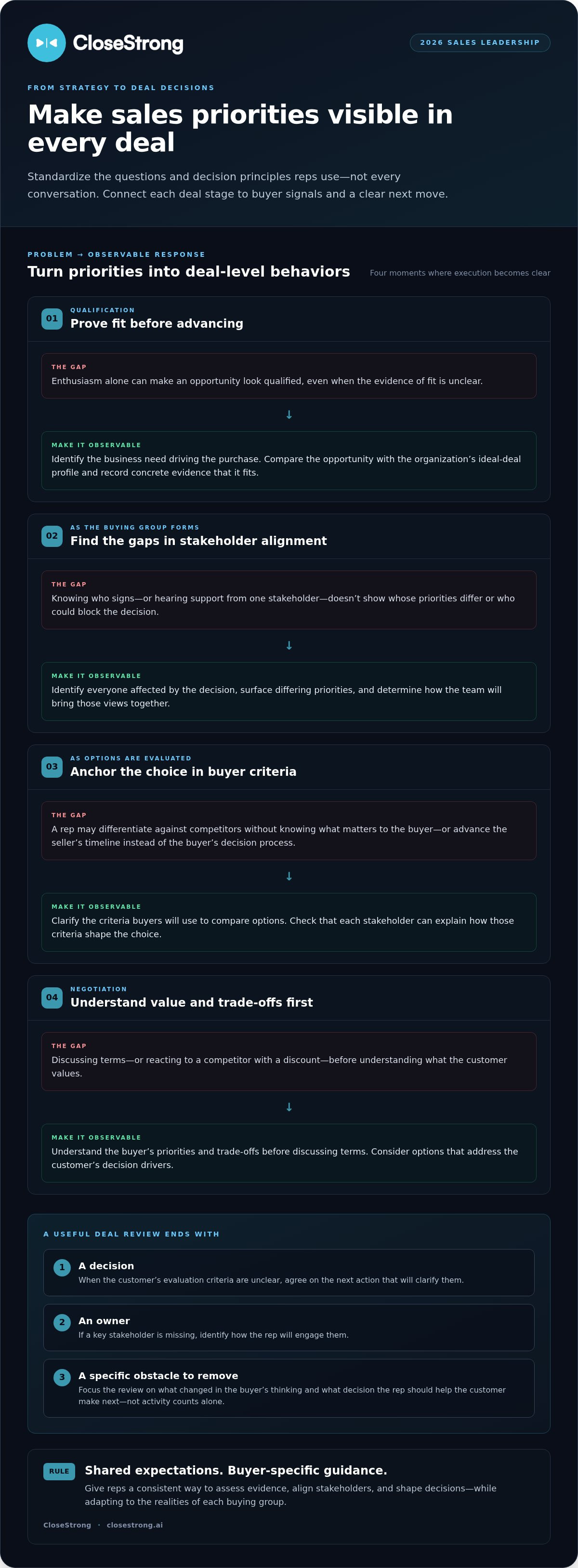
Sales strategy execution is the consistent application of company priorities to the decisions reps make throughout a deal. That definition makes strategy observable. If negotiation discipline matters, leaders can look for reps who understand the buyer’s priorities and trade-offs before discussing terms. If the goal is to pursue stronger-fit opportunities, qualification should reveal whether the deal matches the company’s ideal profile.
Stakeholder alignment and decision criteria turn broad intent into practical questions: Have the people affected by the decision been identified? Does the team understand how the buyer will compare options? These are Sales management principles made concrete at deal level. They also give leaders a consistent basis for guidance without forcing every opportunity into the same script.
Generic playbooks often describe the right process without helping a rep choose the next move. “Build consensus” sounds clear until one stakeholder supports the deal and another remains silent. “Differentiate from competitors” falls flat if the rep doesn’t know which decision criteria matter to the buyer. Guidance has to connect the principle to the live situation.
That’s the difference between reviewing activity and influencing execution. A meeting can report calls made, opportunities advanced, and next steps entered. Useful leadership asks what changed in the buyer’s thinking, which stakeholder needs attention, and what decision the rep should help the customer make next. The first approach records motion. The second can shape it.
A sales leadership system should carry priorities beyond planning meetings and into deal decisions, while giving reps room to respond to the specifics of each buying group. For a deeper look at how that gap can be addressed, explore the enterprise sales execution platform and its role in connecting strategy to action.
A sales leadership system should connect four things: company priorities, the stage of each deal, signals from the buyer, and the rep’s next action. Without that connection, “improve negotiation” stays an aspiration. With it, a manager can see whether the buyer’s decision drivers are understood, which stakeholders still need alignment, and whether the proposed terms reflect what the customer values.
Strong sales leadership strategies for 2026 standardize the questions and decision principles, not every conversation. A buying group with a clear decision process needs different guidance from one where priorities conflict. Reps should adapt to those realities while working from shared expectations about what evidence matters and what to do when it’s missing.
Translate priorities into actions a manager can see in the opportunity. Negotiation discipline means understanding value and trade-offs before discussing terms, then considering options that address the customer’s decision drivers. Stronger qualification means comparing the opportunity with the organization’s ideal-deal profile and recording concrete evidence of fit, rather than relying on enthusiasm alone.
Stakeholder alignment and decision criteria should also be tied to the deal’s progression. Managers can ask:
What business need is driving the purchase, and what evidence shows this opportunity fits?
Who is affected by the decision, whose priorities differ, and how will the team bring those views together?
What criteria will buyers use, and can each stakeholder explain how those criteria shape the choice?
These prompts create a consistent frame without turning the sales process into a script. They also expose when a rep is advancing the seller’s preferred timeline instead of responding to the buyer’s actual decision process.
A deal review should end with a decision, an owner, or a specific obstacle to remove. If the customer’s evaluation criteria are unclear, agree on the next action that will clarify them. If a key stakeholder is missing, identify how the rep will engage them. A status update that simply repeats the CRM notes doesn’t move the deal forward.
Separate signals that need leadership attention from routine updates. A change in buyer priorities, a newly surfaced blocker, or disagreement among stakeholders may call for focused intervention. A completed meeting or sent proposal may only need to be recorded. Keep the review centered on buyer evidence, risk, and the next useful action.
Deal-level guidance helps reps choose their next move in context; a static playbook gives general instructions, and a retrospective report explains what already happened. Managers can use this distinction to keep coaching focused on execution rather than process compliance. For more on carrying priorities into individual opportunities, explore scaling sales strategy execution. Teams looking to put that approach into practice can also explore CloseStrong’s Enterprise Sales Execution Platform.
Calls made, meetings held, and opportunities created show effort. They don’t establish whether a deal is qualified, whether the buying group is aligned, or whether the customer has clear decision criteria. Useful sales leadership metrics connect team activity to evidence of buyer progress. That gives managers something to investigate and act on, not just a dashboard to review.
Pair forecast inspection with deal-level questions. If a rep expects an opportunity to close, ask what the buyer has done to support that forecast: Which stakeholders are engaged? What criteria will shape the decision? What is the next customer decision, and what evidence supports its timing? The answers reveal gaps that a stage label or activity count can hide.
Pipeline volume measures potential, not fit. A large opportunity count can still include deals that don’t match the ideal customer profile or lack evidence of a real buying process. Track qualification evidence alongside volume. For stakeholder coverage, look at whether the rep has identified the people involved and understands their roles. For decision criteria, examine whether the team has captured how buyers will evaluate options, not merely whether a field is marked complete.
Use each measure as a prompt for inspection, not a verdict. A gap may signal a risk, but the manager still needs to understand the deal context before deciding what action makes sense.
| Metric | What it reveals | What it cannot establish alone |
|---|---|---|
| Calls or meetings | Rep activity and buyer touchpoints | Deal fit, buyer commitment, or decision progress |
| Qualified opportunities | Whether evidence supports pursuing the deal | Whether the full buying group is aligned |
| Stakeholder coverage | Known participants and potential gaps | Whether stakeholders agree or will support a decision |
| Decision-criteria coverage | How well the rep understands evaluation factors | Whether the buyer will choose the seller |
| Forecast accuracy | How closely past projections matched outcomes | Why a specific deal will win or lose |
CloseStrong reports a current forecasted-deal success rate of 47%. Treat that figure as company-provided context, not an industry benchmark or a target every team should adopt. A forecast is useful when leaders can connect it to the quality of deal evidence and the decisions reps make as circumstances change.
CloseStrong also reports a 60% win rate for organizations that excel at negotiation, compared with 38% for those that don’t. Its stated deal-optimization rates are 48% for high-performing negotiators versus 4% for others. These comparisons show an observed difference between groups. They don’t prove negotiation performance alone caused the gap or promise the same result for another team.
For sales leadership strategies for 2026, use metrics to locate questions worth answering. Inspect the buyer evidence, test assumptions behind the forecast, then guide the next decision.
More dashboards don’t automatically create better decisions. Visibility tools help leaders see what’s happening; real-time guidance helps reps decide what to do next while a deal is still moving. In complex sales, that difference matters. A useful system brings company priorities and customer decision drivers into the moment a rep is qualifying an opportunity, engaging stakeholders, or shaping an offer.
Evaluate technology by whether it changes the quality of deal decisions, not by how much data it displays. Use this sequence:
Pinpoint where deals stall or reps lack evidence, such as uncertain fit, missing stakeholders, or unclear buyer criteria.
Give reps direction connected to the deal stage and buyer signals, not a generic prompt detached from the opportunity.
Check whether reps act on the guidance and capture stronger evidence of qualification, alignment, or buyer priorities.
Use what happens across deals to improve the guidance, while keeping the focus on useful decisions rather than tool adoption alone.
AI should support decisions that connect company strategy with what customers care about. For example, qualification scoring and ideal-deal identification can help reps assess whether an opportunity fits before investing further effort. As the deal develops, guidance can bring customer decision drivers and competitive positioning into view. Multi-option offers can help reps frame alternatives around buyer priorities instead of defaulting to a single take-it-or-leave-it proposal.
CloseStrong’s platform predicts buyer behavior with 97% accuracy, based on internal research, and is built on analysis of $20 billion worth of win/loss data. These figures describe the platform’s approach and underlying analysis, not a promise that AI will predict every buyer or decide every deal correctly.
Ask whether recommendations reach reps during the deal or only appear later in reports. Then examine whether deal-desk rules, competitive positioning, and customer decision drivers inform guidance in context. This separates execution support from another layer of visibility. For a broader view of how technology choices fit together, see the 2026 enterprise sales tech stack.
These are the practical questions behind effective sales leadership strategies for 2026: Does the tool help a rep take a more informed next step, and can leaders see whether that behavior is changing? CloseStrong’s Enterprise Sales Execution Platform applies AI-driven guidance to rep decisions throughout complex deals. Explore CloseStrong’s deal guidance to see how that approach supports live execution.
A strategy only earns its place in the plan when reps can use it inside real opportunities. CloseStrong’s Enterprise Sales Execution Platform connects leadership priorities with AI-driven guidance for every rep, every deal, and every stage. Instead of leaving every seller to interpret priorities alone, it brings deal-specific direction into the decisions that shape qualification, buyer alignment, and offers.
The capabilities work together around the opportunity. Qualification scoring and ideal-deal identification help teams assess fit. AI Coach provides real-time, in-context assistance as a deal unfolds. Stakeholder alignment and decision-criteria mapping help clarify who is involved and how the customer will evaluate options. Deal-desk rules, competitive positioning, and customer decision drivers inform how reps configure solutions and terms, including multi-option offers.
Precision Guided Selling™ is a methodology supported by AI-driven guidance. Its purpose is to connect company strategy to decisions reps face in specific deals, so priorities such as qualification discipline or negotiation standards can shape action in context. This is behavior change, not training: guidance is tied to live opportunities rather than confined to instruction that reps must later translate on their own.
Custom deal guidance also recognizes that consistency doesn’t mean treating every buyer alike. A rep can apply shared company principles while responding to the customer’s decision drivers, stakeholder dynamics, and competitive situation. Leaders get a way to carry strategy across the sales process without flattening the details that make each opportunity different.
Make the approach practical by moving through four steps:
State what company priorities should look like in rep decisions.
Use buyer signals and opportunity details to see where execution is strong or incomplete.
Put relevant direction in front of reps as they work through deal stages.
Review what is helping reps act on strategy and adjust where it misses the realities of complex deals.
That sequence gives sales leadership strategies for 2026 a practical operating rhythm: set direction, connect it to evidence, support action, and improve the guidance. For a deeper explanation of the methodology, explore Precision Guided Selling software.
Ready to put company priorities to work inside complex deals? Explore CloseStrong’s Enterprise Sales Execution Platform and see how Precision Guided Selling™ brings real-time, deal-specific guidance into sales execution.
The next step isn’t another planning session. Pick one company priority that matters, then define what a rep should do differently when a live opportunity puts that priority to the test. Make the behavior visible. Give managers a clear signal to inspect. Use what happens to sharpen the guidance for the next deal.
That’s how sales leadership strategies for 2026 move from intention to practice: one decision at a time, with leaders focused on helping reps act on what the buyer is showing them. You don’t need to overhaul everything at once. Start with the execution gap that’s costing your team the most clarity, then build from there.
CloseStrong connects leadership priorities to action across complex deals. See how CloseStrong puts your sales strategy into action on every deal, and take the next step toward a more consistent way to lead execution.
The most effective sales leadership strategies for 2026 connect company priorities to observable actions in live opportunities. For example, if protecting value matters, leaders can check whether reps understand buyer trade-offs before proposing concessions. Pair that evidence with forecast and outcome measures, then provide guidance where the rep makes the next decision. This approach supports better deal judgment without promising a specific revenue result.
Improve execution by translating each priority into questions managers can use at relevant deal stages. If a deal is advancing, ask what new buyer evidence supports the next step and whether the people affected by the decision have weighed in. Set clear conditions for leader involvement, such as a material change in buyer requirements. This gives teams shared direction without reducing reviews to playbook recitals or activity reports.
Yes. AI can support deal execution when its recommendations help a rep act on company priorities and customer signals during an opportunity. For instance, it might surface a mismatch between a buyer’s stated evaluation priorities and the solution being proposed. That’s different from automating administrative tasks or summarizing past activity. CloseStrong’s platform predicts buyer behavior with 97% accuracy based on internal research. That company-reported figure is not a guarantee for every deal.
Track pipeline and forecast indicators alongside evidence of deal quality: qualification, stakeholder coverage, and the buyer’s evaluation criteria. A forecast can flag where attention is needed, while deal evidence helps explain what may be driving the forecast. A high number of meetings, for example, doesn’t prove that key decision-makers are engaged. Avoid treating any single measure as a verdict; interpret it against the stage and circumstances of each opportunity.
Review enterprise deals in response to their complexity, stage, and meaningful changes in buyer behavior, not an arbitrary universal schedule. A stable opportunity may need a different level of attention from one where a new stakeholder challenges the business case. Make each review decision-oriented: identify the evidence behind the current view, surface a material risk, and agree on the next action. The goal is useful intervention, not more meetings.
Sales strategy sets direction through the priorities and choices a company makes; execution is how those choices shape decisions in actual opportunities. For example, a strategy may prioritize strong-fit deals, while execution means applying that preference when a rep evaluates a specific buyer’s needs and constraints. Leaders provide the bridge by making strategic intent usable in the work. Without that connection, teams can pursue the same goals but act on them differently.
Look for deal evidence that reps are applying relevant guidance, not merely logging in or generating more activity. In sampled opportunities, examine whether qualification records contain clearer evidence of fit, whether relevant stakeholders are identified, and whether reps can explain the buyer’s decision criteria. Compare these patterns over time and account for deal context. A single metric may show a change, but it cannot establish that AI caused it.


