




A sales strategy that never reaches the deal is just a plan on paper. That’s the problem a business case for sales execution software should address: not a shortage of dashboards or another round of training, but a gap between company strategy and what representatives do in active opportunities. You...
A sales strategy that never reaches the deal is just a plan on paper. That’s the problem a business case for sales execution software should address: not a shortage of dashboards or another round of training, but a gap between company strategy and what representatives do in active opportunities.
You may see the symptoms when deal behavior drifts from strategy or pipeline reviews surface risks after the team has lost its chance to act. Proving that software is worth evaluating takes more than projecting higher revenue. It takes a credible baseline and a clear link between deal-level guidance and measurable changes in execution.
This article shows you how to build that case. Define the operational problem, choose outcomes you can measure, and distinguish guidance inside active deals from added visibility or training. You’ll also see how CloseStrong’s enterprise sales execution platform, powered by proprietary Precision Guided Selling™, is designed to connect company strategy with individual deal execution. The goal is a defensible investment decision grounded in changes the team can test, not a forecast built on wishful thinking.
• Build a business case for sales execution software around a testable link between an operating problem, deal-level guidance, and expected value.
• Trace how company strategy should shape representative choices and deal actions, then identify indicators that can show whether execution is changing.
• Separate the roles of deal guidance, training, CRM records, and analytics so the investment addresses a specific gap without forcing a false either-or choice.
• Use five steps to make the case defensible: define the problem, establish a baseline, map value, estimate investment, and set validation criteria.
• For every expected benefit, assign an owner, data source, measurement window, and attribution limit before evaluating how CloseStrong’s platform and Precision Guided Selling™ support strategy in active deals.
Company strategy can be clear in a planning deck and still disappear inside an active deal. A team may agree to engage multiple decision-makers, validate buyer priorities, or build consensus before advancing an opportunity. If representatives apply those expectations inconsistently, the strategy isn’t shaping execution where it matters.
A business case for sales execution software links an observable operating problem to a proposed intervention and the value the organization expects to create. It isn’t a revenue promise. Treat the software as an investment hypothesis: leaders should be able to explain which execution behavior they expect to change, how they’ll observe the change, and what evidence would show the hypothesis is wrong.
In complex enterprise opportunities, representatives may face different stakeholders, buying conditions, and obstacles. Applying a consistent strategy can be difficult. A pipeline review might reveal that a deal advanced without evidence of buyer alignment, or that a key stakeholder joined the conversation late. By then, the team may have fewer options to influence the outcome.
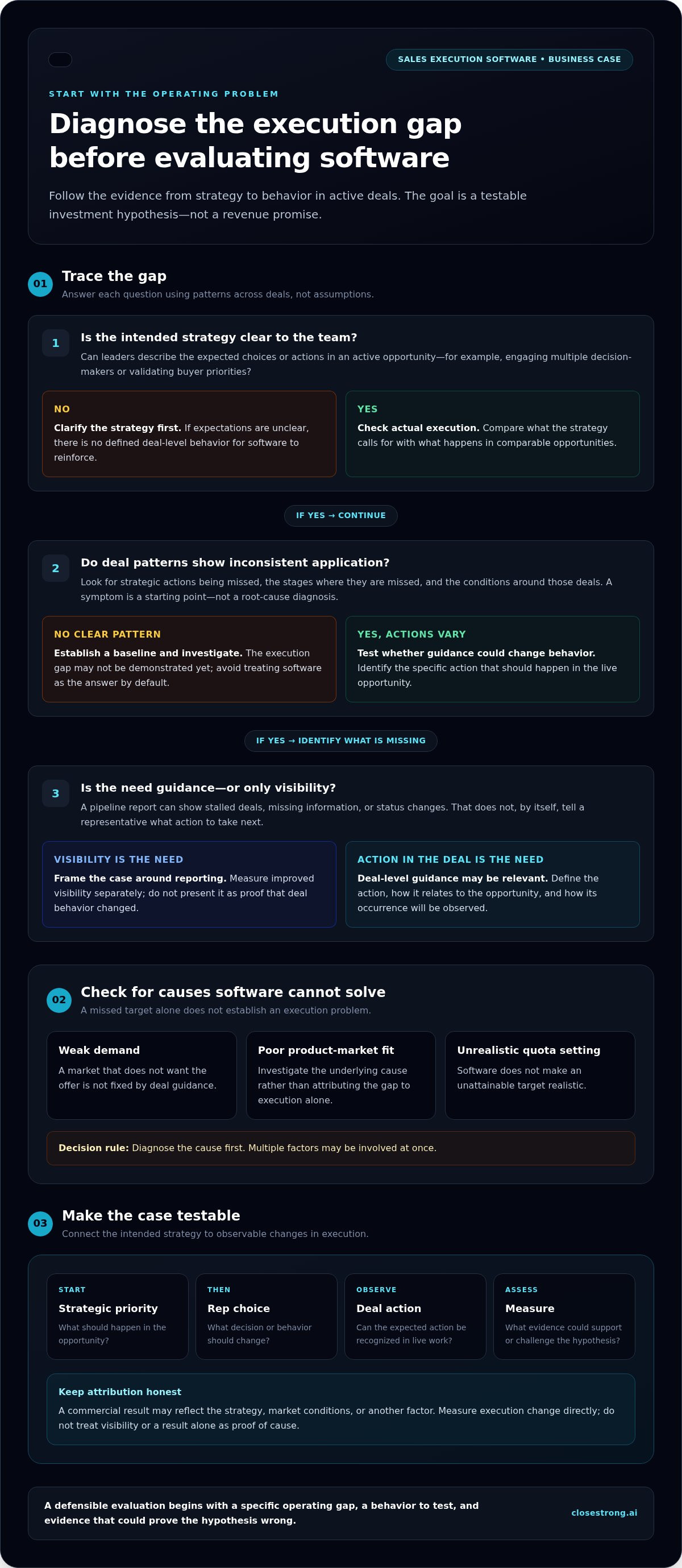
These are observable symptoms, not a root-cause diagnosis. A missed target could reflect weak demand, poor product-market fit, unrealistic quota setting, or execution gaps. Several factors may be involved at once. Before proposing software, compare patterns across deals: which strategic actions are being missed, at what stages, and under what conditions? Sales operations provides useful context for this analysis, including enablement, analytics, and sales administration, as outlined in the Sales Operations Overview.
That distinction matters. Software may be relevant when teams know the intended strategy but struggle to apply it consistently in live opportunities. It won’t fix a market that doesn’t want the offer or make an unattainable target realistic. Diagnose first, then define the specific problem the intervention is meant to address.
Visibility answers, “What’s happening in the pipeline?” Deal guidance answers a different question: “What should the representative do next to move this opportunity in line with the strategy?” Dashboards can surface stalled deals, missing information, or status changes. That information is useful, but seeing a gap doesn’t automatically close it. The representative still needs a way to translate expectations into action.
For example, a dashboard might flag limited stakeholder engagement. A manager can investigate, but the report alone doesn’t identify which action would help or whether that action happened. A business case should distinguish improved reporting from changed deal behavior. Measure both if both matter, but don’t treat visibility as proof of execution improvement.
This is the difference between recording deal status and supporting strategy within an opportunity. CloseStrong’s enterprise sales execution platform overview explains how deal-level guidance connects company strategy with individual deal execution. Start with the operational gap, not the tool, so the investment case focuses on a change the organization can test.
Company strategy creates value only when it changes what happens in individual opportunities. Make that connection visible in the business case: strategic priority, representative choice, deal action, and a measure that shows whether execution changed. Without those links, leaders can’t tell whether a commercial result came from the strategy, market conditions, or another factor.
Deal-level guidance turns a company’s sales priorities into relevant actions and decision support for representatives working on specific opportunities. It doesn’t guarantee a win. It makes expectations usable while a deal is moving, rather than leaving them on a slide or in a static playbook.
A methodology might call for building stakeholder alignment before advancing an enterprise opportunity. To make that principle actionable, teams need questions and actions suited to the deal: which stakeholders have been engaged, whose priorities remain unclear, and what conversation could help close the gap? The guidance should relate to the opportunity, not just present a generic checklist.
A static playbook can explain the standard; deal guidance connects it to the decisions in front of a representative. CloseStrong’s explanation of Precision Guided Selling software and execution explores this strategy-to-action concept. The practical test for a business case is whether the expected action can be recognized in the work on a live opportunity.
Choose a small number of value pathways tied to the problem you diagnosed. Treat each as a hypothesis, then define an observable behavior or operating measure that could support or challenge it.
If the problem is uneven use of a strategic approach, track whether the relevant deal actions occur across comparable opportunities.
If risks surface too late, measure when a defined gap first becomes visible and whether the team identifies it before a key decision point.
If reviews spend time uncovering basic deal gaps, examine whether managers can focus on unresolved issues and next actions instead.
These are leading indicators: they show whether behaviors or operating conditions are changing. Lagging outcomes, such as win rates, deal size, and forecast accuracy, matter too, but pricing, competition, demand, and other factors can influence them. Don’t attribute a revenue change to software alone. Track execution signals first, then assess commercial results over a suitable period and account for other influences.
A disciplined business case for sales execution software links each strategic priority to an action and a measure, while staying clear about what the measure can prove. If you’re mapping that connection for enterprise opportunities, explore CloseStrong’s approach to deal-level guidance.
When deal execution is uneven, the instinct is often to add something familiar: another training session, a CRM field, or a dashboard. These investments do different jobs. The question isn’t which category wins; it’s which gap remains after the tools and processes you already have are doing their jobs.
Training develops knowledge and skills. It can teach a methodology or help representatives practise a conversation, but it doesn’t necessarily guide every decision in a live opportunity. CRM records and organizes customer and deal information, giving teams a place to manage relationships and opportunity records. Visibility tools surface activity, status, and patterns so leaders can see what’s happening.
Each function matters, but capturing a deal update, showing a risk, and helping a representative decide what action fits an opportunity are distinct jobs. A team may have trained on stakeholder alignment and tracked contacts in its CRM, yet still lack a consistent way to apply that priority as a deal evolves. An execution layer focuses on this strategy-to-action gap and can complement existing systems rather than replace them.
For a wider view of how these roles fit together, the discussion of enterprise sales tech stack priorities distinguishes seeing deal activity from supporting execution. Likewise, for organizations coordinating indirect partner networks alongside direct sales teams, check out Computer Market Research to explore dedicated channel management automation. Keep the evaluation grounded in the work the team needs to do, not a checklist of overlapping features.
A dedicated layer merits consideration when the same strategy-to-deal gap appears repeatedly and current processes aren’t resolving it. Leaders should be able to name the decisions or actions that need more consistent guidance. “Improve sales performance” is too vague. “Help representatives assess stakeholder alignment before advancing a complex opportunity” gives the evaluation something concrete to test.
There’s also a shelfware risk. A platform won’t become part of the workflow simply because leaders approve the investment. Before making the case, identify who owns the guidance, when representatives would use it, and how its relevance to active opportunities will be assessed. If guidance is unclear, unowned, or disconnected from how deals are managed, adoption is a foreseeable concern.
Sometimes software isn’t the first move. If expectations conflict, managers interpret the methodology differently, or the sales process has unclear decision points, fix that operating foundation first. Otherwise, software can make confusion easier to distribute. A defensible business case for sales execution software shows why a process change alone won’t address the recurring gap, then explains how guidance could complement training, CRM records, and visibility rather than duplicate them.
A credible business case doesn’t start with a promised return. It starts with an observable problem, then explains how an intervention might change it and how that change will be tested. Keep verified internal data separate from estimates. Label assumptions plainly so decision-makers can challenge the logic instead of debating hidden guesses.
Credible ROI depends on a clear baseline and transparent assumptions, not a confident projection.
Describe the recurring execution gap in operational terms. Specify which deal actions are inconsistent, where they occur, and why current processes aren’t resolving the issue. Avoid broad claims such as “the team needs better performance.”
Choose measures tied to the gap, such as stage progression or consistency of a defined deal action. Record the current result, data source, and measurement window. Work with sales operations and finance to confirm the data is usable and the period is meaningful.
Connect each proposed benefit to a behavior or operational measure, then assign an owner, data source, measurement window, and attribution limit. For example, an owner might monitor action consistency using an existing deal record. State what else could influence the result.
Use internal inputs for applicable software, implementation, administration, and change-management effort. Don’t fill gaps with guessed prices or assumed savings. Mark missing inputs as items to collect, and separate confirmed costs from estimates.
Define what evidence would justify stopping, adjusting, or expanding the evaluation. Set thresholds before reviewing results, name who makes the decision, and include execution measures alongside relevant commercial outcomes. Treat revenue changes cautiously when other factors could explain them.
Pick measures that reflect the diagnosed issue, not just whatever data is easiest to export. Agree with finance and sales operations on the comparison period, definitions, and reporting source before estimating value. If the organization can’t reliably measure an important behavior today, say so. Treat baseline collection as necessary work, not permission to invent a benchmark.
Build conservative, expected, and upside scenarios from explicit assumptions. For each, show which inputs are verified, which are estimates, and how sensitive the conclusion is to changes in those assumptions. A pilot threshold should be specific enough to guide a decision, but grounded in the organization’s baseline and priorities, not a vendor promise.
That discipline turns a business case for sales execution software into a decision tool, not a sales forecast dressed up as ROI. If you’re evaluating how deal-level guidance could address a defined execution gap, explore CloseStrong’s sales execution platform.
A platform belongs in the investment discussion after the organization has identified an execution problem worth solving. Start with the gap, establish what the team can measure, and define what evidence would change the decision. Then assess whether a sales execution approach fits the problem. CloseStrong’s enterprise sales execution platform helps teams implement company strategy on individual deals.
Make the evaluation specific: does the identified gap call for deal-level guidance, or would a process change or another intervention address it better? The answer should come from the operating problem, not a software label or a hoped-for revenue outcome.
CloseStrong’s proprietary Precision Guided Selling™ technology and custom, high-quality deal guidance connect corporate strategy with individual deal execution. The distinction is between stating an expectation and making strategy relevant to the choices a team faces in an opportunity. That is the fit to examine against your business case.
For example, if leaders have identified inconsistent application of a strategic priority, they can assess how custom deal guidance relates to that priority and the team’s real opportunities. Keep the evaluation anchored to the actions the organization wants to see and the measures it has chosen to track. Don’t assume the platform will produce a particular result. Test whether its purpose aligns with the diagnosed gap.
Bring the work already done into the assessment: a defined execution problem, a credible baseline, and agreed success criteria. Compare the proposed approach with actual deal workflows and strategic priorities. If the guidance doesn’t address the actions that need to become more consistent, that’s a meaningful finding. If it does, the team can determine what evidence would justify a broader investment.
Can leaders describe the recurring execution gap in specific terms?
Is deal-level guidance relevant to the decisions representatives face in active opportunities?
Can the team track the agreed execution measures and distinguish them from commercial outcomes influenced by other factors?
A sound business case for sales execution software doesn’t ask a platform to prove its value through promises. It asks whether the proposed guidance fits a documented business need and can be evaluated against clear criteria. Align the problem, proposed approach, owner, measures, and review point before drawing conclusions.
If your team has defined its execution gap and is ready to assess fit, Explore CloseStrong and evaluate the role of deal-level guidance in your business case.
The next move isn’t to make the case sound bigger. It’s to make the decision sharper. Bring together the people who own sales priorities, deal execution, and investment review around one question: what evidence would convince us this approach fits the problem we’ve identified?
That question keeps the evaluation grounded in your team’s workflow. It also gives leaders room to learn, adjust, or decide that another intervention makes more sense. A strong business case for sales execution software doesn’t need certainty about future revenue. It needs a clear reason to evaluate, measures that test the reasoning, and the discipline to act on what the evidence shows.
CloseStrong’s enterprise sales execution platform brings proprietary Precision Guided Selling™ technology and custom deal guidance to the strategy-to-deal execution challenge. Consider whether that approach fits the priorities your team needs to put into practice.
Explore CloseStrong and connect strategy to deal execution. Start your next investment decision with a clearer question and a more confident path to an answer.
A business case for sales execution software explains why a specific execution problem merits investment and how the organization will judge whether the investment helped. For example, if enterprise opportunities repeatedly advance without the right stakeholders engaged, the case should identify that pattern, the expected change in deal work, and the evidence leaders will review. It’s a decision framework, not a guarantee that software will improve revenue.
Calculate ROI by comparing the value of measured benefits with the full investment over a defined period. Use company-approved cost inputs and benefits the organization can reasonably attribute, such as documented changes in a targeted operating measure. A basic formula is (measured benefit minus total investment) divided by total investment. If benefits can’t be converted credibly into financial value, report operational impact separately rather than forcing a dollar estimate.
Start with data that shows the business problem exists: deal records, stage histories, manager review notes, or documented examples of missed strategic actions. Add the information needed to assess adoption and change, such as which opportunities were in scope and when guidance was used. Record definitions and data owners too. If records are incomplete or inconsistent, identify the gap and improve collection before treating the numbers as evidence.
No. Sales execution software and CRM serve different purposes. A CRM organizes customer and opportunity information; execution software focuses on helping teams apply company strategy to deals. CloseStrong provides an enterprise sales execution platform using proprietary Precision Guided Selling™ technology and custom deal guidance. Evaluate whether that role complements current systems and workflows rather than assuming it replaces the system used to maintain customer and opportunity records.
Track whether intended deal behaviors changed before attributing commercial results to software. For instance, compare whether a defined action appears in eligible opportunities before and during an evaluation, using consistent criteria. Where practical, compare similar groups or periods and document differences in deal mix, market conditions, and management attention. Treat win rates or deal values as related outcomes, not automatic proof of causation.
If representatives don’t use the software, the organization can’t reasonably expect the intended workflow change, and the evaluation may produce little evidence about the guidance itself. Diagnose the reason before drawing conclusions: the workflow may be unclear, ownership may be missing, or the guidance may not fit real deals. Set adoption measures and review them early. Then decide whether to adjust the approach, address process barriers, or stop.
A business leader accountable for the execution problem should sponsor the case, with finance and sales operations supporting measurement and investment review. Frontline managers can clarify how deal work happens, while representatives can test whether the proposed guidance fits actual opportunities. Name one person to maintain assumptions, data sources, and review decisions. Shared input matters, but ownership cannot be so broad that nobody is accountable for the evidence.


