





Why does your team keep saying the wrong things in deals despite the endless training you provide? The answer is simple: your execution architecture is broken. You’ve spent millions on expensive sales playbooks that are currently collecting digital dust while your reps go rogue with custom messaging...
Why does your team keep saying the wrong things in deals despite the endless training you provide? The answer is simple: your execution architecture is broken. You’ve spent millions on expensive sales playbooks that are currently collecting digital dust while your reps go rogue with custom messaging. It's frustrating to watch high forecast variance eat your quarterly goals, but more coaching won't fix it. 71% of B2B sales organizations say inconsistent sales messaging is the single biggest obstacle to closing deals. Yet, leadership keeps treating this like a knowledge gap instead of a structural failure.
You’re right to feel like the strategy isn't hitting the street. It’s not. Stop blaming your reps for inconsistent messaging and start fixing the execution gap that is killing your enterprise deals. This isn't a training problem; it's an execution failure. We’re going to show you how to achieve predictable deal outcomes and messaging consistency across a global team. It’s time to move past the visibility of your CRM and start focusing on Precision Guided Selling™ to bridge the gap between corporate strategy and deal execution.
• Stop treating alignment as a meeting. It is a deal-level reality that cannot be coached into existence.
• Understand why inconsistent sales messaging is a structural execution gap, not a symptom of rogue reps.
• Uncover how off-strategy conversations fuel "happy ears" and create the forecast variance that kills enterprise deals.
• Pivot from passive content libraries and post-game analysis to active, in-game guidance for every seller.
• Use Precision Guided Selling™ to bridge the gap between your high-level strategy and real-world deal execution.
Your strategy isn't failing because it's bad. It's failing because it never actually reached the field. Most leadership teams treat alignment as a calendar event. They gather in a room, agree on a direction, and assume the message cascades down. It doesn't. Alignment is not a meeting; it is a deal-level reality. If your reps are pitching a different value proposition than the one you designed, your strategy is dead on arrival.
In 2026, the enterprise sales process has become too complex for vague directives. "Rogue messaging" isn't a sign of a rebellious sales force. It is a symptom of a broken system. When reps don't have clear, actionable guidance for a specific deal, they default to whatever feels easiest. This creates inconsistent sales messaging across your entire organization. It is the gap between brand consistency, which is how you look, and deal-winning messaging, which is what you say to win. One is about aesthetics; the other is about revenue.
Don't confuse this with a few typos in a slide deck. Real inconsistent sales messaging is the systemic failure to communicate your unique value to a buyer. It creates an invisible deal risk that you can't see in your CRM. You think the deal is progressing because the "stage" changed, but the buyer is hearing a version of your story that doesn't solve their specific problem. This isn't just a marketing headache. It's a deal killer. The execution gap is the distance between the boardroom and the Zoom room. It is where your multi-million dollar strategy goes to die because it wasn't translated into deal-level tactics.
We call them "creative" reps, but they are actually just survivalists. When corporate strategy feels abstract or disconnected from the reality of a tough negotiation, reps invent their own value props. They wing it because they have to. This "creativity" has a toxic ripple effect that destroys your bottom line. When every rep tells a different story, you lose the ability to predict outcomes.
The cost of this rogue creativity includes:
• Inflated pipelines based on false value propositions.
• Inaccurate CRM data that makes forecasting a guessing game.
• Longer sales cycles as buyers struggle to understand your true value.
If you want to scale sales strategy execution, you have to stop the guesswork. You don't need more training or better reps. You need a system that ensures the right message is delivered in every single interaction, regardless of who is on the call.
Stop throwing money at workshops. Your $500k sales kickoff was an expensive party; it wasn't a strategy. By Tuesday morning, the "Forgetting Curve" had already wiped out 70% of what your reps learned. Traditional training assumes that if a rep hears a message once, they'll repeat it forever. This is a dangerous lie. In reality, misalignment between what leadership wants and what reps actually say costs companies upwards of $1 trillion every year. You can't train your way out of a structural execution problem. Training is about memory. Consistency is about enforcement.
Your content library is a digital graveyard. Most organizations think a library of decks is a guidance system. It isn't. Content is passive. Deals are active. Having the "right deck" doesn't mean the rep actually hits the right talk tracks during a high-pressure Zoom call. Inconsistent sales messaging happens because there is a massive gap between "knowing what to do" and "doing what you know." Enablement provides the map; execution is the actual driving. If you want to see how this works in practice, look at Precision Guided Selling™. It moves the focus from a library of slides to real-time deal guidance.
The "Super Manager" is a myth. You expect your managers to coach every deal, but the math doesn't work. In complex enterprise environments, a manager with eight reps and fifty active deals can't be in every room. Deal reviews become "data theater." Reps report what they think the manager wants to hear, not what actually happened on the call. This is where strategy goes to die.
This lack of oversight is exactly why enterprise sales process optimization usually fails at the finish line. It relies on human memory and manual intervention. Neither of those scales. Inconsistent sales messaging will continue until you stop relying on people to remember and start using a system that guides. You don't need more managers; you need better mechanics.
Your forecast isn't a prediction. It's a hallucination. Most sales leaders stare at their CRM dashboards and see a pipeline full of "Stage 3" deals, but they don't see the inconsistent sales messaging that's quietly sabotaging every one of them. When your reps are off-script, they aren't just being creative. They're qualifying based on fiction. If the value proposition being pitched doesn't match the actual product strategy, the deal is built on sand.
This is how "happy ears" happen. A rep has a great conversation, but it's based on a promise your organization can't keep or a use case that isn't a priority. The buyer is nodding, the rep is smiling, and the deal moves to the next stage in your CRM. But it's a lie. The deal isn't healthy; it's just noisy. This messaging drift is a primary driver behind the 53% failure rate of forecasted deals. Your CRM is lying to you because the data entering it is filtered through each rep's subjective interpretation of your value. You aren't managing a pipeline; you're managing a collection of individual opinions.
If ten reps are using ten different versions of your story, you have ten different sets of criteria for what constitutes a "win." You can't aggregate that data into a reliable forecast. Spotting risk becomes impossible because you're looking at the wrong signals. You might be tracking activity, but you aren't tracking message alignment. You can't fix a deal that's already gone off the rails because of a fundamental misunderstanding of value.
Simply looking at dashboards won't save you. Many leaders realize that sales deal health software isn't enough if it only monitors surface-level activity. You need to know if the actual words being exchanged match the strategy you've set. Without real-time messaging rigor, your forecast is just a collection of expensive guesses. You need to identify messaging-induced risk before the deal slips, not during the post-mortem.
Buyer confusion is the silent deal killer in enterprise sales. In a world of high-stakes decisions, buyers aren't just looking for features. They're looking for a partner they can trust. When your marketing says one thing and your rep says another, that trust vanishes instantly. You don't look innovative. You look disorganized.
In 2026, the ROI of sales rigor is found in the deals you don't lose to "no decision." When a buyer encounters inconsistent sales messaging, they stop moving forward. They don't tell you why; they just go quiet. They're waiting for clarity that never comes. If your team can't tell a consistent story, why should a buyer believe you can solve a complex problem? While specialized IT consultancy and training from Insoft Services can provide the technical depth your team needs, consistency is the only way to build the authority required to close enterprise-scale deals.
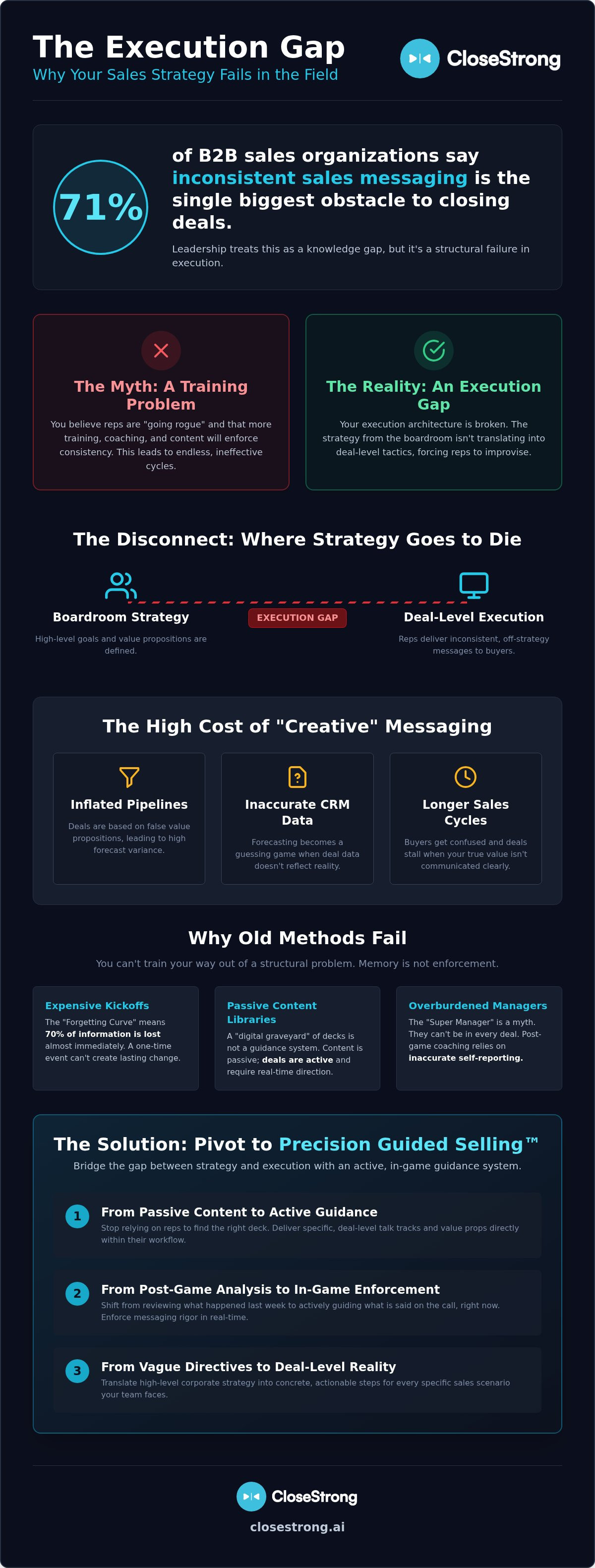
Stop auditing the past. Most sales leaders spend their time in post-game analysis, dissecting why a deal died three weeks after the funeral. This is reactive management. It doesn't save revenue; it just documents failure. If you want to eliminate inconsistent sales messaging, you have to move from the rearview mirror to the windshield. You need in-game guidance that happens while the deal is still breathing.
Your sales playbook shouldn't be a static document gathering digital dust. It needs to be a live guidance system. Enforcing strategy adoption isn't a matter of "hope" or frequent reminders in Slack. It's a matter of infrastructure. You don't need more meetings to discuss alignment. You need software that makes alignment the path of least resistance for your reps. Here are the first steps to turning your strategy into a deal-level reality.
You can't fix what you can't see. Start by identifying exactly where your reps are drifting from the corporate strategy. This isn't about micromanagement; it's about pattern recognition. Look for the specific moments in lost deals where the messaging pivoted away from the value prop. Are reps discounting because they can't defend the price? Are they losing to competitors because they're pitching the wrong features?
When you map these pivots, you'll see that "rogue" behavior is usually a response to a lack of clarity. To fix this, you must drive sales playbook adoption by making the playbook relevant to the actual deal. If the playbook doesn't solve a rep's immediate problem on a Tuesday afternoon call, they won't use it. Period. Identification is the first step toward rigor.
Reps don't need more theory. They need the "what to say" inside the actual deal workflow. This is where most enablement programs fail. They provide a library of content and expect the rep to find the right slide while they're on a live call. It never happens. Inconsistent sales messaging vanishes when the right talk tracks are embedded directly into the process.
Stop asking your reps to remember the strategy. Start using a system that enforces it. Precision Guided Selling™ moves beyond static templates to provide dynamic deal guidance based on the specific context of the opportunity. When the guidance is real-time, the execution gap closes automatically. You move from "post-game analysis" to "in-game coaching," ensuring that every rep speaks with the authority of your best strategist. Ready to stop the drift? See how Precision Guided Selling™ enforces strategy on every deal.
CloseStrong is not a CRM. It is where your CRM strategy actually happens. While your CRM records the past, CloseStrong dictates the future of the deal. The reality of 2026 enterprise sales is that the winner isn't the one with the prettiest plan. It's the one who executes that plan with surgical precision in the field. You don't need more visibility into your failures; you need better execution of your wins.
Precision Guided Selling™ eliminates the "rogue rep" problem by removing the need for guesswork. Reps don't go off-strategy because they want to be rebels. They do it because they lack real-time support during high-stakes moments. By providing custom, high-quality deal guidance based on live data, we ensure that inconsistent sales messaging never reaches the buyer's ears. This is about turning your strategy into a competitive weapon that stays sharp in every interaction, regardless of which rep is leading the call.
Knowing what happened is too late to fix the outcome. Standard revenue intelligence tools provide excellent visibility, but visibility doesn't fix a broken message while the deal is still live. It just records the crash for a later autopsy. CloseStrong provides the "How-To" while the deal is still breathing. We don't just tell you that you're losing; we give your team the mechanics to win. This is the fundamental difference between enablement and execution. One is a passive library; the other is an active guidance system that drives behavior in real time.
Achieving 100% adherence to your sales methodology isn't a pipe dream. It's a matter of choosing the right infrastructure. When you bridge the gap between the boardroom and the Zoom room, you eliminate inconsistent sales messaging and replace it with predictable revenue. You move from a collection of individual contractors to a truly aligned sales force that speaks with one voice. The result is a business that scales because its execution is repeatable, not because it got lucky with a few superstar reps who ignore the playbook. Stop hoping for alignment and start enforcing it. See how CloseStrong enforces messaging consistency on every deal.
Your strategy isn't failing because it's poorly written. It's failing because it's poorly enforced. Stop treating alignment like a suggestion and start treating it like a requirement. Inconsistent sales messaging kills forecasts because it turns your pipeline into a collection of subjective guesses. You don't need more visibility into your losses; you need better execution of your wins. Most organizations are stuck in a loop of post-game analysis, but real revenue is found in the live deal.
Stop guessing and start executing with CloseStrong. You have the strategy. Now, finally, you can have the execution to match. Your team is ready to speak with one voice; you just need to give them the system to do it.
The main cause is a structural execution gap between the boardroom and the Zoom room. Leaders often assume a PowerPoint deck equals alignment, but it doesn't. Inconsistent sales messaging happens because reps are forced to wing it during high-pressure calls. Without real-time guidance, they default to whatever feels easiest. It's not a training failure; it's a lack of deal-level infrastructure that enforces your strategy when it actually matters.
It turns your forecast into a collection of expensive guesses. When reps pitch different value propositions, they use different criteria for qualification. This fuels "happy ears" and leads to the 53% failure rate of forecasted deals. Your CRM data is only as good as the conversations that generated it. If those conversations are off-strategy, your forecast is built on a foundation of fiction and subjective opinions.
Training is a memory game; execution is a mechanics game. Most reps forget most of their training within days because workshops are passive events. You can't expect a rep to recall a complex slide deck while navigating a multi-stakeholder negotiation. Fixing inconsistent sales messaging requires a system that guides the present, not a coach who audits the past. Stop throwing money at workshops and start investing in enforcement.
Enablement is about preparation; execution is about performance. Enablement gives your team a library of content and hopes they use it. Execution ensures they actually do. Think of enablement as the map and execution as the GPS providing turn-by-turn directions. While enablement platforms focus on learning and content usage, an execution platform focuses on the actual behavior and talk tracks used during live enterprise deals.
Track your "lost to no-decision" rates and forecast variance. If buyers are stalling because they don't understand your unique value, your messaging is the culprit. You can also audit the discrepancy between your marketing materials and actual sales talk tracks. Misalignment costs businesses an estimated $1 trillion annually according to Harvard Business Review. If your win rates are stagnant despite a full pipeline, you're likely paying a heavy tax on inconsistent execution.
Avoid tools that only offer visibility. You don't need another dashboard to tell you that you're losing. You need an Enterprise Sales Execution Platform that provides Precision Guided Selling™. The best tools are those that embed strategy directly into the deal workflow. They move beyond passive content management to provide active, high-quality deal guidance that keeps every rep aligned with the corporate mission during every call.
Absolutely. Precision Guided Selling™ is designed to bridge the gap between your CRM strategy and deal reality. It doesn't replace your CRM; it makes the data inside it actually mean something. By enforcing messaging rigor at the point of sale, it ensures that every deal milestone recorded in your CRM is based on strategic alignment rather than a rep's creative interpretation of the value prop.
Stop making them guess. Reps go rogue because your corporate strategy feels too abstract for a real-world negotiation. If the official message doesn't help them win, they'll invent one that does. You stop the drift by providing real-time, custom deal guidance. When you make the right message the path of least resistance, reps stop being creative and start being effective. Rigor is a system, not a personality trait.


