




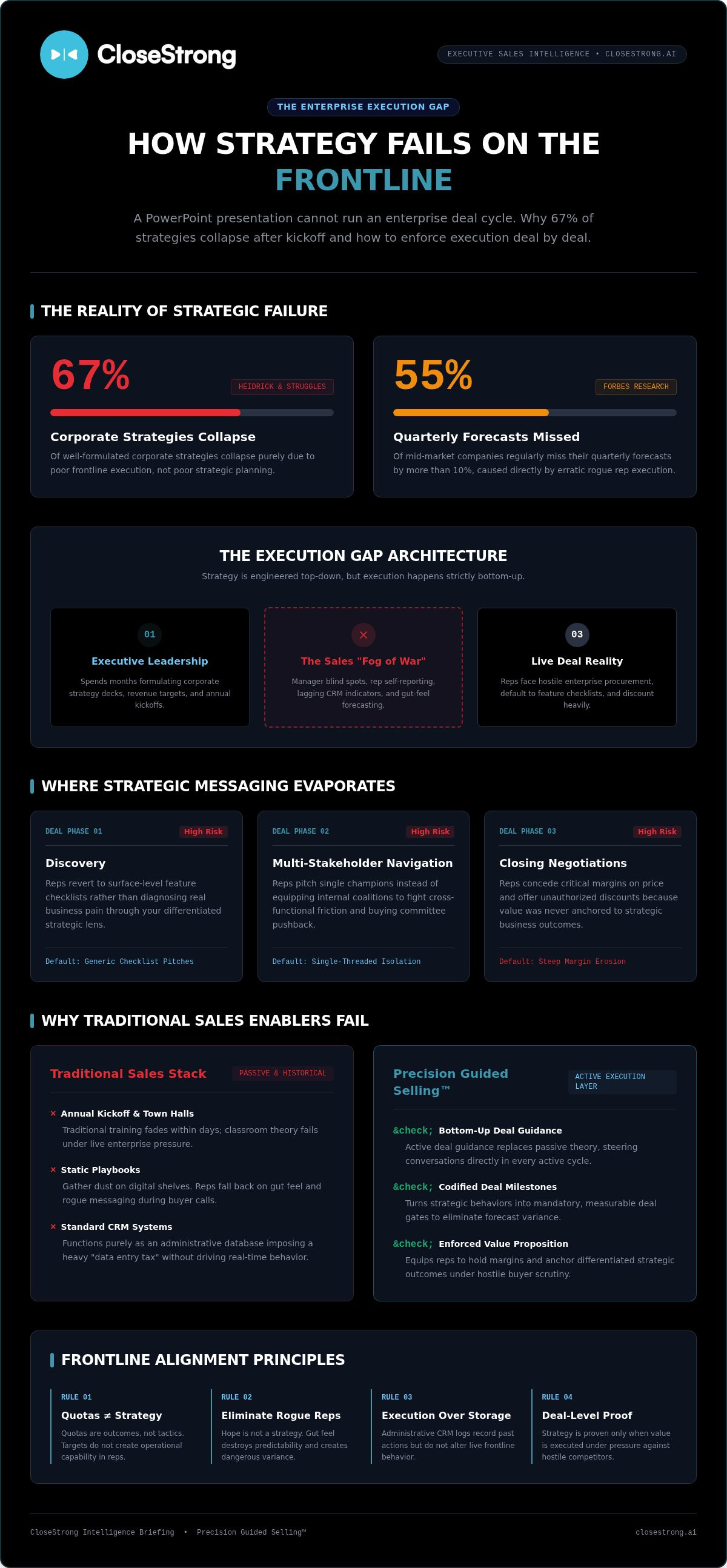
Your annual sales kickoff didn't fail because the slides were uninspired. It failed because a PowerPoint presentation cannot run an enterprise deal cycle. Research from Heidrick & Struggles shows that 67% of well-formulated corporate strategies collapse purely due to poor execution. If you are w...
Your annual sales kickoff didn't fail because the slides were uninspired. It failed because a PowerPoint presentation cannot run an enterprise deal cycle. Research from Heidrick & Struggles shows that 67% of well-formulated corporate strategies collapse purely due to poor execution. If you are wrestling with how to align sales reps to company strategy, you already live with the fallout: your team ignores the new playbook, strategic product launches stall in the field, and rampant forecast variance leaves you answering uncomfortable questions every quarter.
You can't fix this with another town hall or a static enablement binder. True alignment is not a state of mind or a quarterly meeting; it is an active, real-time behavioral requirement enforced deal by deal. In this guide, we break down how to bridge the strategy-to-execution gap, turn high-level mandates into concrete frontline actions, and build the repeatable sales discipline required for predictable revenue growth.
• Strategic alignment isn't forged in an annual kickoff meeting. It is proven only when a rep executes your unique value proposition under pressure in live deals.
• Master how to align sales reps to company strategy by closing the bottom-up execution gap rather than relying on top-down executive mandates.
• Static playbooks fail because traditional training fades within days; revenue teams need active deal guidance rather than passive classroom theory.
• Codify your winning behaviors into concrete deal milestones to eliminate manager blind spots and eradicate forecast variance.
• Deploy Precision Guided Selling™ as an execution layer to translate high-level strategy into visible, deal-level actions that drive predictable revenue.
Executive leadership spends months engineering an immaculate corporate strategy deck. They unveil it at the annual kickoff. Everyone nods. Then Monday morning arrives, and reps sell the exact same way they did last year. In traditional business theory, strategic alignment sounds noble, but in practice, strategic alignment is simply the bridge between what we plan in the boardroom and how we sell in the field. Right now, that bridge is broken.
All-hands meetings, town halls, and shared dashboards will not fix it. They are hollow substitutes for deal-level rigor. Real alignment is not an ideological agreement; it is the frontline ability of an individual rep to execute your unique value proposition under pressure against a hostile competitor. If your reps crumble into generic feature pitches the moment an economic buyer pushes back, your strategy is dead on arrival.
Leadership often points to revenue targets and claims unity. Quotas are not a strategy; they are an outcome. Slapping an aggressive target on a rep does not tell them how to win the deal. When reps face sophisticated enterprise procurement teams without tactical guidance, they ignore corporate directives and fall back on gut feel. The cost of this disconnect is brutal: blown forecast numbers, steep margin erosion from desperate discounting, and widespread brand dilution. Discovering how to align sales reps to company strategy starts by acknowledging that target metrics do not create operational capability.
Most industry analysis restricts the alignment debate to the handoff between sales and marketing. It obsesses over MQL definitions and target account lists. That is the easy part. The real execution breakdown occurs deep in the sales cycle, long after the discovery call ends. That is where strategic positioning usually vanishes. Your CRM will not save you here; it operates as an administrative database that records history rather than driving behavior. Without an enterprise sales execution platform actively steering frontline conversations, high-level corporate strategy remains invisible to the field. Mastering how to align sales reps to company strategy requires embedding real-time guidance directly into every active deal.
Strategy is formulated from the top down, but execution happens strictly from the bottom up. That structural friction creates a massive chasm. Between executive leadership designing annual targets and reps navigating hostile negotiations sits the sales "fog of war." Frontline managers rarely know what is actually happening inside active enterprise cycles. Instead, they rely on rep self-reporting, optimistic pipeline stages, and lagging indicators. By the time a leader spots an off-strategy conversation, the deal is already lost.
Strategic messaging evaporates in three specific deal phases:
Reps revert to surface-level feature checklists rather than diagnosing business pain through your differentiated strategic lens.
Reps pitch single champions instead of equipping internal coalitions to fight cross-functional friction.
Reps concede margins on price because they never anchored value to strategic business outcomes.
Most organizations try to enforce alignment by adding more mandatory fields to their CRM. It backfires every time. A CRM is merely a database of historical records; it is not an engine of execution. Forcing reps to pay a heavy "data entry tax" wastes critical selling hours without offering any guidance in return. When evaluating modern complex B2B sales software, leaders must recognize that data storage does not change human behavior during a live deal.
When you lack execution infrastructure, your team defaults to rogue tactics. Every rep sells their own way, inventing rogue value propositions and off-sheet discounting schemes. This variability destroys operational scalability. Hope is not a strategy, and gut feel is not a methodology. According to Forbes, 55% of mid-market companies regularly miss their quarterly forecasts by more than 10%. That forecast variance is the direct penalty for inconsistent execution. Solving how to align sales reps to company strategy requires eliminating individual guesswork from pipeline execution.
If you want consistent adherence instead of pipeline surprises, you must turn high-level strategic mandates into real-time deal guidance using an enterprise sales execution platform like CloseStrong.
Enablement teams love producing collateral. They build 80-page playbooks, record training modules, and upload battle cards into digital portals. Yet nothing changes on the sales floor. Why? Enablement is about training, but execution is about doing. Providing knowledge does not compel action. According to Salesgenie, only 20% of B2B sales enablement efforts are considered successful. The reason is biological: the human brain follows the "Forgetting Curve," shedding roughly 70% of newly acquired training within just 24 hours.
Dumping information on sellers and expecting them to recall it four months later during a hostile procurement call is operational negligence. It is time to stop teaching reps what to think and start actively guiding how they act. That is why modern revenue teams are adopting precision guided selling software as the natural evolution beyond static enablement.
The annual sales kickoff is an expensive exercise in corporate theatricality. Leaders roll out new packaging, new pricing, and inspiring vision statements. By mid-February, that high-energy hype evaporates entirely. Strategic mandates cannot survive as passive, classroom-style theory. Organizations trying to solve how to align sales reps to company strategy must abandon "just-in-case" training in favor of "just-in-time" guidance delivered directly inside active pipeline opportunities.
Many revenue leaders turned to standard conversation intelligence tools to bridge this divide. Those platforms record calls, generate transcripts, and highlight missed keywords across recordings. But there is a glaring flaw: conversation intelligence is an autopsy. It tells you why a deal collapsed three days after the rep blew the meeting. That is a post-mortem, not a preventative cure. True execution requires correcting trajectory in the moment, not analyzing strategic failure during a Friday pipeline review.
Figuring out how to align sales reps to company strategy means intervening before the mistake occurs. When reps receive custom high-quality deal guidance in real time, strategy stops being an abstract slide deck. It becomes an active standard of frontline performance.
Aligning an enterprise sales force requires concrete operational infrastructure. If you leave strategic adherence to chance, reps will default to their own habits. To establish how to align sales reps to company strategy across hundreds of live deals, follow this five-step execution framework:
Strip away high-level platitudes. Break strategic initiatives into concrete, verifiable buyer actions required at each stage of the cycle.
Stop sending reps to digital content repositories. Put contextual guidance directly in front of them as they advance opportunities.
Ditch raw metrics like call volume and email tallies. Measure whether the rep secured the executive sponsorship and business outcomes demanded by your strategy.
• Deploy strategic deal coaching software to scale manager impact: Remove the coaching bottleneck by embedding automated, deal-level guidance across your entire pipeline.
Feed real frontline objection patterns and competitive pushback directly back to product and leadership teams to refine the go-to-market plan.
If you cannot measure adherence, you do not have a methodology; you have a wish list. True sales team strategy alignment requires converting strategic pillars into unambiguous if/then rules. For example, if a prospect demands an early discount, the rep must secure access to the economic buyer before pricing discussions begin. Establishing a shared, non-negotiable standard for what "good" looks like eliminates subjective pipeline grading entirely.
Frontline managers carry impossible spans of control. A manager overseeing eight reps cannot attend thirty customer meetings every week, which means blind spots inevitably multiply. Technology must act as an objective proxy. Data-driven guidance beats managerial intuition every time. Automated systems detect deal risk weeks before an off-track opportunity wrecks your quarterly forecast, giving teams time to salvage the deal rather than explaining the loss later.
Mastering how to align sales reps to company strategy demands tools built for active execution rather than post-mortem reviews. Explore CloseStrong to turn your corporate strategy into real-time deal guidance today.
Modern enterprise tech stacks contain a fatal architectural flaw. You have systems of record to log transactions and systems of intelligence to record conversations, but you lack an execution layer. That missing layer is the reason corporate strategy dissolves into field chaos. Precision Guided Selling™ solves this vulnerability by taking executive strategy and translating it into custom, deal-level actions at every step of an enterprise pursuit.
Instead of hoping reps remember strategic messaging under fire, this technology places contextual guardrails directly into their daily workflow. It eliminates ambiguity. If a new competitor enters the account, the platform immediately serves up counter-positioning tactics. If procurement demands concessions, it prompts the rep with required trade-offs. This is why leading revenue organizations rely on enterprise sales execution platforms to replace blind optimism with disciplined execution.
Top performers succeed because they intuitively understand how to navigate complex accounts. The other 95% struggle because they lack tactical instincts under pressure. Precision Guided Selling™ replicates the behaviors of your highest-performing sellers across the entire roster. It compresses new hire ramp times from quarters into weeks by transforming strategic documentation into proactive guidance. Rogue selling ends. Standardized rigor takes over. When you solve how to align sales reps to company strategy at the workflow level, pipeline predictability naturally follows.
Stop asking for alignment. Demand execution. Recent enterprise research shows that barely half of corporate go-to-market initiatives succeed, primarily because leaders never embed strategic initiatives directly into the daily mechanics of frontline workflows. The market leaders of 2026 will not be the companies with the most polished kickoff decks. They will be the organizations that govern frontline deal behaviors with precision. If you are serious about mastering how to align sales reps to company strategy, you must control the mechanics of each conversation. Ready to stop guessing? See how CloseStrong enforces your strategy on every deal.
Strategic decks, kickoff speeches, and static database updates will never hit your revenue targets. Only disciplined frontline behavior can do that. When leadership discovers how to align sales reps to company strategy, they stop treating alignment as a cultural aspiration and start treating it as an operational requirement enforced deal by deal.
Bridging this divide requires an enterprise-grade execution focus. CloseStrong equips your team with Precision Guided Selling™ technology, delivering custom deal guidance directly into live sales cycles. Reps stop guessing. Managers stop running post-mortems on lost pipeline. Your corporate strategy becomes visible, measurable, and repeatable across the entire roster.
The gap between your plan and your revenue is completely solvable. Stop the finger-pointing and start executing: discover CloseStrong today.
You align sales strategy with business strategy by translating executive goals into deal-level behaviors. High-level corporate initiatives like margin protection or new product expansion cannot remain theoretical. You must turn them into concrete stage gates and trade-off rules during live negotiations. When strategic priorities govern the actual criteria required to advance an opportunity, your frontline execution naturally reflects your boardroom plan.
The biggest challenge is the frontline execution gap between executive intent and deal reality. Leadership communicates strategy top-down through kickoffs and static decks, but sales reps operate bottom-up in high-pressure calls. Under buyer pushback, reps quickly abandon corporate mandates and revert to personal habits or unnecessary discounting. Bridging this disconnect requires continuous deal guidance rather than periodic town halls or standard enablement reviews.
You motivate sales reps by proving that strategic adherence helps them win bigger commissions faster. When understanding how to align sales reps to company strategy, leaders often rely on punitive quotas or tedious administrative tasks. That fails. Instead, remove deal friction by giving reps clear competitive trade-offs and deal guidance inside their daily workflow. When following corporate strategy reliably closes enterprise accounts, reps adopt it voluntarily.
Sales enablement provides knowledge, whereas sales execution governs live action. Enablement focuses on training programs, battle cards, and collateral repositories that reps study before a call. Execution focuses on what the rep actually says and negotiates while managing an active opportunity. Enablement prepares the seller in the classroom; execution enforces strategic methodology deal by deal in the field.
Enterprise sales strategies fail at the rep level because corporate initiatives are rarely operationalized into daily seller workflows. High-level directives tell reps what executive leadership wants, but they fail to dictate how to handle complex objections in real time. Left without active deal guidance, sellers default to rogue messaging, aggressive discounting, and path-of-least-resistance selling just to hit immediate quarterly quotas.
Technology aligns reps by acting as an execution layer that guides deal behavior in real time. Traditional tools like CRMs merely log historical activities, functioning as static databases rather than active drivers. Modern execution platforms dynamically surface company strategy, required milestones, and risk alerts directly within active accounts. This ensures that every rep consistently executes company goals without requiring a manager on every call.
Precision Guided Selling™ is a proprietary technology that bridges corporate strategy and deal-level execution. Instead of forcing reps to memorize static playbooks, it delivers custom, high-quality deal guidance directly within active opportunities. It analyzes deal variables, detects strategic risks, and prescribes the exact next steps needed to win. This guarantees consistent adherence to your sales methodology across every account in your pipeline.
You measure alignment by tracking milestone adherence and deal quality rather than vanity activity metrics. Evaluating how to align sales reps to company strategy requires looking beyond call counts and CRM stage changes. Measure whether reps secure economic buyer access, enforce non-negotiable contract terms, and sell the strategic product mix at full margin. True alignment shows up in pricing integrity and predictable deal progression.


