




Your weekly pipeline review isn't coaching; it's an autopsy. When late-stage enterprise forecast accuracy hovers at just 47%, relying on gut feel and CRM interrogations turns your revenue targets into a coin toss. If you want predictable growth, you must master how to guide sales reps through comple...
Your weekly pipeline review isn't coaching; it's an autopsy. When late-stage enterprise forecast accuracy hovers at just 47%, relying on gut feel and CRM interrogations turns your revenue targets into a coin toss. If you want predictable growth, you must master how to guide sales reps through complex deals at the point of sale, long before enterprise buying committees go dark.
You already know the frustration of watching major opportunities slip at the end of the quarter because an unmapped CFO or IT stakeholder quietly stalled the purchase. You don't need more administrative reporting or retrospective call summaries; you need execution mechanics that bridge the divide between corporate strategy and daily rep behavior. In this guide, you'll discover how modern sales leaders systematically guide sales reps through complex enterprise deals to eliminate execution gaps and secure predictable revenue. We will break down the essential milestones of enterprise deal mechanics, replace pipeline interrogation with proactive intervention, and show you how to scale top-performer execution across your entire team.
• Mastering how to guide sales reps through complex deals requires abandoning passive CRM inspection and enforcing tactical deal mechanics directly at the point of sale.
• Implement objective buyer-side commitment milestones across five critical deal stages to eliminate false optimism and expose hidden stakeholder blockers early.
• Post-call transcriptions merely document failure after it happens; real-time deal guidance gives reps the exact commercial maneuvers needed while the opportunity is still live.
• Transform administrative deal reviews into high-impact strategy war rooms that spot deal slippage weeks before quarter-end panic sets in.
• Scale top-performer execution across your entire pipeline using Precision Guided Selling™ to turn high-level corporate sales strategy into active, deal-level guidance.
Every week, enterprise sales leaders repeat the same broken ritual. They pull up CRM dashboards, stare at arbitrary close dates, and interrogate account executives about pipeline stages. This isn't coaching. It's backward-looking compliance. In complex accounts, high-level corporate strategies disintegrate the second a rep enters an active deal. Sales leaders assume their methodologies are being executed, but their reps are actually flying blind. Knowing how to guide sales reps through complex deals requires abandoning passive inspection and operationalizing tactical mechanics directly where transactions live or die.
Static org charts and CRM data entry don't change seller behavior during high-stakes commercial conversations. They merely document failure after the buyer goes cold. Understanding modern deal dynamics means recognizing that pipeline inspection produces sanitized status reports rather than revenue velocity.
Grilling reps on whether an opportunity will close by Friday creates a culture of self-preservation. Reps simply push close dates forward, mask risks, and parrot what leadership wants to hear. By the time an executive realizes a deal is stalled, the fatal flaw occurred three weeks prior. Forward-looking guidance flips this dynamic. Instead of running retrospective deal autopsies, leaders must provide real-time deal guidance that uncovers hidden execution gaps while the cycle is still active.
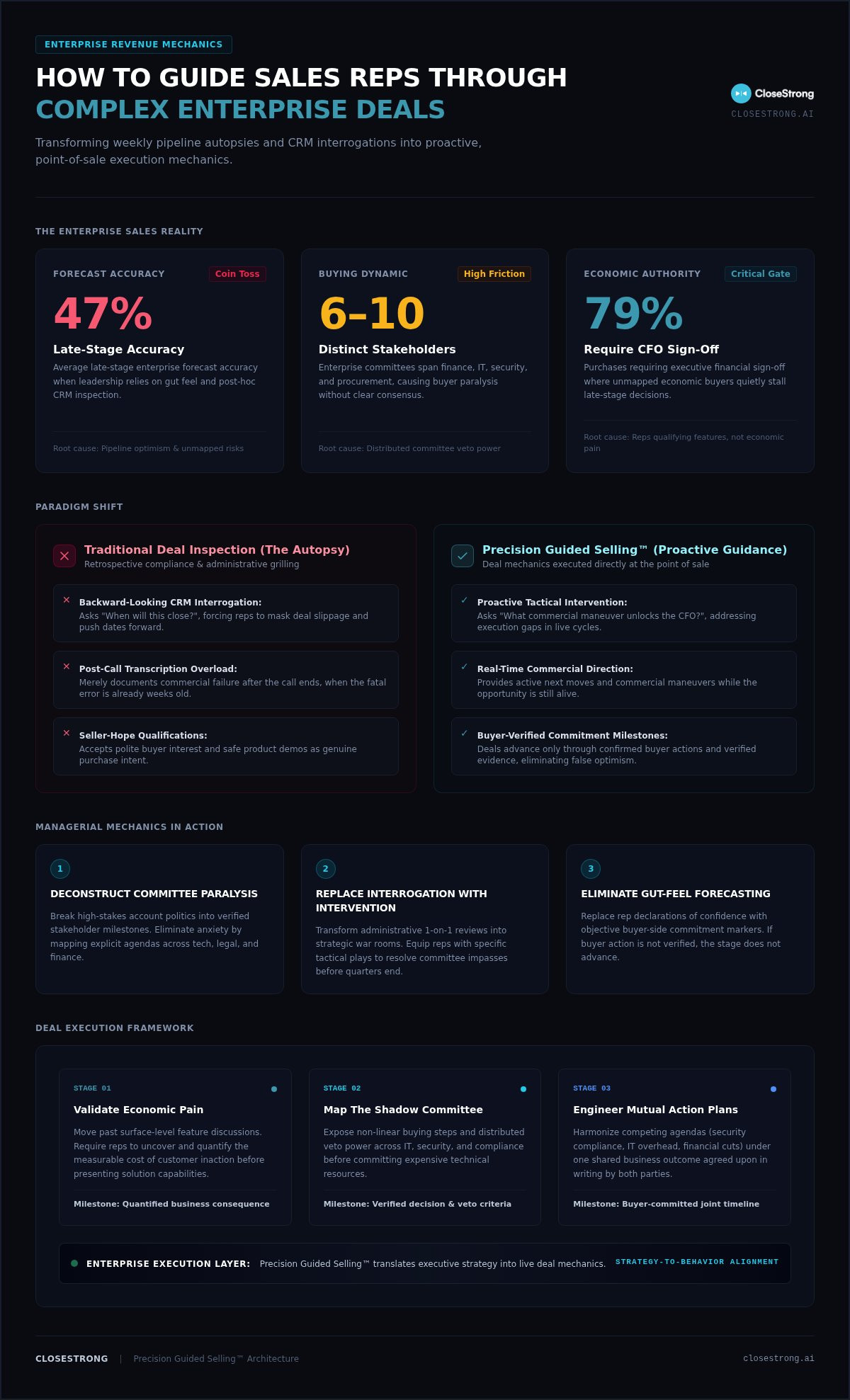
Enterprise accounts stall because buying committees are battlegrounds. Buying groups routinely involve 6 to 10 distinct stakeholders across finance, security, and procurement, with 79% of purchases requiring CFO sign-off. Average reps freeze under this complexity. When reps don't know who owns the budget or what internal politics are at play, performance anxiety takes over. They retreat to safe product demos rather than driving a rigorous solution selling methodology that maps quantifiable business problems to economic buyers.
To master how to guide sales reps through complex deals, leaders must replace managerial guesswork with structured execution mechanics:
Break massive account politics into clear, verified stakeholder milestones.
Shift 1-on-1 conversations from "When will this close?" to "What commercial maneuver unlocks the CFO?"
Replace optimistic rep updates with buyer-verified commitment markers.
When reps have definitive next moves instead of vague playbook theories, hesitation vanishes. Guidance replaces fear, turning chaotic multi-stakeholder cycles into repeatable wins.
Pipeline optimism kills win rates. Reps don't lose enterprise deals at the goal line; they lose them early by accepting polite interest as genuine purchase intent. Knowing how to guide sales reps through complex deals requires a milestone-driven framework anchored in buyer-verified evidence rather than seller hope. If a rep cannot confirm explicit buyer commitments, the deal has not advanced. Period.
Average reps qualify surface features, not economic consequences. Guide your reps to uncover the measurable cost of inaction before they pitch a single capability. Concurrently, they must expose the shadow committee. As detailed in Gartner research on the B2B buying journey, enterprise buying groups tackle non-linear tasks across multiple business units with distributed veto power. Utilizing an enterprise sales execution platform helps reps systematically enforce discovery rigor and surface hidden blockers before leadership commits valuable technical resources.
Deals hit a wall when departmental priorities clash. Security wants compliance, IT wants minimal overhead, and finance wants budget cuts. Show your reps how to align these competing agendas around one shared business outcome. Then, throw out the traditional pitch proposal. Replace it with a mutual action plan co-authored with the buyer champion. This document isn't a vendor task list; it's an executive contract governing technical validation, data governance reviews, and commercial milestones.
Waiting until late stage to engage legal and procurement invites disaster. Work those tracks simultaneously by mid-cycle. Guide reps to anchor the final signature to the customer's internal operational deadline, not the end of your fiscal quarter. When managers master how to guide sales reps through complex deals with objective stage gates, pipeline rot disappears and discounting stops being the only closing lever.
To eliminate execution drift across your entire team, consider deploying custom high quality deal guidance that prompts reps with proven commercial actions at every stage.
Revenue leaders love visibility tools. They buy call recording software, generate AI meeting summaries, and fill dashboards with sentiment scores. Yet win rates stay flat. Why? Because recording a train wreck doesn't prevent it. Conversation intelligence captures what already happened; it documents the failure. It is an autopsy. Mastering how to guide sales reps through complex deals requires active execution systems that direct rep behavior before and during critical interactions, not retrospective transcript mining days later.
Visibility without execution only increases managerial frustration. Knowing a rep mishandled pricing objections on Tuesday doesn't rescue the deal on Friday. When looking at modern complex B2B sales software, the differentiator isn't storage or passive transcription. It's the ability to inject operational strategy directly into the seller's daily workflow.
Reviewing call transcripts is a diagnostic luxury managers rarely have time to indulge. Research shows sales managers have bandwidth to provide substantive deal coaching to only about 10% of active pipeline opportunities. Sifting through 45-minute call recordings leaves the other 90% of complex deals completely unguided. Worse, transcripts cannot tell a rep what commercial move to execute next. They highlight symptoms without prescribing the cure.
In every revenue organization, top performers hold tacit deal intuition. They instinctively know when an economic buyer is blowing smoke, how to trade concessions without sacrificing margin, and when to walk away. Average performers lack this instinct. The true test of how to guide sales reps through complex deals is taking that elite judgment and codifying it into dynamic, real-time guidance across the entire middle 60% of your sales force.
As documented in Harvard Business Review's analysis of effective sales coaching, focusing targeted coaching interventions on middle performers yields the highest revenue returns. To translate that research into reality, organizations must shift from retrospective analysis to proactive execution mechanics:
Equip reps with verified plays before they walk into multi-stakeholder meetings.
Programmatically prompt sellers with discounting thresholds and commercial concessions during live negotiations.
Ensure discovery standards and qualification criteria aren't forgotten PDF playbooks, but active guardrails in every opportunity.
Passive tech documents your losses. Proactive guidance drives your wins.
Stop running 1-on-1s like administrative status interrogations. If your weekly meeting consists of asking, "Did you reach out to procurement?" you are wasting expensive leadership hours. Turn those sessions into strategic deal war rooms. The core challenge in how to guide sales reps through complex deals isn't lack of rep effort; it's lack of tactical execution under pressure. Real coaching deconstructs active deals, stress-tests stakeholder alignments, and rehearses high-stakes commercial negotiations before reps face the customer.
Waiting for quarterly business reviews to course-correct pipeline stalls is organizational suicide. Deals decay in days, not quarters. When you spot deal slippage weeks ahead of time, you can intervene while the account is still winnable.
Most reps confuse buyer responsiveness with deal progression. To strip away false optimism, managers must ask questions that expose structural gaps in the account:
"When the CFO asks why this project cannot wait until next budget cycle, what exact metrics will your champion present?"
"Have we physically seen the security checklist, or are we relying on the buyer's assurance that 'it should be standard'?"
"Did the customer draft the RFP scoring sheet, or did our competitor write it for them?"
If your rep cannot answer these definitively, the deal is at risk. Roleplay the missing interactions on the spot so the rep enters the next client meeting prepared to command the room.
Enterprise transactions produce massive performance anxiety. Facing multiple executives, competing priorities, and rigid procurement rules paralyzes reps who lack clear operational guardrails. Vague advice like "build stronger relationships" only magnifies self-doubt. Instead, deconstruct seven-figure pursuits into verifiable micro-commitments. When reps know the precise milestone required to advance each stage, ambiguity disappears.
This operational clarity is where modern sales methodologies prove their value. Frameworks like MEDDPICC or Challenger fall apart when they remain theoretical concepts filed away in corporate folders. By deploying precision guided selling software, revenue teams operationalize methodology directly into daily rep behaviors, ensuring that standard deal mechanics are enforced across every account.
If you are ready to turn pipeline inspections into proactive closing engines, explore CloseStrong to systematically guide your revenue team through every high-stakes enterprise opportunity.
Corporate strategy doesn't fail in executive boardrooms; it dies in deal execution. Revenue leaders spend months rolling out new commercial models, positioning frameworks, and sales methodologies. Yet when reps step into active accounts, those plans evaporate into guesswork. Solving how to guide sales reps through complex deals at scale requires technology that doesn't just log administrative data, but actively steers rep behavior. CloseStrong delivers an Enterprise Sales Execution Platform engineered specifically to bridge the divide between high-level sales strategy and daily rep-level execution.
Most organizations rely on periodic enablement sessions and passive CRM checklists. That model is dead. CloseStrong's Precision Guided Selling™ embeds corporate strategy directly into live opportunities through custom high quality deal guidance. Instead of expecting an account executive to recall dense enablement manuals during high-stakes negotiations, the platform provides real-time, deal-level prompts tailored to specific account friction points.
Reps receive clear guidance on what buyer commitments to secure, what trade-offs to negotiate, and how to counter hidden stakeholder resistance. As detailed in our breakdown of scaling sales strategy execution, moving from subjective rep optimism to programmatic deal verification is the only way to build predictable enterprise revenue.
Frontline managers cannot sit in on every customer interaction, nor should they have to. CloseStrong acts as execution connective tissue across your sales stack, expanding substantive coaching coverage across active opportunities without requiring an invasive system overhaul. By continuously calibrating deal health against objective buyer milestones rather than rep optimism, leaders eliminate forecast variance before quarters slip away.
Mastering how to guide sales reps through complex deals isn't about micromanagement or demanding more administrative compliance. It's about operationalizing top-performer mechanics across your entire middle tier, equipping every seller with the custom tactical blueprints required to win complex enterprise revenue.
Predictable enterprise revenue doesn't come from aggressive pipeline interrogations or passive call recording software. It comes from disciplined mechanics where deals actually happen. Winning in modern enterprise sales means mastering how to guide sales reps through complex deals with objective milestones, verified buyer commitments, and real-time strategic interventions.
You don't have to accept deal slippage or let late-stage forecast variance dictate your quarter. By equipping your sales force with custom high-quality deal guidance, you bridge the gap between corporate strategy and daily rep execution. CloseStrong's proprietary Precision Guided Selling™ technology is purpose-built to eliminate execution blind spots, giving your revenue organization the exact commercial maneuvers needed to navigate buying committees and close with confidence. Discover how Precision Guided Selling™ eliminates execution gaps and take complete control of your enterprise pipeline today.
Standard CRMs act as historical systems of record; they log past activity and store contact data. They don't direct seller behavior. Deal guidance operates as an execution layer directly inside active accounts. Instead of asking reps to report data for management's benefit, deal guidance prompts reps with specific commercial moves, risk flags, and buyer-side validation steps while the opportunity is live. It transforms passive administrative logging into active, milestone-driven execution.
Classroom training delivers conceptual theory, not situational execution. Reps memorize qualification acronyms during workshops, but forget the mechanics when navigating high-stakes enterprise committees weeks later. When complex objections emerge, reps default to comfortable habits like pitching product features. Effective execution requires translating corporate sales strategy into real-time, deal-level prompts. Reps don't need another slide deck; they need tactical guidance embedded into their daily deals.
Micromanagement happens when managers police administrative tasks like emails sent or CRM fields updated. Effective leaders focus entirely on objective buyer commitment milestones. In mastering how to guide sales reps through complex deals, managers act as strategic advisors in deal war rooms. They evaluate verified evidence, such as access to the economic buyer or confirmed decision criteria, rather than dictating rep schedules. This shifts 1-on-1s from interrogation sessions into collaborative commercial problem-solving.
The biggest warning sign is single-threading, where a rep relies on one enthusiastic contact who lacks budget authority. Other critical red flags include close dates tied to internal fiscal quarters rather than buyer events, unvetted procurement processes, and unquantified business pain. When an opportunity lacks an agreed-upon mutual action plan with verified customer commitments, that deal is already slipping, regardless of what stage the rep reports.
Precision Guided Selling™ does not require a rip-and-replace overhaul of your core infrastructure. CloseStrong deploys as an Enterprise Sales Execution Platform that acts as connective tissue between your current CRM and live field execution. It ingests existing pipeline data and superimposes active, real-time deal guidance into seller workflows. This allows enterprise revenue organizations to enforce rigorous strategy execution directly within active accounts without disrupting operational tech investments.
Yes. Performance anxiety in enterprise sales stems from tactical ambiguity. When reps manage ten conflicting stakeholders without clear playbooks, hesitation sets in. Structured deal guidance eliminates guesswork by breaking seven-figure opportunities into clear, verifiable micro-commitments. Reps gain confidence because they always know the exact commercial move required to advance the account. Removing ambiguity prevents burnout, accelerates quota attainment, and protects valuable sales talent across your organization.
Stakeholder mapping is the foundation of enterprise deal control. Because modern buying committees involve 6 to 10 distinct stakeholders across legal, finance, and security, relying on a single champion creates fatal blind spots. Guiding reps through stakeholder mapping forces them to identify economic buyers, uncover internal detractors, and align conflicting department priorities early. It ensures your team addresses procurement and compliance barriers before entering final commercial negotiations.


