




A staggering 53% of forecasted enterprise deals fail to close. That isn't just a rounding error. It's a systemic collapse of execution. You have the strategy. You have the expensive CRM. You likely even paid for "best-in-class" sales training that your reps forgot three days later. Yet, if you're li...
A staggering 53% of forecasted enterprise deals fail to close. That isn't just a rounding error. It's a systemic collapse of execution. You have the strategy. You have the expensive CRM. You likely even paid for "best-in-class" sales training that your reps forgot three days later. Yet, if you're like most, your win rates for deals over $100,000 are stuck between 12% and 18%. This gap is why enterprise sales outcome improvement remains an elusive goal for most leadership teams. It's a reality that leaves you guessing while revenue stays at risk.
You're tired of high forecast variance and the "black box" of deal health. You want predictable growth, not creative excuses. This case study reveals how to bridge the execution gap by moving beyond the passive recording of data to active, real-time deal guidance. You'll discover how top-tier teams use Precision Guided Selling™ to turn strategic intent into predictable, high-quality revenue. It's time to stop monitoring failure and start enforcing excellence on every single deal.
• The boardroom strategy isn't the problem; it's the execution gap that kills deals before they start.
• CRMs are designed to record history, not create it. Move from passive tracking to active, real-time deal guidance.
• Precision Guided Selling™ eliminates the "intelligence trap" by showing reps exactly how to win, not just telling them they are losing.
• See how a global organization leveraged execution rigor to drive a measurable 30% enterprise sales outcome improvement.
• Engineering revenue requires a system, not a hope. Learn the first steps to standardizing excellence across your entire sales floor.
Your strategy is perfect. Your boardroom deck is beautiful. Your reps are ignoring it. That is the brutal reality of the enterprise sales world. You spent six months designing a methodology, but your front line is still "winging it." This disconnect is the primary reason why enterprise sales outcome improvement remains a pipe dream for most organizations. You aren't failing because your strategy is bad. You're failing because your strategy never actually leaves the boardroom. Strategy is a theory; execution is a fact.
Most sales playbooks are nothing more than expensive digital dust collectors. You have quarterly goals. You have aggressive targets. But look at your reps' daily activities. Are they following the process? Probably not. True predictable enterprise revenue growth doesn't come from a better slide deck. It comes from sales rigor. When reps behave like "lone wolves," your organization pays a heavy price. This "rogue" behavior doesn't just hurt win rates; it destroys your ability to scale.
The high cost of rogue rep behavior includes:
Leadership is left guessing because every rep qualifies deals differently.
Knowledge is not behavior. Reps know what to do; they just don't do it under pressure.
You have no real-time visibility into deal health until it's too late to save the revenue.
Most leadership teams manage by looking in the rearview mirror. You analyze lost deals. You conduct "post-mortems" to figure out what went wrong. It's a waste of time. Knowing why you lost a deal two weeks ago doesn't help you win the one on the table today. Even modern "Revenue Intelligence" tools fall into this trap. They track failure with high-definition clarity, but they don't prevent it. They tell you the house is on fire while offering no water. You don't need more data about your losses. You need a way to enforce your winning strategy while the deal is still live. The Execution Gap is the systemic failure to apply corporate strategy to the individual deal level in real time.
To see real enterprise sales outcome improvement, you must stop hoping for better behavior and start engineering it. If your strategy isn't present during the rep's next call, it doesn't exist.
Most sales technology is passive. It sits back and watches you fail. It records the data of your defeat and presents it in a colorful dashboard after the deal is already gone. Precision Guided Selling™ does the exact opposite. It doesn't just track history; it shapes the future. In high-stakes B2B environments, volume is often a vanity metric. Sending more emails or booking more low-quality meetings won't save your quarter. Precision is the only lever that actually drives enterprise sales outcome improvement. It's about making the right move at the right time with the right stakeholder.
In 2026, enterprise deals involve an average of 13 decision-makers. You can't leave a 13-person consensus to a rep's "gut feeling." Imagine if every rep had your most seasoned strategist sitting on their shoulder during every deal. Not once a week in a coaching session. Not in a post-mortem. Right now. This methodology embeds your winning strategy directly into the daily workflow. It turns "I think" into "I know." It replaces guesswork with a repeatable, high-velocity system of execution.
The foundation of this approach is contextual guidance. The system understands the specific nuances of a deal, the stage it's in, and the obstacles ahead. It provides the rep with the exact next step required by your methodology. This is strategy enforcement. Your sales process is no longer a suggestion; it's a non-negotiable path to revenue. By prioritizing data-driven rigor over rep intuition, you eliminate the "hero culture" where success depends on a few star players. Intuition is inconsistent. Rigor is repeatable.
This is where the enterprise sales execution platform changes the game. It acts as a digital co-pilot that ensures no deal slips through the cracks due to simple execution errors. We are seeing a fundamental shift from manager-led coaching to system-led guidance. Managers should be leading, not forensic investigators of dead deals. When the system handles the guidance, you create a baseline of standardized excellence across the entire floor. You can explore how custom deal guidance transforms execution to see how this works in real-world scenarios.
This isn't just another tool in the stack. It's a fundamental shift in how you view the mechanics of a win. You stop hoping for enterprise sales outcome improvement and start engineering it. When execution becomes a science, revenue becomes a certainty.
Most sales leaders treat CRM as the ultimate source of truth. It isn't. It's a source of history. It tells you who did what, when they did it, and how much they think it's worth. But it never tells you what to do next. This is precisely why enterprise sales outcome improvement remains a struggle for even the most well-funded organizations. You're trying to win today's game by staring at yesterday's scoreboard. It's a passive approach to a high-velocity problem.
In high-stakes deals, you need a system of execution. If your complex B2B sales software only reports that a deal is "at risk," it's failing its primary mission. You don't need a high-definition summary of your failure; you need the mechanics of a win. Tracking is forensic; guidance is proactive. One documents the past, while the other engineers the future.
Traditional recording and transcription tools are fundamentally forensic. They are great at capturing the sound of a deal dying, but they offer no cure in the moment. Transcribing a call or analyzing "sentiment" doesn't change the outcome of the next interaction. We must move from "what happened" to "what must happen next." Knowing a rep had a "good conversation" is a vanity metric if they failed to secure the next critical stakeholder required by your methodology. Recording the past doesn't fix it.
Rigor is the only way to achieve scale. Most teams allow their reps to run "shadow processes" based on personal preference or old habits. This creates a massive, unmanageable variance in your forecast. True enterprise sales outcome improvement requires a unified standard enforced by sales process adherence software. When execution is guided in real-time, the "rep-specific" process disappears. It is replaced by a high-performance engine that works for the entire floor, ensuring that your best strategy is applied to every deal, every time.
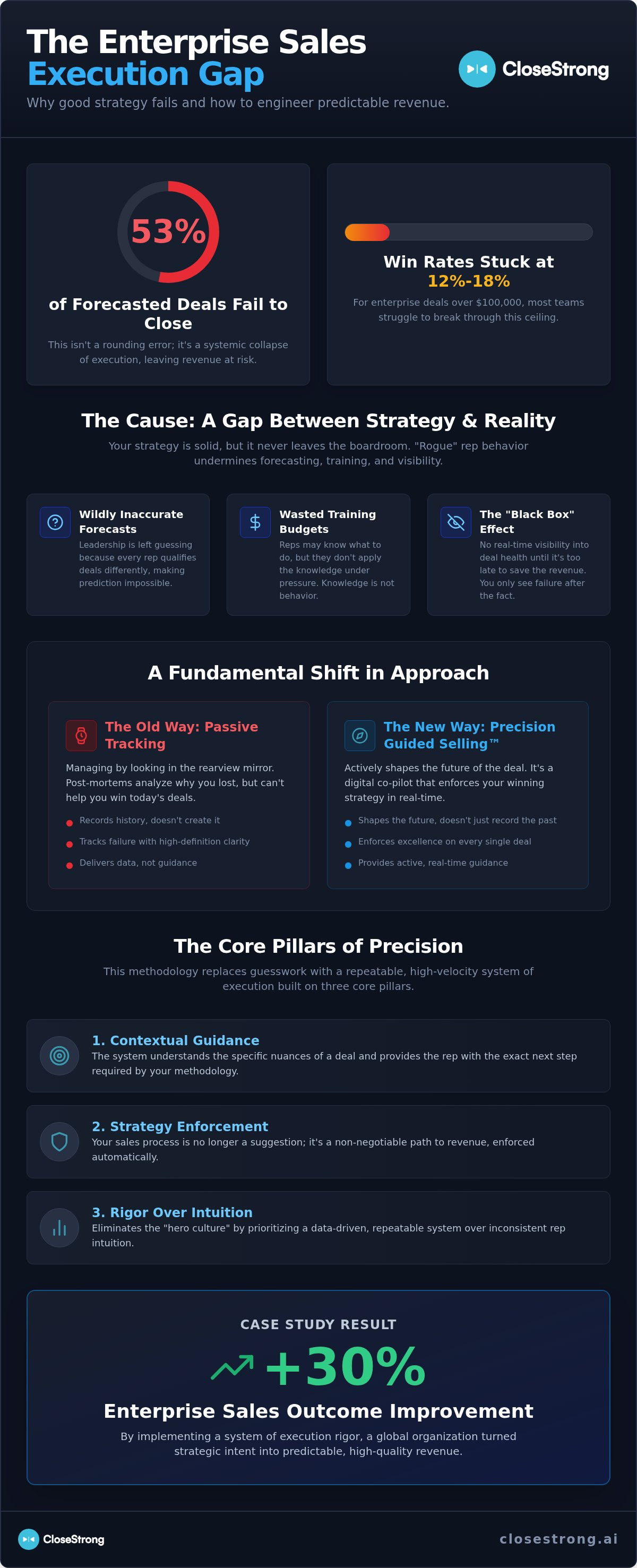
A global technology leader had a $500 million pipeline and a win rate that looked like a coin flip. They had the talent. They had the brand. They even had a CRM overflowing with data. What they didn't have was consistency. Some reps were superstars; others were struggling to hit 10% of their quota. This wasn't a talent problem. It was an execution problem. By implementing Precision Guided Selling™, they didn't just see a minor bump. They achieved a 30% enterprise sales outcome improvement in less than three quarters.
The organization stopped asking reps to "try harder" and started giving them the tools to execute better. They moved from a culture of hero-dependent wins to a system-dependent revenue engine. In high-stakes enterprise environments, you can't afford to have a "B-team" that executes at half the level of your "A-team." You need a floor of excellence that raises the performance of every single person on the sales floor.
The first step was a reality check. We mapped their "official" sales playbook against what reps were actually doing on calls. The results were sobering. Strategy was being abandoned by the second meeting. We identified specific "slippage points" where deals went to die, usually around the engagement of the fifth or sixth decision-maker. By setting a baseline for sales deal health, we realized that many forecasted deals were mathematically doomed from the start. They weren't just losing deals; they were wasting precious resources on the wrong ones.
We didn't give them more training. We gave them an execution system. The platform was configured to mirror their unique closing process, providing reps with real-time prompts based on the specific context of each deal. If a key stakeholder was missing, the system flagged it. If the value prop wasn't aligned with the buyer's pain, the system guided the rep to the right move. Reps stopped guessing. They started executing. Deal velocity increased because the "next best action" was always clear. This wasn't micromanagement; it was a co-pilot for high-stakes wins.
The results were undeniable. Win rates for deals over $100,000 jumped significantly, shifting the needle on total revenue. Forecast variance dropped to single digits. Most importantly, the culture changed. Rigor became the standard, not the exception. This culture of execution now survives rep turnover because the expertise lives in the system, not just in the heads of a few top performers. True enterprise sales outcome improvement isn't about hope; it's about a system that makes winning inevitable. See how our platform engineers high-quality revenue outcomes.
Stop crossing your fingers. Hope is not a strategy, and "luck" is not a scalable business model. You don't need a better Q4 forecast; you need better execution on the deals already in your pipeline. Enterprise sales outcome improvement isn't a happy accident that happens to the most charismatic reps. It's the result of a deliberate, engineered process that removes the "rogue" element from your sales floor. When you stop leaving deal-level decisions to rep intuition, you start winning by design.
The transition from a monitoring-based organization to a leading-based organization is fundamental. Most CROs spend their time monitoring dashboards to see what went wrong. That's a passive role. Leading means shaping the behavior of your team while the deal is still live. It's the difference between being a coroner and being a doctor. One studies the dead; the other saves the living. CloseStrong provides the tools to intervene when a deal is still salvageable, ensuring your strategy is applied where it matters most: the front lines.
You don't need a two-year digital transformation to see results. You need a foundation of execution rigor. The first 30 days are about making your existing strategy non-negotiable. This isn't about replacing your CRM; it's about making it actually work for your reps. We follow a three-step path to eliminate the execution gap:
We take your best practices and turn them into a digital blueprint. No more vague playbooks.
The system provides real-time prompts to reps based on the specific context of their deals. It tells them the "next best move" before they make a mistake.
We use real-time execution data to see what's working and what isn't, allowing you to optimize your process with surgical precision.
You cannot afford to leave deal execution to chance. The cost of a slipped deal isn't just the lost revenue; it's the wasted resources, the missed targets, and the erosion of investor confidence. Reducing forecast variance is the fastest way to drive enterprise sales outcome improvement and increase the predictability of your revenue engine. When you engineer execution, you stop guessing and start growing. It's time to bridge the gap between your boardroom plans and your team's reality.
Ready to fix your execution gap? Explore CloseStrong.
The choice is simple. You can continue to treat your sales process as a suggestion, or you can turn it into a non-negotiable standard for success. Most organizations are drowning in data but starving for execution. They know exactly why they lost last month's deals, yet they have no way to prevent this month's losses. True enterprise sales outcome improvement requires moving past the passive records of your CRM and into the active guidance of an execution platform.
By leveraging Precision Guided Selling™ technology, you bridge the gap between boardroom intent and front-line reality. You stop relying on the "heroics" of a few top reps and start empowering your entire team with custom high-quality deal guidance. This isn't just about software; it's about building a culture of rigor that is specifically built for the complexity of enterprise sales. You have the strategy. Now, it's time to make sure your team actually executes it.
Stop guessing and start guiding; see how CloseStrong improves enterprise outcomes.
The execution gap is closing. It's time to lead your team toward the predictable growth you've already planned for. You're ready to win.
It is the transition from unpredictable, "hope-based" revenue to a consistent, engineered system of wins. Instead of wondering why a deal slipped, you use a system that ensures every opportunity follows your winning strategy. This focus on execution is the only way to achieve sustainable enterprise sales outcome improvement in a complex market. It's about moving from "what happened" to "what must happen now."
Coaching is a post-mortem; this is a co-pilot. Traditional coaching happens in a conference room days after a rep misses a critical step. Precision Guided Selling™ happens in real time, providing the right move at the right deal stage. It removes the delay between identifying a mistake and correcting the behavior. You stop analyzing failure and start preventing it while the deal is still live.
No. Your CRM is a filing cabinet for data. CloseStrong is a system of execution that sits on top of that data. You don't need another place to record history; you need a tool that helps you create it. We integrate with your existing stack to turn static records into active, deal-winning guidance. We don't replace the record; we make the record useful.
You will see behavioral changes in the first 30 days. Measurable win rate improvements typically follow within one full sales cycle. Because the platform enforces rigor from day one, reps stop wasting time on "doomed" deals and focus on high-probability opportunities. This immediate shift in focus accelerates your path to revenue and reduces the time wasted on deals that will never close.
It is the systemic failure to apply your strategy at the individual deal level. It is the primary reason why more than half of forecasted enterprise deals fail to close. Your strategy exists in a slide deck, but your reps are winging it on their calls. Precision Guided Selling™ closes this gap by making your methodology the non-negotiable standard for every deal in your pipeline.
Absolutely. We don't sell you a new theory; we enforce the one you already paid for. Whether you use MEDDIC or a custom internal framework, our platform embeds those specific requirements into the rep's daily workflow. It turns your methodology from a suggestion into a non-negotiable execution path. If it's in your playbook, it's in our guidance.
Top performers embrace it because it gives them a clear, frictionless path to their quota. It removes the guesswork and administrative burden of navigating complex, multi-stakeholder deals. Reps who rely on "gut feeling" or rogue behavior may resist at first. However, the resulting enterprise sales outcome improvement and higher commissions usually win them over once they see the results in their paycheck.
The core features are real-time deal guidance, strategy enforcement, and live visibility into deal health. Unlike traditional tools that only track activities, an execution platform provides contextual prompts based on the specific nuances of a deal. It's designed to guide rep behavior, eliminate deal slippage, and ensure every stakeholder is properly engaged before the forecast date arrives.


