





Visibility is not victory. Knowing you will miss your number three weeks early doesn't change the result. It just gives you more time to polish your excuses. Most leaders are drowning in revenue intelligence that acts like a dashboard camera filming a car crash in high definition. It is great for th...
Visibility is not victory. Knowing you will miss your number three weeks early doesn't change the result. It just gives you more time to polish your excuses. Most leaders are drowning in revenue intelligence that acts like a dashboard camera filming a car crash in high definition. It is great for the autopsy; it is useless for the steering. You have bought every tool on the market, yet your reps still ignore the playbook and deal slippage is the only thing you can actually predict.
We agree that the enterprise stack is bloated. You are tired of tools that provide data but no direction. It is time to stop hoarding data and start closing deals by fixing the execution gap. This guide breaks down why the 2026 winner's circle belongs to those who move beyond observation. We will explore how modern sales execution tools for enterprise must pivot toward Precision Guided Selling™ to ensure consistent strategy across your global team. It is time to trade the rearview mirror for a GPS that actually drives revenue.
• Stop mistaking visibility for victory and learn why your 2026 dashboard is likely just a high-definition recording of a pipeline crash.
• Identify the critical difference between engagement tools built for activity volume and execution platforms designed for high-stakes deal value.
• Audit your current sales execution tools for enterprise to see if they are driving your sales methodology or just collecting digital dust.
• Master the 5 pillars of a modern tech stack that moves your team from passive data collection to active, strategic deal navigation.
• Bridge the strategy-to-execution gap using Precision Guided Selling™ to provide reps with the high-quality, deal-specific guidance they actually need to win.
You have more dashboards than ever. Your pipeline is visible in 4K resolution. You can track every email, every click, and every sentiment score in real-time. Yet, your win rates are stagnant. This is the Visibility Trap. Seeing a train wreck in real-time doesn't stop the crash. It just gives you a front-row seat to the disaster. Most leaders have mistaken "seeing more" for "doing more," and the results are showing up in your forecast variance.
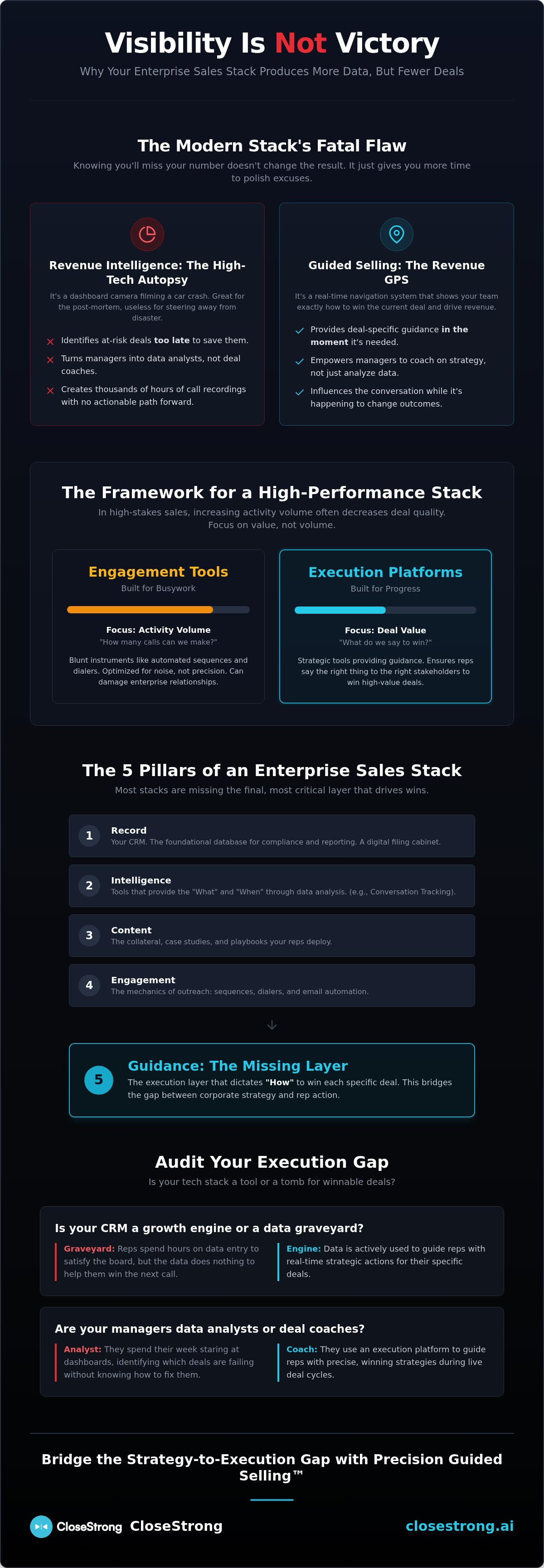
Your managers are exhausted. They spend the majority of their week staring at red, yellow, and green bubbles on a screen. They have become high-priced data analysts rather than deal coaches. They can tell you exactly which deals are failing, but they can't tell your reps how to fix them. This is the fundamental flaw in the modern stack. Knowing a deal is at risk is "Intelligence"; knowing exactly how to save it is "Execution." Most sales execution tools for enterprise stop at the intelligence layer. They identify the problem and leave the solution to chance.
CRM was supposed to be the engine of growth. Instead, it has peaked and is now failing enterprise teams by acting as a digital filing cabinet. It is a graveyard for data. Recording an activity is not the same as executing a strategy. Your reps spend hours on data entry to satisfy the board, but that data does nothing to help them win the next call. The Execution Gap is the distance between corporate intent and rep action. When your strategy lives in a slide deck but your reps live in their inbox, that gap becomes a canyon that swallows winnable deals.
You bought conversation tracking tools to "hear" the market. Now you have thousands of hours of transcripts and AI summaries. What has actually changed? Conversation tracking tells you why you lost three weeks after the fact. It is a high-tech autopsy. By the time a manager reviews the "negative sentiment" in a transcript, the prospect has already stopped returning your calls. The deal is dead. Visibility has become a hollow placeholder for actual leadership and guidance. Real leadership requires navigation, not just observation. You don't need more recordings of past failures; you need a way to influence the conversation while it is actually happening.
Most enterprise leaders suffer from the "More is Better" myth. They believe that if 50 emails a day is good, 500 must be better. It is a lie. In high-stakes sales, increasing activity volume often decreases deal quality. You cannot spam your way into a seven-figure contract. Engagement tools are built for volume; execution platforms are built for value. If your stack is optimized for noise instead of precision, you are simply failing faster at scale.
The 2026 landscape demands a shift. Precision is the new scale. To build a high-performance engine, you must define your stack through five distinct pillars. Each serves a purpose, but only one drives the win.
: Your CRM. It is the foundational database for compliance and reporting.
: Tools that provide the "What" and "When" through data analysis.
: The collateral and case studies your reps deploy.
: The mechanics of outreach, sequences, and dialers.
: The execution layer that dictates "How" to win each specific deal.
Engagement tools are exceptional at managing the mechanics of outreach. They are blunt instruments designed for the top of the funnel. However, automated sequences can actually damage high-stakes enterprise relationships. A generic, automated follow-up sent to a CTO is an insult, not a touchpoint. You must shift from the quantity of touchpoints to the quality of guidance. High-performance sales execution tools for enterprise shouldn't just help you talk to more people. They should ensure your reps are saying the right things to the right stakeholders. You can dive deeper into this distinction by reading Revenue Intelligence vs Sales Execution: Why Visibility Is Not Victory.
Guidance is the final frontier of sales tech. This is where Precision Guided Selling™ becomes mandatory for $100k+ deals. It is not enough to monitor behavior after a call; you must modify behavior before the call happens. Precision Guided Selling™ provides custom, high-quality deal guidance based on the specific scenario of every opportunity. It ensures sales rigor is maintained across global teams, regardless of individual rep experience. It acts as a GPS that keeps every deal on the strategic path. If your managers are tired of doing autopsies on lost deals, it is time to invest in a platform that prioritizes execution over mere activity.
. This is your foundational database. It is essential for compliance, reporting, and satisfying the board. It records what happened, but it does nothing to influence what happens next.
. These tools provide the "What" and "When" through data analysis. They spot trends and flag risks. Think of this as the smoke alarm; it tells you there is a fire, but it doesn't help you put it out.
. This layer manages the "How Much." It handles multi-channel outreach and activity volume. It is built for scale, but scale without precision is just noise.
. This is your sales enablement layer. It ensures reps have the "What to Say" through case studies and decks. The problem? Most reps can't find the right content when a deal is actually on the line.
. This is the critical "How to Win" layer. Powered by Precision Guided Selling™, this pillar provides the navigation your reps need to navigate complex deal cycles.
A fragmented stack creates friction. When your intelligence tool flags a risk but your engagement tool keeps sending generic emails, you have a coordination failure. You need bi-directional data flow between your CRM and your execution platform. Without this, your strategy stays in a vacuum while your reps operate in the dark. If you want to see how these pillars work together in the wild, check out our guide on the Best Sales Productivity Software to Close Deals Faster in 2026.
Does your current stack help you close the deals you already have, or is it just finding new ones for you to lose? Most sales execution tools for enterprise focus on the top of the funnel. That is a mistake. The real ROI lives in execution. A 5% increase in win rate beats a 20% increase in lead volume every single time. It is cheaper, faster, and more sustainable. Achieving this requires Sales Rigor. We define Sales Rigor as the consistent application of winning behaviors across every single deal. It is the difference between a lucky quarter and a predictable legacy.
Most enterprise tech stacks are just expensive digital filing cabinets. They are excellent at storing the history of why you lost, but they are useless at helping you win. To fix this, you need an audit that goes deeper than "user adoption" or "log-in rates." You need to look at behavior. Are your sales execution tools for enterprise actually changing how your reps sell, or are they just adding more clicks to their day? If your tools don't influence the next action, they are just overhead.
. Are your reps actually using MEDDICC to qualify deals in real-time? Or are they filling out the CRM fields five minutes before the forecast call? If the data is retroactive, your methodology is a ghost.
. Every team has "superstar" reps who ignore the official playbook because the playbook is too hard to find. When your best people go rogue, your strategy is officially dead.
. Track how much time managers spend "inspecting" data versus "directing" deals. If they spend 80% of their time asking for status updates, they aren't coaches. They are expensive librarians.
If your forecast is off by more than 10%, your execution layer is broken. You have a visibility problem masquerading as a math problem. High forecast variance is the ultimate symptom of an execution gap. It means you don't actually know what is happening inside your deals. There is a massive difference between "Pipeline Health," which is just a count of opportunities, and "Deal Health," which is the objective reality of the win chance. Most tools focus on the former. You can read more about why most health scores fail in our guide on Sales Deal Health Software: Why Monitoring Health Scores Isn’t Enough.
Most managers have become high-priced data entry clerks for the board. They spend their one-on-ones asking "What happened?" and "What is the status?" This is inspection. It is passive. It is reactive. The 2026 requirement is instruction. You must move from asking for updates to providing real-time, deal-level guidance that scales across the whole team. You don't need more reports; you need a way to tell your reps exactly what to do next to save a slipping deal. It is time to audit your sales execution gap and turn your managers back into the deal-closers you hired them to be.
Most sales execution tools for enterprise are nothing more than glorified task managers. They are built to remind your reps to send an email, but they have no opinion on what that email should actually say. They manage the "When," but they ignore the "How." CloseStrong is different. We didn't build another workflow tool; we built the only platform designed specifically for the "How to Win" layer of your business. If your strategy stops at the CRM, it isn't a strategy. It's just a wish list.
The power of Precision Guided Selling™ lies in its ability to deliver custom, high-quality guidance for every specific deal scenario. We don't believe in generic templates. Every enterprise deal is a unique battlefield with its own internal politics and technical hurdles. CloseStrong ensures that your company's gold-standard strategy is executed on every single opportunity, from the first discovery call to the final signature. Don't just track the deal; drive the outcome.
Why do winnable deals slip? It is usually "rep amnesia." Your reps know the methodology, but in the heat of a complex cycle, they forget the critical steps that move the needle. CloseStrong provides reps with the "next best move" based on your specific winning strategy. It eliminates the guesswork. It ensures that your most junior rep performs like your seasoned veteran by providing the right instruction at the exact moment it is needed. It is about consistency across the board. You can explore the mechanics of this in our deep dive on The Enterprise Sales Execution Platform: Closing the Gap Between Strategy and Reality.
Enterprise teams use CloseStrong to kill the chaos. We help you move from "Hope-Based Selling" to "Precision-Guided Selling." The result is a dramatic reduction in forecast variance. When every rep follows a consistent, high-rigor process, your revenue becomes predictable. You stop guessing which deals will close and start knowing. This isn't about micromanagement; it is about providing the GPS your team needs to navigate the most complex sales environments on earth. It is time to stop being a spectator in your own pipeline. Ready to stop guessing? See how CloseStrong drives execution on every deal.
Visibility is a comfort, but it is not a strategy. You can spend another year staring at high-definition dashboards of deals you are going to lose, or you can choose a different path. The 2026 winner's circle is reserved for leaders who move beyond recording history to actually directing it. You have seen the gap. You know that engagement tools drive volume while execution drives value. It is time to audit your stack and prioritize the "How to Win" layer over the "How Much" layer.
Modern sales execution tools for enterprise must do more than just flag risks. They must offer navigation. CloseStrong's proprietary Precision Guided Selling™ technology eliminates the gap between your corporate strategy and rep execution. We provide custom, high-quality deal guidance for your most complex enterprise cycles. Don't just watch your pipeline; master it. Execute your strategy on every deal with CloseStrong. You have the playbook. Now, ensure your team actually runs it.
A CRM is a system of record, not a system of action. It is a rearview mirror that captures history for your board and your auditors. It tells you what happened last week, but it has no opinion on what should happen next. Enterprise sales execution requires a layer that moves beyond data entry to active navigation. If your tool doesn't influence the next rep behavior, it is just a digital filing cabinet.
Traditional playbooks are static documents that gather digital dust. Precision Guided Selling™ is a dynamic, deal-specific engine that provides real-time instruction. It is the difference between a paper map and a GPS. While a playbook gives general advice, Precision Guided Selling™ analyzes the specific scenario of a $500k deal and tells the rep the exact next move to maintain strategic rigor. It turns theory into behavior.
Yes, native integration is mandatory for success. Effective sales execution tools for enterprise must sit on top of your existing Salesforce or HubSpot instance to be useful. You don't need another silo; you need a way to make your CRM data actionable. By syncing bi-directionally, these platforms turn static records into live guidance without forcing your reps to jump between five different browser tabs.
High forecast variance is the loudest warning sign of a gap. If your "commit" deals are slipping by more than 10% every quarter, your execution layer is failing. Other signs include "rep amnesia" regarding your MEDDICC methodology and top performers going rogue to close deals. When your strategy lives in a slide deck but your reps live in their gut, you have a sales execution tools for enterprise problem.
It replaces rep optimism with objective data. Most forecasts are built on "gut feel" and hope. Real-time guidance enforces sales rigor by tracking whether the strategic milestones of a deal have actually been met. You stop asking "how do you feel about this deal?" and start seeing "did we identify the economic buyer?" This transition from subjective to objective reporting is what drives predictable revenue growth.
It is designed for complexity, not just headcount. While large teams feel the "execution gap" more acutely due to scale, any team managing high-stakes, multi-stakeholder deals needs this level of precision. If your sales cycle involves internal politics, technical evaluations, and six-figure contracts, the risk of human error is too high to leave to chance. Precision is a requirement for value, regardless of company size.
You should see a measurable impact within a single sales cycle. The ROI isn't found in "saved time" or "better data." It is found in the winnable deals you stop losing. By increasing your win rate by even 5%, most enterprise teams cover the cost of the platform almost immediately. You are trading the high cost of deal slippage for the predictable returns of consistent strategic execution.


