



Aligning sales activities with company strategy takes more than setting a revenue target. It requires shared goals and KPIs, clear communication, useful sales enablement, and measures that show how sales work contributes to company outcomes. Without those links, busy reps can hit activity targets wh...
Aligning sales activities with company strategy takes more than setting a revenue target. It requires shared goals and KPIs, clear communication, useful sales enablement, and measures that show how sales work contributes to company outcomes. Without those links, busy reps can hit activity targets while the business moves in the wrong direction.
The problem isn’t a lack of effort. It’s that sales activity can be hard to connect to priorities such as retention, growth, or performance in a target market. A dashboard full of calls and meetings won’t show whether those activities are advancing the company’s strategy.
This article explains how to connect company goals to shared Sales and Marketing targets, equip reps to act on those priorities, and measure sales impact beyond activity counts. You’ll also learn how to assess whether sales is influencing the outcomes the company cares about. The aim is straightforward: make daily sales work pull in the same direction as the business.
• Translate company priorities into shared revenue targets and KPIs so sales effort supports outcomes, not just activity.
• Give reps clear, centralized guidance they can use in real deals, then use their feedback to keep messaging relevant.
• Align Sales and Marketing around common objectives, lead definitions, and handoff expectations to reduce gaps between teams.
• Assess sales performance by how it contributes to company goals, not only by whether reps meet individual quotas.
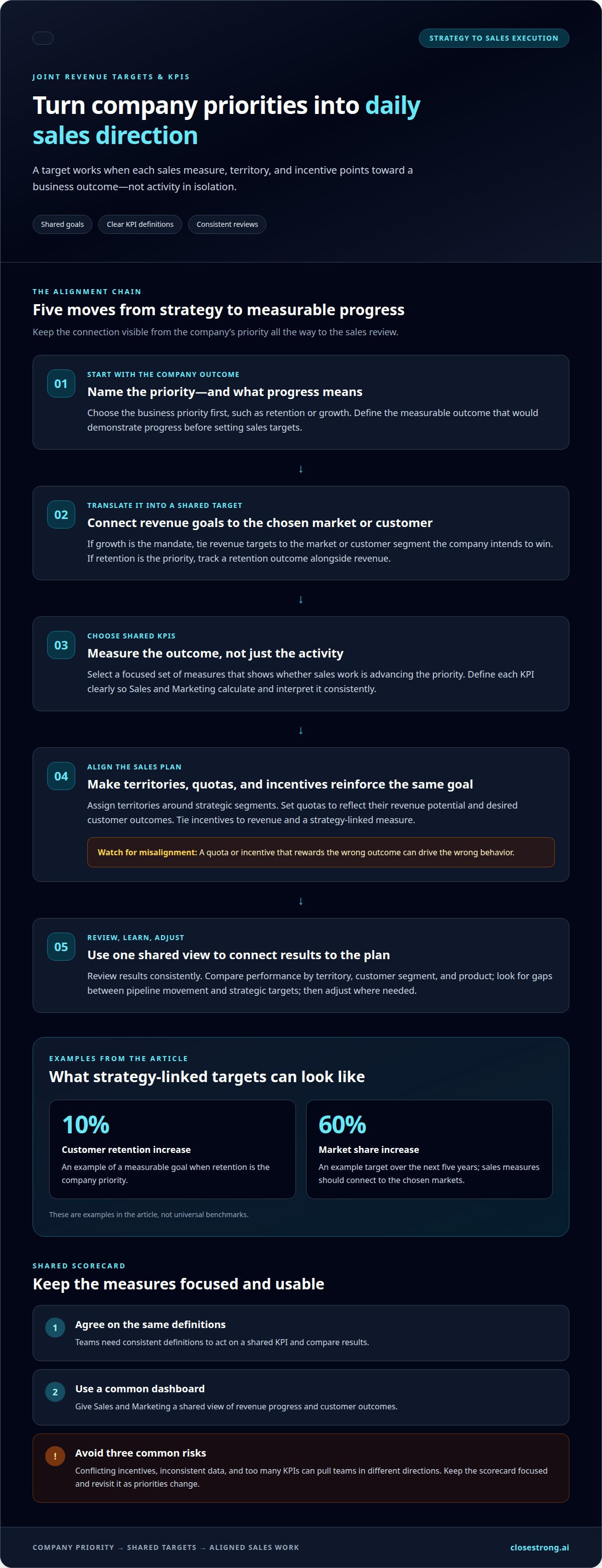
Start with the company outcome, not a quota pulled from last year’s spreadsheet. If retention is the priority, set a measurable goal, such as increasing customer retention by 10%. If growth is the mandate, connect revenue targets to the market or customer segment the company intends to win. That connection turns a broad strategy into a sales direction.
How can sales leaders align territories, quotas, and incentives with strategic priorities? Assign territories according to strategic segments, then set quotas that reflect their revenue potential and desired customer outcomes. Tie incentives to revenue and a strategy-linked measure, such as retention when customer retention is the stated objective. A quota that rewards the wrong outcome will drive the wrong behavior.
To align sales plans with business strategy, first identify the company’s priority and the outcome that would demonstrate progress. Next, choose shared KPIs, assign owners, and review results on a consistent cadence. For example, a company targeting a 60% increase in market share over the next five years needs sales measures tied to its chosen markets, not just total bookings. The operating logic behind aligning sales activities with company strategy is clear: each target should connect daily selling decisions to a business outcome.
Analyze sales data against those KPIs, not in isolation. Compare performance by territory, customer segment, and product, then look for gaps between pipeline movement and strategic targets. A shared dashboard can give Sales and Marketing a common view of revenue progress and customer outcomes. Use regular reviews to identify which activities contribute and where plans need adjustment.
Shared metrics make coordination practical. Sales and Marketing can agree on common revenue targets, review the same dashboard, and plan together. If retention matters, track it alongside revenue. If market expansion matters, examine results in the target segment. Consistent definitions are essential: teams can’t act on a shared KPI if they calculate or interpret it differently.
What are common risks and challenges when aligning sales activities with strategy? Conflicting incentives, inconsistent data, and too many KPIs can pull teams in different directions. A long list of measures also blurs priorities. Keep the scorecard focused, define each metric clearly, and revisit it as business priorities change. When leadership teams struggle to resolve competing priorities internally, strategic advisors such as Robin Lohmann can help clarify management strategy and streamline overarching corporate targets.
A strategy loses force when every rep explains it differently. Create one central source for current priorities, approved messaging, product updates, and deal guidance. Give each update an owner and an effective date. If a product’s value proposition changes, for example, replace the old talk track instead of leaving both versions in circulation. Reps need one clear answer about what to say and why it matters.
Keep the message easy to absorb. Product marketers can use a 2-minute video to explain a strategy and how to pitch it. Pair that clip with a concise written summary, a buyer-relevant example, and the next action reps should take. A seller preparing for a prospect meeting can then find the strategic context and the practical pitch together, instead of piecing them together across scattered files.
Communication should also flow from the field back to the teams shaping the message. After key calls, sellers can record short, asynchronous debrief videos so Marketing can hear the objections prospects raised. Ask reps to name the concern, describe the prospect’s response, and note which message prompted the discussion. Marketing can use those details to sharpen content and messaging, while Sales can see updates reflect real buyer conversations.
Compensation changes need the same clarity. A plan that worked earlier may need revision when market conditions change. Explain what changed, which behaviors the plan now rewards, and when the revision takes effect. Use a concrete scenario to show how a strategic deal or customer outcome fits the updated rules. Ambiguous incentives encourage reps to follow the familiar payout, not the new priority.
Make communication a working loop: publish the strategy, equip sellers, gather call feedback, and update guidance. A centralized execution approach can help keep deal guidance connected to company priorities. For teams that need that connection across active deals, explore guided sales execution.
Separate scorecards create separate agendas. Sales and Marketing need shared objectives tied to the same buyer journey. Choose measures such as pipeline coverage, conversion rates, and sales velocity by segment. Define each metric together, including what counts as a qualified lead and when a deal enters the pipeline. Without common definitions, teams can report different versions of the same result.
How do Marketing, Product, and Sales coordinate around company strategy? Start with a shared company priority, then assign each team a contribution. Marketing creates buyer-stage content, Product clarifies value and product updates, and Sales shares prospect needs and objections. If the strategy targets a specific customer segment, for example, each team should use consistent messaging and evidence suited to that segment.
Make lead handoffs explicit. Sales and Marketing can agree on lead scoring and set a service-level agreement for response times. A two-hour response to a qualified lead is one example of a commitment. Weekly pipeline reviews can surface poor lead fit, stalled follow-up, and missed handoffs. Bring specific records to the meeting, not vague complaints about lead quality.
Shared objectives also improve forecasting. Track conversion and sales velocity by segment, then compare changes with pipeline coverage. Sales should keep customer and opportunity data accurate so Marketing can assess which campaigns attract suitable buyers. If conversion falls in one segment, review lead criteria, buyer context, and sales follow-up before changing the overall strategy.
Keep the operating rhythm practical: agree on objectives, inspect results together, and assign owners to gaps. Marketing can deliver sales-ready leads with clear context; Sales can share feedback on fit and objections; Product can clarify the capabilities behind buyer questions. A shared review turns those inputs into decisions, such as refining lead scoring or creating content for a stage where prospects regularly stall. That is purposeful coordination, not another meeting without an owner.
Quota attainment shows whether reps sold, but not whether their work advanced company goals. Assess influence by tracing a strategic objective to the sales behavior intended to support it, then examining customer and business outcomes. For a retention objective, for example, examine whether sales conversations surface renewal risks early and lead to useful follow-up. The point is to evaluate contribution, not just output.
A 2024 HubSpot report says sales teams in aligned organizations are 103% more likely to exceed their goals. Use that finding as a reason to examine alignment, not as proof that a particular sales activity caused a result. Separate the company outcome from the evidence of sales contribution. That keeps a strong quarter from hiding weak execution or favorable conditions unrelated to the sales plan.
Build a simple evidence chain for each strategic goal: name the company outcome, identify the sales actions expected to support it, and select evidence connecting those actions to customer progress. Then compare results across relevant segments and deal stages. If a segment shows stronger outcomes, inspect deal notes and customer patterns to understand what differed. If activity rose but outcomes did not, revisit the actions or their link to the strategy.
How often should sales activities and targets be reviewed against company strategy? Review them on a regular operating cadence, and revisit them whenever company priorities or market conditions shift. Ask whether current sales behaviors still serve the goal, what the results show, and what decision follows. Don’t change targets simply because one period disappoints; look for a meaningful pattern before adjusting execution.
Keep the assessment useful by assigning an owner to each strategic measure and recording the decision made after review. For example, if the chosen sales approach isn’t advancing a priority, leaders can refine deal guidance or redirect effort toward better-fit opportunities. That turns measurement into action rather than another report. To connect strategic priorities with guidance on active deals, explore sales execution support.
CloseStrong helps sales teams put company strategy into practice on every deal through its Enterprise Sales Execution Platform. When priorities are clear but deal execution varies from rep to rep, consistent guidance can connect strategic goals with the decisions sellers make during the closing process.
Its proprietary Precision Guided Selling™ technology guides representatives through that process, supported by custom, high-quality deal guidance. The focus is practical: help reps apply company priorities within individual opportunities, rather than leave strategy sitting in a presentation. This is a natural next step for teams that have defined shared objectives and now need to carry them into active deals.
To explore how CloseStrong can support your sales execution, visit closestrong.ai.
Strategy matters when it changes what happens in the next customer conversation. Choose one company priority, identify the sales decision it should shape, and make that decision visible in active deals. Then assign an owner to assess whether the guidance is being used and what buyers’ responses reveal. That creates a practical starting point for aligning sales activities with company strategy, without turning execution into another reporting exercise.
Keep the next step focused. Pick a gap between the company’s intention and the way deals are advancing. Decide who will address it, what evidence will show progress, and when the team will revisit the decision. The goal isn’t a perfect plan on paper. It’s a clearer connection between strategy and the choices sellers make every day.
If you’re ready to strengthen that connection in deal execution, contact CloseStrong to discuss alignment. Start with the priorities your team needs to carry into customer conversations, and build from there.
It means directing sales decisions toward the outcomes the business has chosen to pursue. In practice, aligning sales activities with company strategy changes how reps qualify, prioritize, and advance opportunities. If the company is pursuing larger enterprise accounts, for example, sellers should assess buying complexity and strategic fit, not just near-term deal size. The test is whether a sales action supports a stated business priority.
Turn each strategic priority into an observable business result, then identify the sales contribution that could influence it. For a new-market strategy, leaders might track qualified opportunities and conversion within the target market. Assign an owner to each measure and define what counts before tracking begins. That helps teams distinguish genuine progress from activity that looks busy but doesn’t reach the intended customers.
Choose activities and measures based on the strategy, not a universal sales scorecard. A retention strategy may call for identifying adoption concerns in customer conversations and tracking renewal risks. A market-expansion strategy may prioritize outreach to target accounts and measure qualified pipeline in those segments. For businesses exploring fresh revenue optimization avenues, strategic consulting from Mega Income Stream can help identify viable commercial opportunities. If profitability is the priority, leaders can examine discount patterns and deal quality. Each metric should reflect the outcome the company wants.
A strategy map can connect business priorities to sales outcomes, while a shared dashboard shows whether execution supports them. CRM records can organize opportunity details, and a deal-review framework can prompt reps to assess strategic fit, buyer needs, and next steps. Keep these tools connected: if a dashboard flags stalled deals, the review process should help managers identify the obstacle and decide what to do.
Compare strategic outcomes with sales results over time, then examine which segments and deal types contributed. If growth in a target market is the goal, for example, review revenue and opportunity progression there alongside overall performance. Check whether changes in sales execution came before the result, and consider other business or market changes. This gives leaders a stronger basis for deciding what to continue, adjust, or stop.


