





A sales process that depends on individual heroics won’t scale. To learn how to build a scalable sales process, define five to seven stages with clear exit criteria, then give teams shared milestones while allowing reps to adapt conversations to each buyer. Align sales with marketing, product, and c...
A sales process that depends on individual heroics won’t scale. To learn how to build a scalable sales process, define five to seven stages with clear exit criteria, then give teams shared milestones while allowing reps to adapt conversations to each buyer. Align sales with marketing, product, and customer success so information survives every handoff.
Growth exposes weak spots: inconsistent definitions, uneven guidance, and teams working from different versions of the customer story. More tools or more reps won’t fix a process nobody follows.
This guide explains how to create shared language, build team capability, and connect departments around a consistent buyer journey. It also draws a crucial distinction: the sales process sets the order of activities; a rep’s selling system is how they carry them out. Standardize the path, not every conversation. That makes execution repeatable without making it robotic.
• Use your ideal customer profile and buyer personas to focus effort on prospects whose needs and buying context fit your solution.
• Make stage names and qualification rules clear enough that teams can interpret pipeline status consistently.
• Turn onboarding into ongoing practice, using real deal feedback to strengthen how reps handle conversations and objections.
• Build information-sharing habits between sales, marketing, product, and customer success so customer insight shapes the whole journey.
• Standardize the route through a deal, while giving reps room to adapt their selling system to the conversation.
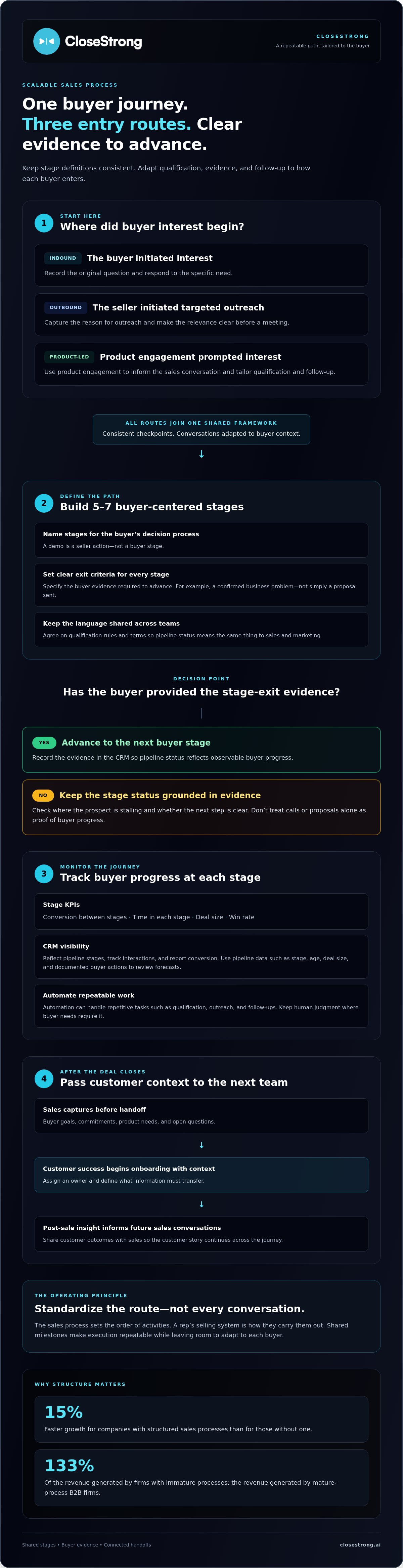
Compare inbound, outbound, and product-led sales by how buyers enter, qualify, and advance through the pipeline. Inbound responds to buyer-initiated interest; outbound begins with targeted seller outreach; product-led sales use product engagement to prompt sales conversations. Use a CRM that reflects pipeline stages, tracks interactions, and reports conversion. Automation can handle repetitive tasks such as qualification, outreach, and follow-ups.
•
Map each buyer step, from first contact through onboarding, and identify the information needed to move forward. For an inbound lead, record the original question; for an outbound prospect, capture the reason for outreach. Look for points where prospects stall and check whether the next step is clear. Map the entire customer journey, not just sales activity, because it continues after the deal closes.
•
Set a consistent framework, then adapt conversations to buyer context. Inbound prospects may need a quick answer to a specific question; outbound buyers may need to see the relevance before agreeing to a meeting. Product-led buyers may show interest through product use. Compare these entry points and tailor qualification, evidence, and follow-up. Keep stage definitions consistent without forcing every prospect into the same conversation.
Document the company traits that make an account a strong fit, then describe the roles involved in its decision. An ideal customer profile guides account selection; buyer personas clarify stakeholders’ priorities and concerns. For example, a finance leader may focus on business impact, while a daily user weighs workflow fit. Use both to focus prospecting and qualification.
A scalable process handles rising sales demand without requiring a proportional increase in resources. Make qualification, next steps, and ownership clear, then automate repetitive tasks such as lead assignment or follow-up. Keep the human interaction where buyer needs require judgment. Companies with structured sales processes grow 15% faster than those without one, while mature-process B2B firms generate 133% of the revenue of firms with immature processes.
Before closing, capture the buyer’s goals, commitments, product needs, and open questions. Pass those details to customer success so onboarding starts with context, not a blank slate. Assign an owner to the handoff and define what information must transfer. Then share post-sale insights with sales, so future conversations reflect real customer outcomes.
Schedule customer check-ins, respond to support needs, and review whether the product continues to meet agreed goals. Use these conversations to surface changing priorities. When a customer’s needs expand, assess whether another solution or capability fits before discussing an upsell. Retention is not only customer success’s concern: the experience after purchase shapes future revenue and referrals.
How to build a scalable sales process starts with shared meaning, not more CRM fields. When teams use the same terms differently, pipeline reports can make disagreement look like progress.
•
Create a team glossary for terms such as qualified lead, decision-maker, and closed-won. Agree on the evidence that makes a lead qualified, then align sales development representatives and account executives on that definition. Make sure marketing uses the same language when handing off leads. Avoid labels like “hot” unless the team defines the buyer evidence behind them. Shared vocabulary makes cross-team reviews more useful.
•
Document a repeatable sequence that handles more opportunities without requiring a matching increase in resources. Include stages, ownership, required customer information, and the next action at each point. For teams asking how to build a scalable sales process, scaling means consistent checkpoints, not identical conversations. Check whether a new rep can follow the documented path and know what to do next. Remove steps that add administration but no buyer insight.
•
Define five to seven stages with clear exit rules. Name stages for the buyer’s decision process, not seller activities: a demo is an action, not a buyer stage. For every stage, specify the evidence the prospect must provide to advance. Keep rules specific and limited. For example, advance when the buyer confirms a business problem, not simply when a rep sends a proposal. That distinction makes pipeline status more meaningful.
Track conversion between stages, time spent in each stage, deal size, and win rate. These measures show where opportunities stall and whether stage definitions reflect real buyer progress. Don’t judge a stage by activity volume alone: calls or proposals don’t prove the buyer is advancing.
Use CRM pipeline data showing stage, age, deal size, and documented buyer actions. Compare actual outcomes with historical stage conversions, then review stalled deals and forecast assumptions. This grounds forecasts in observable activity and reveals where data quality needs attention.
Apply shared fit and readiness criteria, then route leads according to their needs, source, and buying signals. Record the reason for qualification or disqualification in the CRM. This keeps lead assignment consistent as volume grows and gives teams a clear basis for follow-up.
Use these definitions in pipeline reviews and onboarding, not just in a document. A sales execution platform can help teams apply shared deal guidance consistently.
Make guidance part of execution, not a one-time event. Reps need practical support, useful feedback, and clear tools for applying the process on live deals.
Cover the product, sales process, company culture, and values. Then walk new hires through a real opportunity, from first outreach to a clear next step. Show where to find approved sales materials and how to record customer information. A new rep should be able to explain each stage and the action it requires.
Use role-playing to rehearse discovery conversations, objection handling, and deal reviews. For example, ask reps to respond when a buyer says the timing is wrong. Give feedback on listening, follow-up questions, and whether the response connects to the buyer’s stated needs. Practice should reflect actual sales conversations, not scripted performances.
Review call notes, deal outcomes, and customer feedback to identify where the sales team struggles. If prospects repeatedly question implementation, help reps explain the relevant process clearly. If outreach creates meetings but few qualified opportunities, revisit targeting and discovery. Update guidance when the process changes, so outdated advice doesn’t undermine execution.
Add the costs of hiring, onboarding, compensation, coaching, and sales tools. Compare them with incremental revenue and productivity gains over the same period, using actual pipeline and closed-deal results. ROI is the net gain from scaling divided by its total cost. Track assumptions separately so projected gains aren’t mistaken for realized results.
Schedule deal reviews where reps explain buyer needs, risks, and next actions. Use peer examples to share effective approaches, then capture the lesson in the playbook. Gallup reports engaged teams are 23% more profitable. That finding makes engagement relevant to execution, but it doesn’t replace measuring your own sales outcomes.
Provide ongoing support when technology, messaging, or buyer expectations shift. Ask reps where instructions create friction, then compare their feedback with field results. Keep what helps reps serve buyers and move deals forward. Remove material that adds steps without improving customer conversations or sales efficiency.
Sales cannot scale in a silo. Align marketing, product, and customer success around shared customer information, clear ownership, and evidence-based decisions.
Define what makes an incoming lead ready for sales, including fit, need, and buying intent. For example, marketing can record the campaign and topic that prompted an inquiry. Sales can share feedback on lead quality and conversion. Use that feedback loop to refine targeting and messaging, rather than blaming the handoff when pipeline results weaken.
Compare marketing emails, sales outreach, and product information to ensure claims and language are consistent. If a campaign promises a specific outcome, sales should have evidence and approved materials to support the discussion. Create a shared place for current messaging, then assign owners to update it when positioning changes. Buyers shouldn’t hear conflicting explanations from different teams.
Give product teams a useful record of recurring requests, objections, and reasons deals stall. Group feedback by customer need, not by one loud anecdote. For example, sales can report a repeated integration concern alongside relevant deal context. Product can use that signal to assess priorities, while sales adapts its conversations as product capabilities change.
Establish a handoff that captures the buyer’s goals, commitments, key stakeholders, and unresolved questions. Use a shared workspace or collaborative platform so customer success can access the same deal context. Then ask customer success to share onboarding themes and adoption barriers with sales. That feedback can sharpen future qualification and set clearer expectations before closing.
Give marketing, sales, product, and customer success access to agreed definitions and relevant pipeline signals. Review conversion by lead source, common deal obstacles, and customer feedback together. A shared dashboard can reveal gaps; a regular review turns those signals into owners and actions. Track decisions, not just discussion.
Automate repeatable tasks such as routing leads, recording handoff details, or alerting teams to a changed deal status. Keep decisions about customer fit, product priorities, and sensitive conversations with people. Check whether each automation reduces missed information or duplicate work. Remove steps that create noise without helping a team act.
A sales process defines the order of activities. A selling system is how each rep carries them out. Confuse the two, and standardization becomes a script instead of a framework.
Map the process from first contact to closing, with a clear purpose for each stage. For example, a discovery stage should establish the buyer’s problem and decision context. It shouldn’t simply mean a meeting happened. This structured route gives the team common milestones while leaving room for individual judgment.
A selling system covers how a rep prepares, asks questions, manages a conversation, and recovers when a meeting goes sideways. One rep may use a diagram to explore a complex problem; another may ask questions in a different order. Both should uncover the information required by the process before advancing the deal.
Specify what must be learned or agreed before an opportunity moves forward. Then distinguish that requirement from optional techniques, such as a particular opening question or presentation format. This keeps the process consistent without forcing every rep to sound alike. Review real opportunities to see whether personal methods support buyer progress or skip essential milestones.
Track stage conversion, time in each stage, win rate, and average deal size to assess process performance. Use call reviews, deal notes, and coaching feedback to understand how reps execute. If conversion drops after discovery, inspect both the stage definition and the conversations. Don’t assume a new script will fix a broken process.
In a deal review, ask the rep to identify the buyer’s goal, the evidence gathered, and the next milestone. If a meeting stalls, examine how the rep responded and what the buyer needed. Keep the shared process stable while improving techniques that help reps reach its outcomes. This protects consistency without turning selling into robotic compliance.
An Enterprise Sales Execution Platform can help put company strategy into practice on individual deals. CloseStrong’s Precision Guided Selling™ provides custom, high-quality deal guidance for reps working through the closing process. Explore guided deal execution when consistent milestones exist but reps need support applying them in live opportunities.
CloseStrong helps sales teams put company strategy into practice on individual deals through its Enterprise Sales Execution Platform. When shared stages and definitions are in place but reps need support applying them in complex opportunities, Precision Guided Selling™ provides custom, high-quality deal guidance throughout the closing process. It connects the sales strategy with the decisions and conversations reps face in live deals, offering real-time guidance at every stage. A process sets the route; reps need relevant guidance to navigate each opportunity. If your sales team is ready to strengthen execution across deals, contact CloseStrong or visit closestrong.ai.
Knowing how to build a scalable sales process matters only if the process keeps improving. Choose a point of friction visible in actual deals, such as unclear ownership or a stalled decision. Assign someone to address it, then review what changes in customer conversations and deal movement. Deliberate adjustments beat a sweeping redesign that nobody owns.
Use that review to turn observations into a clear next action. Keep the change that helps reps serve buyers and move opportunities forward. Rework the parts that create confusion or unnecessary effort. The goal isn’t a perfect playbook frozen in place. It’s a sales operation that adapts without losing shared direction.
If your team is ready to strengthen deal execution, contact CloseStrong to discuss your sales process. Take the next step with a clear view of where execution needs to improve, and build from there.
A sales process sets the shared route through an opportunity; a sales system is how each rep works that route. For example, two reps can both run discovery while using different questions and preparation methods. Compare their approaches against the same buyer outcomes. If one consistently misses decision-makers, address that execution issue instead of adding another process stage.
Common language lets different people interpret the same opportunity consistently. If marketing, an SDR, and an account executive define “qualified” differently, lead reports and handoffs become unreliable. Agree on observable evidence, such as a buyer confirming a relevant problem and an appropriate next step. Then use that definition in CRM fields, deal reviews, and guidance.
A practical process often uses five to seven buyer-focused stages, from initial interest through decision and handoff. Name each stage for the buyer’s progress, not an action like “send proposal.” For example, a proposal may come before the buyer has agreed on decision criteria. Keep the stage sequence relevant to how customers evaluate, choose, and adopt a solution.
Start with recent won and lost deals, then trace the customer’s actions from first interaction to purchase. Record who owned each step, what information they needed, and what prompted the next move. Compare both outcomes to spot repeated delays or missing handoffs. Document the common path, exceptions, and ownership in one playbook, then test it against a new opportunity.
Assign one accountable owner to each customer-facing step and define what triggers a transfer. For example, an SDR can pass an accepted opportunity to an account executive with the buyer’s stated need, relevant context, and agreed next action. At closing, the account executive can pass goals, commitments, and open questions to customer success. Make the receiving owner responsible for acknowledging the handoff.
Standardize essential guidance, not every sentence a rep speaks. Give reps discovery prompts, approved examples, objection responses, and rules for documenting buyer evidence. Keep scripts conversational and let reps adapt to customer answers. During onboarding, have new hires practice a sample conversation, review the playbook, and explain how they would handle a real deal scenario before working independently.
Watch for bloated stages, unclear qualification, stale CRM records, and handoffs that lose customer context. Review stage conversion, time in each stage, and stalled opportunities to locate friction. If deals pile up after proposals, inspect buyer decision steps and follow-up ownership. Simplify criteria where teams get stuck, assign an owner to each fix, and review whether the change improves deal movement.
Keep the core stages consistent, then adapt evidence, terminology, stakeholders, and approval steps to each market. For example, an industry may require technical review before commercial discussions, while buyers in different regions may expect different communication norms. Have the appropriate compliance owner review applicable requirements and reflect them in the playbook. Record approved variations so local teams don’t invent conflicting rules.


