





Your CRM isn't a strategy. It's a graveyard for optimistic guesses that mask the true risk in your pipeline. In 2026, relying on a sales rep's intuition for your largest enterprise deals is a gamble you'll eventually lose. If you want to know how to de-risk strategic accounts, you have to stop looki...
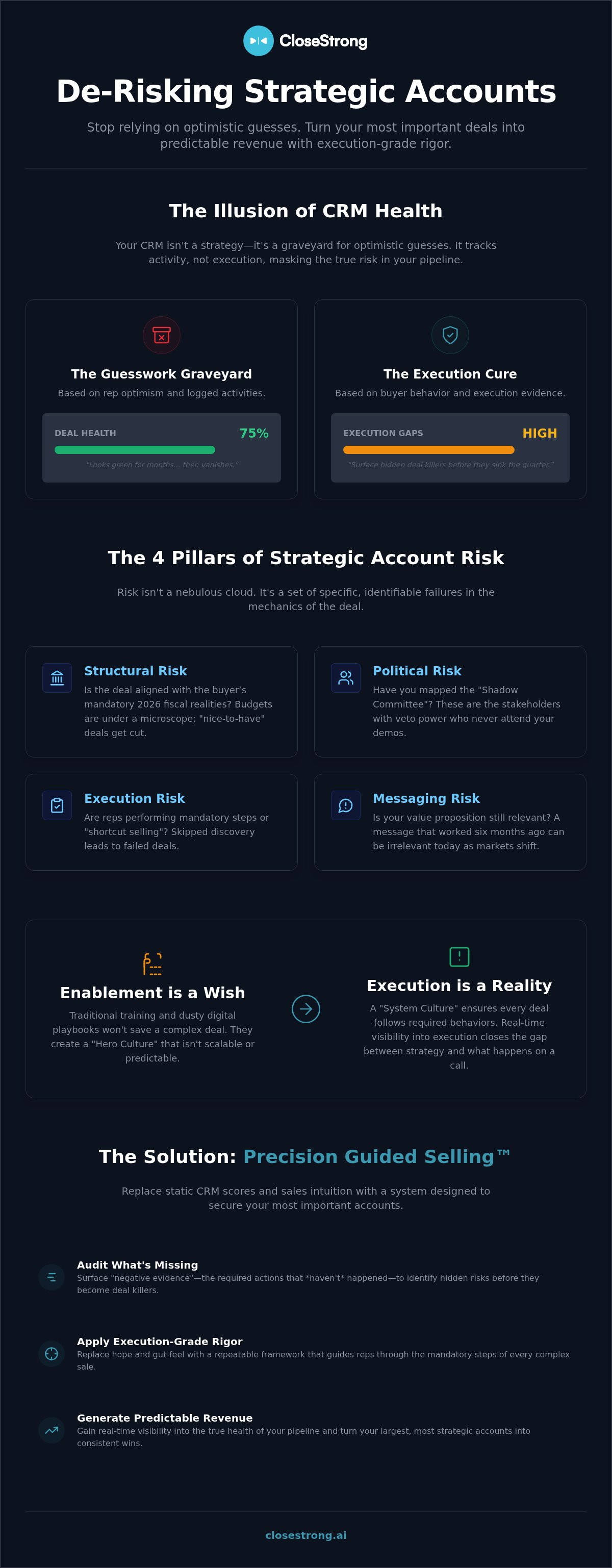
Your CRM isn't a strategy. It's a graveyard for optimistic guesses that mask the true risk in your pipeline. In 2026, relying on a sales rep's intuition for your largest enterprise deals is a gamble you'll eventually lose. If you want to know how to de-risk strategic accounts, you have to stop looking at static dashboards and start looking at execution behavior. Strategy is a wish; execution is the cure.
You've watched "must-win" deals look green for months, only to vanish in the final week of the quarter. It's the inevitable result of letting reps go rogue on complex deals without a repeatable framework. This article promises a way out of the intuition trap. You'll learn how to replace guesswork with Precision Guided Selling™ to secure your largest deals. We're diving into the execution mechanics that provide real-time visibility and turn your strategic accounts into predictable revenue.
• Audit what is missing, not just what is logged. Surface "negative evidence" to identify hidden deal killers before they sink your quarter.
• Master how to de-risk strategic accounts by mapping the "Shadow Committee" and aligning your execution with the fiscal realities of 2026.
• Stop falling for the "Enablement Trap." Traditional training won't save a complex deal; only real-time visibility into required behaviors can bridge the execution gap.
• Replace static CRM health scores with Precision Guided Selling™. Use execution-grade rigor to turn rogue sales intuition into predictable revenue.
The bigger the deal, the bigger the lie. It's the strategic account paradox. When the stakes are low, reps follow the rules. When the stakes are high, they revert to gut feel. They rely on relationships, intuition, and the way they've always done it. This isn't a lack of effort. Your team is working harder than ever. It's a lack of rigor. In 2026, enterprise buyers don't care about your effort. They're more skeptical, more scrutinized, and more likely to kill a deal that feels like a generic pitch. If you want to know how to de-risk strategic accounts, you have to stop trusting the hero and start trusting the system.
A slipped deal costs more than the commission. It erodes your brand authority. It tells the market you don't understand their business. It's a public failure of execution. To fix it, you must first dismantle the myths that keep your pipeline looking green until the day it turns red.
Your CRM is lying to you. Those 75% probability marks are often pure fiction. They aren't based on buyer behavior; they're based on rep optimism. CRM data is frequently used to hide risk rather than expose it. A rep logs a meeting and the dashboard turns green. That's activity tracking, not execution tracking. Activity is what the rep did. Execution is whether the buyer actually moved. If you can't see the difference, you aren't managing risk. You're managing a spreadsheet. Real-time visibility requires moving beyond static data points to capture the actual quality of the interaction.
There's a massive gap between your corporate strategy and what actually happens on a Zoom call. Your sales playbook is likely gathering digital dust. It's too long, too theoretical, and too far removed from the heat of the deal. This creates a "Hero Culture." You rely on a few star performers to drag deals across the line through sheer force of will. But heroes aren't scalable. They aren't predictable. A "System Culture" is the only way to ensure every deal follows the required behaviors for success. Understanding how to de-risk strategic accounts means closing this gap with real-time guidance, not another training workshop. Strategy is just a wish until execution makes it a reality.
Risk isn't a nebulous cloud. It's a set of specific, identifiable failures that happen when rigor is replaced by hope. If you're trying to figure out how to de-risk strategic accounts, you have to identify where the rot starts. It's rarely in the product. It's almost always in the mechanics of the deal itself. You can't manage what you can't see, and most sales leaders are flying blind through four specific pillars of risk.
Is the deal aligned with the buyer’s 2026 fiscal reality? Budgets are under a microscope. If your deal isn't tied to a mandatory corporate initiative, it's a "nice-to-have" that will be cut.
Have you mapped the "Shadow Committee"? These are the stakeholders who never attend your demos but have the power to veto the entire project.
Are the mandatory steps of your methodology actually being performed? Reps often skip the hard parts of discovery because they feel they have "good rapport."
Is your value proposition still relevant? Enterprise cycles are long. A message that resonated six months ago might be completely irrelevant today as the buyer's market shifts.
Most reps talk to the people who like them. That's a comfort move, not a strategic one. You must map the buying committee beyond the champion. Your champion is often the last person to know the deal is dead. You need to identify the Economic Buyer. This individual likely hasn't appeared in a single meeting yet, but they hold the pen and the budget. Political risk is the distance between who you talk to and who signs. If that gap is widening, your deal is in jeopardy. You don't need more meetings; you need the right people in the room.
Deal fatigue is the silent killer of enterprise revenue. In the final stages, reps start "shortcut selling." they stop validating requirements and start assuming agreement. This leads to generic value propositions that fail in a highly customized enterprise environment. This is exactly why scaling sales strategy execution is so difficult. You can't let the message drift. If the value isn't visceral to the C-suite, the deal won't close. To maintain control, you need custom deal guidance that ensures every step is followed, every time. Don't let your most important deals depend on a rep's memory.
Most sales organizations are addicted to the comfort of training. They think another workshop or a shiny new playbook will solve the slippage problem. It won't. Enablement is a wish; execution is the reality. You can't train your way out of a broken process. It's a failure of behavior, not a failure of intelligence. If you want to know how to de-risk strategic accounts, you have to stop focusing on what reps know and start focusing on what they actually do in the heat of a high-stakes deal.
We call this the "Enablement Trap." You buy more tools, provide more content, and hope the behavior changes. But if execution remains invisible, the risk remains high. Enablement prepares the rep for the season; execution secures the deal in the final minutes of the game. One is about theoretical preparation. The other is about the gritty mechanics of winning. You don't need a more prepared rep. You need a more disciplined deal.
Knowledge isn't behavior. The Ebbinghaus Forgetting Curve shows that humans forget nearly 70% of new information within 24 hours. In high-pressure enterprise sales, this curve is even steeper. When a deal gets "hot," reps don't reach for their training manual. They reach for their old, risky habits. This is why precision guided selling software is the only way to maintain rigor. You don't need reps to memorize a methodology. You need a system that enforces it while the deal is live. Training is a point-in-time event; execution is a continuous requirement.
Reviewing a recording after a call is a post-mortem. It tells you why you lost, but it doesn't help you win. Traditional call analysis tools are diagnostic, but guidance is preventative. Real-time deal guidance removes the cognitive load from the rep by telling them exactly what to do next while they are in the moment. This is the shift from Revenue Intelligence to Revenue Execution. Can you really expect a rep to remember a 50-page playbook during a tense negotiation? They won't. If you want to learn how to de-risk strategic accounts, you must stop looking in the rearview mirror and start using a GPS. You can't afford to wait for a manager's feedback loop that happens days after the buyer has already moved on.
Intuition is a liability in enterprise sales. If you want to know how to de-risk strategic accounts, you need a framework that prioritizes execution over optimism. Most organizations fail because they treat every deal as a unique snowflake. They aren't. Every successful enterprise deal follows a pattern of required behaviors. When you deviate from that pattern, you introduce risk. This 5-step framework replaces rep "gut feel" with operational rigor.
Identify the non-negotiable actions for the current deal stage. Did the rep validate the technical requirements with the actual end-users?
Stop looking for reasons the deal will close. Look for the reasons it won't.
Use real-time guidance to ensure every rep follows the winning playbook.
Move away from "how do you feel about this deal?" and toward "show me the evidence of buyer commitment."
Use outcomes from live deals to refine your execution strategy for the next quarter.
The "happy ears" rep is the greatest threat to your forecast. They hear what they want to hear and ignore the red flags. To combat this, you must verify external milestones that are outside of your rep's control. Has the legal review actually started? Is there a documented procurement timeline? If these milestones aren't being met, the deal is at risk regardless of what the rep says. Negative Evidence is the absence of critical buyer engagement. If the buyer isn't performing their required actions, you don't have a deal; you have a conversation. Identifying how to de-risk strategic accounts starts with acknowledging what is not happening.
Strategic account managers often operate in a vacuum. Precision Guided Selling™ provides a safety net by enforcing strategy adherence at the deal level. It ensures that every member of your team executes like your top 1% performers. You shouldn't have to wait for a weekly deal review to find out a rep skipped a critical discovery step. By using an enterprise sales execution platform, you can provide custom deal guidance that keeps every opportunity on track. This isn't about micromanagement. It's about ensuring that your corporate strategy actually reaches the buyer. To stop the slippage and secure your 2026 revenue, see how Precision Guided Selling™ works in real-time.
Strategy documents are where good ideas go to die. Most CROs have a playbook that nobody uses and a CRM that nobody trusts. If you're serious about how to de-risk strategic accounts, you need to turn your strategy from a static document into a live, guiding force. CloseStrong is the only platform built for enterprise-grade execution rigor. It doesn't just monitor the deal; it drives the behavior required to win it. It's the difference between having a map and having a driver who knows the shortcuts.
We're moving beyond the "Guesswork Gap." This is the space between what your forecast says and what the buyer actually does. By eliminating this gap, you reduce forecast variance and gain true predictability. You don't need more "Revenue Intelligence" that tells you why you're failing. You need Revenue Execution that ensures you succeed. It's time to stop looking for data that masks reality and start enforcing the reality you want to see in your pipeline.
In complex, multi-stakeholder environments, luck is not a strategy. You can't leave your largest deals to the whims of a rep's memory. Precision Guided Selling™ provides custom deal guidance that acts as a GPS for every interaction. It ensures that every stakeholder is mapped and every required behavior is executed. This is why monitoring sales deal health software isn't enough. Scores are reactive; guidance is proactive. CloseStrong provides the "adult in the room" perspective for every deal review, ensuring that rigor beats hope every time. No strategic account is left to chance when execution is automated.
2026 is the year of the Execution Platform. The era of bloated tech stacks that only provide "visibility" is over. Visibility without execution is just watching a train wreck in slow motion. Audit your current stack for "Execution Blind Spots" today. If you can't see whether your reps are performing the mandatory steps of your methodology in real-time, you have a risk problem. You've spent years on enablement and training, yet the slippage continues. Stop relying on intuition. Stop wishing for better outcomes. Start guiding your team with CloseStrong. The future of enterprise sales isn't about better training; it's about better execution mechanics.
You can't forecast your way out of a risk problem. CRM health scores are a mirage that hides the truth until it's too late to pivot. If you want to know how to de-risk strategic accounts, you must look at execution behavior. Strategy is a wish; execution is the cure. We've moved past the era where gut feel is an acceptable metric for your largest enterprise deals. You don't need more visibility. You need more control.
Precision Guided Selling™ proprietary technology turns your playbook into a live engine, providing custom, deal-level guidance for high-stakes outcomes. Our Enterprise Sales Execution Platform ensures your reps do what's required, not just what's convenient. With 53% of forecasted enterprise deals failing, the status quo is a gamble you can't afford. Stop relying on rep intuition and start using real-time rigor to secure your 2026 revenue goals. It's time to engineer your success.
Stop the Guesswork: Explore the CloseStrong Execution Platform
Standard deals follow a linear path. Strategic accounts are a political maze. De-risking a standard deal is usually about removing friction in the buying process. Knowing how to de-risk strategic accounts is about uncovering hidden veto players and aligning with 2026 fiscal mandates. One is a tactical sprint. The other is a high-stakes chess match where a single unmapped stakeholder can sink a multi-million dollar forecast.
Software doesn't have "happy ears." Human coaching is often reactive, happening days after a rep misses a critical cue. Precision Guided Selling™ provides real-time, deal-level guidance while the rep is in the moment. It isn't about replacing the manager. It's about giving that manager a way to scale their expertise across every deal without being on every call. Coaching is a wish; execution is the reality.
Look for "Negative Evidence." It isn't just about what's happening; it's about what isn't. Early warning signs include missed external milestones, champions who stop sharing internal politics, and the sudden silence of the economic buyer. If your rep is only talking to the people who like them, you're in trouble. The loudest red flag is a deal that looks green but lacks documented buyer commitment.
It functions as an execution layer on top of your current stack. Your CRM is a graveyard for data; CloseStrong is a live guidance system. It integrates to identify where the Execution Gap is widening and pushes prompts to keep reps on track. It turns static records into a proactive engine that ensures your strategy actually reaches the buyer's ears. It doesn't just store data; it drives behavior.
Adherence is the activity. De-risking is the result. You can follow every step of a methodology and still lose if you aren't validating buyer commitment. True de-risking requires confirming that the buyer is actually performing their required behaviors. It's not enough to check a box in a CRM. You must verify that the economic buyer has skin in the game before you call that deal safe.
The Execution Gap is the distance between your corporate strategy and the reality of a sales call. It's the place where 53% of forecasted enterprise deals fail. Your playbook says one thing, but your rep does another because they're under pressure. Closing this gap requires moving beyond Revenue Intelligence that tells you why you lost. You need an Enterprise Sales Execution Platform that ensures you win.
Stop trusting rep intuition. If you want to know how to de-risk strategic accounts and fix your forecast, you must audit Required Behaviors at every stage. Forecasts fail because they're based on optimism rather than evidence. Accuracy comes from verifying external milestones, like legal review start dates and procurement timelines. If the evidence isn't there, the deal shouldn't be in your forecast. Evidence beats gut feel every time.
Deal fatigue leads to shortcut selling. Reps get eager to close and start skipping critical validation steps in the final stages. They assume the Shadow Committee is aligned because the champion said so. Most late-stage slips happen because the political risk wasn't mapped early on. A veto-player you didn't know existed emerges at the eleventh hour to kill the budget. It's a failure of rigor, not a failure of luck.


