





Your expensive sales methodology is currently gathering dust in a CRM tab or a forgotten PDF. It isn't a playbook; it's a paperweight. Most sales methodology adoption challenges stem from a simple, uncomfortable truth: training is an event, but execution is a habit. You can't expect a rep to remembe...
Your expensive sales methodology is currently gathering dust in a CRM tab or a forgotten PDF. It isn't a playbook; it's a paperweight. Most sales methodology adoption challenges stem from a simple, uncomfortable truth: training is an event, but execution is a habit. You can't expect a rep to remember a complex framework in the heat of a high-stakes negotiation if they only heard it once in a hotel ballroom six months ago.
You're tired of seeing "winging it" as the primary strategy for your mid-market deals. You're frustrated by forecast variance that feels more like a coin flip than a financial projection. It's time to stop blaming your reps and start fixing the infrastructure. We're moving past the era of passive learning and into the era of active, real-time guidance.
This article breaks down why traditional training fails to stick and how you can bridge the execution gap using real-time deal guidance. We will examine the shift from revenue intelligence that looks backward to Precision Guided Selling™ that drives deals forward. You'll learn how to turn your methodology into a living, breathing engine for predictable revenue growth and strategic alignment.
• Stop treating sales training as a one-time event and start viewing execution as a daily habit that requires constant reinforcement.
• Identify and eliminate the "Complexity Tax" and other sales methodology adoption challenges that force reps to revert to old, ineffective habits during difficult negotiations.
• Recognize the execution gap between your high-level strategy and what actually happens on a call, then bridge it with real-time deal guidance.
• Deploy Precision Guided Selling™ as a "GPS for deals" to provide your team with the right moves at the right time, rather than relying on late-stage post-mortems.
• Learn how to move your methodology from a forgotten PDF directly into your CRM to ensure high adherence and predictable revenue growth.
Your sales playbook is a ghost. You spent six figures on a high-end methodology, flew the team to a resort, and printed glossy manuals. Then, reality hit. Research shows that 70% of sales training is forgotten within weeks. It's not because your reps are lazy. It's because a methodology is a map, but execution is the actual driving. Knowing the route doesn't mean you can handle a blowout at sixty miles per hour. Knowing is not doing.
When Sales process engineering remains purely theoretical, it creates a massive execution gap. In 2026, only 48% of account executives hit their quota. That isn't a talent problem. It's a system problem. When reps 'wing it' because the methodology is too complex to use in the moment, you lose more than just deals. You lose the ability to scale. You're left with a wasted budget and a forecast that is essentially a work of fiction. These are the real-world consequences of common sales methodology adoption challenges.
Leadership often lives in a fantasy world where every rep follows the playbook. They see the 'check-the-box' training completion rates and assume the team is aligned. They're wrong. Your reps are off-script the moment a prospect asks a difficult question. This inconsistency breeds a 'hero culture' where a few top performers carry the team through sheer intuition. It looks like success, but it's actually a trap. Hero culture isn't scalable. True growth requires every rep to execute the strategy, not just the ones with the best instincts.
Traditional enablement is failing because it focuses on the 'what'. It gives you the content, the slides, and the battlecards. But execution happens in the 'how'. Having a library of PDFs doesn't help a rep navigate a complex multi-stakeholder deal in real-time. Content findability is a low bar. Strategic deal-level guidance is the new standard. By 2026, the market has shifted. High-performing companies are moving away from passive enablement and toward active execution. If your methodology lives in the CRM as a static field rather than a dynamic guide, you haven't solved your sales methodology adoption challenges. You've just documented them.
Stop blaming your reps for being "uncoachable." The problem isn't their attitude; it's your architecture. Most sales methodology adoption challenges aren't caused by a lack of will, but by a lack of way. You've given them a map for a city that's constantly changing, then you're surprised when they get lost. If you want to fix execution, you have to stop looking at the person and start looking at the friction points that kill your strategy at the deal level.
There are three structural failures that turn your $200k playbook into a paperweight. First, the Complexity Tax. Reps revert to muscle memory the moment a deal gets difficult. Second, the Feedback Lag. Managers are acting as historians rather than coaches. They review what happened last week instead of guiding what should happen today. Third, the Tooling Gap. Your CRM is a database, not a mentor. It records history; it doesn't guide future actions. Analysts at Forrester have highlighted several common reasons for sales methodology failure, but these three deal-level blockers are where revenue is actually lost.
Strategy is a luxury that reps can't afford when a deal is on the line. In high-pressure negotiations, cognitive load is real. If your methodology requires a rep to toggle between three tabs and a 50-page PDF to find their next move, they won't do it. They'll "wing it" because it's faster. To solve this, you don't need more training; you need to simplify the execution. You must strip away the academic fluff and provide the right move at the right time. Bridging this gap requires a move toward real-time deal guidance that lives where the work actually happens.
Manual deal reviews are an autopsy of a dead deal. Most managers are spread too thin to coach every opportunity in the pipeline. They focus on the "big" deals, leaving the mid-market and run-rate business to fend for itself. This creates a massive inconsistency in how your brand shows up. When coaching is retrospective, it's too late to change the outcome. You need to move from "What happened?" to "What's next?" This shift requires a system that provides proactive guidance to every rep on every deal, regardless of whether a manager is in the room.
The "Execution Gap" is the space between your corporate strategy and the reality of a Tuesday afternoon discovery call. If your sales stack only measures the gap but doesn't close it, you aren't managing sales execution. You're just documenting its failure.
Training is a security blanket for leadership. It feels productive. You spend the budget, you hand out the certificates, and you hope for the best. But hope is not a strategy. The "Execution Gap" is the void between your high-level corporate strategy and the reality of a rep sitting in a Zoom room with a skeptical buyer. Most sales methodology adoption challenges exist because we treat adoption as a memory test. It's not. You don't need reps who can recite the methodology; you need reps who can execute it.
In 2026, the average B2B sales cycle is 84 days. That is 84 days of potential mistakes, missed cues, and abandoned frameworks. Training happens once. Execution happens every day. If your methodology is stored in a PDF, it isn't helping. It's just another one of the sales methodology adoption challenges you've failed to solve. More intelligence often leads to analysis paralysis. Reps don't need more data to study; they need a clear path to follow.
Knowing a deal is "at risk" doesn't help a rep save it. This is the fatal flaw of traditional revenue intelligence. It gives you visibility into the wreckage after the crash. It's a rearview mirror. You don't need a rearview mirror; you need a GPS. Visibility tells you that you're lost. Guidance tells you to turn left at the next intersection. Stop looking back. Start guiding forward. An execution platform doesn't just show you that a deal is stalling. It tells the rep exactly what to say next to move it. It replaces the "I think" with "I know."
Passive methodology is a death sentence for growth. Binders and PDFs are where your best ideas go to die. If a rep has to leave their workflow to remember how to qualify a lead, they won't do it. The methodology must live inside the deal. It must be invisible, frictionless, and mandatory. The move from passive training to active execution is non-negotiable. To bridge this divide, firms are turning to an Enterprise Sales Execution Platform to close the gap between strategy and reality. This isn't just another tool in your stack. It's the only tool that actually changes behavior at the moment of impact.
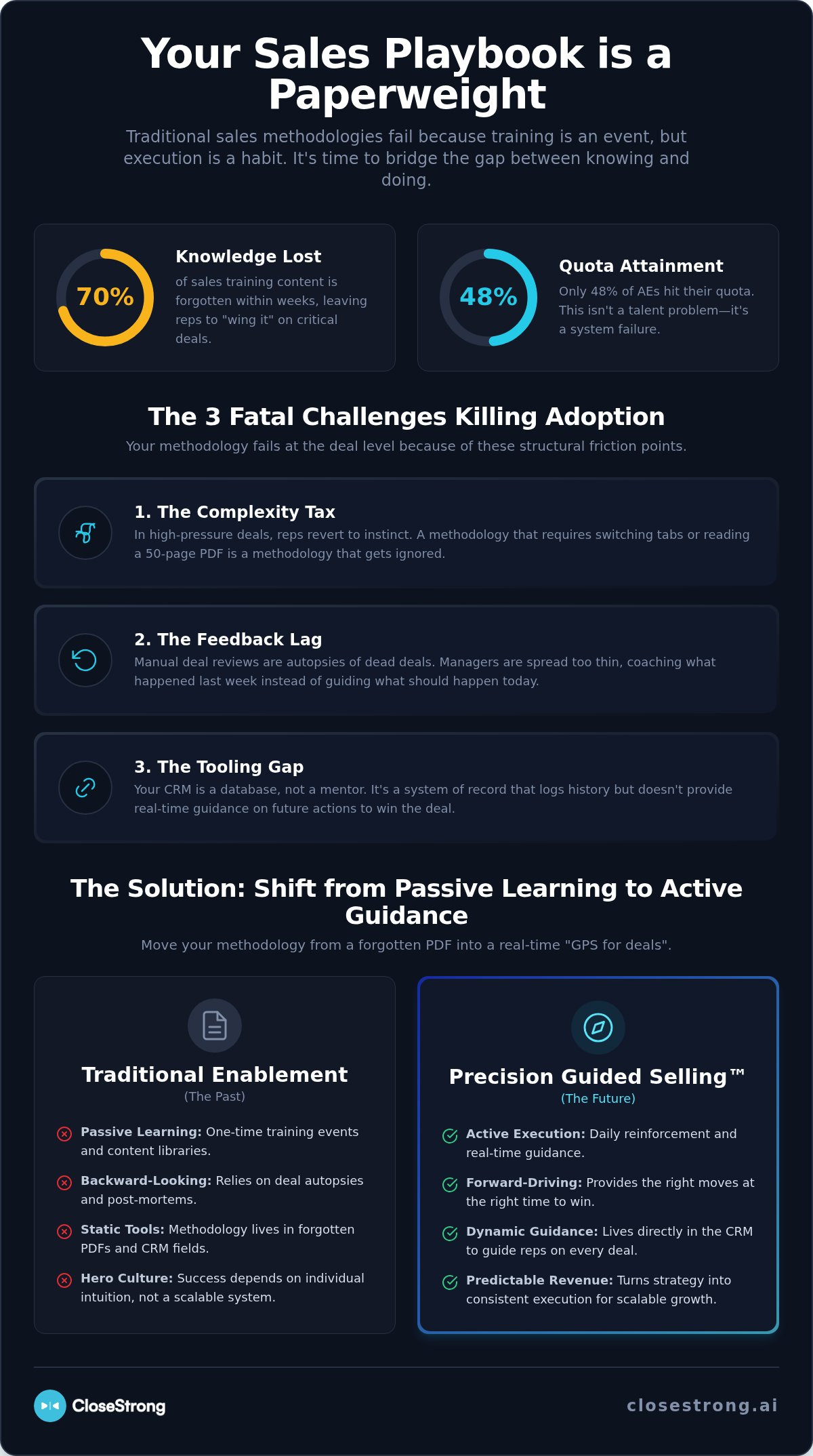
Training is a gamble. You bet that your reps will remember the right play at the right time. Usually, you lose that bet. Precision Guided Selling™ changes the game by moving the methodology from the classroom to the cockpit. It isn't a reminder; it's a GPS for your sales strategy. Instead of hoping a rep remembers page 42 of a PDF during a tense negotiation, the system serves up the specific move they need, exactly when they need it. This isn't just a better way to train. It's a way to stop training altogether.
The most persistent sales methodology adoption challenges vanish when the methodology becomes invisible. If the right behavior is the path of least resistance, reps will take it every time. Precision Guided Selling™ embeds your custom methodology into the deal workflow itself. It turns the "what" of your strategy into the "how" of their daily execution. You aren't asking them to do more work. You're giving them the shortcut to success. It turns every average rep into a top performer by removing the guesswork from the equation.
Enforcing adherence usually means adding friction. You add more CRM fields, more mandatory reviews, and more administrative bloat. It doesn't work. It just makes reps resent the process. Real-time guidance provides value instead of friction. When a rep sees a specific, high-quality prompt that helps them qualify a stakeholder or counter an objection, they use it because it works. This is how you scale strategic rigor without hiring an army of managers. By deploying Precision Guided Selling Software, you ensure that every rep, from the rookie to the veteran, executes with the precision of your top 1%.
Gut feel is the enemy of a reliable forecast. If your reps are "winging it," your revenue projections are just guesses. Precision Guided Selling™ replaces intuition with evidence. It uses data-driven guidance to move deals to the next stage based on actual deal characteristics, not just how the rep "feels" about the buyer. It's the difference between a pilot flying by sight and one using a heads-up display. Scaling a methodology shouldn't be about repeating the same workshop every quarter. It's about building a system that guides every deal to its logical conclusion. It's time to stop guessing and start executing. Explore our Enterprise Sales Execution Platform to see how real-time guidance transforms your pipeline.
Strategy is a hallucination without execution. You can have the most sophisticated sales framework in the world, but if it doesn't show up in a discovery call on a Tuesday afternoon, it doesn't exist. Solving sales methodology adoption challenges isn't a training problem; it's an infrastructure problem. To bridge the gap between your corporate vision and deal-level reality, you must move from passive education to active enforcement. This requires a fundamental shift in how you deploy your playbook.
The path to high-performance execution follows four non-negotiable steps. First, audit your current methodology adherence honestly. Don't look at training completion rates; look at the actual deal data. Second, move your methodology out of the classroom and directly into your CRM. If the strategy isn't where the work happens, the work will happen without the strategy. Third, implement an Enterprise Sales Execution Platform to provide the real-time guardrails your team needs. Finally, shift your managers' focus from "reviewing" history to "guiding" the future. Stop performing autopsies on dead deals and start navigating live ones.
In 2026, execution is the only sustainable competitive advantage. Your competitors have the same data, the same tools, and likely the same consultants. The winner is the team that executes with the most consistency. This requires a cultural shift led by the CRO. You must stop rewarding "heroics" that ignore the process and start rewarding adherence to the system. When you reward the right behaviors, the right outcomes become predictable. Strategic rigor shouldn't be an option. It must be the standard operating procedure for every deal in the pipeline.
Traditional sales techniques are no longer enough to win in a market where buyers are more informed and more skeptical than ever. The average B2B sales cycle now spans 84 days, leaving too much room for error. The industry is shifting toward "Guided Selling" as the mandatory standard for enterprise teams. This isn't a trend; it's a survival mechanism. You can continue to let your reps "wing it" and hope for the best, or you can provide them with the precision they need to win. Stop guessing. Start guiding. The execution gap is closing. Ensure your team is on the right side of it.
The days of relying on "check-the-box" training are over. Your playbook shouldn't be a static document; it should be an active participant in every deal your team touches. By moving away from retrospective reviews and into real-time execution, you eliminate the friction that causes most sales methodology adoption challenges. You don't need more intelligence to look at the past. You need more guidance to win the future.
Strategic rigor is no longer a luxury for the top 1%. It's a scalable reality for every rep in your organization. When you bridge the execution gap, you turn inconsistent "winging it" into a predictable engine for revenue growth. It's time to stop hoping your reps remember their training and start ensuring they execute your strategy. High-stakes deals require high-stakes precision, not just high hopes.
Stop the adoption struggle and start executing with CloseStrong. Our Enterprise Sales Execution Platform uses Precision Guided Selling™ technology to deliver custom deal guidance for enterprise teams. You've already built the strategy. Now, give your team the GPS they need to finish the job. You're closer to consistent, predictable growth than you think.
Reps don't hate success; they hate friction. Most resistance comes from the "Complexity Tax" that new frameworks impose on their daily workflow. If a methodology feels like administrative bloat or requires memorizing a 50-page PDF, reps will ignore it. They revert to old habits because those habits are faster. Adoption only happens when the new way is the path of least resistance to a commission check.
The primary failure point is treating methodology as a one-time event rather than a continuous habit. Training is forgotten within weeks if it isn't reinforced at the deal level. This is the root of most sales methodology adoption challenges. When the strategy lives in a classroom but the execution happens in a vacuum, reps default to "winging it" the moment a negotiation gets difficult or complex.
A CRM is a database; an execution platform is a GPS. CRMs are excellent at recording history and managing contact data, but they don't tell a rep how to win a deal. An Enterprise Sales Execution Platform provides active, deal-level guidance. It bridges the gap between strategy and reality by serving up custom moves during the live sales cycle, turning a passive record into an active closing engine.
Software doesn't replace the coach; it scales the coaching. Managers can't be in every meeting or review every discovery call in real-time. An execution platform provides the immediate, custom deal guidance that a manager would give if they had infinite time. It automates the tactical "what's next" so managers can stop performing autopsies on dead deals and start focusing on high-level team strategy and professional development.
Stop looking at training completion certificates and start looking at deal-level adherence data. True measurement comes from tracking how often reps execute specific strategic moves within their active pipeline. Are they identifying the right stakeholders? Are they countering objections as planned? Real-time platforms track these behaviors automatically, providing a clear picture of adherence that lagging indicators like win rates simply cannot show until it is too late.
Precision Guided Selling™ is the technology that puts your sales strategy into the driver's seat of every deal. It is a system that analyzes deal context and provides reps with high-quality, custom guidance at the exact moment of impact. Instead of generic advice, it offers specific tactical moves designed to move the needle forward. It is the difference between giving a rep a map and giving them a co-pilot.
It removes the "gut feel" from the pipeline. Forecast variance usually happens because reps are guessing about deal health based on optimism rather than evidence. Real-time guidance ensures every rep follows a consistent, proven process. When everyone executes the methodology with precision, deal stages reflect reality. This consistency creates a predictable revenue engine where the numbers in the CRM actually match the money that ends up in the bank.


