




Your CRM says the deal is a "commit," but history says you're just flipping a coin. Research shows the average sales organization only wins about 48% of deals in their late-stage forecast. That isn't a forecasting error. It's an execution failure. If you're tired of watching 30% of your pipeline eva...
Your CRM says the deal is a "commit," but history says you're just flipping a coin. Research shows the average sales organization only wins about 48% of deals in their late-stage forecast. That isn't a forecasting error. It's an execution failure. If you're tired of watching 30% of your pipeline evaporate on the final day, you need to stop obsessing over visibility and start focusing on behavior. Preventing deal slippage end of quarter isn't about buying another dashboard. It's about closing the gap between your boardroom strategy and what your reps actually do when the pressure is on.
You've seen this movie before. The final week hits and suddenly "locked-in" signatures turn into "internal legal delays" or "missing stakeholder" excuses. You've invested millions in revenue intelligence just to get a high-definition view of your own losses. It's time to stop treating slippage as an inevitable tax on enterprise sales. This article will show you how to fix the execution gaps that kill deals in the final hour. We'll move past the autopsy of missed targets and explore how to ensure every rep follows the winning playbook on every single deal.
• Stop confusing visibility with control; dashboards only show you what is already broken while execution fixes the behavior that causes the break.
• Shift your focus from "feel-good" forecast scores to real-world action adherence to start preventing deal slippage end of quarter.
• Eliminate the "Rogue Rep" problem by bridging the gap between your high-level sales strategy and the gritty reality of individual deal execution.
• Replace artificial deadlines with Mutual Action Plans that tie your closing milestones to the buyer’s critical business events.
• Leverage Precision Guided Selling™ to provide reps with custom, high-quality deal guidance that adapts to the specific needs of enterprise sales.
Stop looking at your forecast as a math equation. It's a behavior problem. Most revenue leaders treat deal slippage as a failure of data, thinking that if they just had better visibility, they could predict the future. They're wrong. Visibility is a spectator sport; it doesn't change the score. You can watch a deal fail in high definition through your CRM, but that doesn't stop it from sliding. CRM data is a lagging indicator of what already went wrong weeks ago. By the time the dashboard turns red, the deal is already dead.
The real culprit is the "Happy Ears" trap. Sales reps are naturally optimistic. They hear a verbal "yes" and stop selling. They mistake a friendly stakeholder for a signed contract. This sentiment is the enemy of accuracy. Without structured sales operations processes that enforce specific behaviors, your forecast is nothing more than a collection of rep opinions. Preventing deal slippage end of quarter requires moving past the "what" and mastering the "how" of execution.
Your dashboard says the deal is green because the rep sent ten emails and had three calls. That’s tracking, not driving. Green health scores often hide massive execution gaps because they measure activity instead of progress. It’s the difference between looking at the scoreboard and looking at the play-call. If the play-call is wrong, the score will eventually reflect it, no matter how much "engagement" you see. You don't need more visibility into the outcome; you need control over the actions that create it.
Deal health is the alignment between buyer actions and company strategy. It isn't about how many stakeholders are in the CRM or how many hours were spent on Zoom. In enterprise sales, "engagement" is a vanity metric. Real health is measured by whether the buyer has taken a specific, high-friction action, like introducing you to procurement or agreeing to a mutual action plan. The cost of a committed deal that slides is more than just a missed number; it’s a total loss of momentum and a massive waste of resources that could have been spent on winnable opportunities.
Your boardroom strategy is brilliant. Your front-line execution is probably a mess. There is a massive disconnect between the high-level methodology you bought and the actual conversations happening in the field. Most organizations treat strategy as a destination, but in enterprise sales, strategy is only as good as the last email sent by a rep. This is why preventing deal slippage end of quarter remains an uphill battle. You have the map, but your reps are driving off-road.
The "Rogue Rep" isn't just a myth; it's a systemic risk. Even your top performers often ignore the playbook, relying instead on gut feeling and historical habits. They skip steps. They forget stakeholders. They default to discounting. This creates deal aging and forecasting distortions that leave leadership guessing. Visibility tools tell you the rep is off-track, but they don't force them back into the lane. Strategy is what you intend to do; execution is what actually happens.
Training is a one-time event. Execution is a daily discipline. Most sales tech stacks are built for "intelligence," the autopsy of what went wrong, but they fail at "action." You don't need more enablement that tells reps what to do once a quarter. You need a system that ensures they do it every day. To win, you must prioritize Precision Guided Selling Software: Execution Over Enablement in 2026. Enablement provides the "what," but execution provides the "how" in real-time. It’s the difference between reading a playbook and having a coach in your ear during the championship game.
Enterprise complexity demands a system, not a vibe. When a deal involves ten stakeholders across legal, infosec, and finance, a rep’s "gut feeling" is a liability. Precision Guided Selling™ acts as the final link in the enterprise sales chain. It moves the organization from coaching after the fact to guidance in the moment. Instead of a manager asking "Did you talk to the economic buyer?" during a Friday pipeline review, the system prompts the rep to do it before the deal stalls. This deal-level rigor prevents the "forgotten stakeholder" syndrome that kills momentum in the eleventh hour. If you want to stop the slide, you need an Enterprise Sales Execution Platform that turns your strategy into a series of non-negotiable actions.
Your CRM health score is lying to you. It's a "feel-good" metric designed to make managers sleep better, but it often masks massive risk. Most health scores are based on activity, such as emails sent, meetings booked, or sentiment analysis that claims the buyer "sounds excited." Sentiment is not a strategy. Excitement does not sign contracts. Real deal health is binary: either the rep followed the execution playbook, or they didn't. We call this Action Adherence. If you aren't measuring adherence, you aren't preventing deal slippage end of quarter; you're just guessing with a prettier chart.
Traditional health scores are retrospective. They look at what happened and try to assign a color to it. Precision Guided Execution does the opposite. It looks at what must happen next to stay on track. This distinction is critical for revenue growth. Consider the Harvard Business Review research on sales process execution, which proves that disciplined adherence to a formal process is the primary driver of revenue. If your health score doesn't reflect that discipline, it's a vanity metric.
Generic revenue intelligence platforms and recording tools are great for post-game analysis, but they don't change the game while it's being played. They tell you what was said; they don't tell you what should have been said. This is the shift from "post-game film" to "real-time quarterbacking." By the time you listen to a recording and realize the rep missed a critical procurement hurdle, the deal has already slipped. You need to move beyond monitoring. Read more on Sales Deal Health Software: Why Monitoring Health Scores Isn't Enough to understand why passive observation is a recipe for missed quarters.
Precision Guided Selling™ replaces "gut feelings" with data-driven rigor. It identifies missing milestones, such as a skipped security review or an unverified economic buyer, before they become slips. This framework turns standard "deal reviews" into "deal execution sessions." Instead of a rep defending their forecast, the session focuses on the specific actions required to close the gap. It's about eliminating forecast variance through surgical precision. When every deal follows a custom, high-quality guidance path, slippage becomes an anomaly rather than a quarterly tradition.
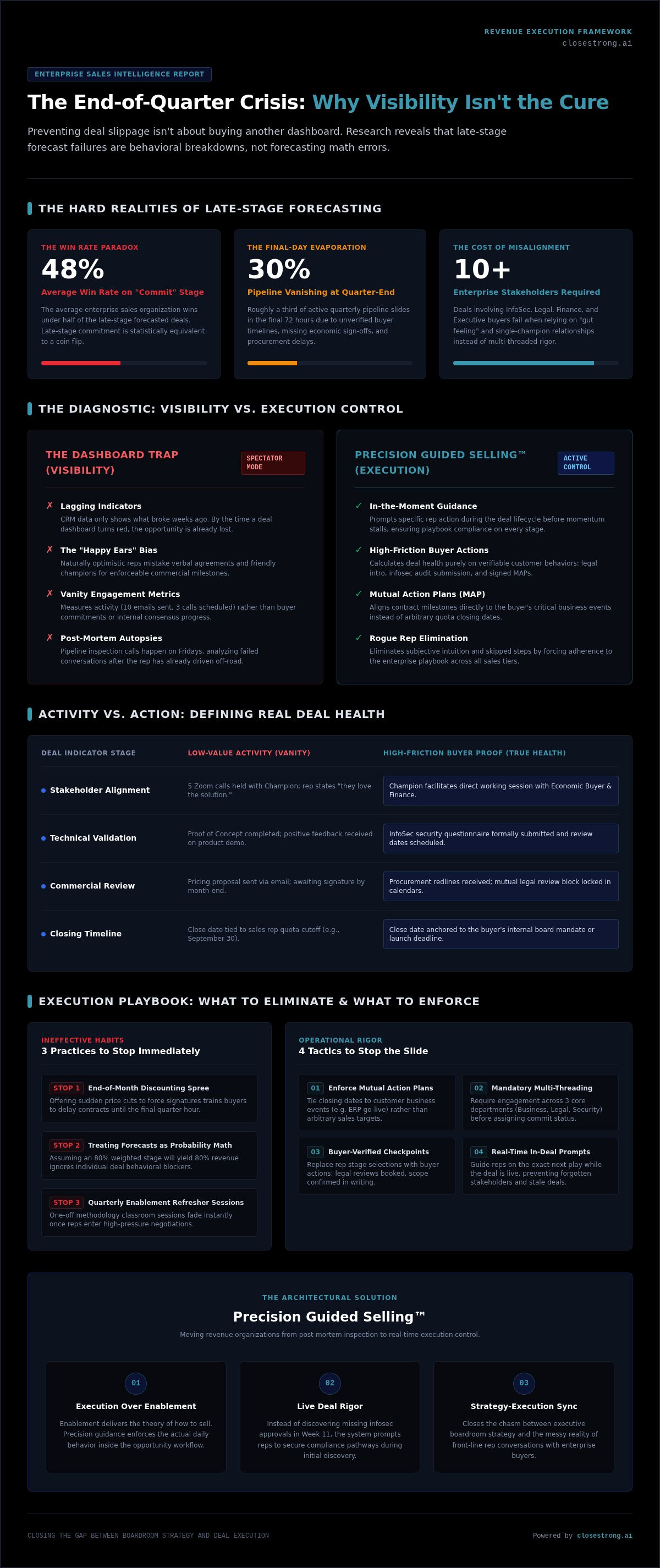
Stop treating your quarter-end like a fire sale. Most managers think they are "closing" when they are actually just begging. If your strategy relies on a heavy discount to get a signature by Friday, you haven't built a business case; you've built a bribe. Preventing deal slippage end of quarter requires surgical execution, not desperate concessions. You need to stop the behaviors that signal weakness and start enforcing the rigor that enterprise buyers actually respect. Revenue isn't a suggestion. It is the result of disciplined behavior.
First, make the Mutual Action Plan (MAP) a non-negotiable requirement. A MAP isn't a polite suggestion or a "nice-to-have" document. It is a shared contract for the sales process itself. If the buyer won't agree to the milestones, they aren't buying this quarter. Second, perform a brutal "Go/No-Go" audit in the final 72 hours. If the economic buyer hasn't personally validated the business case, the deal is likely a hallucination. Qualify it out now to save your team's energy for winnable fights. Finally, stop the artificial deadlines. Professional buyers see right through "this offer expires at midnight." It kills your margin and your credibility.
Deals rarely slip because of the product. They slip because the rep doesn't understand how their customer actually buys. Most deals evaporate in the final 10 days because of a misunderstood signature process. You must guide your reps to map the real procurement timeline, not the one the champion "thinks" will happen. The Legal Bottleneck is the structural friction between a commercial verbal agreement and the final executed contract, and you preempt it by forcing redlines to occur parallel to the business negotiation rather than after it. If you wait for the verbal to start the paperwork, you've already lost the quarter.
Single-threaded deals are just slips waiting to happen. If your rep is only talking to one person, they aren't selling; they're hoping. You need an Enterprise Sales Execution Platform to enforce stakeholder mapping across the entire buying committee. This is the difference between a "Contact List" and a "Power Map." A contact list is just a directory of names. A power map is a strategic blueprint that identifies who owns the budget, who owns the risk, and who can veto the entire project. If you want to see how real-time guidance can enforce this rigor on every deal, explore the CloseStrong execution engine. Don't leave your revenue to chance when you can guide it with precision.
CRM is where data goes to die. It is a system of record, not a system of results. If you are still relying on a dashboard to save your quarter, you have already lost. Most teams have plenty of visibility; they know exactly which deals are failing in high definition. What they lack is the mechanism to change that outcome while there is still time on the clock. CloseStrong isn't another layer of "intelligence" designed to sit on top of your stack and report on your losses. It is the Enterprise Sales Execution Platform that bridges the gap between the strategy you discussed in the boardroom and the high-stakes deal your rep is about to blow in the field.
Precision Guided Selling™ doesn't just track milestones. It enforces them. It adapts to the specific, gritty needs of enterprise sales, where one missed stakeholder or a misunderstood procurement path results in a 90-day slide. The world's most disciplined sales teams are moving beyond the passive observation of CRM. They are moving toward precision execution. Preventing deal slippage end of quarter requires more than a "health score" based on email volume. It requires a system that guides every rep to the right action on every deal, every time, without exception.
Getting started does not mean replacing your CRM. It means making your CRM actually work for your reps instead of just for your analysts. By integrating deal-level guidance, you turn a static database into a dynamic execution engine. The impact is immediate: forecast variance drops, and rep performance stabilizes. When reps have a clear, guided path, they stop guessing and start closing. For a deeper dive into the mechanics of this shift, read The Enterprise Sales Execution Platform: Closing the Gap Between Strategy and Reality. This is how you move from "what happened" to "what needs to happen now."
The choice is simple. You can continue watching your forecast erode as the final week approaches, or you can start guiding those deals to the finish line with surgical accuracy. In 2026, "Execution" is replacing "Enablement" as the CRO’s top priority because visibility without action is just a high-definition view of failure. It is time to stop being a spectator in your own revenue cycle and start controlling the variables that matter. Stop the slippage. Get a CloseStrong demo.
Visibility is a spectator sport. It lets you watch your deals fail in real time, but it does nothing to change the outcome. To stop the slide, you must shift your focus from tracking results to guiding actions. Preventing deal slippage end of quarter requires more than a CRM dashboard; it requires a commitment to deal-level rigor and action adherence. When your reps follow a proven playbook instead of relying on gut feelings, you eliminate the "happy ears" that corrupt your forecast.
CloseStrong is the Enterprise Sales Execution Platform designed for this exact purpose. Our Precision Guided Selling™ technology provides custom guidance for complex deals, ensuring that no stakeholder is forgotten and no procurement hurdle is missed. You can finally eliminate forecast variance and ensure your global team executes your strategy on every single opportunity. The era of passive revenue intelligence is over. It's time for active execution. Stop the slippage. Get a CloseStrong demo. You have the power to close more deals within the intended quarter starting today.
Slippage stems from a gap between boardroom strategy and rep behavior. It isn't a lack of visibility; it's a lack of discipline. Reps often rely on "happy ears" and skip critical milestones like validating the economic buyer or mapping the procurement path. When reps ignore the playbook, deals stall. It's a behavioral failure that no amount of dashboard monitoring can fix. You don't need more data; you need better execution on every deal.
Improving accuracy starts with preventing deal slippage end of quarter by enforcing strict action adherence. You must stop relying on rep sentiment and start measuring whether specific, high-friction milestones have been met. If the buyer hasn't taken a committed action, the deal isn't a commit. Replace "gut feelings" with a data-driven rigor that ensures every opportunity in your pipeline follows your organization's winning execution playbook. Accurate forecasts are built on behavior, not hope.
Sales engagement measures volume; sales execution measures value. Sending five hundred emails is engagement, but it doesn't mean you're winning the deal. Execution is the disciplined adherence to a strategic process that moves a deal toward a signature. Engagement tools track that you are talking. An Enterprise Sales Execution Platform ensures you are saying the right things to the right people to close the deal. Don't confuse activity with progress.
Precision Guided Selling™ prevents slippage by providing reps with real-time, deal-specific guidance. It identifies missing milestones, such as a skipped security review or an unverified budget owner, before they turn into quarter-end crises. Instead of a manager performing an autopsy after a deal slips, the technology acts as a digital coach. It ensures reps execute the correct "give-gets" and trade-offs while the deal is still winnable. It turns your corporate strategy into immediate, deal-level action.
A CRM is a passive database, not an active execution engine. It records what happened but doesn't tell a rep how to fix what's broken in the moment. Relying on a CRM to prevent slippage is like using a scoreboard to win a game; it shows you the score, but it doesn't call the plays. You need a system that bridges the gap between static data entry and live deal steering to change outcomes.
Identify slipping deals by looking for "action gaps" rather than activity levels. A deal with high email volume can still be dead if the rep hasn't secured a Mutual Action Plan. Look for stagnation in the procurement process or a lack of multi-threading. If the buyer isn't meeting agreed-upon milestones, the deal is already sliding. Real-time execution data exposes these risks weeks before the deadline hits. Don't wait for the red dashboard.
Procurement is where "verbal yeses" go to die. Most deals slip because reps treat procurement as a formality instead of a strategic stage. They wait until the business case is won to start the signature process, creating a legal bottleneck. To stop the slide, you must force procurement and legal redlines to happen parallel to the business negotiation. If you aren't mapping the signature path early, you're just guessing on your close date.
Yes, an Enterprise Sales Execution Platform is designed to integrate with your existing CRM. It doesn't replace your system of record; it makes it actionable. While your CRM stores the data, the execution platform uses that data to provide custom, high-quality deal guidance. This ensures your reps spend less time on administrative entry and more time executing the specific behaviors that drive revenue. It turns your CRM from a static archive into a competitive weapon.


