




Last year, 48% of enterprise go-to-market strategies died before they ever reached a customer. They didn't fail because of a lack of data. They failed because visibility is not the same thing as victory. If you're struggling to bridge the gap between sales performance management vs sales execution,...
Last year, 48% of enterprise go-to-market strategies died before they ever reached a customer. They didn't fail because of a lack of data. They failed because visibility is not the same thing as victory. If you're struggling to bridge the gap between sales performance management vs sales execution, you're likely realizing that dashboards don't close deals. You've spent millions on tools that look great in board meetings but do nothing to help a rep win on a Tuesday afternoon.
You know the frustration of high forecast variance despite having "all the facts." Your managers are buried in administrative reporting instead of coaching. Your reps treat the sales playbook like an optional suggestion. This disconnect is what happens when you mistake a report card for a strategy. One measures the past. The other secures the future. You aren't lacking information; you are lacking the ability to influence the outcome while the deal is still live.
This article will stop the confusion between administrative reporting and deal-level winning. We will explore why SPM is merely a post-mortem while Precision Guided Selling™ provides the real-time guidance required to win. It's time to move beyond tracking failure and start ensuring every rep executes your strategy on every single deal.
• Stop confusing reporting with winning. SPM is the report card, but sales execution is the tutor that actually changes the grade.
• Master the strategic differences of sales performance management vs sales execution to understand why territory planning means nothing if your reps can't navigate a complex stakeholder map.
• Escape the reporting trap by realizing that seeing a "red" deal doesn't tell a rep how to turn it "green" or provide the rigor needed to win.
• Learn how to bridge the execution gap by codifying your sales strategy directly into the digital workflow rather than leaving it in a static playbook.
• Discover how Precision Guided Selling™ moves your team beyond administrative oversight and into high-quality, real-time deal guidance.
Most sales leaders are drowning in data but starving for results. They confuse the infrastructure of sales with the act of selling. It's a fatal mistake. The debate of sales performance management vs sales execution isn't just a semantic exercise; it's the difference between watching a ship sink and knowing how to plug the hole. SPM is the blueprint. Execution is the construction. Visibility into a failing deal doesn't help you save it any more than a thermometer helps you cure a fever. You can see the heat, but you're still sick.
Let's talk straight. Sales Performance Management is a back-office function designed to keep the CFO happy. It's about the "Who" and the "How Much." Sales Execution is a front-line reality designed to keep the competition awake at night. It's about the "How." Sales Execution is the real-time application of strategy to specific deal mechanics. If your strategy isn't showing up in the live deal, your strategy doesn't exist.
Foundationally, Sales Management includes everything from planning to performance metrics. But in the modern tech stack, SPM has drifted into a historical archive. It tracks where you've been. It doesn't tell you where to go next. You don't win deals by looking in the rearview mirror.
SPM handles quotas, territories, and commissions. These are essential but purely administrative. They provide the "what" of your organization's goals. Execution handles discovery, qualification, and closing. These are tactical and decisive. They provide the "how." There is a dangerous trend of mistaking Sales Operations for Sales Execution. Operations builds the engine; Execution drives the car. One is about maintenance; the other is about momentum. If your team is spending more time updating dashboards than refining deal tactics, you've already lost the battle.
Visibility is the biggest lie in sales technology. You've been told that if you can see the problem, you can fix it. It's a myth. Seeing a "red" deal on a dashboard doesn't tell a rep how to turn it "green." It just confirms they're losing. In the battle of sales performance management vs sales execution, visibility is a spectator sport. You're sitting in the stands watching the game, but you have no way to call a play while the clock is running. If you know that 40% of your forecast will slip every single quarter, why can’t you stop it? Because you're managing the ghost of a deal instead of the reality of the rep.
Traditional SPM tools are reactive by design. They are built for the back office, not the front line. There is a massive difference between "Revenue Intelligence" and "Execution Guidance." Revenue Intelligence tells you what happened. It’s a post-mortem. Execution Guidance tells you what to do next. It’s a playbook. You don't need more data; you need more direction. Relying on a platform that only tracks status is like trying to drive a car by looking exclusively at the fuel gauge. You know when you're empty, but you have no idea how to get to your destination.
SPM metrics are almost exclusively lagging indicators. Quota attainment, win rates, and cycle lengths are all autopsies of past behavior. When you rely on lagging data, you create a culture of "post-mortem" coaching. You're telling the rep what they did wrong after the buyer has already signed with a competitor. While aligning Sales Performance Management and HR can improve transparency and motivation, it still won't tell a rep how to handle a specific stakeholder objection in the moment. You need leading indicators that focus on rep behavior and deal mechanics, not just stage movement in a CRM.
Reps don't need more dashboards. They need clear instructions. There is a heavy psychological toll to "oversight" without "support." When a manager spends all their time asking "What is the status?" instead of "What is the next best action?", the rep feels policed, not empowered. This is where the execution gap widens. Instead of just watching the clock, you need to provide real-time support through a dedicated sales execution platform that guides every step. Move away from the noise of administrative reporting. Focus on the signal of tactical winning.
Sales Performance Management is the architecture of your sales force. It answers the "Who" and the "How Much." It tells you which rep owns which zip code and how much they must sell to keep their job. But territory planning means nothing if the rep can’t navigate a complex stakeholder map. You can give a rep the most lucrative territory in the country; if they can't handle a three-party negotiation with procurement, legal, and the VP of IT, they will fail. The core conflict in sales performance management vs sales execution is simple. SPM scales the organization. Execution scales the win rate.
Administrative data is useless in a live negotiation. It fails you at the three most critical moments where deals are won or lost. First, when a buyer throws a curveball objection that isn't captured in your CRM stages. Second, when procurement demands a 20% discount and your rep lacks the value-justification prompts to hold the line. Third, when a silent blocker enters the decision committee and your "visibility" tools never saw them coming. SPM tracks the result of these moments. Execution controls the moments themselves.
Setting a quota is a goal. Providing deal guidance is the path. Most companies are great at the former and terrible at the latter. They tell reps to "go win" but leave the "how" up to chance. CloseStrong bridges this gap by turning corporate strategy into deal-level prompts. We don't just tell you what you owe; we tell you how to get it. Our Precision Guided Selling Software ensures that your strategy isn't just a PDF in a drawer. It's a live assistant in the deal. It moves the needle from passive management to active winning.
Forecasting is like predicting the weather. You look at the clouds and guess if it will rain. Execution is about building the shelter. If you're cold, knowing the exact temperature doesn't help. You need a roof. Forecast accuracy is a vanity metric if your win rate is stagnant. You can be 100% accurate at predicting you'll lose 40% of your deals. That's not success; that's a well-documented failure. We shift the focus from predicting revenue to producing revenue. Don't just watch the forecast. Control the outcome by mastering the mechanics of the deal.
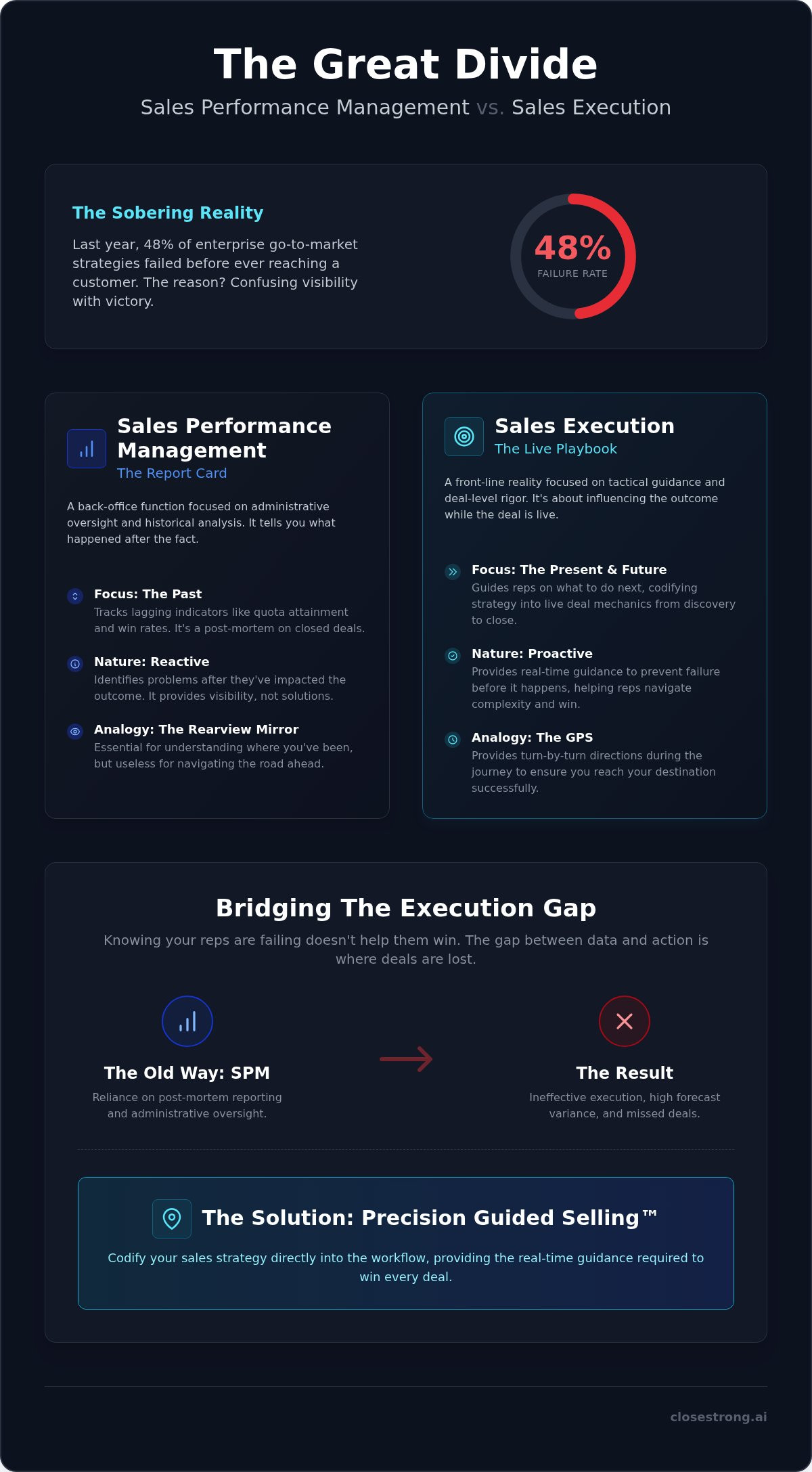
The "Execution Gap" is the graveyard of corporate ambition. It's the silent space between what leadership thinks is happening and what reps actually do in the field. When your high-level strategy meets a live deal, the strategy usually loses. This is the fundamental failure in the sales performance management vs sales execution debate. Management provides the roadmap, but execution provides the discipline to stay on the road. You can't manage a gap you aren't actively closing. You must transition from passive oversight to active guidance.
Bridging this gap requires a fundamental shift in how you deploy your strategy. It's not about more meetings; it's about better mechanics. Follow these steps to move beyond reporting:
Stop leaving the "how" to chance. Embed your sales methodology directly into the digital workflow so it's impossible to ignore.
Traditional reviews are autopsies. Replace them with real-time guidance that course-corrects deals while they're still alive.
Stop obsessing over activity volume. Measure adherence to the strategic behaviors that actually drive win rates.
Use Precision Guided Selling™ to automate the "adult in the room" coaching. This ensures strategy is applied even when managers are busy elsewhere.
Top performers are often a scaling nightmare. They win, but nobody knows how. They ignore the playbook because it's usually a static document. This creates a fragile revenue engine. An enterprise sales execution platform enforces rigor without slowing down the deal. It turns individual talent into a repeatable process. Straight talk: Process adherence isn't about control; it's about predictable growth. If you can't repeat the win, you don't own the win.
Managers spend 80% of their time auditing CRM data; they should spend 80% coaching. Most sales leadership roles have devolved into administrative bookkeeping. That's a waste of talent. Automated guidance frees up leadership to focus on high-level strategy. The impact of the ability to scale sales strategy execution on management overhead is massive. Stop counting deals. Start winning them. Free your managers to lead instead of just reporting on the status quo.
Ready to stop the reporting and start the winning? Explore the CloseStrong platform and close your execution gap today.
Visibility is a sedative. It makes you feel like you're doing something while you're actually just watching the clock. In 2026, the market has no patience for spectators. The era of "seeing the failure" is over. We've entered the era of preventing it. Precision Guided Selling™ is the evolution of the sales tech stack because it moves beyond the passive debate of sales performance management vs sales execution. It doesn't just record the history of your sales organization; it dictates the future of your deals. One tells you that you're losing. The other ensures you win.
CloseStrong provides the strategic rigor your existing systems lack. We don't just show you that a deal is stuck in stage three. We provide the custom, high-quality deal guidance required to move it to "Closed-Won." This isn't about luck or individual heroics. It's about behavioral rigor. When every rep executes your strategy with the precision of your top 1%, predictable revenue growth isn't a goal. It's a mathematical certainty. You don't need more charts. You need more wins.
Generic prompts are for amateurs. Your reps don't need a nudge to "follow up." They need to know how to navigate a multi-threaded power struggle. They need to know which value proposition to lead with when the CFO enters the room. This is the critical link between complex B2B sales software and actual execution. If your platform isn't providing specific, high-quality guidance for the enterprise context, it's just an expensive filing cabinet. We turn your strategy into a live assistant that ensures every rep behaves like an expert, every time.
Stop accepting forecast variance as a fact of life. It’s not an inevitable reality; it’s a symptom of an execution gap you’ve failed to bridge. Every percentage point of variance represents a deal you should have won but didn't because your strategy stayed in the boardroom instead of the field. The ROI of closing this gap is measured in win rates and margin, not just report accuracy. You have a choice to make. Are you going to keep managing performance, or are you going to start executing deals? The days of mere visibility are dead. The decade of execution has arrived.
Visibility into failure is not a strategy. It is a tragedy. You've spent years perfecting the art of the post-mortem, but knowing exactly why you lost a deal three weeks ago won't help you win the one on your desk today. The fundamental divide in sales performance management vs sales execution is the difference between recording history and creating it. You don't need another dashboard to tell you that your forecast is slipping. You need the enterprise-grade deal rigor that stops the slip before it happens.
Success requires shifting from administrative oversight to tactical guidance. When you bridge the gap between corporate strategy and individual deal outcomes, you stop guessing and start growing. It's time to eliminate forecast variance by ensuring every rep has the precision required to navigate complex cycles. Don't just manage your team's performance; drive their results through behavioral rigor and real-time support.
Stop managing failure and start guiding success with CloseStrong. Our Precision Guided Selling™ technology provides the high-quality guidance your team needs to close the execution gap once and for all. You have the strategy. Now, let's execute it.
SPM is the organizational architecture. It defines who sells what and how they get paid. Sales execution is the live action within that framework. The main difference in sales performance management vs sales execution is timing and intent. SPM looks at the past to adjust territories or commissions. Execution looks at the current deal to ensure the rep follows the strategy. One is about reporting the outcome; the other is about influencing it while the deal is live.
No, and it shouldn't. Your CRM is a system of record; it's a database for holding contact names and deal stages. It's a digital filing cabinet. Sales execution software is a system of action. It sits on top of your CRM to provide real-time guidance. While the CRM tells you that a deal exists, the execution platform tells you how to win it. Think of the CRM as the scoreboard and execution software as the coach.
It improves win rates by codifying your high-level strategy into specific, deal-level prompts. Instead of hoping a rep remembers their training, Precision Guided Selling™ provides real-time instructions based on the unique mechanics of the deal. It removes the guesswork from complex cycles. By enforcing behavioral rigor, it ensures every member of your team executes with the same precision as your top 1% performers. You stop relying on individual heroics and start relying on a repeatable process.
Deals fail because SPM is an administrative function, not a tactical one. You can have perfect territory alignment and a transparent commission structure, but if your rep can't handle a procurement objection, the deal dies. SPM provides visibility into the failure, but it doesn't provide the guidance to prevent it. Most enterprise failures happen at the deal level because of poor execution, not because the quota was set incorrectly or the territory was too large.
Not even close. Sales enablement is about preparation; it provides the training, content, and playbooks that reps are supposed to use. Sales execution is about application. It's the difference between giving a soldier a manual and guiding them through a live mission. Enablement often ends up as a "shelf-ware" PDF that reps ignore. Execution forces the strategy into the daily workflow. It ensures the training you paid for actually shows up in the live negotiation.
Look at your forecast variance. If you consistently miss your numbers despite having "clean" CRM data, you have an execution gap. Another sign is a massive performance delta between your top 1% and the rest of the team. This indicates that your strategy isn't being executed consistently. When reps ignore the playbook or managers spend all their time auditing instead of coaching, your strategy is dying at the deal level. You have visibility, but no control.
Stop looking at win rates as your primary metric; those are lagging indicators. Success in sales performance management vs sales execution is measured by methodology adherence and stakeholder engagement. Are your reps actually covering the entire decision committee? Are they following the custom deal guidance provided for complex objections? High-quality execution is marked by behavioral rigor. When you see consistent adherence to the sales process across the entire team, the revenue growth follows as a natural consequence.


