





Your sales engagement platform isn't winning deals. It is just automating noise. You have more activity than ever, yet your forecast variance remains a disaster. It is time to stop pretending that a high volume of emails equals a high probability of closing. When comparing a sales execution platform...
Your sales engagement platform isn't winning deals. It is just automating noise. You have more activity than ever, yet your forecast variance remains a disaster. It is time to stop pretending that a high volume of emails equals a high probability of closing. When comparing a sales execution platform vs sales engagement platform, the difference is clear. One manages the volume of your outreach; the other manages the execution of your strategy. You don't have a volume problem. You have a strategy-to-deal execution gap.
You see the symptoms every day. Reps go rogue and ignore the playbook. Your CRM data reflects busywork but ignores actual deal health. It is frustrating to watch executive strategy die at the desk of an individual contributor. This article will show you how to stop leaving the sale to chance by bridging the gap between strategy and reality. We will explore how Precision Guided Selling™ provides the specific, high-quality guidance your team needs to achieve predictable revenue. It is time to move beyond the engagement trap and ensure every rep on your floor performs like a top-tier closer.
• Stop confusing activity with progress. High outreach volume is a vanity metric if it doesn't translate into predictable deal execution.
• Master the shift from a sales execution platform vs sales engagement platform to prioritize deal health over simple activity logging.
• Bridge the "Execution Gap" between executive strategy and daily rep behavior using Precision Guided Selling™.
• Eliminate forecast variance by replacing guesswork with custom, high-quality deal guidance that forces methodology adherence.
Activity is the great liar of enterprise sales. You see a dashboard glowing with green metrics. Thousands of emails sent. Hundreds of calls made. A calendar packed with "initial discovery" sessions. On paper, your team is crushing it. In reality, your revenue is flat and your forecast is a work of fiction. This is the Engagement Trap. It is the dangerous belief that volume and velocity are substitutes for strategy and skill. When you look at the sales execution platform vs sales engagement platform debate, you are really looking at the difference between making noise and making money.
The "Execution Gap" is where deals go to die. It is the massive canyon between the high-level strategy you polished during the QBR and what actually happens on a Tuesday morning Zoom call. Your strategy says "focus on value," but your rep is on a call talking about features because they don't have real-time guidance. Engagement tools focus on the "how many." Execution platforms focus on the "how well." You don't need more sequences. You need more strategy in the moment of truth.
More emails will not save a bad deal. In complex B2B sales, "more" is often the enemy of "better." High activity levels frequently mask a lack of direction. When reps are measured solely on outreach volume, they stop being strategic closers and start being automated spammers. This creates an environment where reps go "rogue," ignoring the sales playbook because it is too hard to follow while hitting their activity quotas. The cost is staggering. You lose deals not because you didn't call, but because you didn't execute the right move at the right time. A busy rep is not always a productive one. A strategic closer, however, knows that every action must align with the ultimate outcome.
A Sales Execution Platform is not a dialer. It is not a CRM. It is a guidance system for the entire deal lifecycle. While a CRM is a passive graveyard for data, a SEXP is an active participant in the sale. Its core function is to ensure that your corporate strategy is actually executed on every single deal, every single day. It provides the "adult in the room" perspective that engagement tools lack. By using Precision Guided Selling™, a SEXP translates complex methodologies like MEDDIC or Force Management into specific, deal-level actions. It moves the needle from "did we send the email?" to "did we advance the deal?"
Records what happened in the past.
Automates the volume of the present.
Guides the strategy for the future.
Sales Engagement Platforms (SEPs) are the industrial-grade megaphones of the sales world. They are built for one thing: scale. They excel at the top of the funnel where volume is the primary lever. You get cadences. You get multi-channel outreach. You get automated activity logging that makes your CRM look like a beehive of productivity. But don't mistake a busy beehive for a finished house. The reality is that SEPs stop providing value the moment a meeting is booked. They are prospecting tools, not closing tools. They automate the noise. They do not manage the outcome. This distinction between noise and outcome is critical in any competitive field; for example, in the music industry, Apolone provides a targeted alternative to the noise of generic tactics by focusing on strategic Spotify growth.
The core tension in the sales execution platform vs sales engagement platform debate is the difference between starting a conversation and finishing a sale. SEPs handle the "who" and the "when." They do not handle the "how." Relying on an SEP for deal management is a recipe for hope-based forecasting. You are looking at activity metrics and praying they lead to revenue. Activity is a lead indicator of effort, not an indicator of success. If your forecast relies on how many emails were sent last week, you aren't forecasting. You are guessing.
SEPs are brilliant for SDRs and BDRs. They automate the drudgery of pipeline generation. However, they hit a wall during the complex stages of an enterprise deal. This is the "Post-Meeting Drop-off." An automated sequence cannot navigate a 7-stakeholder committee or handle nuanced objections. In enterprise accounts, "Sequence Fatigue" is a real threat. Your prospects don't want to be part of a cadence; they want a strategic partner. If you want to stop guessing and start winning, you need custom deal guidance that goes beyond the initial hello.
Most SEPs function as a high-velocity data pipe for your CRM. They log every touchpoint, but logging is not interpreting. This leads to the "Dirty Data" problem. Your CRM fills up with activity logs that reflect effort but hide the actual health of the deal. For a deeper dive into why visibility alone is a trap, read The 2026 Enterprise Sales Tech Stack. An SEP tells you the rep sent an email. It doesn't tell you if that email moved the needle. It provides the noise; it ignores the signal.
If engagement platforms are the megaphone, execution platforms are the GPS. The industry has spent a decade obsessing over how to reach more people. It has spent almost zero time on how to actually win the deal once someone answers. This is the fundamental divide when looking at a sales execution platform vs sales engagement platform. One tracks the volume of the noise. The other manages the signal of the strategy. Understanding this difference is the only way to stop treating your revenue forecast like a game of roulette.
Most sales leaders spend their time asking "What did you do last week?" This is a post-mortem. It is useless for changing the outcome of a live deal. A Sales Execution Platform (SEXP) flips the script. It asks, "What should you do next?" It moves from retrospective reporting to prospective guidance. It doesn't just log that a meeting happened. It ensures that the meeting moved the deal forward according to your specific methodology. Whether you use MEDDIC, Force Management, or a custom framework, an SEXP makes that strategy a reality instead of a PDF gathering dust on a shared drive.
Precision Guided Selling™ is the end of sales guesswork. It is not "enablement." Traditional enablement is passive. It gives a rep a deck and hopes they use it. Precision Guided Selling™ is active. It is proprietary technology that provides custom high quality deal guidance in the moment of truth. It tells the rep exactly which stakeholder to engage, which value wedge to drive, and which trap to set for the competition. It is the difference between a rep who is just "busy" and a rep who is a surgical closer. You aren't just scaling activity. You are scaling expertise.
Corporate strategy often dies a quiet death in the field. The CEO wants to move upmarket, but the reps are still selling like it's 2019. This "Execution Gap" is the primary reason enterprise plans fail. An SEXP bridges this gap by hardcoding your strategy into the daily workflow of every rep. It ensures that every deal reflects the high standards of your top-tier closers. To understand why these plans typically break down at the deal level, see our deep dive on Scaling Sales Strategy Execution. When strategy meets the deal in real-time, predictable revenue becomes a mechanical certainty rather than a lucky break.
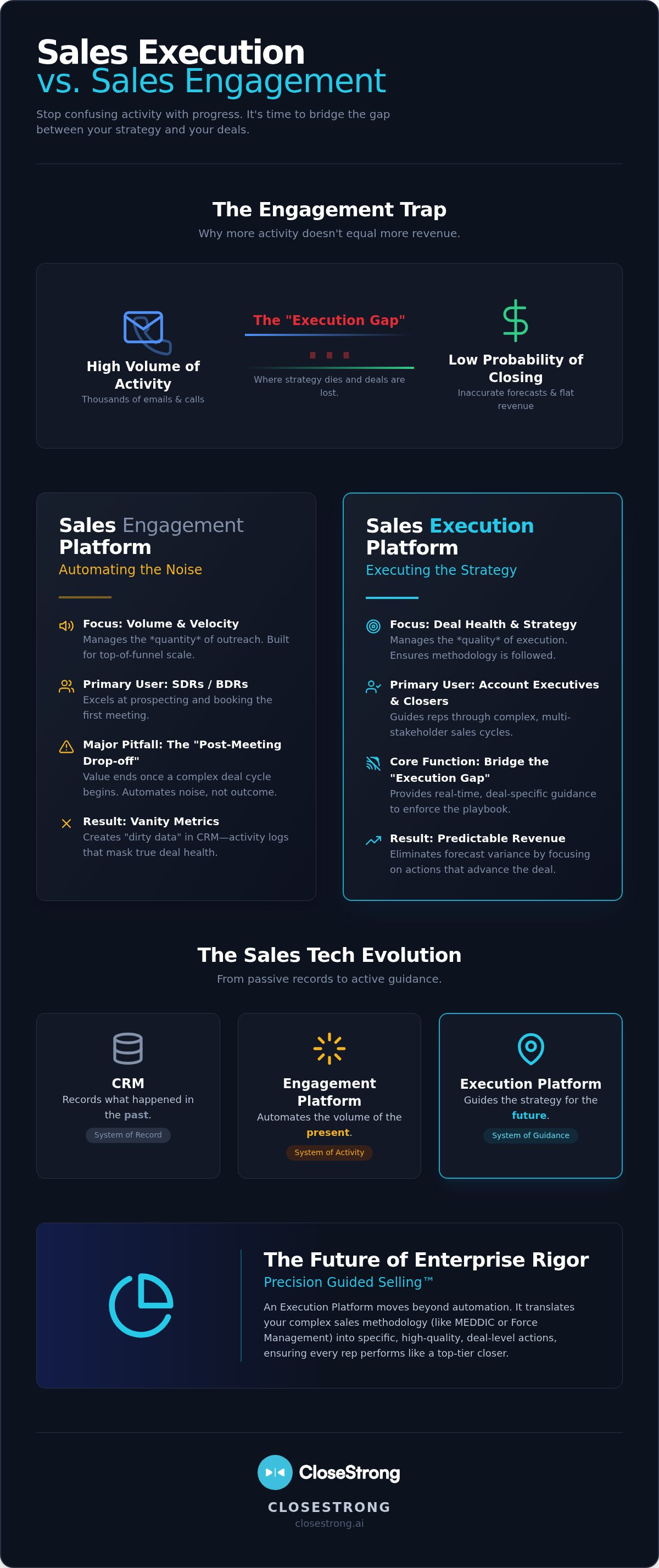
Don't confuse a full inbox with a full bank account. One is a measure of noise. The other is a measure of results. The industry loves to blur the lines, but the reality is binary. When you evaluate a sales execution platform vs sales engagement platform, you are choosing between managing the start of the race or the finish line. Engagement is for prospecting. Execution is for closing. If you have an army of reps sending thousands of emails but your forecast still looks like a work of fiction, your problem isn't engagement. It is execution.
Engagement tools measure activity. They tell you how many people clicked a link or opened an email. Execution platforms measure adherence. They use Precision Guided Selling™ to ensure your reps are actually following the strategy required to win a complex deal. Engagement manages the inbox. Execution manages the deal. You probably need both. But let's be clear: engagement without execution is just expensive noise. It is like buying a faster car to drive off a cliff. You get to the disaster sooner, but the outcome is the same.
For a Chief Revenue Officer, the metrics that matter shift as the deal progresses. Engagement platforms live in the world of open rates, reply rates, and meeting sets. These are vanity metrics if the meetings don't close. Sales Execution Platforms focus on win rates, deal velocity, and forecast accuracy. The user focus is also distinct. High-volume SDRs need the automation of an SEP to generate pipeline. High-stakes AEs need the rigor of an SEXP to navigate the "messy middle" of an enterprise deal. In your tech stack, the SEXP sits between the CRM and the rep's actual workflow, providing the guidance that the CRM lacks.
How do you know you have an execution problem? Look at your pipeline. If you have high slippage and low win rates on deals that were supposedly "qualified," your strategy is failing at the deal level. Reps are guessing. They are missing key stakeholders. They are failing to communicate value. More training won't fix this. You cannot train your way out of a guidance problem. You need real-time, deal-level direction that forces methodology adherence. For a deeper look at why your current setup is failing, check out our analysis on Complex B2B Sales Software.
If you are ready to stop leaving your revenue to chance, it is time to implement an Enterprise Sales Execution Platform and turn your strategy into a closing machine.
Traditional sales techniques are dead in the water without a guidance system. You can train your reps until they are blue in the face, but if they lack real-time direction, they'll revert to their worst habits the moment a call gets difficult. This is the final word on the sales execution platform vs sales engagement platform debate. Engagement tools get you to the meeting. Precision Guided Selling™ gets you to the signature. It's the difference between a rep who hopes for a win and a closer who engineers one.
We need to move beyond the era of simple conversation intelligence. Passive recording tools are brilliant for post-mortems. They tell you exactly what was said during a botched discovery call. But recording a crash doesn't prevent the next one. CloseStrong moves the needle from tracking to guidance. It's the difference between a black box flight recorder and a sophisticated autopilot system. It doesn't just tell you what happened. It tells you what to do next to keep the deal on the rails.
Most forecasts are built on a foundation of gut feel and rep optimism. That isn't a business plan. It's a prayer. To achieve predictable revenue, you must replace feelings with data. Deal health software provides the objective reality of your pipeline, but monitoring a score isn't enough. You need to know how to move that score. Read our analysis on Sales Deal Health Software to understand why scores without guidance are useless. Custom high quality deal guidance ensures that predictability is a byproduct of rigor, not a lucky break.
CloseStrong is the Enterprise Sales Execution Platform designed for high-stakes environments. It doesn't just suggest actions. It guides every rep through every deal with surgical precision. It ensures that your corporate strategy isn't just a slide in a QBR deck, but a lived reality in every transaction. By hardcoding your methodology into the daily workflow, we eliminate the rogue rep problem once and for all. Every member of your team starts performing like your top 1% because they're following the same winning playbook, every single time.
Implementing Precision Guided Selling™ in your organization is the only way to bridge the strategy-to-execution gap. It forces adherence to the standards that drive revenue. Stop guessing. Start guiding. It's time to turn your sales process into a mechanical certainty.
You have enough activity. You have enough sequences. What you don't have is a way to ensure your strategy actually survives the reality of a complex enterprise deal. The choice between a sales execution platform vs sales engagement platform isn't just about software; it's about whether you want to manage the volume of your outreach or the outcome of your revenue. Engagement tools scale the top of your funnel, but they leave the most critical part of the sale to chance. Execution platforms bridge that gap.
By implementing Precision Guided Selling™ technology, you move from hope-based forecasting to mechanical certainty. You provide enterprise-grade deal guidance that forces methodology adherence on every single transaction. This is how you close the strategy-to-execution gap and turn every rep into a top-tier closer. The days of reps going rogue are over. The era of predictable revenue is here.
Stop leaving deals to chance. Discover Precision Guided Selling™ with CloseStrong.
It's time to take control of your pipeline and lead your team with the rigor they deserve. You have the strategy. Now, finally, you have the execution to match.
No, an SEP cannot replace an SEXP. They serve entirely different masters. An SEP is built for SDRs who need to scale outreach. An SEXP is built for AEs who need to navigate complex committees and close high-stakes revenue. When comparing a sales execution platform vs sales engagement platform, remember that automation without guidance is just faster failure. You don't need more noise; you need more results. Stop pretending volume is strategy.
Precision Guided Selling™ improves win rates by replacing rep guesswork with surgical, real-time direction. Most reps fail because they lose the thread of the strategy during a long sales cycle. This technology provides custom high quality deal guidance at every milestone. It doesn't just suggest content; it dictates the next strategic move. This rigor ensures every rep on your floor performs like a seasoned enterprise closer. It turns your methodology into a mechanical certainty.
You absolutely need both. A CRM is a passive database of what happened in the past. It is a graveyard for data. A Sales Execution Platform is an active guidance system for what should happen next. Think of the CRM as your ledger and the SEXP as your GPS. One records the score; the other tells you how to play the game. You wouldn't fly a plane with only a logbook; you need a cockpit.
Enterprise sales involve multiple stakeholders, complex procurement, and nuanced value wedges. Outreach automation is designed for simple, high-volume prospecting. It cannot navigate a seven-person buying committee or handle a competitive trap. In the sales execution platform vs sales engagement platform landscape, the SEP hits a wall the moment the meeting is booked. You need execution rigor to move from a hello to a signed contract. Volume is not a substitute for skill.
It hardcodes your methodology directly into the rep's daily workflow. Most sales methodologies like MEDDIC die because they are too complex to remember in the heat of a deal. An SEXP turns those abstract principles into concrete, deal-level actions. It doesn't ask the rep to remember the playbook. It forces them to follow it. This eliminates rogue behavior and ensures strategy is executed perfectly every time. It makes your methodology unavoidable.
The key features include Precision Guided Selling™ technology, real-time deal health scoring, and custom high quality deal guidance. Unlike engagement tools that focus on cadences and dialers, an Enterprise SEXP focuses on stakeholder mapping, value alignment, and methodology adherence. It provides a strategic layer that sits on top of your CRM to bridge the gap between executive strategy and individual deal reality. It is built for closing, not just prospecting.
You measure the ROI through three primary levers: win rate, deal velocity, and forecast accuracy. If your win rates increase and your forecast variance drops to near zero, the platform is doing its job. Traditional tools focus on activity ROI, which is a vanity metric. True execution ROI is measured in predictable revenue and the elimination of the hope-based forecast that plagues most enterprise organizations. Results matter more than activity logs.


