





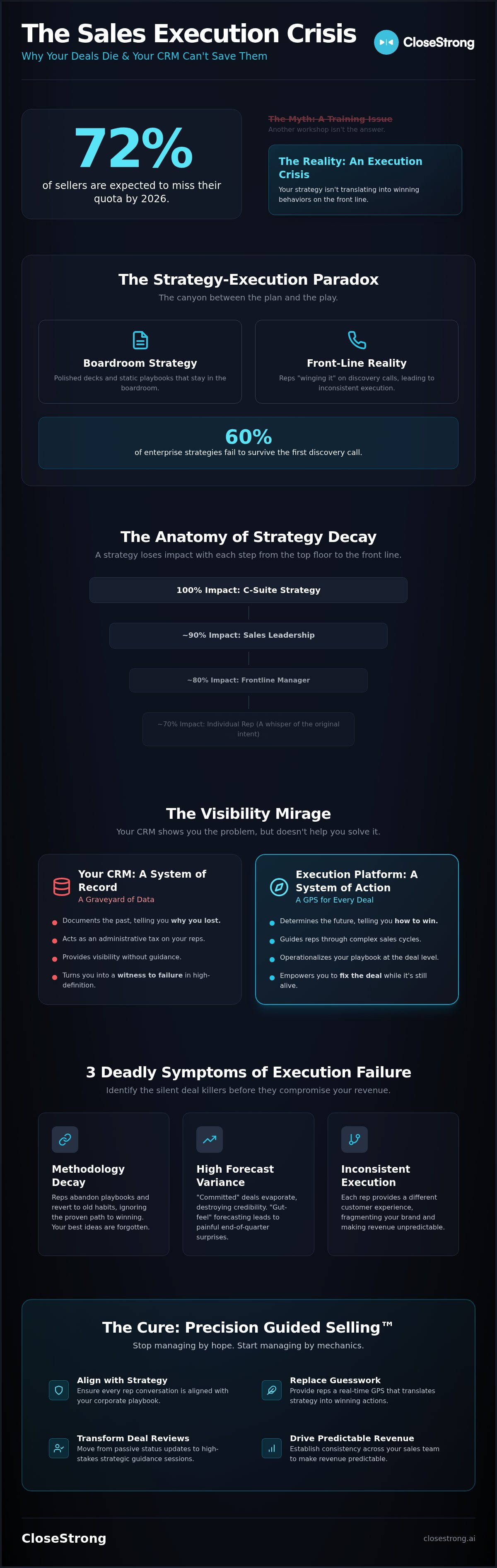
72% of sellers are expected to miss their quota in 2026. That isn't a training issue; it's an execution crisis. You've felt that pit in your stomach during the final week of the quarter when a "committed" deal suddenly evaporates. You're tired of the end-of-quarter surprises that destroy your credib...
72% of sellers are expected to miss their quota in 2026. That isn't a training issue; it's an execution crisis. You've felt that pit in your stomach during the final week of the quarter when a "committed" deal suddenly evaporates. You're tired of the end-of-quarter surprises that destroy your credibility and the "gut-feel" forecasting that keeps you up at night. The reality is that your CRM is a system of record, not a system of action. It tells you what happened, but it's completely blind to the symptoms of poor sales execution happening in real-time.
We're going to stop the bleeding. In this guide, you'll identify the silent killers of your enterprise deals and learn why your current sales tech stack is actually hiding the execution gaps costing you millions. We'll move past the "what" of your strategy and dive into the "how" of winning. You're about to see how to align every individual rep conversation with your corporate playbook and replace guesswork with Precision Guided Selling™. It's time to stop managing by hope and start managing by mechanics.
• Stop confusing a strategy deck with actual sales behavior and learn why 60% of enterprise strategies fail to survive the first discovery call.
• Recognize that your CRM is a system of record, not action; it's designed to document your losses rather than prevent them.
• Identify the critical symptoms of poor sales execution, such as high forecast variance and methodology decay, before they compromise your entire revenue engine.
• Audit your deal reviews to transform them from passive status updates into high-stakes strategic guidance sessions that move the needle.
• Implement Precision Guided Selling™ to provide reps with a real-time GPS that translates corporate strategy into winning deal-level actions.
Your $100M strategy deck is beautiful. It is also completely useless. The Sales Execution Gap is the canyon between that polished PowerPoint and a Tuesday morning discovery call where a rep is winging it. Industry data suggests that 60% of enterprise sales strategies fail to translate into actual rep behavior. This isn't a talent problem. It's a visibility problem. Your strategy is failing your reps because it stays in the boardroom while they are in the trenches. When a plan is invisible during a deal, it doesn't exist.
True sales effectiveness isn't about working more hours or "trying harder." It is about the cold, hard rigor of following a proven path. Execution is the mechanics of winning; strategy is just the intent. If your reps are forced to guess their way through a complex cycle, you aren't leading a team. You're managing a collection of independent contractors. This lack of consistency is one of the most dangerous symptoms of poor sales execution because it makes your revenue unpredictable.
A brilliant annual strategy loses 10% of its impact every time it moves down the management chain. By the time it hits the street, it's a whisper of the original intent. This decay creates the "Rogue Rep" syndrome. These aren't bad actors or rebels. They are survivors. They've realized that your static playbooks are the graveyards where your best ideas go to be forgotten. They ignore the corporate "what" because you haven't given them a functional "how." They default to what worked three years ago, even if it's killing your margins today.
Your customers don't care about your internal vision or your quarterly goals. They only care about the experience they get in the room. When execution is inconsistent, your brand identity becomes fragmented. One rep sells on value; another defaults to a price war. This "gut-feel" selling is a death sentence in a 2026 enterprise environment where buyers are paralyzed by risk. Protecting that trust also means securing your brand against external threats; utilizing enterprise-grade intelligence from openSquat to identify brand impersonation ensures your customers aren't misled by malicious domains. If your reps can't execute with precision, the customer sees a disorganized vendor, not a strategic partner. You don't need another training workshop. You need an Enterprise Sales Execution Platform that acts as a GPS for every deal, ensuring your strategy survives the first five minutes of every client interaction.
Sales leaders are addicted to dashboards. They believe that more data equals more control. It's a lie. Your CRM is a system of record; it documents the past. Execution is a system of action; it determines the future. When you see a deal marked as "At Risk" on a screen, you aren't managing. You're observing a tragedy in slow motion. This is the "Visibility Trap." Seeing the problem doesn't tell your rep how to save it. Even modern conversation intelligence tools are post-mortems. They tell you why you lost last week, but they don't help you win this afternoon. In 2026, the elite teams are moving beyond Revenue Intelligence. They are demanding Revenue Execution. They want to fix the deal while it's still alive.
The persistent symptoms of poor sales execution often hide behind high activity numbers. Your reps might be making the calls, but are they following the strategy? Harvard Business Review research on the gap between strategy and performance shows that most companies lose a huge chunk of their potential value right at the execution phase. This happens because visibility is not guidance. If you want to close that gap, you need to operationalize your playbook at the deal level. You don't need a witness to your failure; you need a guide for your success.
Reps hate your CRM for a simple reason: it's an administrative tax. It asks for everything and provides nothing. Most complex B2B sales software acts as a digital filing cabinet. It doesn't tell a rep which stakeholder is missing or which value prop to pivot to when a competitor enters the fray. It records the name of the buyer but ignores the mechanics of the buy. Visibility without guidance is just watching your forecast fail in high-definition. If your tech doesn't help a rep navigate a Tuesday morning discovery call, it's just digital dead weight.
Many "Health Scores" are based on feelings, not facts. Standard sales deal health software often mistakes high activity for high rigor. Ten emails to a low-level champion do not mean a deal is healthy. It means your rep has "Happy Ears." They are hearing what they want to hear because they lack the guidance to ask the hard questions. You don't need more metrics. You need to identify the real symptoms of poor sales execution by auditing the rigor of the conversation, not just the volume of the noise. It's time to stop looking in the rearview mirror and start using a GPS for your revenue. Operationalize your playbook at the deal level to ensure every rep follows the proven path to revenue.
High forecast variance is the first sign of a dying sales organization. If your "Committed" deals slip more than 20% of the time, you don't have a market problem. You have an execution crisis. Deal slippage isn't an act of God. It's a failure of discovery. When deals that looked "perfect" suddenly ghost your team, it means your reps missed a critical stakeholder or failed to tie the solution to a business outcome. These are the classic symptoms of poor sales execution that management teams often misdiagnose as "bad luck" or "longer buying cycles."
The second symptom is methodology decay. You spent $500k on a sales methodology that your mid-pack reps are now ignoring. They claim it's "too slow" for real deals. In reality, they've defaulted to "gut-feel" selling because your process is a static document rather than a dynamic guide. Finally, there's the "Hero Culture" trap. When 80% of your revenue comes from 20% of your reps, your business isn't scalable. Those "heroes" often win by ignoring every process you've built, leaving the rest of the team to flounder without a map. This creates a ceiling on your growth that no amount of hiring can break.
Stop treating deal slippage as an administrative error. Every slipped deal is an autopsy waiting to happen. Most managers use sales deal health software to look at activity, but activity isn't rigor. You might see ten meetings on the calendar and assume a deal is healthy. That's "Fake Rigor." Real rigor is knowing if the rep confirmed the budget authority during the second call. If your pipeline reviews are just status updates instead of strategic interventions, you're just watching the clock run out on your quarter.
Reps suffer from "Enablement Fatigue." They have all the content but none of the context. They know what the slides say, but they don't know what to say when a prospect brings up a niche competitor. This is the "Next Best Action" vacuum. To fix this, precision guided selling software is no longer optional. It's the only way to keep your methodology alive in the heat of a deal. Without real-time guidance, your strategy is just a suggestion. These symptoms of poor sales execution will continue to haunt your forecast until you replace static training with active, deal-level execution.
Don't wait for the quarter-end post-mortem to find out why you missed your numbers. That's just an autopsy. You need a biopsy while the deal is still alive. Start by comparing your "Winning Playbook" against the actual activity logs of your bottom 60 percent. If your top earners are following one process and the rest of the floor is winging it, you have a systemic failure. This gap is one of the most obvious symptoms of poor sales execution. Most managers ignore it. They hope for a miracle. Miracles don't scale.
Audit your Deal Reviews next. Are they strategic guidance sessions or just boring status updates? If your managers are asking "When is it closing?" instead of "What is the next specific action to move the needle?", you're wasting time. Then, track your "Strategy-to-Action" time. When you pivot your messaging to meet a new market threat, how long does it take to actually hear that change in a rep's discovery call? In most enterprise shops, it takes months. In 2026, you don't have months. You need technology that provides real-time rigor, not just retrospective reporting.
Manual coaching is a bottleneck. It is unscalable and subject to manager bias. To truly scale sales strategy execution, you need automation, not just more managers. You must determine if you have a "Rep Problem" or a "System Problem." Usually, it is the latter. Reps fail when the system doesn't provide Custom High Quality Deal Guidance at the moment of impact. You need to institutionalize rigor so that every rep, not just your heroes, follows the proven path to revenue. This isn't about micromanagement. It is about providing the support they need to win.
Take a hard look at your sales execution tools for enterprise. Do they tell the rep what to do? Or do they just ask what they did? Most tech stacks are reactive. They provide visibility, which is just a fancy way of saying they let you watch your forecast fail in real-time. The final frontier of productivity is the "System of Action." This is where technology stops reporting and starts guiding. If your stack doesn't provide a clear next step for every complex deal, it is just digital dead weight. It is time to stop auditing the past and start guiding the future of your deals with CloseStrong.
You've diagnosed the rot. You've identified the symptoms of poor sales execution that are bleeding your forecast dry. Now, you have a choice. You can keep buying "Visibility" tools that let you watch your revenue die in high-definition, or you can actually fix the mechanics of the deal. At CloseStrong, we believe strategy is only as good as the next click in the deal. If your plan doesn't survive the first five minutes of a discovery call, it isn't a strategy. It's a fantasy. Most organizations treat strategy as a destination. We treat it as a behavior.
Precision Guided Selling™ is the cure. Think of it as a GPS for your sales reps. A map tells you where you are, but a GPS tells you exactly when to turn to reach your destination. Most sales tech provides maps; we provide turn-by-turn guidance. By reducing forecast variance by just 10 percent, enterprise teams can add millions to the bottom line without hiring a single new rep. The future of sales isn't "Enabled" by static content. It is "Guided" by active execution. This is how you move from hoping for a win to engineering one.
The mechanics are simple but brutal. CloseStrong provides an enterprise sales execution platform that delivers custom, high-quality deal guidance based on your specific winning playbook. We use a "Straight-Talk" approach to deal health. We don't care about activity volume; we care about strategic rigor. Our data challenges rep assumptions and silences "Happy Ears" by demanding proof of progress. It bridges the gap between what you planned in the boardroom and what actually happens on the phone. This isn't just another layer of software. It's an institutionalized way of winning.
Execution is the only strategy the customer ever sees. You can spend millions on boardroom planning. However, if your mid-pack reps can't execute that plan on a Tuesday morning, your investment is wasted. Stop investing in more dashboards that report on your failure. Start investing in a system that ensures your team actually follows the playbook on every single deal. This is your ultimate competitive advantage. While your rivals are guessing their way through the quarter, your team will be executing with surgical precision. It's time to stop the "gut-feel" selling and start driving predictable revenue. Close the Execution Gap with CloseStrong today.
You've spent years building a strategy and millions on a tech stack that only tells you why you lost. It's time to stop the cycle of end-of-quarter panic. The symptoms of poor sales execution aren't just numbers on a dashboard; they're the missed discovery questions and the ignored stakeholders that kill deals in the dark. You don't need another CRM report. You need a way to institutionalize winning behavior at the deal level.
Precision Guided Selling™ technology turns your static playbook into an active GPS for every rep. It provides custom deal-level guidance for complex enterprise sales, ensuring your strategy survives the reality of the front line. By eliminating the gap between strategy and deal-level reality, you transform your revenue engine from a guessing game into a machine of surgical precision.
Stop guessing and start executing with CloseStrong. You have the plan. Now, give your team the tools to actually follow it. The results will follow.
The primary symptoms of poor sales execution include forecast variance exceeding 20%, methodology decay where reps ignore playbooks, and a "hero culture" where 80% of revenue comes from 20% of the team. You'll also see deals that "ghost" after seemingly perfect discovery calls. These signals prove your strategy isn't surviving the front line. It's not a talent issue; it's a lack of real-time guidance during complex cycles.
A CRM is a system of record that documents the past. An Enterprise Sales Execution Platform is a system of action that directs the future. While CRMs act as digital filing cabinets for data entry, execution platforms provide real-time guidance on what to do next in a deal. One tells you what happened; the other tells you how to win. It's the difference between a static map and a live GPS.
Reps ignore strategies because most playbooks are static documents that provide zero deal-level value. They view corporate strategy as an administrative tax rather than a competitive advantage. When a methodology feels "too slow" or lacks context for a specific conversation, reps default to gut-feel selling. They aren't being rebellious; they're surviving. They need guidance that lives where they work, not in a PDF that's buried in a portal.
The Execution Gap is the canyon between your high-level strategy deck and the actual behavior of your reps during a sales call. It's the space where $100M plans go to die because they don't translate into daily actions. Research shows that 60% of enterprise strategies fail to reach the front line. This gap creates unpredictable revenue and prevents your organization from scaling beyond a few top-tier performers who wing it.
Precision Guided Selling™ reduces forecast variance by replacing rep "feelings" with strategic rigor. It forces reps to provide proof of deal progress based on your specific winning playbook. Instead of a rep saying a deal is "committed" because they have a good feeling, the system demands evidence of stakeholder alignment. This eliminates "Happy Ears" and ensures your forecast is built on mechanics and reality, not hope.
Yes, technology can improve rigor by removing the administrative tax of manual data entry. Instead of asking reps to report what they did, Precision Guided Selling™ tells them what to do next. It provides the right content and the right questions at the right time. This streamlines the deal cycle. It's not more work; it's better work. It turns every rep into a high-performer by institutionalizing the winning path.
Sales enablement is about "knowing"; sales execution is about "doing." Enablement provides the training and content, but execution ensures that knowledge is actually applied in the heat of a deal. You can't train your way out of an execution crisis. While enablement fills the library, execution provides the turn-by-turn guidance that moves a prospect from discovery to close. One is a library of theory; the other is a GPS.
You have a Visibility Mirage if your dashboards tell you a deal is "At Risk" but can't tell you how to save it. If your tech stack provides a post-mortem of why you lost rather than a blueprint for how to win, you're just watching the forecast fail in high-definition. A true system of action identifies symptoms of poor sales execution in real-time and provides the specific guidance needed to pivot before the quarter ends.


