





Why are your reps still dropping the ball at the one-yard line when your commission plans are the most competitive in the industry? You've invested in the best incentives money can buy. You've automated the payouts. Yet, your forecast variance remains a disaster. It's time to stop confusing motivati...
Why are your reps still dropping the ball at the one-yard line when your commission plans are the most competitive in the industry? You've invested in the best incentives money can buy. You've automated the payouts. Yet, your forecast variance remains a disaster. It's time to stop confusing motivation with ability. The debate of sales compensation software vs sales execution platform isn't just about features. It's about the difference between tracking a failure and preventing one. You likely believe that if you dangle a big enough carrot, the revenue will follow. It won't.
Incentivizing a rep to win isn't the same as enabling them to win. One tracks the result; the other dictates the behavior. In this guide, you'll discover why your current tech stack is likely failing your 2026 revenue goals by focusing on the rearview mirror instead of the windshield. We'll break down the strategy-to-execution gap and show you how to move from passive data tracking to deal-level rigor. You'll learn how to align corporate strategy with actual rep behavior to finally achieve predictable revenue. Stop paying for failure and start guiding the win.
• Stop confusing motivation with ability. High commissions don't fix bad sales habits; they only reward the deals that happen to cross the finish line.
• Navigate the divide between sales compensation software vs sales execution platform to understand why one tracks the past while the other secures your future revenue.
• Recognize that CRMs and comp tools are systems of record and reward, not systems of action. They don't change behavior; they only document it.
• Learn how Precision Guided Selling™ replaces guesswork with deal-level rigor. It provides the custom guidance your reps need to win high-stakes enterprise deals.
• Audit your 2026 tech stack to move beyond passive data tracking. Start prioritizing tools that bridge the gap between corporate strategy and actual rep execution.
Leaders love the "coin-operated" rep myth. It's convenient. It's simple. It's also wrong. If your team is consistently missing their numbers, it isn't because they lack the desire to get paid. It's because they lack the roadmap to get there. Motivation is a baseline. It's not a strategy. In the high-stakes world of 2026 enterprise revenue, you can't just dangle a carrot and hope for the best. You need more than a system of reward. You need a system of action.
The dangerous assumption in most boardrooms is that if we pay them more, they'll figure it out. This mindset creates an expensive tech stack that only tracks data without changing behavior. This is the core of the sales compensation software vs sales execution platform debate. One tool records the outcome. The other dictates the process. It's the difference between a mirror and a map. If you want to stop paying for failure, you have to stop assuming that a competitive commission plan is the same thing as a winning sales strategy.
Sales compensation software is essentially a sophisticated calculator for Finance and Sales Ops. It excels at commission calculation, quota setting, and territory management. Its goal is a faster, more accurate payout process. While it adheres to foundational sales management principles regarding incentives, it remains retrospective. It tells you what happened and what you owe. It does nothing to help a rep handle a difficult objection or navigate a complex buying committee. It tracks the reward, but it doesn't build the result.
A sales execution platform is built for the win, not just the payout. It's designed for reps, managers, and the CRO who are tired of high forecast variance. By leveraging Precision Guided Selling™, these platforms provide custom, high-quality deal guidance at every stage of the cycle. They enforce deal-level rigor where it matters most. When evaluating sales compensation software vs sales execution platform options, the distinction is clear. One automates the administrative burden of rewards. The other provides the tactical guidance necessary to ensure those rewards are actually earned.
The strategic divide between these two tools is a matter of time. Compensation software is retrospective. It lives in the past. It waits for the deal to close, calculates the math, and cuts the check. It's a receipt. Execution platforms are prospective. They live in the future. They analyze the deal while it's still breathing and tell you exactly what needs to happen to win. It's a flight plan. If you're managing by looking in the rearview mirror, don't be surprised when you hit a wall.
Most organizations suffer from the "Incentive Gap." This is the space where great commission plans meet terrible sales habits. You can have the most lucrative accelerators in the industry, but if your reps don't know how to navigate a multi-threaded enterprise deal, that money stays in your bank account. You aren't paying for effort; you're paying for results. But how do you ensure those results happen? You move from paying for the outcome to guiding the behavior. This is the fundamental shift in the sales compensation software vs sales execution platform debate.
Compensation tools are fantastic at managing the administrative burden of complex payout structures. They eliminate spreadsheets and manual errors. But that's where the value stops. These tools rely on lagging indicators. They tell you what already happened. They can't tell you why a deal is slipping or why your top rep suddenly lost their edge. They track the "what" of your budget but ignore the "why" of your losses. They are systems of record, not systems of action. They manage the cost of sales, but they don't drive the engine of growth.
This is where you operationalize your corporate strategy on every single deal. A sales execution platform bridges the execution gap where sales strategies go to die. Instead of hoping reps remember their training, you provide custom high-quality deal guidance in real-time. You aren't just rewarding the finish line; you're providing the GPS to get there. By focusing on deal-level rigor, you turn strategy into a repeatable reality. When choosing between a sales compensation software vs sales execution platform, you are choosing between documenting your history and engineering your future. If you want to see how this works in a live environment, you should explore how execution platforms drive revenue.
Your tech stack is bloated, yet your win rates are flat. Why? You've built a museum of data, not a machine for winning. CRMs are systems of record. They are digital filing cabinets where deal history goes to collect dust. Compensation tools are systems of reward. They are payroll extensions that calculate the price of success or failure. Neither of these tools actually changes what a rep does on a Tuesday morning call. This is the fundamental issue in the sales compensation software vs sales execution platform debate. You're tracking the result while ignoring the behavior.
The "Execution Gap" is the graveyard of revenue. It's the space between your expensive sales playbook and what the rep actually types on their keyboard. Even call recording and conversational intelligence tools fall short here. They show you what happened on the call. They provide a high-definition transcript of the failure. But visibility is not execution. Knowing you're losing isn't the same as winning. You need a system that intervenes before the deal dies, not one that performs the autopsy.
Most CROs fall into the CRM data trap. They believe that more fields and more health scores lead to better forecasts. They're wrong. It's just more noise. You can't forecast your way out of a bad process. You have to move beyond complex B2B sales software that only monitors health scores. Monitoring isn't managing. Seeing a deal is "red" doesn't tell the rep how to turn it "green". It just gives you a front-row seat to the crash. Garbage in, garbage out remains the law of the land in enterprise forecasting.
Enablement isn't the solution either. Traditional enablement is a library of content that nobody reads. Reps don't need a 40-page white paper when they're in the middle of a pricing battle. They need specific, deal-level instructions. This is the difference between execution and enablement in 2026. Enablement is general. Execution is precise. If you want to bridge the sales compensation software vs sales execution platform divide, you need "Precision" over "General" training. You need a system that guides the win, not just one that records the attempt.
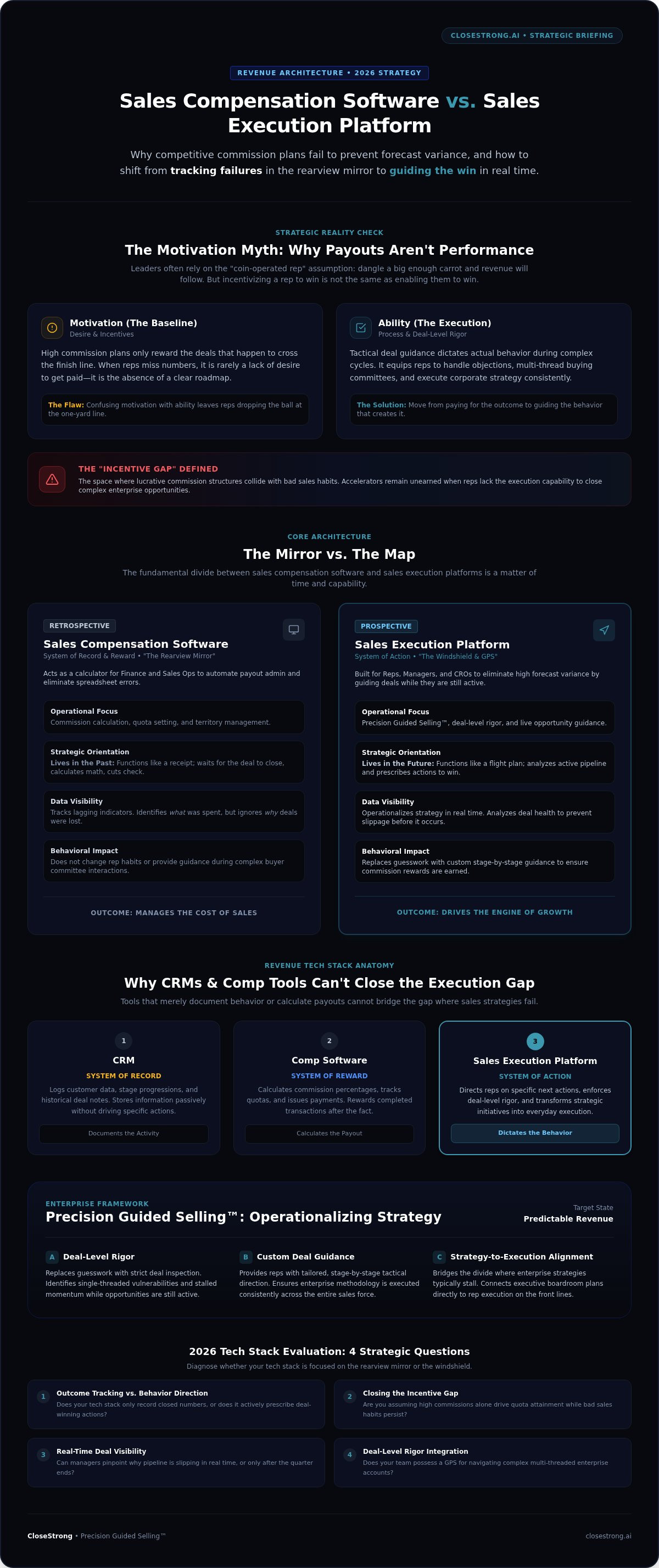
The first step toward hitting your 2026 targets isn't buying more software. It's auditing the software you already have. Look at your tech stack. Is it a tool for bookkeeping or a tool for battle? Most organizations are over-indexed on tracking and under-indexed on driving. They have perfect visibility into their failures but no mechanism to prevent them. When comparing sales compensation software vs sales execution platform, you must ask one question. Are we struggling to calculate the checks, or are we struggling to earn them?
You don't need a hybrid tool that does both poorly. You need a stack that addresses specific operational friction. If your back office is a mess, fix the math. If your front line is losing winnable deals, fix the execution. These categories can and should coexist. One manages the cost of your sales force; the other ensures that cost produces a return. It's not an either/or decision; it's a priority decision based on where your revenue is leaking.
You need to prioritize compensation software when the administrative burden of your success is breaking your finance team. If your operations professionals are drowning in manual spreadsheets every month, you have a scale problem. If your reps spend more time disputing their commission checks than they do prospecting, you have a trust problem. You need this tool to model new incentive structures for national rollouts without manual errors. It's about efficiency and accuracy in the reward process.
You need to prioritize a sales execution platform when your "best" deals are consistently slipping out of the quarter. This is a sign of deal-level rot. If your corporate strategy stays in the boardroom and never reaches the sales floor, you have an execution problem. You need a system that allows you to scale sales strategy execution without the chaos of manual coaching. When your win rates are flat despite a motivated team, the sales compensation software vs sales execution platform debate is over. You have enough motivation. You need more rigor.
Stop guessing why your forecast is off. If you are ready to move beyond passive tracking and start driving deal-level outcomes, it's time to see how a sales execution platform transforms your results.
In 2026, every one of your competitors has a decent product and a competitive commission plan. The "carrot" is no longer a secret weapon. It's table stakes. If your strategy relies solely on motivation, you've already lost. The only sustainable competitive advantage left in a crowded market is execution. This is where Precision Guided Selling™ changes the game. It moves beyond the passive tracking often found in the sales compensation software vs sales execution platform debate and enters the realm of real-time intervention. It's the difference between watching a recording of a crash and having a co-pilot who grabs the wheel.
Custom deal guidance is the antidote to the "hero culture" that plagues most sales orgs. You don't need one or two superstars to carry the quota. You need a system that replicates their logic across the entire team. CloseStrong's proprietary technology turns every rep into your top performer by providing the rigor that training alone cannot sustain. It doesn't just motivate them to win; it provides the mechanical steps to ensure they do.
Most tools analyze activity. They count emails. They track meetings. They log calls. Activity isn't progress. Precision Guided Selling™ analyzes deal health through the lens of execution, not just volume. It doesn't just tell you a deal is stuck; it tells the rep exactly how to move it forward. By providing actionable steps for high-stakes deals, it ensures every opportunity follows your proven winning methodology. It eliminates the "one-yard line" fumbles by providing the specific guidance needed to navigate complex buying committees. Guesswork is for amateurs. Rigor is for winners.
What is the value of a predictable forecast? For most CROs, it's the difference between a successful quarter and a disaster. By enforcing deal-level rigor, you reduce forecast variance to near zero. You stop hoping for the best and start engineering the outcome. This isn't just about closing more deals; it's about increasing average deal size through better strategic alignment. When every rep operates with the precision of your top performer, your bottom line reflects a reality that payouts alone can't deliver.
Choosing between sales compensation software vs sales execution platform isn't a technical choice. It's a leadership choice. One tool manages your expenses. The other manages your success. If you're tired of paying for effort and ready to start paying for wins, the path forward is clear. Precision isn't a luxury in 2026. It's a requirement for survival.
Motivation is the fuel; execution is the engine. You won't reach your 2026 revenue goals by simply paying for effort while ignoring the mechanics of the win. The choice between sales compensation software vs sales execution platform isn't just about adding another line item to your budget. It's about deciding whether you want to record history or dictate it. You must close the gap between your boardroom strategy and the rep's keyboard. Precision isn't a luxury. It's the only way to survive in a market that doesn't care about your excuses.
Stop rewarding the attempt and start ensuring the result. You have the choice to keep performing autopsies on lost deals or to operationalize your strategy on every single opportunity. It's time to move beyond passive tracking and embrace real-time rigor. By turning every rep into a top performer, you transform your forecast from a guess into a guarantee.
Stop guessing and start winning with CloseStrong's Precision Guided Selling™. Close more deals with custom deal guidance and eliminate forecast variance for good. You have the talent. Now give them the roadmap they need to dominate. Success is waiting. Go get it.
The main difference lies in timing and intent. Sales compensation software is a retrospective tool used to calculate payouts after a deal closes. It is a system of reward. In contrast, a sales execution platform is a prospective tool used to guide the deal while it is still active. It is a system of action. One tracks what you owe; the other ensures you actually win.
No, it is not a replacement. Your CRM is a digital filing cabinet, a system of record where you store contact data and history. CloseStrong does not sell CRM software. Instead, our platform sits on top of your CRM to turn that static data into actionable guidance. It transforms your CRM from a passive database into an active engine for winning high-stakes enterprise deals.
It improves accuracy by replacing rep gut feel with deal-level rigor. Most forecast variance comes from reps being overly optimistic about deals they aren't actually controlling. Precision Guided Selling™ forces a reality check on every opportunity by providing custom deal guidance based on your proven winning methodology. When every deal follows a strict execution path, your forecast becomes a reflection of reality rather than a wish list.
While it is designed for the complexity of enterprise sales, any organization with a multi-threaded sales cycle and high stakes can benefit. The debate of sales compensation software vs sales execution platform is most relevant for teams where losing a single deal impacts the quarterly goal. If your sales strategy is failing at the deal level, you need execution rigor regardless of your total headcount.
Reps use tools that help them make money. Unlike CRMs, which often feel like big brother monitoring, an execution platform provides immediate value through custom deal guidance. It tells them exactly what to do next to close the deal. When reps see that the platform helps them hit their accelerators faster, adoption stops being an issue. It is not admin work; it is a competitive advantage for their paycheck.
You will see deal-level clarity almost immediately. Within the first few weeks, managers can spot at-risk deals that were previously hidden by optimistic CRM statuses. Full revenue impact typically tracks with your average sales cycle. If your cycle is six months, you will see a measurable decrease in forecast variance and an increase in win rates within that window as the new rigor takes hold.
Yes. These tools are complementary, not competitive. Your compensation software handles the back-end math of payouts, while CloseStrong handles the front-end execution of the deals themselves. Integrating the two ensures that your incentive strategy is perfectly aligned with your deal-level execution. You use one to reward the win and the other to ensure the win actually happens in the first place.
The Execution Gap is the space where your expensive corporate strategy goes to die. It is the disconnect between the high-level playbook in the boardroom and the actual behavior of a rep on a sales call. Even with the best sales compensation software vs sales execution platform setup, if your reps don't have real-time guidance, they will fall back on old habits. Closing this gap requires deal-level rigor.


