





Most deal reviews are just expensive autopsies performed on dead revenue. You spend hours staring at CRM data that's more fiction than fact, wondering why your forecast looks like a work of creative writing. It's a waste of your time and your company's resources. This sales manager guide to deal ins...
Most deal reviews are just expensive autopsies performed on dead revenue. You spend hours staring at CRM data that's more fiction than fact, wondering why your forecast looks like a work of creative writing. It's a waste of your time and your company's resources. This sales manager guide to deal inspection isn't about watching the scoreboard; it's about guiding the play in real-time. Visibility without guidance is just watching your deals fail in high definition. You deserve better than a front-row seat to a train wreck.
You've likely accepted that "rogue" reps and gut-wrenching end-of-quarter surprises are just the cost of doing business. They aren't. They're symptoms of a broken process that prioritizes reporting over actual execution. This guide promises to move you past the "what happened" and into the "how we win" by enforcing a strategic framework that turns every rep into a playbook execution machine. We'll break down how to implement Precision Guided Selling™ to eliminate variance and drive predictable, high-quality revenue growth. It's time to stop inspecting the damage and start inspecting the execution.
• Stop performing autopsies on failed revenue and start using real-time inspections to correct failing deal strategies before the quarter expires.
• Use this sales manager guide to deal inspection to pivot from tracking activity volume to verifying the actual strength of the business case.
• Identify the "Invisible No" by mastering stakeholder mapping and enforcing strict adherence to your corporate sales playbook.
• Automate routine data hygiene checks to reclaim your meeting time for high-stakes "pressure testing" and strategic deal guidance.
• Close the execution gap by replacing passive observation tools with Precision Guided Selling™ to drive predictable revenue growth.
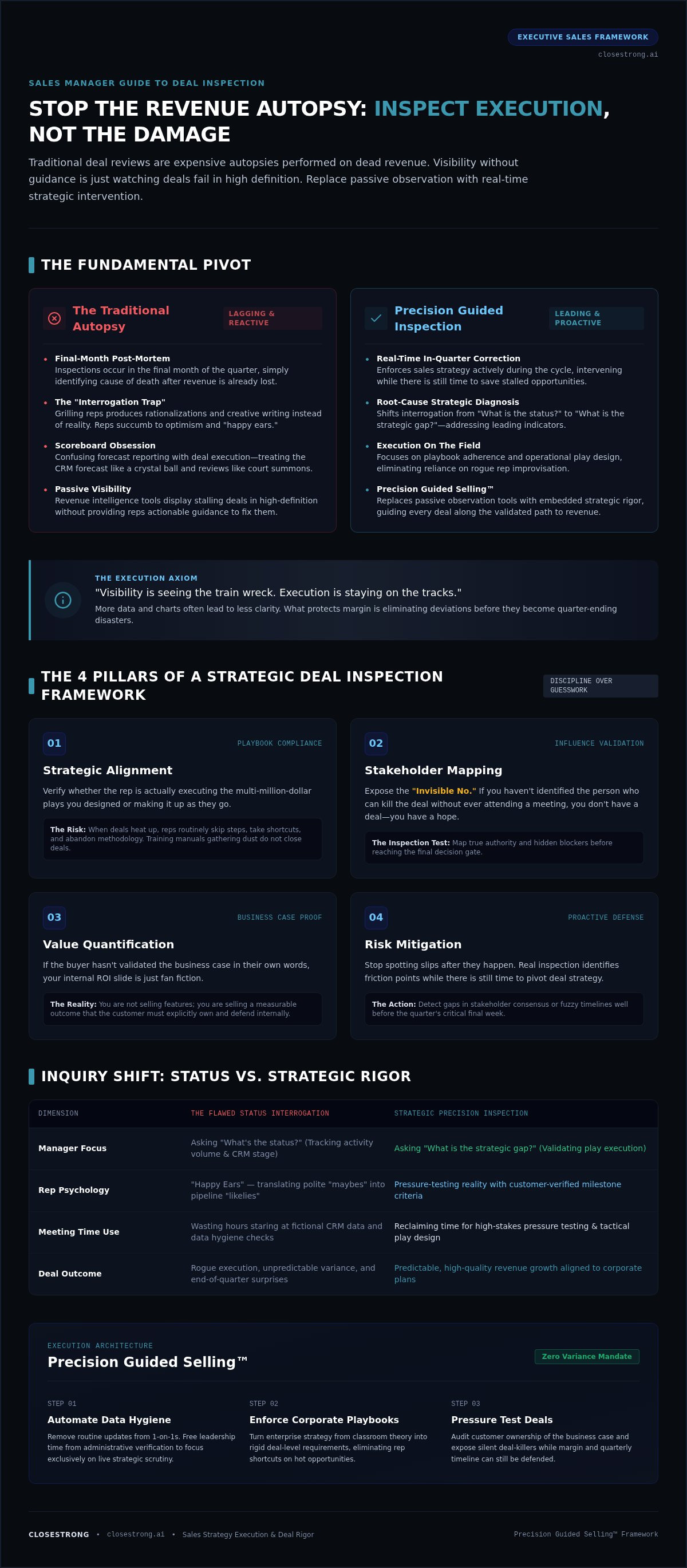
If your deal review happens in the final month of the quarter, it's not an inspection. It's an autopsy. You aren't managing revenue; you're just identifying the cause of death. Traditional deal reviews fail because they focus obsessively on what happened instead of how to fix it. This is the fundamental flaw in most sales organizations. They treat the forecast like a crystal ball and the deal review like a court summons. This sales manager guide to deal inspection is designed to flip that script. We're moving away from passive observation and toward active intervention.
We need to be clear on terms. Deal inspection is a proactive enforcement of sales strategy, not a retrospective data check. It's about ensuring your reps are actually executing the plays you've designed. Most managers confuse forecast management with deal execution. Forecast management is about the scoreboard. Deal execution is about the play on the field. If you only look at the score, you've already lost the game. Aligning your team with core sales management principles requires moving beyond the "what" and into the "how."
Traditional reviews are often less about strategy and more about interrogation. When you grill a rep on why a deal hasn't moved, they don't give you the truth. They give you a story. Reps lie to their managers, but more dangerously, they lie to themselves. This is the "happy ears" phenomenon. They hear a polite "maybe" and record it as a "likely." It's not a lie of malice; it's a lie of optimism. This creates a fictional pipeline that keeps you up at night. You must stop asking "What's the status?" and start asking "What is the strategic gap?" Status is a lagging indicator. Strategy is a leading one.
Visibility is seeing the train wreck. Execution is staying on the tracks. Modern revenue intelligence tools give you visibility in high definition, but they don't provide guidance. They show you that a deal is stalling, but they don't tell the rep how to save it. More data often leads to less clarity. You don't need more charts; you need better execution. The cost of the sales team execution gap in enterprise deals is staggering. Every time a rep goes rogue and ignores the playbook, your margin for error shrinks. Real deal inspection identifies these deviations before they become disasters. It ensures every deal follows the established path to revenue rather than hoping for a lucky break.
Rigorous inspection isn't a checklist. It's a discipline. Most managers treat deal reviews like a casual chat about the weather. This is a mistake. A true sales manager guide to deal inspection requires four non-negotiable pillars to move the needle. Without these, you're just guessing with more confidence.
Is the rep actually executing the plays you spent millions designing? Or are they making it up as they go? Methodology only works if it's applied to the deal, not just taught in a classroom.
Every enterprise deal has an "Invisible No." If you haven't identified the person who can kill the deal without ever attending a meeting, you don't have a deal. You have a hope.
If the buyer hasn't validated the business case in their own words, your ROI slide is just fan fiction. You aren't selling a product; you're selling a measurable outcome that the customer must own.
Stop spotting slips after they happen. Real inspection identifies friction points while there's still time to pivot. It's about seeing the gap in the stakeholder map or the lack of a clear timeline before the quarter's final week.
Reps are creative. In enterprise sales, that's often a liability. The moment a deal gets "hot," reps tend to ignore the playbook. They skip steps. They take shortcuts. They prioritize speed over strategy. This is where the execution gap widens. Your enterprise sales execution platform shouldn't be a suggestion. It must be the standard. Precision Guided Selling™ ensures that methodology isn't a training manual gathering dust. It's the active guidance that keeps every deal aligned with corporate goals. Not a loose guideline, but a rigid requirement for success.
Traditional tools look for signals. They track email opens and meeting counts. This is a distraction. High activity does not equal high strategy. You can send 100 emails to the wrong person and still lose. Real risk is often invisible to "signal-based" tools. Not this: tracking activity volume. But that: verifying strategic depth. Does the rep have access to power? Do they know who actually signs the check? This "Economic Buyer" test is a cornerstone of sales management best practices. We need to move beyond sales deal health software that only monitors scores. We need behavior change. This is the next level of the sales manager guide to deal inspection. If you want to see how this works in practice, you should explore our approach to deal guidance. Stop watching deals fail in high definition. Start guiding the execution that wins them.
Modern revenue intelligence has a fatal flaw. It confuses movement with progress. Most managers spend their week counting the number of emails sent or tracking meeting duration. This is "Activity Theater." It feels productive, but it's a distraction. Not this: monitoring activity volume. But that: verifying the quality of the business case. If you're relying on legacy conversation intelligence tools, you're looking at the past. These are after-the-fact tools. They tell you why you lost after the deal is already cold. A real sales manager guide to deal inspection focuses on guiding the future, not just recording the wreckage.
Activity is a proxy for effort, but strategy is the only proxy for outcomes. You can't close a deal on effort alone. You close deals on strategic alignment. When you focus on how many calls a rep made, you're managing behavior, not revenue. You're rewarding the wrong things. High activity without a clear business case is just a fast way to reach a "no." Stop celebrating the hustle and start scrutinizing the strategy. If the rep isn't following the playbook, the volume of their activity is irrelevant.
More CRM data doesn't lead to more predictable revenue. It leads to noise. You see a high volume of signals and assume the deal is healthy. You're wrong. You're confusing buyer interest with buyer intent. Interest is attending a demo. Intent is a champion risking their internal capital to build a business case. Signal-based tools often miss this distinction. They see "engagement" and give you a green light. To find the truth, you must filter out the noise and focus on strategic execution. Look for the milestones that actually indicate progress, not just the clicks that indicate curiosity.
The CRM is a database of record, not a guide for action. It's where data goes to die. Relying on it for execution is like trying to drive a car by looking in the rearview mirror. This is why complex B2B sales software must evolve. It can't just be a place for data entry. It must bridge the gap between the CRM and the actual sales conversation. You need an execution tool that provides deal-level guidance in real-time. Without it, your reps are just guessing, and you're just watching them fail. Deal inspection requires a tool that actively shapes the conversation, not just one that records it after the fact.
Most deal reviews are administrative theater. You sit in a circle and recite CRM fields that everyone can already see. It's a waste of talent. This sales manager guide to deal inspection demands a higher standard. We're here to scrutinize, not to summarize. A high-stakes review is about finding the truth, even when it's uncomfortable. If you aren't uncovering risks that the rep missed, you aren't inspecting; you're just auditing.
Data hygiene is a prerequisite, not a meeting topic. Automate the basic checks. If the close date is in the past or the amount is zero, fix it before the call. Your meeting time is for strategy, not data entry.
This is where you find the cracks. If a rep's story is too perfect, it's probably wrong. Push until you find the friction points.
Compare the rep's current actions to your established playbook. Identify exactly where the deal deviates from the winning path.
Define the "Precision Move." Not a vague follow-up, but a strategic maneuver designed to force a decision or uncover a hidden blocker.
Reps often hear what they want to hear. Your job is to listen for what they're missing. Start by asking: "What happens if the internal champion leaves tomorrow?" If the deal dies with them, you don't have a deal. You have a relationship. Follow up with: "Why would the prospect choose to do nothing?" Status quo is your biggest competitor. If the rep can't articulate the specific cost of inaction, the prospect won't either. Finally, ask: "Who is the competitor we haven't heard about yet?" There is always someone else in the room. If the rep says there isn't, they aren't looking deep enough.
Vague follow-ups are where revenue goes to die. "Checking in" is not a strategy. It is a nuisance. You must move from casual coaching to strategic execution steps. This is where precision guided selling software becomes a force multiplier. It provides real-time guidance that turns a standard review into a deal-closing workshop. Instead of manual mentorship that fails to scale across an enterprise team, you get automated rigor at the deal level. If you are ready to stop guessing and start implementing a deal scrutiny framework that works, it is time to change your approach to guidance. Turn your reviews into the engine of your revenue, not the exhaust.
Manual deal reviews are a bottleneck. You can't be in every meeting. You can't read every email thread. When you rely solely on your own intuition to catch slips, you're gambling with the company's revenue. CloseStrong changes this dynamic by turning your high-level strategy into granular, deal-level guidance. It's the difference between handing a rep a map and giving them a GPS. We don't just track what happened; we dictate what should happen next. This is how you eliminate the execution gap and ensure your playbook isn't just a document, but a living part of every deal.
This sales manager guide to deal inspection has highlighted the fatal flaw of visibility without action. Competitors want to sell you "signals." They want you to watch your deals fail in high definition. We reject that. Signals are just noise if your reps don't know how to respond to them. Precision Guided Selling™ is the cause of a healthy pipeline; a predictable forecast is merely the result. By automating the rigor of your inspection process, you move from a reactive state of damage control to a proactive state of strategic enforcement.
To be effective, sales execution tools for enterprise must be invisible. If a tool feels like another chore for the rep, they'll ignore it. If it feels like an unfair advantage, they'll live in it. The future of sales management isn't more manager-led interrogation. It is system-led execution. We are moving toward a world where the platform identifies the strategic gap and provides the guidance before the manager even enters the room. That's how you scale enterprise excellence.
We built CloseStrong for the deals that matter. These are the complex, multi-stakeholder, high-stakes enterprise plays where a single "rogue" move can kill a year's worth of work. We don't just monitor health scores. We guide reps through the closing process with surgical accuracy. By enforcing strategy on every deal, we help your team close more revenue with better outcomes. CloseStrong is the only platform designed to bridge the gap between your executive strategy and the gritty reality of deal-level execution.
Stop inspecting the past. It's gone. You can't change it. Start guiding the future. Your first move is to audit your current deal review process. Look for the "Activity Theater." If your meetings are spent reciting CRM fields, you're losing money. It is time to replace manual coaching with automated rigor. See how CloseStrong automates deal rigor with Precision Guided Selling™. Stop watching the scoreboard and start guiding the play.
You can keep performing autopsies on failed deals or you can start enforcing the strategy that wins them. This sales manager guide to deal inspection has laid out the path from passive observation to active intervention. Not this: watching signals and hoping for the best. But that: using custom high-quality deal guidance to ensure every rep executes the playbook with surgical precision. Visibility is a commodity. Execution is your competitive advantage.
Trusted by enterprise sales leaders for strategy execution, our Precision Guided Selling™ technology bridges the gap between your executive vision and the reality of the deal. Don't let another quarter slip away due to fictional CRM data or rogue reps who ignore the methodology. It's time to demand more from your process and your platform. Stop guessing and start closing with CloseStrong. You've already built the strategy. Now, give your team the tools to actually execute it. Success is a choice; make it today.
Deal inspection is about strategic enforcement; deal coaching is about skill development. Inspection asks if the rep followed the corporate playbook on a specific deal. Coaching asks how the rep can improve their overall delivery. You don't coach a pilot while the plane is crashing; you inspect the flight path. Effective sales management requires both, but inspection is the primary lever for closing the revenue gap in the current quarter.
You should perform deal inspections weekly for high-stakes enterprise accounts. Monthly reviews are too slow; quarterly reviews are just autopsies. Enterprise deals are complex and move fast. If you wait thirty days to inspect a deal, you've already missed the pivot point. Rigor requires frequency. This sales manager guide to deal inspection advocates for a consistent, high-velocity rhythm that identifies strategic deviations before they become unrecoverable forecast slips.
Look for the "Invisible No" and the missing cost of inaction. A major red flag is a rep who only has access to a "champion" but no line of sight to the economic buyer. If your rep can't explain why the prospect would choose to do nothing, they haven't validated the business case. These aren't just signals; they're structural failures. Real inspection exposes these gaps before the final week of the quarter.
Deal inspection rigor can be automated, but strategic nuance requires a manager. Precision Guided Selling™ technology automates the enforcement of your playbook at the deal level. It handles the "did they do it" so you can focus on the "how do we win." This shift moves your role from a data auditor to a strategic commander. System-led execution ensures that rigor happens on every deal, not just the ones you have time to review.
It improves accuracy by stripping the fiction out of your pipeline. Most forecasts are based on rep sentiment and "happy ears." Strategic inspection replaces gut feelings with objective evidence of playbook execution. When you verify the quality of the business case rather than just counting emails, the "surprises" disappear. You get a forecast built on strategic reality, not creative writing. This is the core of a modern sales manager guide to deal inspection.
CRM data is a database of record, not a source of truth. It's often filled with fictional dates and stagnant stages. In an effective inspection, CRM data serves as the starting point for a pressure test. You aren't there to read the fields; you're there to verify them. High-quality inspection exposes the gap between what's in the system and what's actually happening in the buyer's room. Data is the exhaust; execution is the engine.
Deals slip because the review was administrative theater, not a strategic pressure test. Most "successful" reviews focus on activity volume and positive sentiment. They fail to identify the "Invisible No" or the competitor who hasn't been mentioned yet. If your review doesn't uncover a strategic gap, you didn't run an inspection. You just sat through a story. Real rigor finds the friction points that reps are too optimistic to see.


