





In 2025, 87% of enterprises missed their revenue targets. Most leaders think they have a strategy problem. They don't. They have an execution problem. You spent months crafting a brilliant playbook, yet your reps are still "freestyling" every deal. High forecast variance and ignored methodologies ar...
In 2025, 87% of enterprises missed their revenue targets. Most leaders think they have a strategy problem. They don't. They have an execution problem. You spent months crafting a brilliant playbook, yet your reps are still "freestyling" every deal. High forecast variance and ignored methodologies aren't just annoying; they're symptoms of a broken system. You've been treating alignment like a quarterly meeting. It isn't. Alignment is a real-time behavioral requirement. It's time to stop talking about operationalizing sales strategy and start actually doing it at the deal level.
We all agree that a CRM is just a database; it's a rearview mirror that lacks the power to change outcomes in the moment. This article will show you how to close the strategy-to-execution gap for good. You'll learn how Precision Guided Selling™ transforms abstract initiatives into uniform, high-quality execution. We'll explore the shift from post-mortem analysis to real-time deal guidance that ensures every rep sells like your top performer. It's time to trade your "hope-based" forecast for predictable, scalable revenue growth.
• Stop treating alignment like a calendar event. Learn why true strategic alignment happens at the deal level, not in a conference room.
• Identify the "Execution Gap" where your best ideas go to die. Discover how to bridge the divide between top-down strategy and bottom-up field reality.
• Move beyond passive playbooks that gather digital dust. Master the mechanics of operationalizing sales strategy by codifying your winning way into real-time, actionable milestones.
• Stop relying on training that reps forget within 24 hours. Shift your focus from enablement to execution by providing guidance exactly when the rep needs it.
• Deploy the missing layer of your tech stack. See how Precision Guided Selling™ provides the high-quality deal guidance required to force-multiply your strategy across the entire team.
Corporate strategy usually lives in a glossy PowerPoint deck. It's built in a boardroom, presented at a kickoff, and then promptly ignored by the people actually talking to customers. This isn't just a failure of communication. It's a failure of execution. Strategic alignment is the bridge between what we plan and how we sell. If your reps can't execute your unique value proposition under the high-pressure heat of a live deal, you don't have a strategy. You have a wish list. True operationalizing sales strategy requires moving past the fluff of "shared vision" and getting into the grit of deal-level rigor.
Meetings don't create alignment. Shared KPIs don't create alignment. These are administrative band-aids for a systemic wound. Real alignment is about the mechanical consistency of every conversation your team has. It's about ensuring the "winning way" isn't a secret held by your top 5% but a repeatable standard for the entire floor.
Most leaders mistake a quota for a strategy. They aren't the same. A quota is a result; strategy is the specific set of behaviors required to achieve that result. When reps lack a clear, actionable path, they default to their own gut feel. They ignore the corporate playbook because it's too abstract to help them win a Tuesday afternoon discovery call. The cost of this misalignment is staggering. It shows up as lost deals, eroded margins, and a diluted brand that looks just like every other competitor. Without a disciplined approach to sales operations that prioritizes execution over theory, your strategy is just noise.
Traditional alignment advice is obsessed with the handoff. It focuses on lead quality and shared target lists. While that matters, it's not where the wheels fall off. The real execution gap happens after the discovery call. This is where the "what" of marketing meets the "how" of a complex sale. Most organizations think they've solved this with a database, but a database doesn't guide a rep through a difficult negotiation. Right now, your enterprise sales execution platform is likely invisible to your reps because it isn't integrated into their actual workflow. Operationalizing sales strategy means making the right behavior the easiest path for the rep to take in real-time.
Strategy is a top-down hallucination. Execution is a bottom-up reality. Most leaders build their playbooks in a vacuum, assuming that a clear directive will naturally translate into field success. It won't. Between the boardroom and the buyer, there's a "Fog of War" that swallows your best intentions. Managers are often flying blind, looking at CRM stages that tell them where a deal is, but never how it's being handled. This lack of visibility is the primary reason operationalizing sales strategy feels like an impossible task.
Strategy leaks out of a deal in three specific moments. First, in discovery, where reps settle for surface-level pain instead of digging for the business case. Second, during multi-stakeholder navigation, where the team clings to a friendly champion but fails to engage the economic buyer. Finally, at the closing table, where your unique value proposition is traded away for a desperate discount. If you aren't guiding these moments in real-time, you aren't managing; you're just spectating.
Your CRM is a graveyard of data, not an engine of execution. It's a system of record designed for accounting, not a system of guidance designed for selling. Reps view it as a "data entry tax" that slows them down rather than a tool that helps them win. Strengthening the links between strategy and sales requires moving past static databases. Modern complex B2B sales software must provide active, deal-level direction that tells a rep what to do next, not just what they did yesterday.
Rogue behavior is the enemy of scale. When every rep sells their own way, you don't have a sales organization; you have a collection of independent contractors. This inconsistency is the root cause of massive forecast variance. You can't predict revenue if you can't control the behavior that creates it. Hope is not a strategy, and gut feel is not a methodology. To fix this, you need a way to make your strategy the "path of least resistance" for every person on the floor. If you're ready to stop the leakage, exploring a dedicated enterprise sales execution platform is the first step toward reclaiming control of your deals.
Enablement is a passive sport. Execution is a contact sport. Most organizations dump millions into the former and wonder why the latter never improves. They provide content, recorded sessions, and "battle cards" that stay buried in a shared drive. This is because enablement is about training, while execution is about doing. One is theoretical; the other is operational. If you want to move the needle, you have to stop teaching reps what to think and start guiding how they act in the moment of truth.
The science of learning is brutal for sales leaders. Reps forget 70% of training within 24 hours. Your expensive three day bootcamp is a fading memory by the time your team hits the phones on Tuesday morning. This cognitive cliff is the primary obstacle to operationalizing sales strategy. You cannot train your way out of an execution crisis. Instead, you must evolve toward precision guided selling software that moves strategy from the classroom into the live deal. It's the difference between giving someone a map of the woods and providing a GPS that corrects every wrong turn in real-time.
The Sales Kickoff is a high-priced hype cycle. It's designed to build energy, but that energy has a shelf life that rarely lasts until February. Managers leave the SKO with a new PowerPoint deck; reps leave with a headache and a stack of stickers. Strategy fails because it isn't reinforced at the deal level. You don't need "just-in-case" learning that sits on a shelf. You need "just-in-time" guidance that surfaces the right move exactly when a rep is staring at a stalled pipeline. Execution happens in the trenches, not the auditorium.
Most strategic plans are built on a whiteboard and die in a spreadsheet. To change the outcome, you have to change the mechanics of the deal itself. Operationalizing sales strategy isn't about better slides; it's about better steps. You don't need a more detailed playbook. You need a more actionable execution layer. Here is how you force-multiply your strategy across the entire sales floor.
Stop using vague terminology. Turn your strategy into actionable deal milestones that every rep must hit to move forward.
Replace passive playbooks with real-time direction. If a rep has to leave their workflow to find an answer, you've already lost the moment of truth.
Stop measuring activities like "emails sent." Start measuring strategic outcomes, such as "economic buyer identified" or "business case validated."
Use strategic deal coaching software to replicate high-quality coaching across every single opportunity in your pipeline.
Use deal data to refine your strategy. If your "winning way" isn't winning, the data will tell you why before the quarter ends.
A methodology you can't measure is just a suggestion. If you cannot measure adherence, you do not have a methodology. You have a culture of "doing your best," which is unscalable. To fix this, you must translate high-level strategy into specific If/Then deal guidance. If the buyer mentions a competitor, then the rep must pivot to X. If the deal is over a certain threshold, then specific stakeholders must be involved. True sales team strategy alignment requires a single source of truth for what "good" looks like in every deal.
Your managers are your biggest bottleneck. They cannot be in every meeting, and they shouldn't try to be. Instead, technology must act as their proxy, providing real-time guardrails for the team. This allows leaders to spot deal risk before it hits the forecast, rather than performing an autopsy after the loss. Data-driven guidance beats managerial intuition every time. It’s the only way to ensure operationalizing sales strategy happens at scale. Ready to see how this works in practice? Explore our enterprise sales execution platform today.
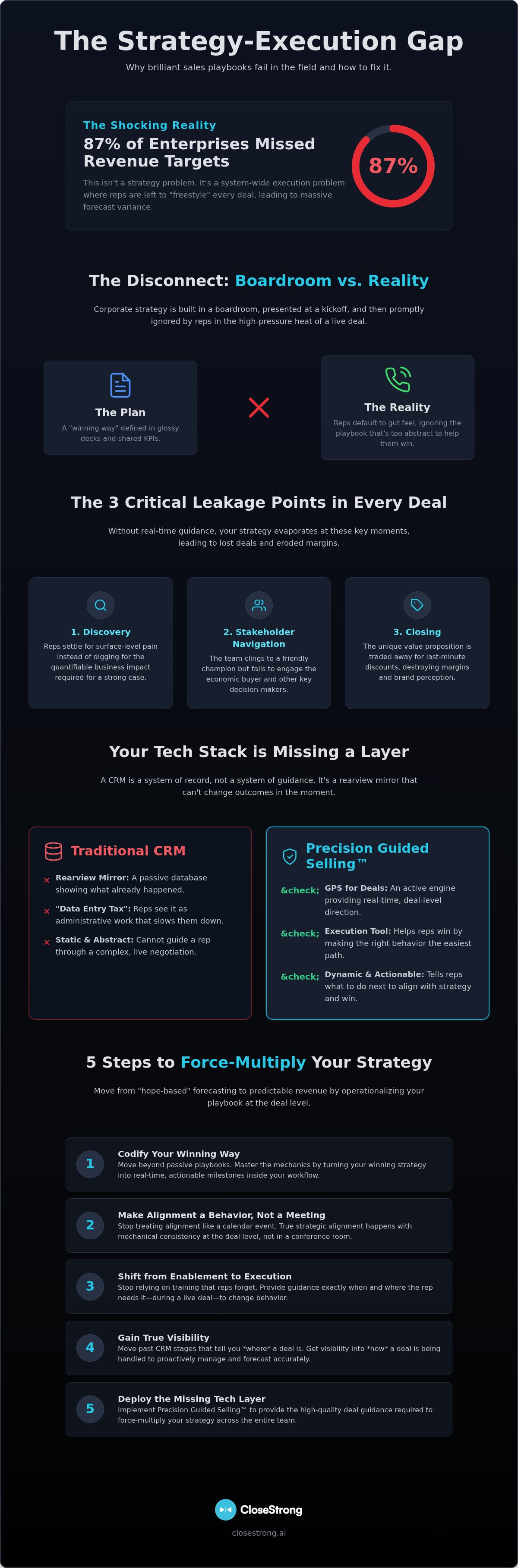
Most sales tech stacks are fundamentally incomplete. You have a database for records and a dashboard for results, but you're missing the layer that actually drives the work. This is the Execution Layer. It’s where the high-level theory of the boardroom meets the high-stakes reality of the deal. Without it, operationalizing sales strategy is just a dream. Precision Guided Selling™ is the technology that makes that dream a mechanical reality. It doesn’t just store data; it dictates action. It isn't a passive library of content; it's an active engine of behavior.
In complex enterprise sales, "good enough" is a recipe for a lost deal. You need more than a generic process. You need custom, high-quality deal guidance that adapts to the specific nuances of every opportunity. Precision Guided Selling™ translates your abstract strategy into deal-level actions that reps can't ignore. It provides the guardrails that keep your team from drifting into rogue behavior. This is why enterprise sales execution platforms are no longer optional. They are the only way to ensure that what you planned in January is actually what’s happening in June.
The goal isn't just to have a few superstars. The goal is to ensure every rep sells like your top 5%. When you embed strategy directly into the workflow, you eliminate the "guessing game" that plagues most sales floors. This level of strategic rigor significantly reduces ramp time for new hires. They don't have to spend six months "learning the ropes" through trial and error. Instead, the strategy is built into the tool they use every day. Beyond software, scaling a high-performance team often requires robust HR infrastructure, which you can explore when you visit Sullivan Group HR. We are ending the era of rogue selling and beginning the era of disciplined, scalable execution. Operationalizing sales strategy becomes the default setting, not a manual effort.
Stop asking for alignment. Start demanding execution. The market is too crowded and the stakes are too high to rely on hope as a management style. In 2025, 87% of enterprises missed their revenue targets because they couldn't control what their reps were doing in live deals. The winners of 2026 will be the leaders who stop treating strategy like a PowerPoint deck and start treating it like a real-time requirement. If you can't control the deal-level behavior of your reps, you can't control your revenue. It’s that simple. Ready to stop guessing? See how CloseStrong enforces your strategy on every deal.
Most sales leaders are exhausted by corporate excuses. They're tired of the "freestyling" that led to 87% of enterprises missing their revenue targets in 2025. You’ve seen why traditional alignment is a myth and why your playbook is likely gathering dust in a shared drive. Strategy isn't something you talk about once a year; it's something your reps must execute every single hour. Operationalizing sales strategy means moving from post-mortem autopsies to real-time, deal-level rigor. It's the difference between hoping for a result and engineering it.
Stop treating sales as an unpredictable art form. Start treating it as a disciplined, mechanical science. You must bridge the gap between your boardroom vision and the gritty reality of the discovery call. By deploying Precision Guided Selling™ technology, you provide the custom deal guidance your team needs to win under pressure. This isn't about another dashboard; it's about an enterprise-grade execution focus that ensures every rep on your floor sells like your top 5%. You have the plan. Now, build the team that finally executes it.
Stop the finger-pointing and start executing; discover CloseStrong today.
Business strategy is the destination; sales strategy is the engine. Alignment happens when corporate goals are translated into specific, deal-level behaviors. It isn't about a shared vision statement or a quarterly meeting. It's about codifying your unique value proposition into the actual steps a rep takes during discovery and negotiation. If your reps aren't executing the strategy in live deals, the strategy doesn't exist.
The biggest challenge is the "Execution Gap" between the boardroom and the field. Most leaders assume a PowerPoint deck equals a plan. It doesn't. Reps default to their own gut feel because your strategy is too abstract to help them win a Tuesday afternoon call. Without a system to enforce strategic rigor, your team will always prioritize their own habits over your corporate playbook.
You don't motivate them with speeches; you make the strategy the path of least resistance. Reps follow what helps them win deals and hit quota. If your strategy is a burden, they'll ignore it. If it's embedded in their workflow as real-time guidance, they'll adopt it. Success is the best motivator. Show them that operationalizing sales strategy leads to higher win rates and bigger commissions.
Enablement is about training; execution is about doing. Enablement provides the map, but execution is the actual driving. Most companies over-invest in passive training that reps forget within 24 hours. Execution focuses on the mechanics of the deal itself. It's the difference between teaching a rep how to handle an objection in a classroom and guiding them through it during a live negotiation.
Strategies fail because they are "just-in-case" rather than "just-in-time." You give reps a 50-page playbook and expect them to remember it under pressure. They won't. Strategies die in the "Fog of War" of complex deals where surface-level pain takes precedence over strategic value. If your strategy isn't visible and actionable at the deal level, it's just noise that reps tune out to survive.
Technology acts as a real-time guardrail for behavior. It shouldn't just record what happened; it should dictate what happens next. By operationalizing sales strategy through a dedicated execution platform, you remove the guesswork. Technology scales manager impact by providing the custom deal guidance that leaders can't provide personally for every single opportunity. It turns your strategy from a static document into a dynamic deal engine.
Precision Guided Selling™ is the technology layer that translates corporate strategy into deal-level actions. It doesn't just store data like a CRM; it provides active, high-quality guidance for every rep. It ensures that every conversation follows your "winning way" by surfacing the right milestones and maneuvers in real-time. This creates a uniform standard of execution that makes revenue growth predictable rather than accidental.
Stop measuring activities and start measuring strategic outcomes. Alignment isn't about how many emails were sent; it's about whether the rep identified the economic buyer or validated the business case as defined by your methodology. You measure alignment by tracking adherence to strategic deal milestones. If the rep is hitting the strategic marks you've codified, they are aligned. If they aren't, they're just "freestyling" your forecast.


