





What if the deals stalling in your pipeline aren’t a rep problem, but a process problem? Common sales process bottlenecks include stalled handoffs, inconsistent discovery, and opportunities that linger without a clear next step. These are symptoms. Treating each one in isolation can hide the root ca...
What if the deals stalling in your pipeline aren’t a rep problem, but a process problem? Common sales process bottlenecks include stalled handoffs, inconsistent discovery, and opportunities that linger without a clear next step. These are symptoms. Treating each one in isolation can hide the root cause.
It’s frustrating when opportunities slow between stages and nobody can explain why. Reps may be working hard while following different playbooks. When results vary, leaders need to know whether the process is failing or an individual needs support. The answer isn’t to blame the rep or add technology and hope for the best. It’s to find where execution breaks down.
This article explains how to locate friction across the sales process, distinguish visible symptoms from underlying causes, and prioritize fixes that support deal progression. We’ll look at where deals commonly stall, what to check before changing the process, and how clear guidance or an enterprise sales execution platform can help reps apply strategy consistently to individual deals.
• Trace where deals lose momentum, from qualification and evaluation to approvals and cross-team handoffs.
• Use evidence from multiple opportunities to distinguish process ambiguity, skill gaps, buyer constraints, and inconsistent execution.
• Match the response to the root cause instead of treating every stalled deal as a rep performance issue.
• Prioritize common sales process bottlenecks by how often they occur and how directly they impede deal progression.
• Choose documentation, manager-led reviews, or deal-level guidance based on what reps need to execute the process consistently.
Opportunities sit in the pipeline. Reps log calls, update records, and keep the forecast current, yet deals still don’t move. A busy CRM isn’t proof of progress. A sales process bottleneck is a recurring point where deal progress, decision-making, or ownership slows down. The delay is visible, but its cause may not be.
A bottleneck is a repeated slowdown in the sales journey. The stalled deal is the symptom, not the diagnosis. The cause could be unclear stage expectations, a missed buyer requirement, an approval delay, or inconsistent execution. The sales process typically moves through defined stages, but teams need to examine how work and decisions actually pass between them, not just what the pipeline labels say.
One delayed opportunity may have a buyer-specific reason. A bottleneck is more likely when similar delays recur at the same stage, handoff, approval, or customer decision. Compare stalled deals with opportunities that moved through the same point. Did the successful deals reach the right stakeholders earlier? Was ownership clearer? Look for a repeatable difference before changing the process. A missed date alone doesn’t show that the process is broken.
Start with patterns that suggest lost momentum: opportunities repeatedly aging in one stage, records without a clear buyer-facing next step, or decision-makers appearing late in the cycle. Inconsistent qualification and deal reviews are also worth investigating. They may point to unclear guidance, different deal conditions, or a skill gap. Treat them as signals, not conclusions.
Activity volume can’t settle the question. Calls and emails show that work was recorded, not that the buyer made a decision or agreed to a next step. Look for evidence of movement, such as confirmed priorities, access to relevant stakeholders, or a defined decision path. For example, if several deals reach evaluation without agreement on who will assess the solution or how, the stalled stage is a clue. The cause still needs validation.
That distinction matters. Treat every slow deal as a process failure and you may overcorrect. Treat every delay as an individual performance issue and you may miss an obstacle affecting the whole team. Start by asking whether the slowdown repeats, where it occurs, and what changed in the deals that kept moving.
Deal momentum can break at any stage, but the visible delay doesn’t tell you who or what caused it. A buyer may be waiting on internal alignment. Your team may have left a question unanswered, a handoff unowned, or an approval path undefined. Identify who controls the next move before choosing a fix. Pushing a buyer won’t resolve an internal ownership gap.
Early friction often starts with a weak fit check or an incomplete problem definition. A prospect may express interest, but that doesn’t confirm urgency, business impact, or a reason to change. If discovery stays at the surface, the team may advance an opportunity without understanding which outcomes matter or how the buyer will evaluate options. Validate priorities, impact, and timing before treating interest as readiness.
The same discipline matters during evaluation. If decision criteria weren’t established in discovery, buyers may introduce new requirements, compare options on different terms, or revisit the problem itself. The visible symptom is a deal circling in evaluation. The underlying cause may be an assumption that went untested earlier. For broader context on the demands of enterprise workflows, see complex B2B sales software.
Handoffs create risk when marketing, sales, specialists, and leadership contribute without clear ownership. A specialist may answer a technical question while the account representative assumes the specialist owns follow-up. The buyer hears nothing. Assign a named owner to each next step, and make the handoff’s purpose and expected outcome explicit.
Buyer-side consensus is a separate challenge. A supportive contact may not represent everyone who can shape or approve the decision. If finance, IT, procurement, or other stakeholders surface late, the team may need to revisit requirements and restart parts of evaluation. Map who influences the decision, what each person needs, and how the group will reach agreement.
Final approval isn’t one generic hurdle. Procurement may review commercial terms, legal may assess contract language, and executives may weigh strategic priority or risk. Treat each as a distinct process: identify the responsible buyer, required information, open questions, and agreed next step. These are common sales process bottlenecks, but the right fix depends on whether the delay sits with the buyer or the seller.
When you’ve identified a recurring internal execution gap, an enterprise sales execution platform may help teams apply company strategy more consistently to individual deals. First diagnose the bottleneck so you can assess whether the platform addresses it.
A deal stuck in the same stage is a symptom, not a diagnosis. The cause might be vague stage criteria, a rep struggling to apply the process, a buyer unable to align internally, or inconsistent execution from one opportunity to the next. Common sales process bottlenecks can look alike in a pipeline report. The evidence, and therefore the right response, can differ.
| Visible symptom | Possible root cause | Evidence to inspect | Suitable response |
|---|---|---|---|
| Deals advance with little buyer evidence | Unclear stage definitions or exit criteria | Compare documented criteria with what reps record before advancing | Clarify stages, required evidence, and decision rules |
| One rep repeatedly misses key steps | Skill gap or difficulty applying guidance | Review active opportunities and ask the rep to explain their next move | Provide focused support or deal-level guidance |
| Several deals pause after buyer evaluation | Buyer-side constraints, such as unresolved priorities or approval requirements | Check stakeholder input, decision criteria, and the buyer’s agreed timeline | Help clarify the decision path, or reset expectations where needed |
| Reps handle similar deals in different ways | Inconsistent execution or guidance that isn’t usable in context | Compare actions and deal plans across similar opportunities | Reinforce shared expectations and support consistent application |
Start with the standard: do stage definitions specify buyer evidence and meaningful exit criteria? Then compare those written expectations with actions on active deals. If the guidance is missing or ambiguous, the process needs work. If it’s clear but applied unevenly, execution may be the issue. Interview reps and review a range of opportunities before deciding. One unusual deal won’t reveal a reliable pattern.
Don’t assume every delay belongs to the seller. A buyer’s budget review or internal disagreement may slow progress even when the team has followed its process. Look for evidence that separates seller-controlled actions from buyer-controlled decisions. This helps leaders avoid changing a sound process to solve a buyer constraint, or blaming a rep for an unclear internal rule.
Clarify the process when teams lack shared stages, ownership, or decision rules. Rewriting documentation won’t help much if expectations already exist and reps struggle to apply them to active opportunities. In that case, deal-level guidance can help translate strategy into actions for a specific opportunity. An enterprise sales execution platform can support that connection between strategy and execution.
Software alone won’t repair an unclear or unused process. Fix the underlying rule first, then consider whether technology can help teams follow it. Technology supports execution; it can’t replace sound strategy, buyer evidence, or human judgment.
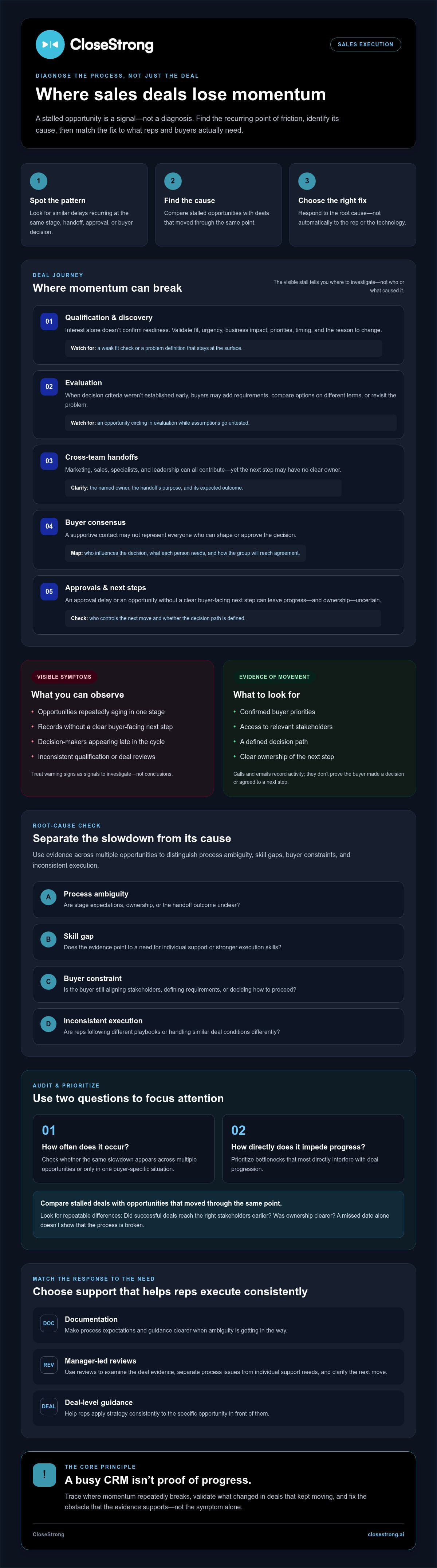
A useful audit doesn’t start with a dramatic deal that went sideways. It starts with repeatable evidence. Map how opportunities move in practice, find where progress repeatedly slows, then test what’s causing the delay before changing the process. This prevents a single anecdote from driving a fix that doesn’t address the wider pattern.
Map the buyer and seller actions required to move each stage forward. Then review a representative set of opportunities, including deals that stalled and deals that progressed. Look for recurring signs such as longer stage duration, repeated extensions, rework, or next steps that remain undefined. Ask reps and managers where work waits, but treat their observations as leads to investigate, not proof.
Use a simple sequence:
Record the actions and evidence expected at each transition.
Compare opportunities for recurring delays, handoff gaps, or rework.
Check deal records and review conversations with the people involved.
Assign an owner and change the process or execution support to fit the evidence.
Check whether the expected behavior changed, then revisit the diagnosis if it didn’t.
Define a small set of observable indicators before making a change. For a handoff problem, check whether an owner and next action are clear. For a stage-advancement issue, inspect whether the required buyer evidence is present. Set a review point in advance so the team can compare what happens after the intervention with what it observed before.
Be careful with activity counts and deal-health scores. They can flag something worth examining, but they don’t explain whether a buyer has made progress or why a deal is stuck. Sales deal health software is most useful alongside the context behind each opportunity, not as a substitute for evidence.
Rank possible issues using three tests: how often they recur, how directly they impede buyer progress, and how strong the supporting evidence is. A frequent, well-documented delay deserves attention before a one-off complaint with an uncertain cause. Choose one focused change, name an owner, and avoid launching several initiatives at once. If the expected behavior doesn’t change by the review point, revisit the diagnosis rather than automatically doubling down.
If your audit shows that reps need help applying company strategy to individual opportunities, explore CloseStrong’s approach to deal-level execution.
Deal guidance is worth considering when the sales strategy and process are clear, but reps still struggle to apply them consistently to specific opportunities. A playbook can explain what good execution looks like. It may not resolve what a rep should do next when a buyer’s priorities shift, a stakeholder raises an objection, or the decision path changes. That’s the gap between having guidance and applying it in a live deal.
There’s no single right delivery method. Documentation can work when expectations are straightforward and easy to find. Manager-led reviews provide human judgment and room to discuss deal context, but depend on managers being available and applying guidance consistently. Platform-based deal guidance may suit teams that need strategy translated into actions for individual opportunities. None of these options fixes an unclear process by itself.
Start with fit, not features. Ask whether the guidance reflects your company’s strategy and applies to situations reps actually face. Check how it supports sellers through the closing process, and whether representatives can use the guidance in their real deal work. Ask vendors to explain workflow fit and verify any integration or implementation claims directly. Don’t assume compatibility or capabilities that haven’t been confirmed.
Match the platform’s role to a validated cause. If the problem is buyer-side delay, unclear stage criteria, or an approval rule the team hasn’t defined, more deal guidance may miss the mark. If reps understand the process but struggle to turn it into consistent actions across opportunities, it may be a better fit. Involve sales leaders and representatives in reviewing real, representative deal scenarios.
Before evaluating an intervention, define what adoption and execution should look like. For example, decide what evidence would show that reps are applying the agreed strategy to opportunities, and how you’ll review that evidence. Results depend on the team’s process, adoption, and fit. A platform supports execution; it doesn’t replace sound strategy or judgment.
CloseStrong provides an enterprise sales execution platform using Precision Guided Selling™ and custom deal guidance to help teams apply company strategy to individual deals. If your diagnosis points to inconsistent deal-level execution, explore CloseStrong and assess whether its approach fits the need.
Common sales process bottlenecks are signals to investigate, not reasons to assign blame. Find where deals repeatedly lose momentum, then use opportunity evidence to distinguish process gaps, inconsistent execution, and buyer-side delays. Choose a focused fix and review whether it changes the behavior you set out to improve.
Technology can support consistent execution, but it won’t repair a process that’s unclear or unused. CloseStrong’s enterprise sales execution platform uses Precision Guided Selling™ technology and custom, high-quality deal guidance to connect company strategy with actions on individual deals.
If your diagnosis points to a need for deal-level guidance, explore CloseStrong’s enterprise sales execution platform and assess whether it fits your team’s needs. Start with the real source of friction to give deals a clearer path forward.
Identify common sales process bottlenecks by looking for repeated delays across opportunities, not by diagnosing one stalled deal. Compare deals that progress with those that pause, then inspect stage changes, handoffs, next steps, and the buyer evidence recorded. Ask representatives and managers where work tends to wait, and check those observations against opportunity records. Prioritize a cause only when deal evidence and team feedback both point to a recurring pattern.
Common examples include weak qualification, incomplete discovery, unclear stage expectations, missed handoffs, late stakeholder alignment, and slow internal approvals. These are patterns to investigate, not a checklist of universal causes. The same symptom, such as a deal lingering in evaluation, could reflect unclear buyer criteria or inconsistent seller execution. Before choosing a fix, identify where buyer progress stops, what information or decision is missing, and who owns the next action.
Deals often stall because priorities, decision criteria, or the buyer’s approval path remain unclear. Key stakeholders may be absent, or the buyer and seller may leave a meeting without agreeing on the next step. Internal handoffs and approval processes can also slow momentum. Pipeline status alone won’t reveal which issue is at play. Review the last meaningful buyer action, unresolved questions, decision criteria, and the person accountable for moving the opportunity forward.
Start by mapping how work moves through the existing process and locating repeated waits, handoff gaps, or rework. Clarify what evidence is needed to advance each stage, who owns each transition, and what a useful next step looks like. Then test one focused change across representative opportunities and review what happens. Add software only if a validated execution need remains. A new tool won’t resolve unclear expectations by itself.
Automation can help with repetitive work when the task and its rules are already clear, but it can’t repair a flawed process or replace sound deal judgment. It won’t establish whether qualification criteria are useful or create alignment among a buyer’s stakeholders. First diagnose the delay. Then decide whether process clarification, automation, manager support, or deal-level guidance fits the cause. Before adopting a platform, verify that it supports the workflow your team actually needs.
Measure friction using indicators tied to its suspected cause, such as repeated stage extensions, missing next steps, or delayed handoffs. Define each indicator and record a baseline before changing the process. Review a representative group of opportunities, then combine pipeline evidence with feedback from the people involved. Don’t treat one metric as proof. Check whether the expected execution behavior changed and whether buyers are making progress through the decision process.
Consider deal guidance software when your process and strategy are clear, but representatives struggle to apply them consistently to complex opportunities. First confirm that inconsistent execution is recurring rather than assuming a technology gap. Compare options using real deal scenarios: does the guidance reflect company strategy, address individual deal situations, and support reps through the closing process? CloseStrong provides an enterprise sales execution platform using Precision Guided Selling™ and custom deal guidance. Verify fit and product claims with the provider.


