





What if the fastest path to sales forecast accuracy improvement is to stop asking reps to sound more certain? Forecast calls often surface bad news too late, while CRM stages and confident updates can make a deal look healthier than buyer evidence supports. More optimism won’t fix that. Better input...
What if the fastest path to sales forecast accuracy improvement is to stop asking reps to sound more certain? Forecast calls often surface bad news too late, while CRM stages and confident updates can make a deal look healthier than buyer evidence supports. More optimism won’t fix that. Better inputs will.
If you’re tired of forecast surprises and spreadsheets that still can’t tell you what will close, the frustration is justified. A complex deal isn’t automatically a risky one, and a confident rep isn’t proof of buyer commitment. Leaders need a consistent way to separate facts from assumptions before the forecast is on the line.
This article shows how to diagnose forecast errors, assess deal commitments using verifiable evidence, and turn what you learn into action. You’ll see how to test whether a deal’s timing and next steps are grounded in buyer behavior, spot patterns behind over- or under-forecasting, and build a repeatable review process. The goal isn’t perfect predictions. It’s a dependable forecast that gives your team time to respond.
• Measure forecast accuracy against actual results over a clearly defined period. Don’t confuse it with quota attainment or rep confidence.
• Test stage updates against buyer actions. Stale close dates and unverified assumptions can make a rollup look stronger than the evidence.
• For sales forecast accuracy improvement, compare results consistently and trace each variance to its likely source before changing the process.
• Use a repeatable review cadence to challenge assumptions, confirm what changed, and assign a clear next action for each deal.
• CloseStrong’s enterprise sales execution platform uses Precision Guided Selling™ to provide custom deal guidance that helps turn forecast insight into action for representatives.
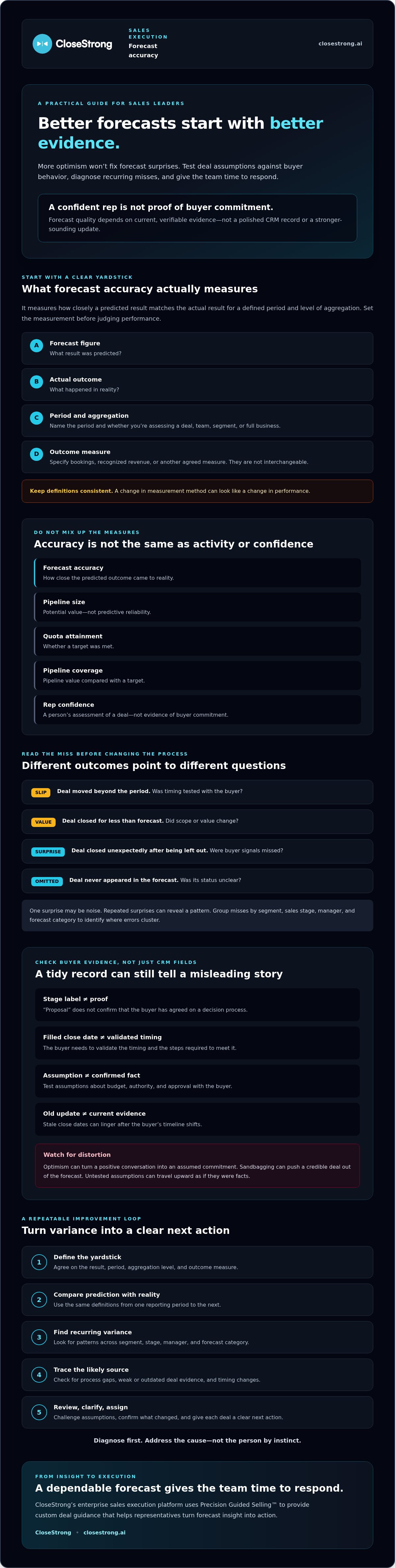
A forecast miss is a signal, not a diagnosis. Before changing stages, adding spreadsheet columns, or pressing reps for firmer commitments, define what the forecast was supposed to predict. Without that baseline, the team can’t tell whether the problem was weak evidence, a shifting deal, inconsistent definitions, or a mismatch between the forecast and the measure being judged.
Forecast accuracy measures how closely a predicted result matches the actual result for a defined period and level of aggregation. State all four parts: the forecast figure, the actual outcome, the period being measured, and whether you’re assessing an individual deal, a team, a segment, or the full business. Also specify the outcome, such as bookings, recognized revenue, or another agreed measure. These aren’t interchangeable.
Use the same definitions from one reporting period to the next. Otherwise, a change in measurement method can look like a change in performance. The Demand forecasting overview discusses forecasting and measuring forecast accuracy. The practical rule is simple: define the yardstick before judging the result.
Forecast accuracy measures how close the predicted outcome came to reality. Pipeline size measures potential value, not predictive reliability. Quota attainment tells you whether a target was met. Pipeline coverage compares pipeline value with a target. Rep confidence reflects a person’s assessment of a deal. Each can inform a review, but none substitutes for forecast accuracy.
Don’t treat every miss as the same problem. A deal may slip beyond the period, close for less than forecast, close unexpectedly after being left out, or never appear in the forecast. Each outcome raises a different question. Was timing untested? Did scope or value change? Were buyer signals missed? Was the deal omitted because its status was unclear?
One surprise may be noise. Repeated surprises can reveal a pattern. Group misses by segment, sales stage, manager, and forecast category to see where errors cluster. For example, repeated slips in one segment may point to timing assumptions that don’t hold there. Consistent misses in a forecast category may suggest its criteria are too loose.
That’s where sales forecast accuracy improvement starts: tracing recurring variance to its source, not assigning blame by instinct. Check whether the cause was a process gap, weak or outdated deal evidence, or a timing change. Then address the cause. A rep may have made a poor call, but the forecast system may also have failed to define what qualifies as a commitment. Diagnose first, then act.
A CRM record can be complete and still tell a misleading story. A deal may have an owner, value, stage, and close date, yet the forecast can rest on assumptions nobody has tested with the buyer. Fields capture information. They don’t prove that information is current or accurate.
Stage labels create false confidence when treated as evidence by themselves. “Proposal” doesn’t confirm that the buyer has agreed on a decision process. A close date isn’t solid just because it’s filled in. The buyer needs to validate the timing and the steps required to meet it. A reliable sales forecast depends on sound inputs, not simply tidy records.
People can distort those inputs, too. Optimism can turn a positive conversation into an assumed commitment. Sandbagging can push a credible deal out of the forecast to make a later result look safer. Stale close dates linger after the buyer’s timeline shifts. Untested assumptions about budget, authority, or approval can then travel upward into the rollup as if they were facts.
Forecast risk grows when internal confidence outruns buyer-confirmed evidence. That’s the distinction leaders need to hold onto. A complex deal may carry real uncertainty, but uncertainty isn’t the same as an information gap the team could have uncovered earlier. Risk becomes avoidable when warning signs go untested or a blocker surfaces only at forecast time.
Enterprise deals involve moving parts: multiple stakeholders, procurement, legal review, competition, and buying steps that may not be visible to the seller. Complexity alone doesn’t make a deal unhealthy. The danger is an unresolved step with no owner, no buyer-confirmed timing, or no plan to clear it. A late legal review or an unengaged decision-maker can push timing or affect the likelihood of closing, even when the opportunity is in a late stage.
Look beyond a simple health label. Ask who has confirmed the next step, what could block it, and when the team will know whether the assumption holds. For a deeper look at why deal-level visibility matters beyond a score, see sales deal health software and deal-level visibility.
For sales forecast accuracy improvement, the answer isn’t to label every complicated deal as risky or demand louder confidence from reps. It’s to expose missing buyer evidence early enough to respond. Teams that want to turn deal findings into representative actions can explore CloseStrong’s enterprise sales execution platform, which uses Precision Guided Selling™ to provide custom deal guidance.
A forecast number tells you whether the team was right. Variance analysis helps explain why it wasn’t. To make the comparison useful, match the forecast and actual result to the same period, sales population, and outcome. Then examine what changed in the deals behind the total.
Choose a formula that fits your reporting needs and document it before comparing periods. One common approach is percentage error: (forecast minus actual) divided by actual, multiplied by 100. The sign shows whether the forecast was higher or lower. Absolute percentage error shows the size of the miss without its direction. Absolute variance is the raw difference between forecast and actual.
There’s no single formula every team must use. What matters is applying the same method to the same sales population and period. Decide how to handle edge cases in advance. If actual sales are zero, for example, percentage error cannot be calculated by dividing by actual. Document whether the team reports the absolute variance separately or uses another agreed treatment.
The table below uses illustrative figures. It shows how a variance can prompt an investigation, not prove its cause.
| Forecast | Actual result | Variance | Likely source to investigate |
|---|---|---|---|
| 100 units | 80 units | 20 units above actual | Deals slipped or closed for less than forecast |
| 60 units | 75 units | 15 units below actual | Deals closed unexpectedly or were omitted |
Use saved forecast snapshots, not memory. Compare what the team predicted at a consistent point in each period with the final outcome. Then review forecast category, close-date changes, deal value, and documented buyer evidence. Did the buyer confirm the timing? Did the expected value change? Did a deal move categories without a new buying signal?
Look across periods for recurring patterns. Repeated slips suggest timing assumptions may be weak. Consistent deal-size reductions point to value estimates worth testing. Differences in stage conversion or segment results may expose criteria that need closer review. While teams can analyze these trends manually, leveraging business analytics platforms like Nodal AI can help uncover operational patterns and actionable insights across organizational data. A single miss can be noise; a repeated pattern gives leaders a place to investigate.
Better accuracy doesn’t mean eliminating uncertainty. It means surfacing assumptions sooner, while there’s still time to question them and act. That’s the practical work of sales forecast accuracy improvement: connect the number to the evidence, then trace the gap to a cause. For related context on connecting company direction to deal execution, see enterprise sales execution and strategy-to-deal alignment.
A forecast review should change what the team knows or does. If it’s just a tour of CRM fields, it’s administrative theater. Use the same sequence each time, focus on decisions and material risks, and make someone responsible for the next step.
Confirm the forecast period, outcome being measured, forecast categories, and what evidence qualifies a deal for each category.
Review the buyer-confirmed decision process, stakeholders, next steps, and timing. Separate what the buyer has said or done from what the rep expects.
Ask: What changed? What did the buyer confirm? What still needs to happen? Probe gaps without treating uncertainty as proof that a deal is lost.
For each material risk, record a specific follow-up, a responsible owner, and when the team will check progress.
After the period closes, compare the forecast with the result. Identify repeated errors and decide whether definitions, deal practices, or the review process need to change.
Keep the conversation anchored in evidence. Did the buyer confirm the desired outcome and decision process? Are the relevant stakeholders engaged? Is the next step agreed, owned, and timed? Ask representatives to label each statement as observed evidence, an inference, or internal optimism. That distinction makes weak assumptions visible without turning the review into a blame session.
Don’t interrogate every field or recite every opportunity. Prioritize changes that could affect timing, value, or the decision to commit. For each important uncertainty, name the owner and follow-up action. If procurement timing is unclear, for instance, the action might be to confirm the review steps with the buyer, not simply to flag the deal as “at risk.”
A risk without an action is just a label. Turn each finding into a practical move, such as confirming who signs off, resolving an open question, or agreeing on the next buyer meeting. Set a review point so the team can see whether the action reduced uncertainty. Escalate blockers early, but don’t mistake a complex deal for a doomed one.
After the period ends, look for recurring misses by category, segment, or stage. Use the pattern to adjust the process or reinforce the evidence standard, then carry that learning into the next review. That’s the operating loop behind sales forecast accuracy improvement: inspect, act, and learn.
To explore how deal guidance can support execution, learn about CloseStrong’s enterprise sales execution platform, which uses Precision Guided Selling™ to provide custom deal guidance.
A forecast review can identify a weak buyer signal, a missing stakeholder, or a timing assumption that needs testing. But insight only matters if it changes what happens in the deal. Reliable forecasting rests on three connected habits: use buyer evidence, review it consistently, and assign action when the evidence exposes a gap. That’s how sales forecast accuracy improvement becomes an operating practice, not a last-minute push for more confident updates.
A sales execution platform may fit when leaders need company strategy applied consistently across complex deals. A forecast process records and assesses deal information; execution guidance helps representatives apply strategy to individual opportunities. It complements, rather than replaces, a CRM or the team’s forecast process. CloseStrong’s enterprise sales execution platform uses Precision Guided Selling™ and custom deal guidance to help teams apply company strategy on each deal. Read more about Precision Guided Selling software and deal execution.
Start with the measurement, then build the habits around it. Choose one forecast definition and establish a baseline using comparable historical periods. Set recurring review questions that test buyer-confirmed evidence and surface actionable deal risks. After each review, make the next move explicit: what needs to happen, who owns it, and when the team will check progress.
Then use the post-period review to spot patterns and refine the process. Did the team act on the evidence? Did a known uncertainty remain unresolved? Did the same assumption cause another surprise? Keep the answers focused on improving decisions, not adding more fields or demanding certainty that buyers haven’t provided.
If deal findings need to translate into representative action, explore CloseStrong’s enterprise sales execution platform as a potential execution layer. Its role is deal guidance, grounded in Precision Guided Selling™, not replacing the systems and forecasting discipline your team already uses.
Better sales forecast accuracy improvement doesn’t come from asking for louder confidence. It comes from learning what caused the miss, checking deal assumptions against buyer evidence, and acting on risks while there’s still time to respond.
Set a consistent way to compare forecasts with actual results, then use each review to identify what changed and what needs to happen next. A forecast should do more than report a number. It should help the team make a better decision about the deal in front of them.
When leaders need company strategy applied to individual deals, CloseStrong’s enterprise sales execution platform uses proprietary Precision Guided Selling™ and custom deal guidance to support deal execution. Explore CloseStrong’s enterprise sales execution platform as a potential execution layer for turning forecast insight into action.
Start with the evidence, keep the review disciplined, and make each forecast a chance to get sharper. More dependable results begin with a process your team can repeat.
Improve sales forecast accuracy by basing deal commitments on buyer-confirmed evidence, not stage labels or rep confidence alone. Define what each forecast category means, review changes in buyer timing and deal value, and record the next action for material risks. After each period, compare the forecast with the actual result and look for recurring patterns. Then adjust the review process or evidence standards that allowed those misses to persist.
There isn’t one accuracy rate that’s good for every sales organization. The right benchmark depends on the forecast horizon, sales cycle, deal mix, and how your team calculates accuracy. Instead of adopting a target without context, establish a baseline using consistent definitions and comparable periods. Then track whether accuracy and forecast bias improve over time, while checking that the process still gives leaders enough time to respond to risk.
Sales forecasts often miss because their inputs don’t reflect current buyer evidence. A rep may use an unconfirmed close date, assume an approval step is complete, or leave a deal in a stage after the buyer’s plans have changed. Optimism, sandbagging, omitted opportunities, and late escalation can distort rollups, too. Enterprise complexity adds uncertainty, but stale assumptions and untested buying steps are gaps teams can work to expose earlier.
Compare the forecasted amount with the actual result for the same period, outcome, and sales population. One approach is percentage error: (forecast minus actual) divided by actual, multiplied by 100. Absolute percentage error removes the direction of the miss, while absolute variance shows the raw difference. No single formula fits every team. Document your chosen method and how you handle a zero actual result before comparing periods.
Yes, better CRM data can improve the information leaders use to assess a forecast, but complete fields alone don’t make a prediction reliable. A close date may be entered correctly as a field and still lack buyer confirmation. Keep records current, use consistent stage definitions, and distinguish observed buyer actions from assumptions. Treat the CRM as a place to record deal information, not proof that the deal will close as forecast.
Review forecasts on a consistent schedule that matches how quickly deals can change. Many teams use regular deal-level reviews, management rollups, and broader strategic reviews, with the frequency set to fit their sales cycle and planning needs. Focus each discussion on what changed, what the buyer confirmed, and what must happen next. Revisit results after the period closes so recurring errors inform future deal reviews and process changes.
Forecast accuracy describes how closely a forecast matches the actual result. Forecast variance is the difference between those two figures, often expressed as an amount or percentage. For example, if a forecast is higher than the actual result, the variance shows the size and direction of the gap; an accuracy measure summarizes closeness according to the team’s chosen formula. Define both consistently so leaders can compare periods without confusing the metric with the diagnosis.


