





CFOs don't reject sales software; they reject vanity metrics disconnected from verifiable cash flow. Walk into a budget defense with soft productivity promises, and you walk straight into an executive veto. You already feel the friction in the room. Finance views your current tech stack as an expens...
CFOs don't reject sales software; they reject vanity metrics disconnected from verifiable cash flow. Walk into a budget defense with soft productivity promises, and you walk straight into an executive veto. You already feel the friction in the room. Finance views your current tech stack as an expensive graveyard of shelfware, while volatile forecasts consistently erode your operational credibility. Successfully justifying sales technology to the CFO requires abandoning seat-utilization charts for defensible unit economics. Finance doesn't fund rep activity. They fund margin expansion, capital efficiency, and risk reduction.
You don't need another generic vendor ROI calculator that your finance department will immediately shred. Discover the exact financial framework and deal-level evidence required to secure CFO approval for an enterprise sales execution platform. This playbook breaks down how to link software capabilities directly to EBITDA, CAC reduction, and audit-proof forecast predictability so you can walk out of your next capital allocation review with unanimous sign-off.
• Shift the internal pitch from rep productivity to balance sheet protection by framing deal execution failure as an unhedged operational risk.
• Master the 5-step financial narrative for justifying sales technology to the CFO using audit-proof math around slipped pipeline and CAC reduction.
• Learn why finance defunds passive recording tools and CRM data loggers that document mistakes without altering deal outcomes.
• Connect granular, deal-level sales behaviors directly to forecast integrity, gross margin defense, and predictable EBITDA.
• Deploy an enterprise operational governance model that secures executive consensus before entering final capital allocation reviews.
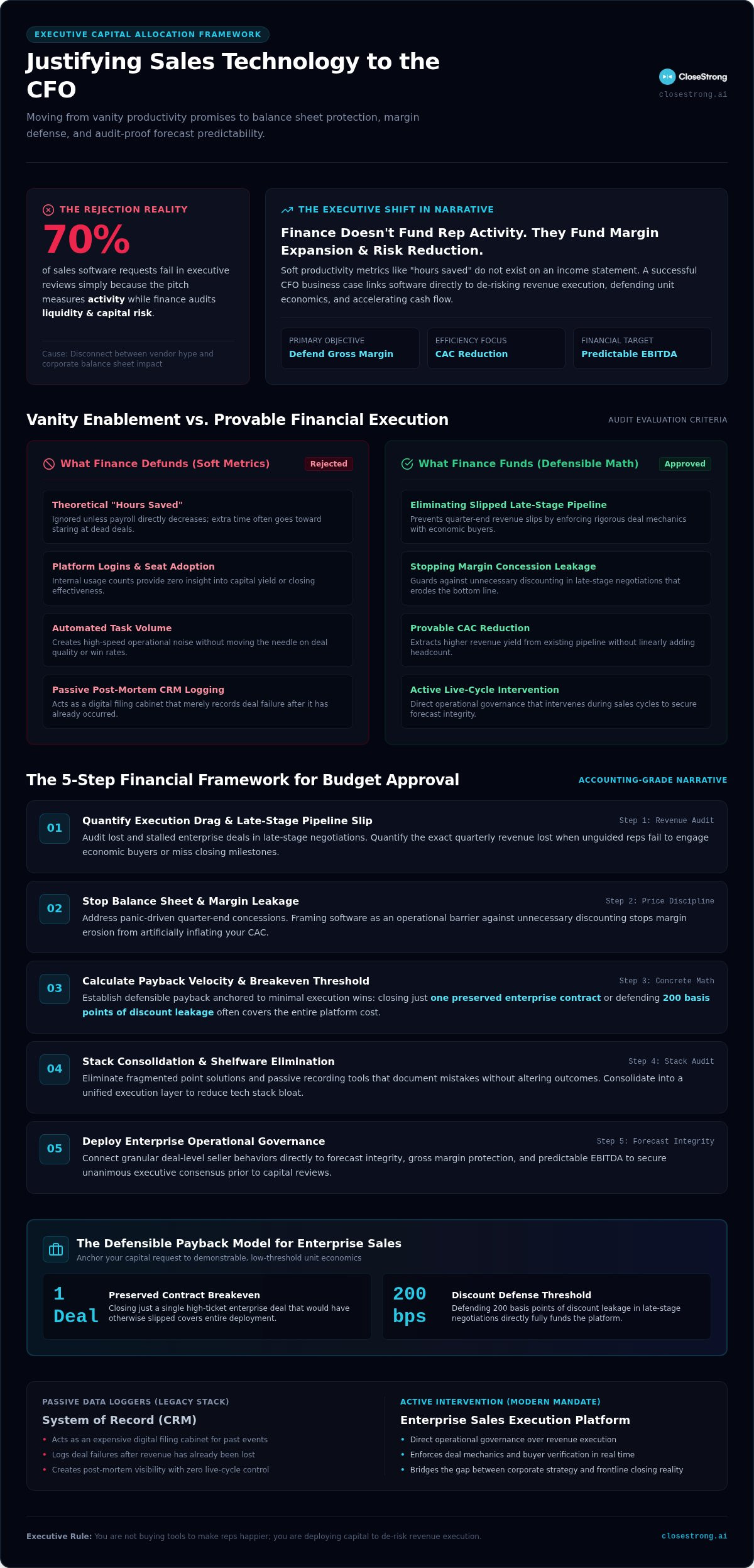
Most revenue leaders walk into budget reviews with a flawed assumption: they believe finance evaluates software based on operational utility. It doesn't. CFOs evaluate software through the lens of capital risk and balance sheet impact. When pitches rely on vendor hype, they hit a wall. Roughly 70% of software requests fail simply because the pitch measures activity while finance audits liquidity. The corporate software purge eliminated patience for bloated stacks. If a platform doesn't defend margins or accelerate cash flow, it's considered operational deadweight.
Successfully justifying sales technology to the CFO means ditching seller-centric arguments entirely. You aren't buying tools to make sales reps happier. You are deploying capital to de-risk revenue execution.
Finance leaders view "sales productivity" as an executive hallucination unless it triggers an immediate, tangible reduction in operating payroll. Pitching "three hours saved per rep every week" invites an immediate, hostile question: Are you reducing head count by three hours of capacity, or are you just giving them more time to stare at dead deals?
Hours saved do not appear on an income statement. When measuring corporate performance, leadership relies on rigorous financial accounting rather than vendor theories. Standard metrics like Return on Investment (ROI) require real dollar returns, yet sales pitches regularly cite soft metrics that finance ignores:
Internal activity metrics that tell finance zero about capital yield.
Inflated top-of-funnel numbers that mask poor closing discipline.
High-speed operational noise that doesn't improve deal quality.
Theoretical capacity means nothing if win rates remain flat. Finance only credits investments that demonstrably shrink customer acquisition cost (CAC) or prevent quarter-end revenue slips.
Every CFO remembers the multi-million dollar CRM implementation they signed off on three years ago. In their eyes, that investment was supposed to deliver pipeline clarity and predictable growth. Instead, it became a high-priced digital filing cabinet. Passive systems of record don't close enterprise deals; they simply log post-mortem posturing after a deal is already lost.
When you ask for more point solutions to fix what the CRM failed to solve, finance hears excuses. The reality of modern pipeline defense requires an enterprise sales execution platform rather than static databases. A database records failure. An execution platform actively intervenes in live sales cycles to enforce deal mechanics. When justifying sales technology to the CFO, you must position the platform as direct governance over revenue execution, not another layer of administrative shelfware.
Securing budget requires an accounting-grade operational narrative. You must prove how the software protects committed revenue, stops balance sheet leakage, and accelerates net cash flow. If you present vendor-created spreadsheets promising a 400% return based on estimated time savings, finance will reject your pitch immediately. Use this structured methodology instead.
Start by auditing your slipped pipeline. Calculate the quarterly revenue lost when enterprise deals stall or collapse during late-stage negotiations. These losses stem directly from unguided rep behaviors: failing to identify economic buyers, offering unnecessary early concessions, and missing critical closing steps. When enterprise reps panic at quarter-end, they sacrifice price discipline. That margin concession flows straight off your bottom line, artificially inflating your customer acquisition cost (CAC). Frame software adoption not as a feature purchase, but as an operational barrier against deal degradation.
Establish a defensible payback timeline anchored to a concrete metric: the incremental revenue required to cover the deployment. In enterprise sales, closing just one preserved contract or defending 200 basis points of discount leakage often funds the platform entirely. Present that breakeven threshold early to demystify the investment.
Pair that calculation with stack rationalization. Show the CFO you are eliminating software redundancies by cutting point solutions that merely observe failure:
• Retire passive conversation recorders that document errors without preventing them.
• Deprecate disparate enablement repositories that reps ignore during active negotiations.
• Consolidate fragmented point solutions under modern sales execution tools for enterprise that enforce closing rigor in real time.
Show that software consolidation directly offsets new expenditures. This signals you share finance's mandate for capital efficiency.
Close the business case by removing implementation risk. Avoid demanding a sitewide enterprise license upfront. Structure a phased rollout with distinct, measurable checkpoints tied to pipeline momentum and forecast accuracy.
Agree on three independent leading indicators for a 90-day review period: a reduction in stalled enterprise proposals, improved adherence to deal qualification criteria, and tighter forecast variance. Once finance independently confirms those operational improvements, scaling the deployment becomes an automatic governance decision rather than an annual budget brawl. If you want to establish an audit-proof narrative that withstands scrutiny, explore how to de-risk your deployment model with CloseStrong.
By shifting from rep sentiment to cash flow preservation, justifying sales technology to the CFO turns into an open-and-shut business conversation.
Enterprise finance leaders do not evaluate software categories equally. They divide sales tools into two distinct buckets: discretionary vanity enablement and non-negotiable operational execution. When justifying sales technology to the CFO, your investment must sit firmly in the second camp. Enablement tools capture activity, catalog content, and report on past behavior. Execution systems govern how deals are actively qualified, negotiated, and closed.
The distinction between the two operational philosophies is stark:
| Evaluation Vector | Vanity Enablement | Provable Sales Execution |
|---|---|---|
| Core Function | Retroactive inspection and recording | Live, deal-level closing guidance |
| Operational Role | Passive system of record | Active operational governance |
| Financial Metric | User adoption and hours logged | Win-rate defense and CAC reduction |
| CFO Perception | Discretionary overhead to cut | Risk-mitigation infrastructure |
Conversation intelligence platforms offer a clear example of the autopsy trap. Finance teams are cutting these tools because listening to a failed sales call three days after the prospect went dark does not recover lost gross margin. Post-call diagnostics tell leadership why a deal slipped, but they provide zero mechanism to stop that slippage while the opportunity is still alive.
Inspection observes mistakes. Intervention prevents them. Monitoring algorithmic pipeline health scores will not revive a stalled enterprise negotiation. Revenue teams don't suffer from a lack of post-mortem analysis; they suffer from unguided execution during the moments that make or break enterprise commitments.
Unguided enterprise reps cost organizations millions in preventable discounting and slipped quarters. When sellers lack deal-level parameters, they run subjective sales cycles, skip critical economic justifications, and surrender price leverage at the end of the month. To finance, this lack of behavioral standardization represents an unmanaged operational hazard.
CFOs demand operational rigor. They expect manufacturing floors to operate under strict tolerances, and they increasingly expect the commercial engine to follow the same discipline. Successfully justifying sales technology to the CFO hinges on framing software as an enforcement mechanism. Deploying precision guided selling software replaces subjective rep guesswork with enforced corporate strategy, ensuring every seller executes the exact closing behaviors required to protect quarterly cash flow.
Every line item on a balance sheet tracks back to human behavior in the field. When enterprise sales leaders fail to grasp that connection, budget proposals stall. Finance doesn't reject tech investments out of spite; they reject them because sales leaders present micro-level pipeline tactics without explaining their macro-level financial impact. If you want executive buy-in, you must show how micro-coaching at the deal level ripples through working capital, debt covenants, and shareholder equity.
Erratic forecasts carry a massive hidden cost. When quarter-end revenue lands 15% below internal guidance, the CFO must adjust short-term borrowing facilities, delay planned capital expenditures, and explain the variance to the board. In volatile credit environments, an unpredictable top line hikes your corporate cost of capital and depresses enterprise valuation.
Deal-level guidance solves this by stripping subjective optimism out of the pipeline. Reps often flag opportunities as "commit" based on gut feelings or polite buyer emails. Precision guidance replaces that guesswork with verified buyer actions: signed mutual action plans, verified procurement schedules, and confirmed legal redlines. With reliable milestones in place, cash collection cycles normalize. Finance gains the operational predictability needed to allocate cash reserves without holding emergency liquidity buffers.
Rogue discounting erodes customer lifetime value. When an enterprise seller drops contract values by 15% in the final forty-eight hours of a quarter to hit quota, that revenue doesn't bounce back at renewal. The concession locks into the multi-year baseline, depressing gross margin for the customer's entire lifecycle.
Defend your margins by installing operational guardrails directly inside live negotiations. Most teams attempt this by reviewing passive charts, but as we examine in our breakdown of sales deal health software, passively monitoring health scores does not alter buyer outcomes. Strategic guidance must enforce value-based negotiation parameters in real time:
Block concessions that fail to extract reciprocal commercial value.
Require executive access or extended payment terms in exchange for tiered volume discounts.
Ensure sales cycles adhere to enterprise packaging and implementation fee minimums.
By connecting frontline execution to EBITDA expansion, justifying sales technology to the CFO turns into an easy win. You aren't pitching an expense. You are presenting an operational hedge for the balance sheet. To secure predictable cash flow across your entire pipeline, implement CloseStrong's deal execution platform.
Walk into an executive review with a standard software pitch, and you will leave empty-handed. CFOs don't buy features; they underwrite controls. Before you schedule the formal budget meeting, ensure your proposal reads like an enterprise risk-mitigation plan rather than a sales enablement wish list. When justifying sales technology to the CFO, you are not asking for an operational allowance. You are offering executive governance over revenue execution.
Run through this mandatory checklist before presenting your case:
Historical pipeline losses tied directly to unguided seller behavior.
Line items for redundant call recorders and shelfware to decommission immediately.
A 90-day evaluation based on verified deal progression rather than rep login counts.
Proof that deal guidance prevents unnecessary end-of-quarter discounting.
Position CloseStrong's Enterprise Sales Execution Platform as strategy execution insurance. Your organization already spent millions deploying a CRM and staffing a field sales team. CloseStrong protects that sunk capital. Generic sales methodology training fades within weeks, and passive CRMs only document failure after the contract is lost.
Powered by Precision Guided Selling™, CloseStrong delivers custom high-quality deal guidance in real time, bridging the corporate strategy-to-execution gap. It enforces direct strategy adherence during active buyer conversations, transforming rep closing behaviors into an audit-proof system of operational governance.
Condense your business case into a single page. Finance executives don't read forty-slide decks. Your memo must isolate four core sections: the quantified problem statement, the consolidation math, the breakeven timeline, and the gated pilot framework. Frame technology adoption around deal-level operational integrity rather than seat utilization.
Ready to turn your budget defense into an open-and-shut mandate? You can partner with CloseStrong to engineer an audit-proof, CFO-ready business case that links deal execution directly to enterprise EBITDA. When justifying sales technology to the CFO, don't leave revenue predictability to chance.
Finance leaders don't reject software out of stubbornness. They reject unchecked spending that fails to protect liquidity. When you trade soft productivity claims for margin preservation and forecast integrity, the entire dynamic shifts. Successfully justifying sales technology to the CFO isn't about defending rep perks; it's about installing operational controls that safeguard enterprise cash flow.
CloseStrong eliminates forecast variance by replacing subjective deal reviews with systematic closing rigor. Powered by proprietary Precision Guided Selling™ technology, the platform bridges corporate strategy and rep execution by enforcing custom high-quality deal guidance across complex enterprise sales cycles. Stop entering budget battles on the defensive. You have the leverage, the framework, and the financial logic required to win executive consensus. Build your audit-proof CFO business case with CloseStrong and secure unanimous approval for your revenue engine.
CFOs reject proposals because they pitch soft hours saved and vanity logins rather than hard cash flow impact. When justifying sales technology to the CFO, sales leaders often fail to show how software reduces customer acquisition costs or defends gross margins. Instead, they present unprovable productivity gains that don't reduce headcount or prevent deal slippage. Finance views that as unhedged discretionary spending.
Anchor the calculation to margin defense and slipped deal recovery, not rep time savings. Calculate the net cash yield of closing one additional preserved enterprise contract or preventing 100 to 200 basis points of end-of-quarter discounting. Subtract the software cost, then divide that net gain by the platform expenditure. This produces an audit-proof return grounded in EBITDA rather than theoretical capacity.
Enablement tools are passive systems that store content and record mistakes retroactively. An enterprise sales execution platform provides active operational governance. Instead of conducting post-mortem call autopsies, CloseStrong uses Precision Guided Selling™ to deliver custom high-quality deal guidance in real time. It intervenes during active buyer negotiations to enforce company strategy and protect deal terms before contracts close.
No. CRMs are passive data registries designed to log historical activity, not guide human behavior during live negotiations. They record deal stages after actions occur, which does nothing to prevent unguided rep errors or rogue discounting. An enterprise sales execution platform sits on top of your CRM to operationalize strategy, turning static account records into active closing rigor without replacing core database investments.
An enterprise sales execution platform typically achieves payback within one or two fiscal quarters. Because enterprise deal sizes are large, rescuing a single stalled contract or eliminating margin erosion on major renewals offsets the entire annual software expenditure. When paired with retiring redundant recording point solutions, the breakeven threshold accelerates, often achieving full cash payback within 90 to 180 days.
Ditch activity charts and present balance sheet metrics. Focus on forecast variance reduction, net CAC improvement, average discount percentage compression, and gross margin protection. When justifying sales technology to the CFO, demonstrate how deal-level guidance shortens sales cycles, improves cash conversion velocity, and frees up operating cash flow. Finance expects defensible unit economics, not optimistic pipeline volume.
Forecast variance happens when reps label deals as committed based on subjective optimism rather than verified buyer actions. Real-time deal guidance eliminates this subjectivity by enforcing rigid milestone verification. CloseStrong's Precision Guided Selling™ technology guides reps to complete critical qualification steps, secure mutual action plans, and confirm economic buyers before advancing pipeline stages, creating an audit-proof forecast finance trusts.


