





An estimated 60% of qualified deals are lost to “no decision,” not a competitor, according to Harvard Business Review, cited in February 2026. The practical lesson is that deals often stall at specific moments when buyers hesitate and sellers fail to take a useful next step. If your team is asking h...
An estimated 60% of qualified deals are lost to “no decision,” not a competitor, according to Harvard Business Review, cited in February 2026. The practical lesson is that deals often stall at specific moments when buyers hesitate and sellers fail to take a useful next step. If your team is asking how to improve win rates enterprise sales, start by finding those moments.
It’s frustrating when win-rate reports don’t align across teams, forecast reviews surface risk too late, and sellers struggle to turn strategy into action. A single benchmark won’t solve those problems. Even the denominator changes the picture: Industry data reports a 21% average B2B win rate across all opportunities and 29% for qualified opportunities in 2026.
This guide shows you how to establish a consistent baseline, identify where deals stall or are lost, and improve seller actions without pushing poor-fit opportunities or undermining buyer trust. You’ll learn how to define the right win-rate measure, diagnose friction in individual deals, and turn what you learn into repeatable next steps. The goal isn’t more activity for its own sake. It’s better decisions in the deals that matter.
• Set consistent rules for which opportunities count so your win-rate baseline is useful and comparable over time.
• Separate execution friction from poor fit, pricing, timing, competition, and buyer-side change. Review no-decisions and slipped deals, not just closed losses.
• Learn how to improve win rates enterprise sales by choosing changes that address a diagnosed cause and lead to observable seller actions.
• Use a repeatable deal loop: diagnose the issue, choose a behavior, guide it, inspect buyer evidence, and refine the next step.
• See how deal-specific guidance can help translate sales strategy into clear next actions across active opportunities.
A win rate is useful only when everyone calculates it the same way. Otherwise, an apparent improvement may simply reflect a different mix of opportunities. Before asking how to improve win rates enterprise sales, define the measure, reporting period, and rules for which deals count.
Quotable definition: “Enterprise sales win rate is the number of eligible opportunities closed-won divided by the number of eligible opportunities with a final closed outcome during a defined reporting period.” No single benchmark fits every sales motion. Your baseline should reflect your business and support fair comparisons.
Specify the numerator, denominator, opportunity status, and reporting period before you calculate the rate. For example, decide whether the reporting period is based on close date and whether the denominator includes closed-won and closed-lost opportunities. Keep open deals out of this calculation. Measure pipeline conversion separately so unsettled opportunities don’t distort a rate based on final outcomes.
Document how your team treats renewals, partner-sourced deals, pilots, and reopened opportunities. Renewals might sit outside a new-business rate, while partner-sourced opportunities can remain included and be reported as a separate source segment. Decide whether a pilot is a distinct deal type and how to count a reopened opportunity after its final disposition. The important thing is to apply a stable policy, not change the rules to fit the result.
Break out results by deal size, customer segment, product, source, and sales motion. Compare similar opportunities. Ebsta and Pavilion reported average win rates of 18-19% for new business and 45% for expansion deals in August 2026. If expansion makes up a larger share of closed outcomes, the company-wide rate could rise even if performance within each motion stays the same. That would reflect a change in deal mix, not proof of improved seller execution.
Enterprise deals also differ in complexity. Complex sales typically involve longer cycles and multiple decision-makers, so a segment with more stakeholders shouldn’t be casually compared with a faster, simpler sales motion. Track the overall rate for leadership, then use segment-level rates to identify where performance is changing.
A percentage shows what happened, not why. Pair the baseline with evidence from individual deals to see where opportunities are progressing or stalling. This sales deal health measurement guide explains why it’s useful to look beyond a single score and examine what’s happening inside active deals.
A closed-lost label doesn’t explain what to change. The cause might be weak product fit, pricing, a competitor, timing, or a buyer organization that couldn’t agree to make a change. It might also be an execution gap: the seller didn’t reach the economic buyer, left decision criteria unclear, or failed to agree on a concrete next step. A lost deal is an outcome, not a complete diagnosis.
Review wins, losses, no-decisions, and slipped deals. A win can reveal a repeatable practice. A no-decision can point to stalled consensus. A slipped deal may mean the buyer’s timeline changed or that momentum was never established. Treating all three as “lost” hides the distinctions that matter when deciding how to improve win rates enterprise sales.
Don’t treat a retrospective CRM label such as “price” or “competition” as the full explanation. Capture the evidence: what the buyer said, which alternatives were considered, whether the required capabilities matched, and when progress slowed. Compare similar opportunities by segment, deal type, and stage before attributing a different result to one representative’s behavior.
Some factors are outside the seller’s control. Record them clearly, but don’t let them become a catch-all explanation. If multiple deals stall because sellers don’t confirm decision criteria or engage key stakeholders, that recurring pattern deserves attention, even when individual opportunities also face budget or timing constraints.
Trace each opportunity through discovery, evaluation, consensus, decision, and close. At each stage, look for observable buyer evidence. Did the buyer confirm the business impact? Were the decision criteria and process discussed and validated? Have the people who will approve, use, or block the purchase been engaged? Are next steps agreed with owners and dates, or are they only assumptions?
These checks help distinguish a buyer-led delay from a seller who hasn’t connected company strategy to the needs of the specific opportunity. To examine this gap further, review the enterprise sales execution gap analysis. Deal guidance can help teams translate strategy into actions in active opportunities. Explore CloseStrong’s deal guidance as one possible execution layer. For more perspective on trust and consultative selling in enterprise sales, see Insights from Top Sales Leaders.
Don’t respond to a weak win rate by adding dashboards, meetings, or activity targets without a diagnosis. Start with the friction you found, then choose an intervention that changes a specific seller behavior. If the cause is unclear, the proposed fix is a guess.
For each change, define four things: the observed problem, the behavior you expect to change, the effort required, and the leading signal that would show whether the behavior is happening. That turns “how to improve win rates enterprise sales” into a testable operating question, not a mandate to do more.
Adjust qualification when poor-fit deals repeatedly enter the forecast. Use stakeholder planning when sellers lack access to key decision-makers or struggle to build buyer consensus. Use targeted coaching when comparable deals reveal a recurring execution gap. Choose deal-specific guidance when sellers need help applying the company’s strategy to the next action in an active opportunity.
The best intervention isn’t necessarily the biggest. Choose the smallest practical change that addresses the pattern without adding unnecessary friction.
| Intervention | Use it when | Behavior to change | Leading signal | Effort to consider |
|---|---|---|---|---|
| Qualification changes | Poor-fit opportunities recur | Test fit and buying conditions before advancing | More opportunities meet agreed qualification criteria | Revise criteria and apply them consistently |
| Stakeholder planning | Buyer access or consensus is weak | Map decision roles and plan buyer conversations | Relevant stakeholders participate in the process | Coordinate outreach around buyer needs |
| Targeted coaching | A repeated seller skill gap appears | Apply a specific skill at a defined deal moment | Evidence of the behavior in buyer interactions | Focus coaching on the observed gap |
| Deal-specific guidance | Strategy isn’t translating into deal actions | Take a relevant, clear next step in the opportunity | The planned buyer action occurs and is documented | Keep guidance relevant to deal context |
Choose one leading indicator tied directly to the intervention. If sellers are meant to confirm decision criteria, measure whether buyers have confirmed them, not how many fields representatives completed. Compare defined cohorts while accounting for segment, deal mix, and sales-cycle timing. Where feasible, test the change against comparable deals instead of attributing every movement in win rate to the intervention.
Watch for side effects. Stricter qualification may reduce opportunity volume. More review steps may burden sellers without improving buyer progress. Keep changes that affect meaningful buyer behavior. Refine or drop changes that only add process.
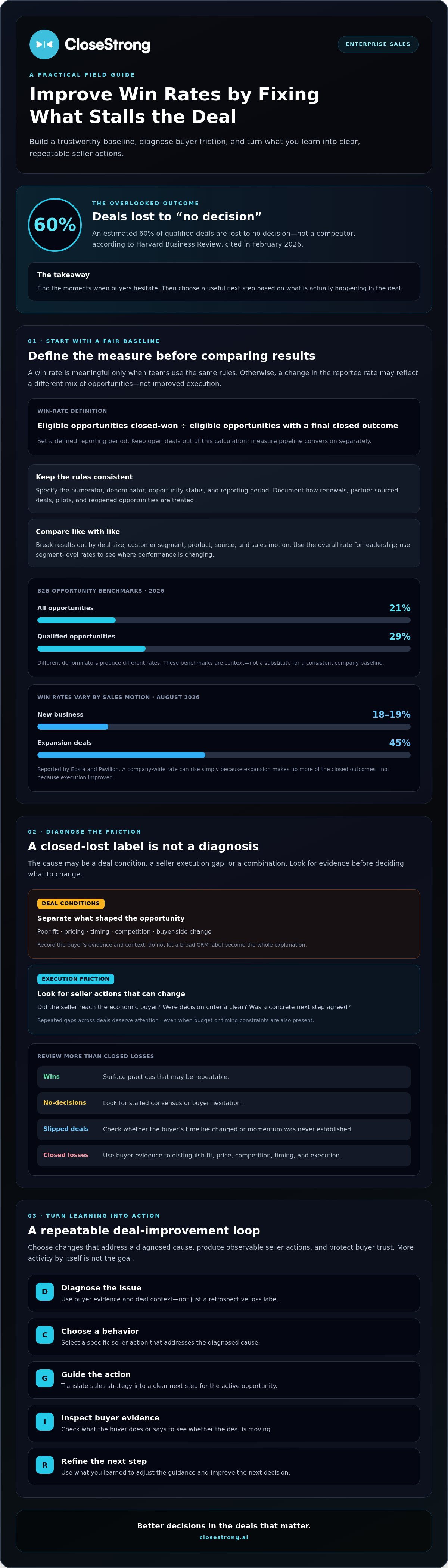
A repeatable process turns deal diagnosis into a seller’s next move. It doesn’t mean putting every opportunity through the same script. It means using a consistent loop to respond to what buyers actually do, then checking whether the action moved the deal forward. That’s the practical answer to how to improve win rates enterprise sales: make strategy useful in live opportunities.
Name the specific risk or friction, such as an unconfirmed decision process or a stakeholder who hasn’t engaged. Separate evidence from assumptions.
Choose the next seller action that addresses the issue. Keep it focused enough to complete before the next buyer interaction.
Give the representative direction that fits the deal and buyer moment, rather than a generic reminder to “build value.”
After the interaction, check what the buyer confirmed, challenged, or changed. Don’t count activity as progress without evidence of buyer movement.
Update the deal plan based on what happened. If the expected signal didn’t appear, revisit the diagnosis or choose a different action.
A useful review isn’t a recital of status updates. Ask: What changed since the last review? What has the buyer confirmed? What evidence is still missing? Then assign one practical next action for each material risk, with a named owner and follow-up date. If the deal needs leadership, product, legal, or executive support, make the request or decision explicit. End the review with clarity, not another round of vague updates.
Keep CRM fields focused on what helps the team act: evidence, ownership, and dated next steps. A field that collects optimistic commentary without clarifying who will do what or what the buyer has agreed to is extra admin, not useful deal information.
Use a real opportunity to prepare for a specific conversation. If a seller needs to clarify the buyer’s decision criteria, practice how to ask and follow up rather than rehearsing a broad sales slogan. Offer guidance before the key interaction when possible. Afterward, review the buyer’s response and update the plan. This connects coaching to execution, not just advice.
For more ways to make deal reviews actionable, read the enterprise deal review improvement guide. If your team needs a way to connect strategy with actions in active opportunities, explore CloseStrong’s Precision Guided Selling.
Manager-led deal reviews can surface risks, but they can’t guide every seller through every buyer interaction. Advice may arrive too late, vary from one manager to another, or stay too general to help with the next move. To scale improvement, make the team’s chosen sales strategy useful when a representative needs to act.
An enterprise sales execution platform can help address that gap. CloseStrong’s Precision Guided Selling™ and custom deal guidance are designed to translate company strategy into deal-level execution and guide representatives through the closing process. This doesn’t guarantee better outcomes. It offers a way to make guidance relevant to active opportunities.
Useful guidance starts with the opportunity’s context, not a generic script. It should help a representative connect sales strategy to the buyer’s situation, identify relevant questions, and choose a clear next action. For example, if the buyer’s decision process is unclear, guidance could help the seller focus on questions that clarify who is involved and what needs to happen before a decision.
Guidance should support seller judgment, not replace it. Representatives still need to listen, discover what matters to the buyer, and adapt to the conversation. Managers also need a practical way to reinforce the chosen approach in deal discussions, rather than introducing a separate process that competes with selling.
Before choosing a platform, ask how its guidance reflects your sales process, individual deal context, and team standards. Does it help sellers identify an actionable next step, or simply add another checklist? Can managers examine evidence of buyer progress without asking representatives to duplicate information elsewhere? Define what you need to see and what would create avoidable administrative work.
CloseStrong offers Precision Guided Selling as an approach to applying strategy in individual deals. Review the Precision Guided Selling overview to understand its stated approach. Then assess whether deal-level guidance fits your team’s needs by considering the friction you’ve identified and the actions you want sellers to take. If the gap is between strategy and execution in active opportunities, talk with CloseStrong about deal-level guidance.
Improving enterprise win rates starts with reliable measurement, but a baseline alone won’t change outcomes. Define which closed opportunities count, compare similar sales motions, and look beyond loss labels to find where buyer momentum or seller execution breaks down.
Then make the diagnosis actionable. Choose a specific behavior, connect deal reviews to buyer decisions, and look for evidence that the next step moved the opportunity forward. That’s how to improve win rates enterprise sales without mistaking more activity for meaningful progress.
When your strategy is clear but difficult to apply consistently in active deals, CloseStrong offers an enterprise sales execution platform. Its Precision Guided Selling™ approach connects company strategy with deal-level guidance, including custom deal guidance. Outcomes aren’t guaranteed, and fit depends on your team’s execution needs.
See how CloseStrong brings deal guidance into enterprise sales execution. Start with the friction you can observe, then define a clearer next move for each important deal. Your team can make progress one informed decision at a time.
Divide eligible closed-won opportunities by eligible closed outcomes, then multiply by 100 to report a percentage. Define the reporting period and which opportunity types count before comparing results. Exclude open deals from the closed-outcome denominator, and decide how to treat renewals, no-decisions, and reopened opportunities. Apply those rules consistently over time. Otherwise, a change in the calculation can look like a change in sales performance.
There’s no single win-rate target for every enterprise sales team. Results vary with qualification, customer segment, product, competition, sales cycle, and the definition of an eligible opportunity. Start by comparing your current rate with a consistent historical baseline and relevant internal cohorts, such as new business versus expansion. Before relying on an external benchmark, check its source, publication date, sample, and methodology to confirm it’s a fair comparison.
Identify why comparable deals are being lost or stalled, then address the pattern instead of making price cuts the default. Strengthen discovery, confirm the buyer’s decision criteria, build access to relevant stakeholders, and agree on concrete next steps. For leaders asking how to improve win rates enterprise sales, the key is to test these buyer-facing changes across comparable opportunities. Track both the behavior and deal progress rather than assuming one tactic caused a better result.
No-decision outcomes can stem from unresolved priorities, weak internal consensus, unclear business impact, or an unconfirmed buying process. Don’t settle for a generic loss label. Review what buyers said and did, then look for recurring friction across similar deals. If stakeholder alignment repeatedly breaks down, test earlier engagement with relevant decision-makers. If the business case remains unclear, help the buyer clarify the impact and agree on a specific next step.
Set a consistent review cadence, then adjust it to deal complexity, risk, and the pace of buyer decisions. A review should examine new evidence, surface a specific obstacle, and produce an action with an owner. For example, if a key decision-maker hasn’t engaged, agree who will reach out and by when. Skip meetings that simply repeat CRM status. The goal is to improve the next move, not add another reporting ritual.
Sales software can support more consistent execution by helping teams apply relevant information, process guidance, and deal actions. It can’t guarantee a win or replace qualification, buyer understanding, or seller judgment. Define the execution problem, the behavior you want to change, and the evidence you’ll track before evaluating a platform. CloseStrong offers an enterprise sales execution platform using Precision Guided Selling™ and custom deal guidance to connect company strategy with individual opportunities.


