





Your CRM is not a strategy. It is a $126 billion filing cabinet where deal data goes to die. You have spent years and millions of dollars hoping that better record-keeping would somehow translate into better selling. It hasn't. Instead, you are left with high forecast variance and a sales team that...
Your CRM is not a strategy. It is a $126 billion filing cabinet where deal data goes to die. You have spent years and millions of dollars hoping that better record-keeping would somehow translate into better selling. It hasn't. Instead, you are left with high forecast variance and a sales team that treats your hard-earned playbook like a suggestion rather than a mandate. The reality is that CRM limitations for sales strategy execution are baked into the software's DNA. These systems were built to look backward, not to drive a deal forward.
You know the frustration of watching a promising lead wither because a rep ignored the methodology. We are going to stop the bleeding. This article will show you why enterprise execution in 2026 requires a dedicated layer beyond the database. You will learn how to move from passive record-keeping to Precision Guided Selling™. We are diving into how automated guidance and strategic rigor can finally turn your data graveyard into a predictable revenue engine. It is time to stop recording history and start winning it.
• Stop mistaking a database for a deal-closing engine and learn why your current stack is looking backward instead of driving revenue forward.
• Identify the structural CRM limitations for sales strategy execution that cause your corporate playbook to vanish the moment a rep opens a lead.
• Discover how Precision Guided Selling™ replaces gut-feel forecasting with a rigorous, real-time coaching layer that reps actually use.
• Learn how to bridge the execution gap and achieve predictable growth without the pain of a "rip and replace" software overhaul.
Your CRM is a digital autopsy. It tells you exactly why a deal died, but it never taught your rep how to keep it alive. Traditional Customer relationship management (CRM) systems were architected for administrators, not for closers. They are designed to capture history, not to create it. This is the first of many CRM limitations for sales strategy execution: it focuses on the "what" while completely ignoring the "how."
Most CRMs are data graveyards. It is a harsh reality that up to 70% of the data stored in these systems is irrelevant to closing the next deal. It is noise. It is clutter. Managers spend their Fridays squinting at dashboards, hoping for a miracle. They see a deal in the "red" and call a meeting to ask why. But visibility is not a strategy. Seeing a car crash in high definition does not help you steer the vehicle. We must move from "What did you do last week?" to "How do we win this deal today?"
Management tracks the pipeline. Execution moves it. When you look at a CRM health score, you are looking at a post-mortem. It is a report card, not a tutor. High-stakes enterprise sales require a system of action, not just a system of record. If your strategy evaporates the moment a rep picks up the phone, you don't have a talent problem. You have a tool problem. You are asking a spreadsheet to do a strategist's job. Management is about the past; execution is about the future.
CRM fields are built for compliance. They are boxes to be checked so that the CFO can sleep at night. To a rep, the CRM is a tax. It is a time-sink that takes them away from actual selling. By 2026, the standard has shifted. We no longer value data entry for the sake of documentation. We value strategic execution. CRM limitations for sales strategy execution stem from this fundamental flaw: the software was never meant to guide a rep through a complex, multi-stakeholder environment. It was meant to count the beans, not grow the crop. It is time to stop treating your database like a deal-closing engine.
Growing the crop requires active, consistent engagement across multiple channels. While Answer Strong can automate the phone calls and texts that keep your pipeline moving, you still need a layer of strategic rigor to ensure those automated touchpoints are driving the deal forward.
CRM is a record-keeper. It knows who you called. It knows when you called. It has no idea how you should have handled the objection that killed the deal. This is the structural failure at the heart of CRM limitations for sales strategy execution. A database is passive. Execution is active. You don't need more records; you need more results. Stop treating your filing cabinet like a cockpit.
Strategy often dies in the "Execution Gap." This is the space between your executive boardroom and the rep's desk. You build a brilliant plan, but it evaporates the second a rep opens their browser. Why? Because the CRM doesn't care about your strategy. It only cares about data entry. It is a system designed for accountants, not athletes. To bridge this divide, you need precision guided selling software that forces methodology into the live workflow.
Think of your CRM as a library. It’s full of past interactions and dusty notes. It’s great for research. It’s useless for navigation. Execution isn't a library; it's a GPS for the next meeting. Even high-end "Revenue Intelligence" platforms, while providing deep insights, primarily offer better mirrors. They show you exactly how you messed up after the fact. They don't provide a steering wheel to avoid the crash. They give you a high-definition recording of the failure. True strategy implementation requires a behavior-first architecture that prompts the right move at the right time. It is about influencing the outcome before the recording starts.
Your sales playbook is likely a PDF sitting in a shared folder. That is where strategy goes to be ignored. CRM workflows are too rigid for the messy reality of enterprise deals. They offer linear steps for non-linear problems. They demand compliance when the rep needs agility. Enterprise execution requires complex B2B sales software that adapts to the deal as it happens. If your reps are winging it because the CRM is too clunky to help, your strategy is already dead. You can modernize your execution layer without replacing your existing database. Stop settling for a record of what happened and start driving what happens next.
The "Rogue Rep" is your biggest asset and your greatest risk. They are the high performers who ignore your CRM because they realize it is a tax on their time rather than a tool for their success. They win deals in spite of your tech stack, not because of it. But when your strategy relies on the individual brilliance of a few lone wolves, you don't have a scalable business. You have a collection of habits. This is where CRM limitations for sales strategy execution become a direct threat to your bottom line. If your best people can't find value in the system, your strategy is already dead on arrival.
Most enterprise forecasts are built on "Forecast Hope." You look at a CRM dashboard and see a 70% probability because a deal is in Stage 4. That number is a lie. It is a gut feel dressed up as data. CRM health scores are often nothing more than a rep's optimistic opinion. This lack of rigor leads to massive forecast variance and slipped deals that "looked great" on Friday but vanished by Monday. Visibility into the pipeline is a boardroom vanity metric. It makes leadership feel in control while the reps are still winging it on every call.
Visibility into a car crash in slow motion doesn't stop the impact. You can see every activity, every email, and every meeting logged in your database, but that doesn't mean the deal is healthy. Monitoring activity is not the same as enforcing outcome-driven rigor. To move the needle, you need sales deal health software that is proactive rather than descriptive. It isn't enough to know that a meeting happened. You need to know if the right stakeholders were in the room and if the specific value drivers of your strategy were actually discussed. CRM shows you the shadow of the deal; execution software shows you the deal itself.
Enterprise deals outgrow standard CRM opportunity stages within weeks. A complex B2B sale involves dozens of stakeholders and shifting requirements that a linear "Stage 1 to Stage 5" workflow cannot capture. Manual coaching is the traditional fix, but no manager can provide high-quality guidance for 50 simultaneous complex deals. The math doesn't work. Strategy implementation requires hard-coding your methodology into the daily workflow. This isn't about more training workshops. It is about using software to provide real-time deal guidance that adapts to the messiness of reality. Stop asking your managers to be everywhere at once and start giving your reps the tools to execute flawlessly on their own.
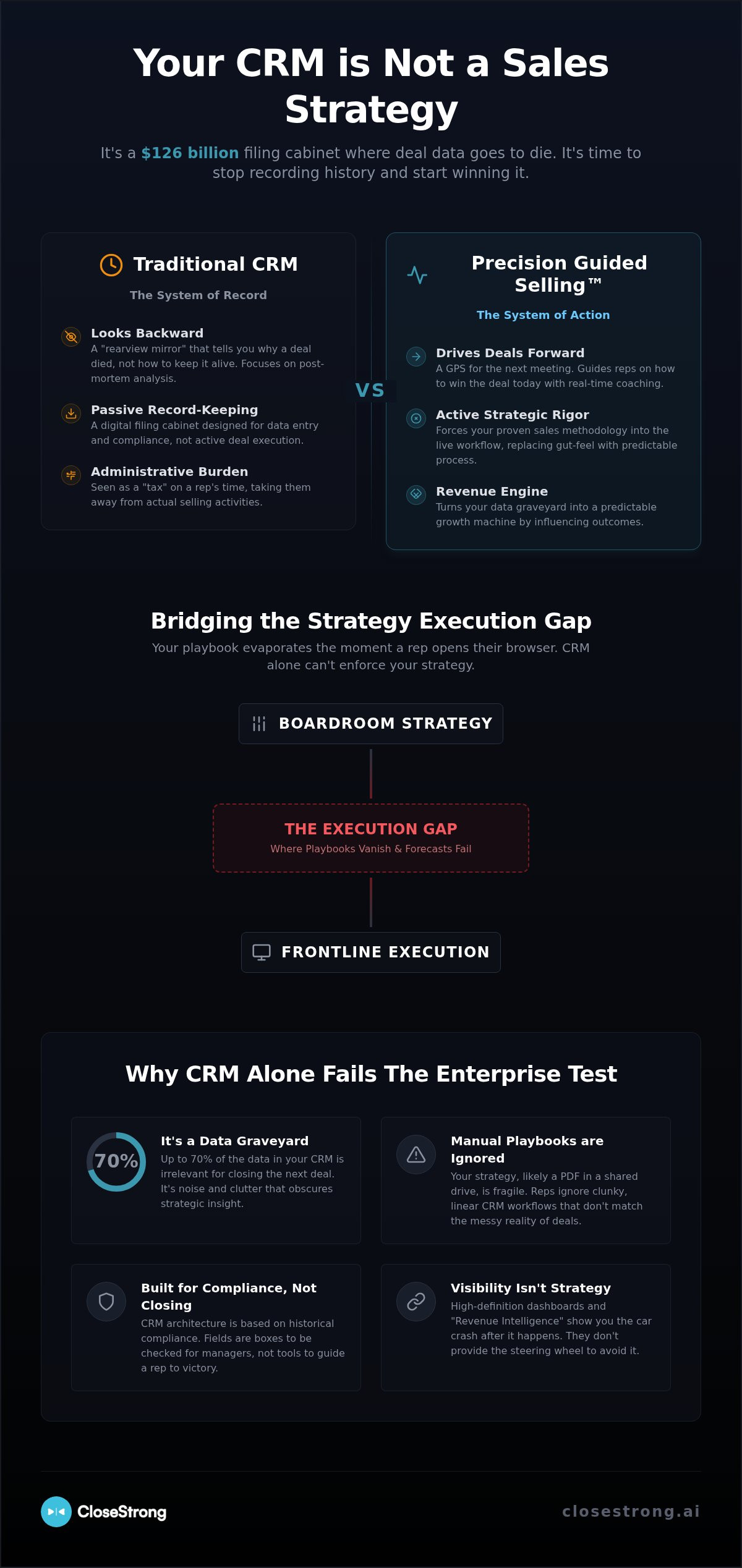
Precision Guided Selling™ is not a CRM upgrade. It's a fundamental shift in how enterprise deals are won. For decades, sales leaders have accepted CRM limitations for sales strategy execution as a necessary evil. We settled for databases that record history instead of engines that drive the future. Precision Guided Selling™ flips the script. It moves the rep from a data entry clerk to a high-performance executor by providing real-time, deal-level guidance. It's the difference between looking at a map and having a live navigator in the passenger seat.
You don't need to add headcount to scale sales strategy execution. You need a system that enforces your methodology on every deal, every day. Manual coaching is a bottleneck. It's subjective, inconsistent, and impossible to scale across a global team. Automated deal guidance provides the strategic rigor your enterprise demands without the overhead of a massive enablement team. It treats selling as a science, not a series of guesses. Custom deal guidance is the antidote to the generic, one-size-fits-all playbooks that reps ignore. Every enterprise deal has unique stakeholders and shifting power dynamics. A static PDF cannot handle that. Precision Guided Selling™ adapts to the specific reality of the deal.
The process is methodical. We start by ingesting your proprietary methodology into the engine. This isn't a static document; it’s a living logic. Protecting this kind of high-value digital IP is essential, and for hardware-level security, you can visit Cold Crypt. The system then performs a real-time analysis of every deal against winning patterns. Finally, it provides the "Next Best Action." It removes the cognitive load from the rep, allowing them to focus on the human elements of selling while the software handles the strategic rigor. It doesn't ask the rep how they feel about the deal. It tells them what they must do to close it.
Forecast variance is the price you pay for CRM limitations for sales strategy execution. When you rely on a database, you rely on human opinion. Humans are biased. They have "happy ears." They want to believe the deal is closing even when the evidence says otherwise. Precision Guided Selling™ replaces these subjective updates with objective execution data. The result is inescapable process adherence. You get predictable revenue growth because the system surfaces the truth about every deal in the pipeline. It’s time to get serious about deal execution and stop relying on luck.
CloseStrong isn't another database. It is the engine that finally makes your database move. If your CRM is the fuel tank, CloseStrong is the high-performance motor. One holds the resources; the other converts them into velocity. You don't need to throw away your current stack to fix CRM limitations for sales strategy execution. You just need to stop expecting a storage unit to drive your revenue. We don't do "rip and replace" here. We do "plug and win."
The implementation roadmap is direct and results-oriented. We don't spend months in vague discovery workshops that lead to more slide decks. We take your boardroom strategy and turn it into a "Precision Guided" reality. This is how you close the gap between your star performers and the rest of the pack. By hard-coding the habits of your top 5% into the software, you ensure that every rep executes with the same strategic rigor. It is about elevating the floor of your entire organization rather than just raising the ceiling for a few lone wolves.
Execution doesn't mean starting over from scratch. CloseStrong sits on top of your existing sales execution tools for enterprise. It doesn't replace your CRM; it redeems it. We take the data that is currently rotting in your fields and make it useful for the rep at the moment of truth. Most reps suffer from tool fatigue because they're asked to fill out more forms for no personal gain. CloseStrong changes that math. We provide high-value guidance that helps them win. This makes CRM data entry a byproduct of success rather than a chore. It is a system that gives back more than it takes.
The ROI of closing the execution gap is immediate and measurable. When you eliminate the CRM limitations for sales strategy execution, you eliminate the gut feel that leads to slipped deals. We have seen this move the needle on complex deals that were previously written off as unwinnable. It turns unpredictable outcomes into process-driven victories. Success in 2026 isn't about having the best records. It's about having the best execution. Stop guessing and start guiding: see CloseStrong in action.
You have been treating your CRM like a strategy. It isn't. It is a database that records the past while your future revenue slips through the cracks. We have exposed the CRM limitations for sales strategy execution that keep your forecast in a state of constant variance. You don't need another report; you need a system of action. High-stakes enterprise deals don't wait for manual coaching or quarterly reviews. They require proprietary Precision Guided Selling™ technology that forces methodology into every interaction.
The choice is simple. You can keep managing a data graveyard or you can start driving execution. CloseStrong is designed specifically for high-stakes enterprise deals to eliminate subjective forecast variance and ensure every rep follows the playbook. It is time to bridge the gap between boardroom ambition and deal-level reality. Stop settling for visibility into failure and start enforcing the mechanics of success.
Ready to close the execution gap? Discover the CloseStrong platform.
Your revenue growth is no longer a matter of luck. It is a matter of execution. Let's get to work.
No, it is not a replacement. You keep your CRM for the accountants and the historians who need a system of record. Sales execution software is for the closers. It sits on top of your existing stack to turn passive data into active deal guidance. Think of it as the brain that finally tells your database what to do with all that stored information.
It moves from yesterday's news to today's win. Standard coaching is a manager looking at a deal once a week and giving a gut-feel opinion. Precision Guided Selling™ is an always-on engine. It analyzes deal progress against winning patterns in real-time. It doesn't ask how a rep feels. It tells them what they must do to move the deal forward.
You can try, but you'll likely fail. CRMs are built on a system of record architecture that values compliance over agility. Forcing complex, non-linear deal logic into a standard CRM creates a data tax that reps will eventually ignore. You end up with more fields to fill and zero strategic lift. CRM limitations for sales strategy execution are structural, not just a configuration issue.
It is the graveyard of boardroom strategy. The Execution Gap is the distance between your high-level sales plan and what actually happens on a live call. Most organizations suffer from this because their tools focus on activity counts rather than outcome-driven rigor. It is the specific point where your must-win deals go to die because the rep lacked real-time direction.
It is the only way to make those methodologies actually stick. Most playbooks are PDFs that sit in a shared folder gathering digital dust. Execution software hard-codes MEDDIC or Challenger into the rep's daily workflow. It makes methodology adherence inescapable. If the rep doesn't perform the necessary strategic steps, the deal simply does not progress in the system.
You will see a measurable shift within your first full sales cycle. Forecast accuracy improves the moment you stop accepting subjective rep updates as truth. By using objective execution data, you remove the happy ears bias that plagues most pipelines. You move from "I think this will close" to "The data proves this deal is on track."
They will use it because it makes them money. Reps hate CRMs because they are administrative black holes that take time and give nothing back. They love execution platforms because the system helps them navigate complex stakeholders and close larger deals. It is a tool for their own success, not just a leash for their manager.
One looks at the past; the other drives the future. Revenue Intelligence tools are great for autopsies. They show you exactly why you lost a deal after it is already gone. Sales execution software is the steering wheel. It provides the guidance needed to avoid the crash before it happens. Don't settle for a high-definition recording of a failure when you could have prevented it.


