




A dashboard can show what’s happening in a deal. It can’t tell a rep what to do next. Enterprise deal guidance software earns its place when it turns company strategy into useful choices on complex opportunities, not another layer of data to scan. Sales leaders know the gap: strategy gets announced,...
A dashboard can show what’s happening in a deal. It can’t tell a rep what to do next. Enterprise deal guidance software earns its place when it turns company strategy into useful choices on complex opportunities, not another layer of data to scan.
Sales leaders know the gap: strategy gets announced, CRM fields get filled, and reps still make high-stakes decisions without consistent direction. More visibility won’t fix the problem if the next move remains unclear. Reps need guidance that reflects the deal in front of them and helps them act as it changes.
This article explains what enterprise deal guidance software should do, how to evaluate its effect on execution, and how to connect company priorities to practical deal-level actions. We’ll look at the difference between surfacing information and guiding decisions, along with the capabilities that matter across complex opportunities. CloseStrong’s Enterprise Sales Execution Platform uses Precision Guided Selling™ to provide custom deal guidance that brings strategy closer to the choices reps make every day.
• Enterprise deal guidance software should turn company strategy into relevant next steps for specific opportunities, not simply add another view of pipeline data.
• Understand how CRM, enablement, sales intelligence, and deal guidance support different parts of execution rather than treating one as a replacement for the others.
• Evaluate guidance by whether it reflects your sales strategy, fits the deal context, and helps reps make informed moves as opportunities progress.
• Connect leadership priorities to deal-level actions so strategic standards show up in the decisions reps make.
• CloseStrong’s Precision Guided Selling™ connects company strategy to individual deals through custom deal guidance.
Enterprise deal guidance software helps sales representatives decide what to do on a specific opportunity by translating company sales strategy into deal-level direction. It goes beyond recording status or storing sales content. Its purpose is to make strategic priorities useful in the choices reps face as a complex opportunity develops.
Guidance supports the decisions and actions involved in progressing a deal. It can help a rep consider which customer needs to address, what risks to investigate, or how to align a proposed next step with the company’s sales approach. The right action depends on the opportunity. A useful framework connects company-wide standards to deal context instead of giving every rep the same generic checklist.
That connection matters because enterprise opportunities rarely move in a straight line. Stakeholders may have different priorities, decision processes can shift, and a promising conversation doesn’t necessarily mean the deal is advancing. Reps need to interpret what’s happening and choose a move that fits both the buyer’s situation and the company’s strategy.
This is where deal guidance supports the broader work of Sales operations, which focuses on a sales organization’s effectiveness and efficiency. For a closer look at how strategy and execution connect, see this enterprise sales execution platform overview.
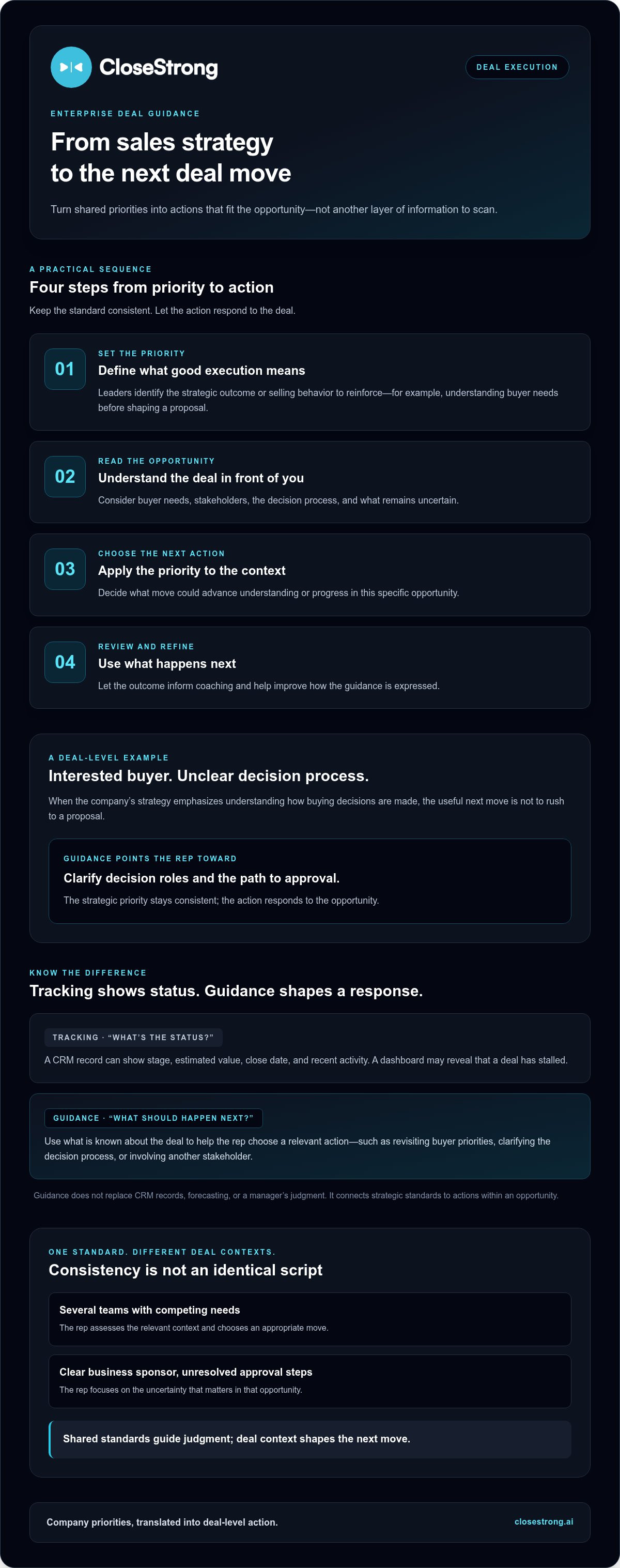
Tracking answers, “What’s the status?” Guidance addresses, “Given what we know, what should happen next?” A CRM record can show the stage, estimated value, close date, and recent activity. Those details help teams maintain visibility, but the rep still has to determine which action fits the situation.
More fields don’t automatically produce better decisions. A dashboard might reveal that a deal has stalled without indicating whether the rep should revisit the buyer’s priorities, clarify the decision process, or bring another stakeholder into the conversation. The gap between seeing a problem and choosing a response is where company strategy can disappear from day-to-day execution.
Guidance doesn’t replace CRM records, forecasting, or a manager’s judgment. Those serve different purposes: capturing information, assessing pipeline expectations, and applying human experience. Deal-level guidance helps connect strategic standards to actions within an opportunity. Ask a practical question: does it help reps make a better-informed move, or simply give them more information to sort through?
Strategy matters in a deal only when it changes what a rep does. Connecting leadership priorities to decisions in a specific opportunity takes more than a static playbook. Enterprise deal guidance software can support that connection when its direction is relevant to the deal in front of the rep.
Start with the priorities. Leaders define the outcomes and selling standards that matter, such as understanding buyer needs before shaping a proposal or identifying who participates in the decision. Translate those priorities into questions or actions reps can apply to an opportunity. Then use what’s known about that deal to identify a relevant next move.
Deal guidance connects strategy with execution by turning shared sales priorities into actions that fit the opportunity in front of the rep.
Consider a hypothetical enterprise opportunity where a buyer has expressed interest, but the decision process is unclear. If the company’s strategy emphasizes understanding how buying decisions are made, useful guidance would prompt the rep to clarify decision roles and the path to approval before rushing to a proposal. The priority stays consistent, while the action responds to the deal.
Identical prompts applied everywhere quickly become noise. One opportunity may involve several teams with competing needs; another may have a clear business sponsor but unresolved approval steps. Guidance should help reps examine the relevant context, not force both deals through the same script.
Consistency comes from shared standards, not identical moves. Leaders can establish what good execution looks like, while reps use those standards to assess each opportunity and choose an appropriate action. This also gives managers a stronger basis for coaching behavior, not just reviewing outcomes. Harvard Business Review discusses the value of leading indicators for developing selling behaviors rather than relying only on lagging results.
A practical sequence keeps the work grounded:
Define the strategic outcome or selling behavior leaders want to reinforce.
Identify the buyer’s needs, stakeholders, decision process, and current uncertainty.
Apply the priority to the deal context, then decide what move could advance understanding or progress.
Use what happens next to inform coaching and improve how guidance is expressed.
That’s the difference between distributing advice and supporting execution. CloseStrong’s Precision Guided Selling software overview explores how custom deal guidance can bring company strategy closer to the choices reps make on individual opportunities. Explore CloseStrong’s approach to deal execution to see how strategic priorities connect to deal-level action.
These tools solve different problems. A CRM organizes customer and opportunity information. Enablement equips sellers with knowledge and content. Sales intelligence surfaces useful signals. Deal guidance focuses on how a team applies its sales strategy within an individual opportunity. Treating them as interchangeable creates confusion rather than better execution.
No. CRM helps teams record and manage customer relationships, interactions, and opportunity details. Deal guidance uses the context of a live opportunity to help reps apply company strategy as they decide what to do next. The roles can complement each other: one maintains the record, while the other helps turn strategic standards into deal-level action. Harvard Business Review has explored why CRM can fall short when it becomes primarily an inspection tool, a useful distinction in Deal Guidance Software vs. CRM.
| Category | Primary purpose | Primary user | Execution role |
|---|---|---|---|
| CRM | Organize customer and opportunity information | Sales reps, managers, operations teams | Provides a shared record of relationships, activity, and pipeline |
| Enablement | Provide learning resources, messaging, and sales content | Reps, enablement teams, managers | Helps sellers build knowledge and find reusable materials |
| Sales intelligence | Surface information and signals relevant to accounts or buyers | Reps, analysts, sales leaders | Supports account research and informs decisions with useful context |
| Deal guidance | Apply sales strategy to a specific opportunity | Reps and sales leaders | Helps shape actions around the needs and circumstances of a live deal |
A content library can hold strong messaging, qualification resources, and sales materials. But storing advice isn’t the same as helping a rep apply it to a particular deal. If a seller has to search broad resources and work out alone what matters to the opportunity, the content may be available without being actionable.
Sales intelligence has a different job. It can surface account details, buyer activity, or other signals, but a signal doesn’t determine the response. Reps still need to interpret what that information means for the opportunity and choose an appropriate action. Deal guidance connects that interpretation to the company’s sales approach.
Is the CRM or existing content library already enough? It may be if reps can consistently translate the information and resources they have into sound deal decisions. If they can’t, adding more fields or materials won’t necessarily close the gap. This analysis of complex B2B sales software explores why enterprise execution may require more than CRM visibility. Enterprise deal guidance software should complement the systems and expertise a team already relies on, not claim to replace them all.
Don’t start with a feature list. Start with the execution problem. Are reps missing key buyer stakeholders? Do opportunity reviews surface risks without clarifying the next move? Does company strategy show up inconsistently across deals? Name the behavior you need to change before judging interfaces or dashboards. Otherwise, polished software can solve the wrong problem.
Use these questions to test whether enterprise deal guidance software fits how your team sells:
Check whether company standards translate into guidance reps can use on individual opportunities, rather than staying general principles.
It should reinforce consistent expectations while accounting for differences in buyer needs, stakeholders, and decision processes.
Identify the roles that should use it and the points in your sales process where a decision or action could benefit from support.
They should understand how it relates to the opportunity and what choice or action it helps them consider.
Make the assessment specific. If your priority is understanding how a buying group makes decisions, examine whether guidance helps reps investigate that issue in a live opportunity. A generic library of sales advice may contain relevant material, but the rep still has to find it, interpret it, and apply it.
Define the behavior you want to see before choosing success measures. For example, leaders might want reps to clarify decision roles consistently before advancing an opportunity. Then distinguish usage from execution: a rep opening guidance shows activity, but it doesn’t prove they applied the relevant strategy in a customer conversation or next step.
Build an evaluation around observable evidence:
Does the guidance reflect your actual sales priorities and standards?
Can representatives understand and apply it at the moments that matter?
Does it account for the opportunity rather than offer the same prompt in every situation?
Can managers see whether the intended action or decision-making behavior is showing up in deal reviews?
Can the team assess whether execution is becoming more consistent without assuming software alone will improve win rates, deal speed, or forecast accuracy?
Keep the test grounded in your team’s reality. CloseStrong’s enterprise sales execution platform uses Precision Guided Selling™ to connect company strategy with individual deals through custom deal guidance. Explore CloseStrong’s approach to deal-level execution.
CloseStrong’s Enterprise Sales Execution Platform addresses a practical challenge: company strategy can be clear at the leadership level and still fail to shape choices inside individual opportunities. The platform uses proprietary Precision Guided Selling™ to help enterprise sales teams apply that strategy to their deals through custom, high-quality deal guidance.
The focus is execution. Rather than another library of general sales materials, CloseStrong provides guidance connected to the opportunity a rep is working. That distinction matters in enterprise selling, where deal context varies and a broad principle may not tell a seller what it means for the next decision.
Precision Guided Selling™ brings company strategy closer to deal-level action. It helps teams translate strategic priorities into guidance reps can use as they work through individual opportunities. The aim is to connect what the company wants its sales approach to accomplish with the choices representatives make on actual deals.
For example, if a team’s strategy emphasizes understanding a buyer’s priorities, guidance can help make that standard relevant to an opportunity rather than leaving it as a general instruction. The specific deal still matters. A rep considers the situation in front of them and uses the guidance in context.
This execution focus distinguishes CloseStrong’s approach from simply making information visible or placing content in a shared repository. The platform provides custom, high-quality deal guidance designed to help teams apply strategy consistently across opportunities. It supports reps and sales leaders without suggesting that software replaces their judgment.
A guided selling approach can fit teams that have clear sales priorities but struggle to see those priorities reflected consistently in deal decisions. Before evaluating enterprise deal guidance software, leaders can return to the execution gap and ask:
Does guidance reflect the company’s actual sales priorities and standards?
Can representatives understand how to apply it during the sales process?
Does the guidance account for differences between opportunities instead of treating every deal alike?
Can leaders assess whether reps are applying the intended approach, not just opening or viewing guidance?
If those questions reveal a gap between strategy and deal-level action, CloseStrong offers an execution-focused way to address it. See how CloseStrong guides enterprise deal execution.
Enterprise deal guidance software should do more than make opportunity data visible. It should help reps apply company strategy to the choices they face in individual deals. Evaluate it by whether guidance fits your sales motion, supports deal-specific action, and reinforces the behaviors your team wants to see, not by how many features it lists.
CRM, enablement, and sales intelligence each have distinct roles. Deal guidance complements them by connecting strategic priorities to execution. CloseStrong’s enterprise sales execution platform brings company strategy into individual deals through proprietary Precision Guided Selling™, providing custom, high-quality deal guidance.
If your team is ready to close the gap between strategy and rep action, see how CloseStrong brings strategy into enterprise deals. Better execution starts with making the right guidance useful where the deal is happening.
Enterprise deal guidance software helps sales teams apply company strategy to individual opportunities. It supports deal-related decisions and actions rather than simply storing customer records or displaying opportunity status. For example, guidance might help a representative consider how a company sales priority applies to a specific buyer situation. Evaluate whether the guidance connects your strategy with the sales work reps actually do.
It helps representatives apply sales strategy and standards to the opportunities they’re working on. That can be useful when a deal involves several stakeholders, competing needs, or unclear decisions. The goal is to make strategic priorities relevant to deal execution, not simply surface more information. Start by identifying the actions your team wants to strengthen, then assess whether the software supports those actions in context.
No. Sales enablement and deal guidance support different parts of selling. Enablement commonly prepares reps through learning, content, and resources; deal guidance focuses on applying strategy to a specific opportunity. A team may need stronger preparation, better support during live deals, or both. Clarify where the execution gap occurs before evaluating tools, so you can distinguish a need for general learning resources from a need for deal-level guidance.
Start by naming the deal decisions or strategic behaviors your team needs to execute more consistently. Then assess whether enterprise deal guidance software connects those priorities to relevant direction for individual opportunities. Consider who will use the guidance, when it should help, and how leaders will assess whether reps apply it. Compare the software’s approach with those requirements, rather than choosing by feature count or interface polish alone.
Sales intelligence helps teams gather or interpret information about accounts, buyers, or opportunities. Deal guidance helps representatives apply company strategy to actions within a particular opportunity. A signal, such as a change in buyer activity, may provide useful context, but it doesn’t automatically determine how a rep should proceed. Identify whether your team needs more information, better interpretation, or stronger consistency in deal-level execution.
Define the behaviors the guidance is meant to support before assessing results. Then separate usage, such as whether reps access the guidance, from evidence that they apply strategic priorities in their deal work. Leaders can review agreed process indicators and deal practices over time, alongside broader business measures. Interpret results in the team’s operating context; software use alone doesn’t prove a behavior changed or guarantee better sales outcomes.


