




Bigger targets won’t fix inconsistent quota performance. If results swing from one period to the next, the problem may be how deals are selected, advanced, and coached. Learning how to consistently hit enterprise sales quota starts with making execution repeatable, not hoping the pipeline comes thro...
Bigger targets won’t fix inconsistent quota performance. If results swing from one period to the next, the problem may be how deals are selected, advanced, and coached. Learning how to consistently hit enterprise sales quota starts with making execution repeatable, not hoping the pipeline comes through.
Enterprise deals are hard to predict. A forecast can show what might close, but it may not reveal which opportunity is at risk or what a rep should do next. And company strategy only matters when reps can apply it in real buyer conversations.
This playbook shows how to turn quota into a practical plan for pipeline and deal execution. You’ll learn how to assess whether pipeline can support the target, spot deal risks early, and coach reps with guidance that fits the opportunity in front of them. Connect those steps in a repeatable operating rhythm so quota attainment depends less on last-minute scrambling and more on the decisions your team makes deal by deal.
• Learn how to consistently hit enterprise sales quota by treating attainment as a repeatable operating outcome, not a lucky quarter.
• Turn the target into a practical plan: document assumptions, assess pipeline, identify gaps, and assign next actions.
• Separate busywork from buyer progress by checking for clear decisions, stakeholders, approval paths, and next steps.
• Use a regular quota review rhythm to surface deal risks and agree on specific actions, not just inspect forecasts.
• See when generic playbooks need deal-specific guidance to help reps apply company strategy in complex opportunities.
One strong quarter isn’t a system. Consistent attainment means understanding what drove results, repeating effective choices, and addressing gaps before they become end-of-period surprises. That takes more than checking whether reps hit quota. Examine the assumptions and deal-level evidence behind the result.
Quota outcomes show what closed; leading indicators help reveal whether the team is creating and advancing enough qualified opportunities to influence what closes next. Qualified pipeline and deal progression aren’t guarantees of revenue. They are signals to investigate. Sales planning is part of the broader discipline of Sales management, but a useful plan must reflect your own targets, sales cycles, and buying process.
Meeting quota once can reflect a timely large deal, an unusually favorable territory, or a strong run of execution. Sustained performance means results are repeatable across sales periods, rather than dependent on one outlier.
Look beyond the team average. A few high performers can conceal missed targets in a segment, territory, or group of reps. Compare results across relevant groups, then interpret them against the company’s quota design and typical deal cycle. A benchmark without that context can mislead.
Start with the plan, not the blame. Check whether target assumptions match pipeline stage, deal size, expected close timing, and qualification criteria. Then trace what changed. Did opportunities repeatedly slip? Did buyer decisions stall? Were key stakeholders or approval steps missing from the plan?
Check whether expected deal volume, size, and timing are realistic for the period.
Confirm that opportunities meet qualification standards and have a plausible path to a decision.
Identify repeated close-date changes or deals that remain in stage without new buyer evidence.
Look for gaps the team can address, such as unclear business outcomes or limited access to decision-makers.
Separate external constraints from fixable execution gaps. Territory conditions, market shifts, or buyer timing may limit near-term potential. Reps may still be able to clarify the buying process, build stakeholder access, or test whether the opportunity is real. The goal isn’t to label every miss as a rep failure. It’s to find the cause early enough to choose a useful response.
That diagnosis is the starting point for how to consistently hit enterprise sales quota: understand the gap before prescribing more activity. A fuller pipeline won’t solve a qualification problem, and more follow-ups won’t unblock a decision if the buyer’s approval path is unknown.
A quota becomes useful when it tells the team what to do next. Don’t apply a generic pipeline coverage rule and assume the math will work. Build the plan from your own conversion rates, deal values, and sales cycle timing, then test those assumptions against evidence of buyer progress.
Use this sequence to make the target operational:
Define the revenue or bookings goal, the period it covers, and which deals count toward it.
Record expected deal size, win rate, stage conversion, and time to close. Mark estimates clearly.
Review opportunities by stage, value, timing, qualification, and evidence of buyer commitment.
Identify whether the shortfall is in pipeline volume, deal quality, timing, or movement through the buying process.
Give each priority deal an owner, a specific next step, and a date to review progress.
Work backward from the target using your team’s own historical win rates and deal values. Then account for how long opportunities typically take to close. If current results differ from historical results, update the assumptions instead of treating last year’s conversion pattern as a law. A universal coverage ratio can hide important differences between segments, deal types, and sales cycles.
Keep the logic visible: what the team expects to close, what evidence supports that expectation, and what must happen next. Revisit the model when conversion or timing changes. This turns pipeline planning into a working forecast, not a number copied into a slide.
When planning reveals a raw top-of-funnel shortfall rather than an execution bottleneck, teams may need to supplement outbound outreach with targeted prospect sourcing. In specialized industries such as insurance, sales teams often rely on lead providers like closrtech.com to keep pipeline volume aligned with quota requirements.
Opportunity count and total value offer little reassurance if buyers aren’t moving. Check whether reps can reach the people involved in the decision, explain the approval process, confirm timing, and point to a meaningful buyer commitment. A large opportunity without those signals is potential, not a reliable path to quota.
For deals that matter, identify what is missing. Does the rep need access to another stakeholder? Is the mutual plan still agreed by both sides? Has the buyer confirmed a decision step, or is the close date based on seller optimism? Use the answers to decide where focused effort could change the outcome and where the forecast needs a sober adjustment.
For more context on connecting company strategy to individual opportunities, read this enterprise sales execution platform guide. Teams looking to bring custom deal guidance into execution can also explore CloseStrong’s enterprise sales execution platform.
A full calendar can create the illusion of momentum. Calls, emails, and updated CRM fields show that work happened, but they don’t prove the buyer moved closer to a decision. To improve enterprise deal execution, look for evidence that the customer has clarified what they need, who must agree, and what happens next.
Ask whether the buyer has confirmed the problem and desired business outcome. Can the rep explain the decision process, key stakeholders, and criteria the buyer will use? Is there a specific next step the buyer has agreed to own? These signals give you something to investigate. A CRM entry or health score can point to a question, but it can’t answer it by itself.
Use a simple comparison during deal reviews:
| Weak signal | Stronger evidence to investigate |
|---|---|
| “Had a great meeting” | The buyer confirmed a business problem and its impact. |
| Several follow-up emails sent | The buyer agreed to a specific next step and owner. |
| Opportunity marked “on track” | The rep can explain the decision path, criteria, and timing. |
| One enthusiastic contact | The rep understands who else is involved and how to engage them. |
These aren’t boxes to tick blindly. A buyer-owned next step matters only if it advances the decision. For a deeper look at why scores alone can miss deal risk, see this sales deal health software guidance.
Don’t cover a delay with optimistic notes or an unsupported close date. Reconfirm the buyer’s priorities, stakeholders, decision criteria, and timing. Then name the unresolved risk plainly. Is the business case unclear? Is an approver missing? Has the buyer’s timing changed?
Agree on one concrete action that addresses the risk, with an owner and a follow-up point. If the buyer can’t confirm a next step, reassess the opportunity’s timing and forecast rather than treating seller activity as progress. This is how to consistently hit enterprise sales quota: use deal evidence to guide the next move, not activity volume to reassure the team.
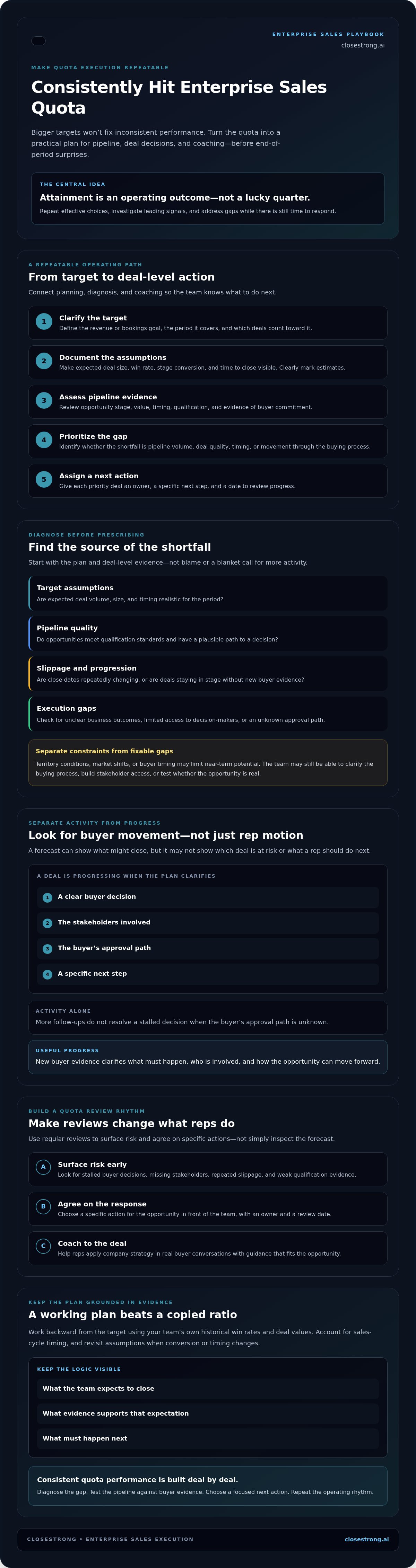
A quota review should change the next move, not just record the latest status. Set a regular cadence that gives managers and reps time to inspect deal risks, make decisions, and assign actions. The right frequency depends on your sales cycle and team needs. What matters is consistency: reviews should happen early enough to influence execution, not just explain a miss after the period ends.
Use the same core questions across deals, then tailor the discussion to each opportunity. Start with what changed since the last review. Ask what the buyer has committed to, what could block a decision, and what evidence supports the current timing. Avoid stage-by-stage recitations. Ask for specifics that clarify the next move.
Identify new buyer information, risks, or shifts in timing.
Distinguish buyer-owned next steps from rep activity.
Surface gaps in stakeholder access, approval steps, or business outcomes.
Record one action, its owner, and the agreed follow-up point.
Track a small set of outcome and execution measures, and define them consistently across the team. For example, make sure everyone uses the same criteria for a qualified opportunity, stage progression, and a slipped close date. Otherwise, the dashboard creates noise instead of a shared view of performance.
Coach the decision in front of the rep. If a deal lacks access to a key stakeholder, work through how to earn that access. If the buyer’s decision process is unclear, help the rep identify what to confirm. Generic encouragement rarely changes behavior. Specific guidance tied to the deal gives the rep a practical next step.
Track recurring obstacles, such as stalled approvals or unclear buyer outcomes, and use those patterns to sharpen team guidance. At the next review, check whether the agreed action happened before repeating advice or changing the forecast. That follow-through makes coaching useful and keeps the review grounded in evidence.
For organization-wide considerations, see sales strategy execution at scale. To help reps apply company strategy in individual deals, explore CloseStrong’s custom deal guidance. A repeatable review rhythm is one practical part of how to consistently hit enterprise sales quota: inspect the evidence, make a decision, and make ownership clear.
A shared playbook gives the team a common direction, but it can’t answer every question that surfaces in a complex deal. Different buyers, approval paths, and business priorities call for guidance that connects company strategy to the opportunity in front of the rep. Without that bridge, a sound strategy can remain a document instead of shaping live deal decisions.
Consider three ways teams commonly support execution:
Playbooks and checklists give reps consistent reference material, but the rep must decide how it applies to a specific deal.
Managers can tailor advice to the deal, but access and consistency may vary across reps and opportunities.
Deal-specific guidance can connect shared strategy with the situation at hand. Evaluate whether it’s relevant and usable without adding unnecessary process.
These approaches can complement each other. Technology can help carry guidance into execution, but it can’t replace sound strategy, buyer evidence, or a rep’s judgment. No tool can make an unclear business case clear without the right buyer conversation.
Assess fit before judging the promise. Does the guidance reflect your company’s strategy and the realities of individual deals? Can reps use it as part of their work without adding another layer of process? Decide in advance how leaders will assess adoption and outcomes, using measures your organization already defines and can verify. Don’t assume a platform improves quota attainment without evidence from your own team.
CloseStrong provides an enterprise sales execution platform powered by its proprietary Precision Guided Selling™ technology. Its custom deal guidance is designed to connect company strategy with individual deal execution. This may fit organizations looking to help reps apply shared strategy in complex opportunities, alongside their existing systems and processes.
The point isn’t to add technology for its own sake. It’s to make the company’s chosen approach more usable when deal decisions happen. If you’re evaluating how to consistently hit enterprise sales quota, assess whether deal-specific guidance addresses a real execution gap, then define how you’ll judge fit using your own evidence and measures.
Explore CloseStrong to assess whether its enterprise sales execution platform and custom deal guidance fit your team’s approach.
Consistent quota performance doesn’t come from pushing harder on every deal. It comes from diagnosing the gap, planning pipeline around your team’s actual conversion and timing, and judging progress by buyer evidence rather than activity alone. A steady review rhythm then turns those signals into clear decisions, specific coaching, and owned next steps.
That’s the practical answer to how to consistently hit enterprise sales quota: connect the target to the actions reps take in real opportunities, then adjust based on what the data and buyers reveal. Generic playbooks can set direction, but complex deals often need guidance shaped for the situation.
CloseStrong’s enterprise sales execution platform uses proprietary Precision Guided Selling™ technology to provide custom deal guidance designed to connect company strategy with deal execution. Explore CloseStrong’s enterprise sales execution platform and assess whether it fits your team’s approach. Build the rhythm, give reps guidance they can apply, and make each review move the work forward.
A sales team can improve consistency by turning its quota into a plan for pipeline, deal execution, and coaching. Start with realistic assumptions based on the team’s own win rates, deal values, and sales cycles. Then review whether opportunities show buyer progress, identify risks, and assign specific next steps. The practical answer to how to consistently hit enterprise sales quota is a repeatable operating process, adjusted when market, territory, or deal conditions change.
There’s no single pipeline coverage ratio that works for every enterprise team. The right planning assumption depends on your historical win rate, deal size, sales cycle, segment, and data quality. Calculate coverage from your own closed outcomes, then revisit it when those inputs shift. Treat the ratio as a planning signal, not proof that the pipeline is healthy or that quota is secured.
Start with the remaining quota and divide it by the relevant historical win rate to estimate the opportunity value needed. For example, if your team typically wins one out of four qualified opportunities, use that conversion rate as a planning assumption, not a promise. Segment the calculation if win rates vary by deal type or market. Then check close timing, average deal value, and buyer evidence before relying on the estimate.
A full pipeline can still contain weakly qualified opportunities, stalled buyer decisions, unrealistic close dates, or deals without access to key stakeholders. Pipeline value alone doesn’t prove there’s a credible path to revenue. Inspect deal movement and buyer commitments to identify risks the rep can address. Also review whether target assumptions, territory conditions, or expected sales-cycle timing have changed, rather than blaming every shortfall on execution.
Set a deal review cadence that fits your sales cycle and gives reps time to act on new information. Focus each review on material changes, buyer commitments, decision risks, and specific next steps, not a recital of status updates. Keep owners and follow-up actions visible between meetings. If reviews keep repeating the same questions without changing decisions or support, simplify the process and make the discussion more evidence-based.
No. Software can’t guarantee sales results. Outcomes depend on buyer decisions, market conditions, strategy, execution, and other factors. An enterprise sales execution platform may help reps apply relevant guidance across individual deals, but it can’t replace sound judgment or buyer evidence. Evaluate tools against execution problems your team has identified, then use reliable internal performance data to assess whether the tool is useful. Treat promised outcomes cautiously unless they’re independently verified.
Focus deal reviews on a small number of decisions that can change outcomes. Use information the team already has, ask reps for buyer evidence, and finish with a clear owner and next action. Remove fields or meetings that don’t support a decision. If you add a tool, assess whether it provides useful deal guidance within the team’s workflow or creates another layer of reporting to maintain.


