





A deal can look healthy in the CRM and still be going nowhere. A stage label isn’t proof that a buyer has made a decision, aligned stakeholders, or agreed on a next step. Effective enterprise sales cycle management tracks buyer progress, not just rep activity. Long, complex deals make this distincti...
A deal can look healthy in the CRM and still be going nowhere. A stage label isn’t proof that a buyer has made a decision, aligned stakeholders, or agreed on a next step. Effective enterprise sales cycle management tracks buyer progress, not just rep activity.
Long, complex deals make this distinction hard to ignore. Opportunities linger without clear evidence of movement, while managers lack a consistent view of buyer decisions and risks. Even a solid playbook can fall short when reps have to apply it deal by deal. The answer isn’t more stage names or pipeline reviews. It’s clearer decision points and practical guidance tied to what’s happening in each opportunity.
This guide shows you how to define stages around buyer evidence, spot stalled or at-risk deals early, and help reps apply company strategy without turning every opportunity into a copy-and-paste process. You’ll learn what to look for at each point in the cycle, which questions expose risk, and how deal-specific guidance can connect enterprise strategy to execution.
• Build enterprise sales cycle management around buyer decisions and evidence, not a universal set of stage labels.
• Set clear stage exits so teams can distinguish real buyer progress from activity that only updates the CRM.
• Use a consistent review checklist to surface risks, clarify ownership, and choose a useful next action without treating every delay as a lost deal.
• Separate cycle management from CRM tracking, forecasting, and deal reviews, then use each for the decision it’s best suited to support.
• Evaluate deal-specific guidance by how well it helps reps apply company strategy to live opportunities and gives managers useful visibility.
A CRM stage can say “evaluation” while the buyer is still deciding whether the problem deserves budget. That gap matters. Enterprise sales cycle management connects the stages a team uses to the decisions buyers must make, the actions sellers take, and the oversight leaders need to keep deals moving for sound reasons.
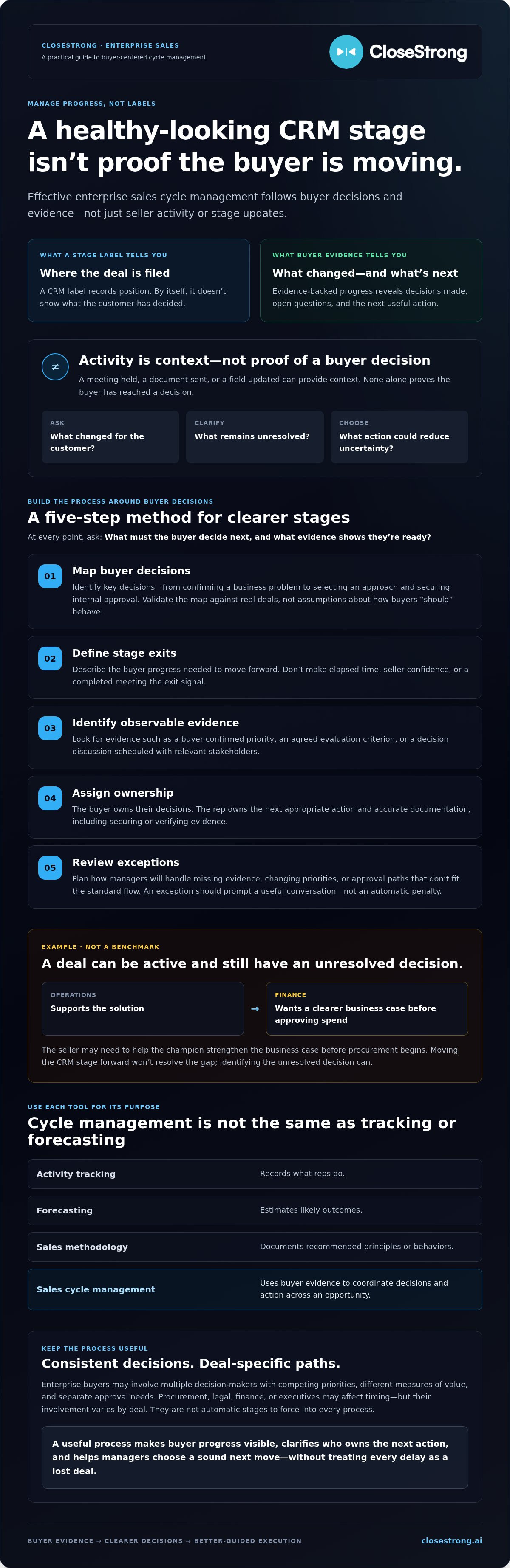
Recorded stage movement shows where a deal is filed; evidence-backed buyer progress shows what the customer has decided and what must happen next. That distinction separates cycle management from three related activities. Activity tracking records what reps do. Forecasting estimates likely outcomes. A sales methodology documents recommended principles or behaviors. Cycle management uses buyer evidence to coordinate decisions and action across an opportunity.
Complex sales, also known as enterprise sales, often involve longer buying processes and multiple decision-makers. The challenge isn’t simply the number of people. Stakeholders can have competing priorities, different measures of value, and separate approval needs. Procurement, legal, finance, or executives may influence timing, but their involvement varies by deal. They aren’t automatic stages to force into every process.
Example, not a benchmark: A buyer’s operations team supports a solution, but finance wants a clearer business case before approving spend. The seller may need to help the champion strengthen that case before procurement begins. Moving the CRM stage forward won’t resolve the gap. Identifying the unresolved decision can.
The goal is consistent decision-making, not identical deal journeys. A useful process clarifies what evidence supports progress, who owns the next action, and when a manager should step in. It should leave room for deal-specific risks and approval paths rather than rewarding reps for completing fields or logging activity alone.
That doesn’t make activity or CRM records irrelevant. They provide context, but a meeting held, document sent, or field updated does not prove the buyer has reached a decision. Ask what changed for the customer, what remains unresolved, and what action could reduce that uncertainty.
A documented sales process can still fall short if it doesn’t help a rep apply strategy to a live opportunity. For a related look at the limits of CRM-only approaches, see complex B2B sales software. The management test is simple: can the team see buyer progress clearly enough to choose a useful next move?
Build stages around changes in the buyer’s decision process, not around the seller’s calendar. A well-defined sales cycle can offer a starting point, but enterprise teams should adapt it to how their customers evaluate, approve, and buy. There’s no universal stage count or fixed cycle length. The right structure helps a rep answer one question at every point: what must the buyer decide next, and what evidence shows they’re ready?
Use this five-step method to shape your process:
Identify the key decisions a customer must make, from confirming a business problem to selecting an approach and securing internal approval. Validate these against real deals, not assumptions about how buyers “should” behave.
Describe the buyer progress required to move forward. Avoid exits based only on elapsed time, seller confidence, or a completed meeting.
Specify what a rep can point to, such as a buyer-confirmed priority, an agreed evaluation criterion, or a scheduled decision discussion with relevant stakeholders.
Name who is responsible for securing or verifying each piece of evidence. The buyer owns their decisions; the rep owns the next appropriate action and accurate documentation.
Decide how managers handle missing evidence, changing priorities, or approval paths that don’t fit the standard flow. An exception should prompt a useful conversation, not an automatic penalty.
Buyer evidence is a stronger stage signal than activity volume because it shows what the customer has decided, not merely what the seller has done. Use that as a design test. If a stage doesn’t help a rep recognize buyer progress or choose a sensible next move, simplify or redefine it. This is the practical core of enterprise sales cycle management: consistent decision rules applied to the reality of each deal.
Separate buyer-confirmed facts from rep interpretation. “The executive sponsor supports the initiative” is an assumption unless the sponsor has said so or taken a clear action. A useful exit criterion might be: “The buyer has confirmed the business priority and agreed who will participate in the next decision.” Tailor the wording to your sales process and capture the evidence behind it.
Trigger a review when expected evidence is missing, the buyer postpones a decision, or no one owns the next step. Don’t ask for another status update. Ask what buyer-facing action could clarify the obstacle, involve a missing stakeholder, or confirm whether the decision path has changed. For a closer look at connecting strategy to individual opportunities, read about scaling sales strategy execution. Teams looking to carry company strategy into live deals can also explore CloseStrong’s deal guidance.
These tools and practices serve different purposes. Confuse them, and teams can end up with more updates but no clearer decisions. A CRM can capture deal details without telling a rep what action will move the buyer forward. Forecasting estimates likely outcomes. Deal reviews help teams interpret specific opportunities. Enterprise sales cycle management connects buyer progress to the decisions and actions needed across the process.
| Approach | Purpose | Core question | Useful output |
|---|---|---|---|
| Cycle management | Coordinate buyer decisions, seller actions, and oversight across stages | What evidence shows the buyer is progressing, and what should happen next? | Clear stage criteria, owners, and next actions |
| CRM tracking | Record and organize deal information | What information and activity are logged? | Deal history and pipeline records |
| Forecasting | Estimate likely revenue outcomes | What is expected to close, and when? | A view of expected outcomes and uncertainty |
| Deal reviews | Examine individual opportunities and decide where help is needed | What is blocking progress, and what intervention could help? | Agreed actions, ownership, or a revised assessment |
A forecast may show a deal as likely to close, but that estimate doesn’t explain whether the buyer has confirmed priorities or aligned decision-makers. Cycle management examines the evidence and work behind progression. CRM records can support that examination, but a logged call or updated close date is not, on its own, proof of a buyer decision.
Look for buyer-confirmed milestones: the customer has validated a business priority, introduced relevant stakeholders, or agreed to a specific next decision. Logged calls and completed seller tasks provide context. They show activity, not necessarily movement toward a decision. A health score can help flag a deal for attention, but it can’t replace judgment about the evidence underneath it. See why sales deal health software needs more than a score to support sound management.
A review earns its place when it resolves a decision, evidence gap, risk, or ownership question. If the meeting simply repeats CRM fields, it’s status theatre. Use consistent questions across deals to make reviews comparable, while leaving room for each buyer’s context. More process isn’t better unless it changes a decision or clarifies who owns the next action. Keep the review focused: What’s known? What’s uncertain? What will the team do next?
A delayed decision is a signal to investigate, not a verdict that the deal is lost. The buyer may be resolving an internal priority, waiting on approval, or reconsidering the path forward. Strong enterprise sales cycle management helps leaders distinguish these possibilities and respond with a useful action instead of pushing for activity just to make the pipeline look busy.
Use this checklist to keep deal reviews focused:
What decision does the customer need to make next?
What has the buyer confirmed, and what remains an assumption?
Who is involved, who is missing, and whose concerns are unresolved?
What could delay or change the decision, and what supports that assessment?
Who is responsible for addressing the next uncertainty?
What specific buyer-facing step will clarify progress or reduce risk?
Start with what changed since the last review. Then ask which buyer decision is closer, further away, or still unclear. Identify missing stakeholders, unresolved concerns, and the evidence behind the current close plan. If a date or probability has shifted, understand why. End with a named owner and a concrete next step, not an untested confidence rating.
Managers should coach toward an action that matters to the buyer. If finance needs a clearer rationale, for example, the rep might work with the champion to confirm the business case and who must approve it. “Make more calls” isn’t a deal strategy. The right action depends on what is blocking this buyer’s decision.
Identifying deal risk names the uncertainty; changing the conditions behind it gives the team a chance to influence what happens next. A postponed decision may reflect a real obstacle, a changed priority, or an unclear buying process. Diagnose before prescribing. Consistency means asking disciplined questions across opportunities, not forcing every deal into the same response.
Use the deal information teams already maintain when it answers the review questions. Then look across opportunities for recurring delays, frequently missing evidence, or unclear ownership. Those patterns can reveal process friction worth fixing. Don’t add fields or reporting steps unless they help someone make a better decision.
An enterprise sales execution platform addresses a broader challenge: helping teams carry company strategy into individual deals. CloseStrong’s Precision Guided Selling™ is designed to provide custom, high-quality deal guidance for that purpose. Explore CloseStrong’s deal guidance to consider how it may fit your approach to enterprise execution.
A documented sales process gives teams a shared map. It defines the company’s intended approach and helps create consistency. But a map doesn’t tell a rep how to respond when a live deal takes an unexpected turn. Enterprise sales cycle management becomes execution when reps can apply strategic direction to the buyer, evidence, and risks in front of them.
That distinction matters. Generic instructions can overlook the conditions shaping an individual opportunity. Deal-specific guidance should help reps think through how company strategy applies to their situation, without pretending every deal follows the same path. When evaluating solutions, look beyond whether a process is documented. Ask whether it can guide decisions and actions in real opportunities.
Use these criteria to assess whether an approach can bridge strategy and execution:
Does it offer clear, useful direction, or simply repeat general process language?
Can the guidance account for the opportunity’s buyer decisions, stakeholders, and risks?
Can reps and managers use it within their actual deal work? Verify how it works in practice rather than assuming particular integrations or capabilities.
Does it help leaders understand where guidance is needed and support a more focused deal conversation?
Consider what reps and managers would need to change in their day-to-day work, and whether that effort is realistic for the team.
Keep the category clear, too. A CRM records and organizes deal information. Sales training workshops focus on training. Lead generation services focus on finding prospects. An enterprise sales execution platform has a different purpose: helping teams carry company strategy into live deal execution. Don’t assume one category replaces another.
CloseStrong’s enterprise sales execution platform uses Precision Guided Selling™ to help enterprise teams implement company strategy on individual deals through custom, high-quality deal guidance. That is the platform’s purpose, not a claim about specific workflows, integrations, implementation details, or customer results. For more context on the approach, read about Precision Guided Selling software.
Use the criteria above to decide whether deal-specific guidance would address a gap in your current process. If you’re ready to explore that approach, Explore CloseStrong’s approach to enterprise sales execution.
Enterprise sales cycle management works when stages reflect buyer decisions, reviews expose real evidence, and each risk leads to a purposeful next action. A CRM can record activity, but progress depends on understanding what the buyer has decided, what remains unresolved, and who owns the next move.
Consistency matters, but identical instructions for every opportunity don’t account for deal-specific realities. Reps need guidance that connects company strategy to the conditions of a live deal. CloseStrong’s enterprise sales execution platform is designed to bridge corporate strategy and individual deal execution through Precision Guided Selling™ and custom, high-quality deal guidance.
Ready to explore how that approach could support your team’s execution? Explore CloseStrong’s approach to enterprise sales execution. Start with clearer evidence, better questions, and practical guidance to give your team a stronger foundation for moving complex deals forward.
Enterprise sales cycle management coordinates sales stages, buyer decisions, seller actions, and oversight across complex opportunities. Rather than treating a stage change as proof of progress, teams define what buyer evidence supports moving forward and what action should follow. This gives reps and managers a shared way to assess deal movement, surface uncertainty, and ground decisions in what the customer has confirmed.
Manage a long enterprise sales cycle by breaking it into buyer decisions, not arbitrary time periods. Define what evidence supports progress at each stage, track who must contribute to the decision, and assign an owner to the next action. For example, if a buyer postpones an evaluation, clarify what changed and agree on a useful follow-up. Review meaningful changes and risks without assuming every delay means the opportunity is lost.
A CRM records and organizes deal information; sales cycle management guides how a team interprets progress and acts on it. A CRM may show that a meeting happened or a close date changed, but those entries don’t necessarily explain what the buyer decided or what the rep should do next. The two concepts are related, but they aren’t interchangeable: records provide context, while management connects evidence to decisions and ownership.
Look for buyer-confirmed movement, such as validated business priorities, access to relevant stakeholders, or agreement on the next decision and its participants. Compare that evidence with what was known at the previous review. Seller activity, including calls and follow-up tasks, can help explain the work underway, but it doesn’t prove the buyer is closer to deciding. If evidence is missing, treat progress as uncertain and investigate.
Enterprise deals can stall when stakeholders disagree, priorities shift, approval paths remain unclear, or concerns about value go unresolved. Sometimes the buyer needs time to coordinate internally; sometimes the seller hasn’t uncovered who must decide or what information is missing. Don’t default to “the deal is dead” or “the buyer is busy.” Identify the specific uncertainty, confirm it with the customer where possible, and choose an action that addresses it.
Review deals often enough to act on meaningful changes, but don’t force every opportunity into the same meeting cadence. Set a regular review rhythm that fits your team’s operating needs, then trigger an additional discussion when buyer evidence disappears, a decision is postponed, a key stakeholder is missing, or ownership is unclear. Keep each review focused on what changed, what remains uncertain, and who owns the next step.
Not automatically. A sales execution platform and a CRM have distinct purposes: a CRM records and organizes deal information, while an execution platform can help connect company strategy to action on individual opportunities. CloseStrong’s platform uses Precision Guided Selling™ to provide custom deal guidance for enterprise teams. Evaluate each system against your requirements, and verify specific capabilities before deciding whether either can replace another tool.


