



More dashboards won’t give you control of a deal. Sales leader peace of mind comes from knowing what’s actually happening in important opportunities, not just hearing a confident update or watching another metric move.You’re accountable for results, but rep updates can leave key questions unanswered...
More dashboards won’t give you control of a deal. Sales leader peace of mind comes from knowing what’s actually happening in important opportunities, not just hearing a confident update or watching another metric move.
You’re accountable for results, but rep updates can leave key questions unanswered: Is the buyer engaged? Is the next step clear? Is the team applying company strategy, or relying on instinct? Adding review meetings may create more activity without resolving the uncertainty. To build confidence without guesswork, focus on consistent execution within each deal.
This article explains what peace of mind means for sales leaders and how to evaluate approaches that can build it. You’ll see why visibility alone isn’t control, what to look for in deal-level guidance, and how representatives can put company strategy into practice with each opportunity. CloseStrong’s Enterprise Sales Execution Platform, built around Precision Guided Selling™, provides custom deal guidance to help connect strategy with execution. The goal isn’t certainty about every outcome. It’s a clearer view of where deals stand and where your team needs to act.
• Define sales leader peace of mind as confidence based on credible deal execution, not optimistic updates.
• Find sources of deal uncertainty by looking beyond activity and pipeline visibility to next actions and strategy use.
• Compare CRM visibility, forecast reviews, manager coaching, and deal-level guidance by the role each plays and the gaps each can leave.
• Use four practical criteria to assess whether your team has clear strategy, evidence in deals, actionable guidance, and consistent follow-through.
• See how CloseStrong’s Precision Guided Selling™ connects company strategy to execution on individual deals.
You own the forecast, but the deal updates you rely on may leave out the details that matter. A representative says an opportunity is progressing. The number looks plausible. Yet the buyer’s priorities, decision process, or next action may still be unclear. That gap makes it hard to know whether the forecast reflects deal execution or optimism.
Sales leader peace of mind is confidence grounded in credible deal-level execution: leaders can see how representatives are applying company strategy, what evidence supports progress, and where action is needed, without assuming every deal will close. It’s an operating outcome, not a guarantee of results or freedom from uncertainty.
Some uncertainty is part of enterprise sales. Buyers can change priorities, involve new stakeholders, or take longer to decide. Leaders can’t remove those realities. But uncertainty caused by inconsistent updates, unclear next steps, or weak guidance is different. The team can address it by improving how it evaluates and advances deals.
A forecast summarizes expectations. It doesn’t necessarily explain the actions behind each opportunity. A deal can be marked as likely to close while the buyer’s decision criteria remain untested or the next meeting has no clear purpose. The forecast gives leaders a roll-up; credible execution gives them context.
Confidence erodes when each representative interprets progress differently, or when risks surface only during a late-stage review. Sales leaders need a consistent basis for understanding what is happening, not a system that promises perfect predictions. The broader discipline of sales management includes planning, strategy, and operations; deal execution is where those priorities meet the buyer’s reality.
Leaders need to know whether representatives can translate company priorities into relevant actions within individual deals. If the strategy calls for understanding business impact, for example, is the rep connecting the proposed solution to the buyer’s stated needs? The question isn’t whether every rep follows an identical script. It’s whether each deal reflects the strategy in a way that fits its circumstances.
Consistent execution doesn’t mean identical buyers, conversations, or outcomes. It means the team applies shared standards while responding to the specifics of each opportunity. With custom deal guidance, representatives can get support putting company strategy into practice, while leaders gain a clearer basis for assessing execution.
That’s why sales leader peace of mind is tied to accountability. Leaders remain responsible for results, but they can make better-informed decisions when deal progress is grounded in observable actions rather than confident summaries alone. The aim isn’t certainty. It’s knowing where execution is strong, where it’s off track, and what deserves attention next.
Uncertainty grows when leaders can’t connect a deal’s reported status to the work happening inside it. Updates may arrive in different formats, next steps may be vague, and company strategy may be applied unevenly from one representative or opportunity to another. The result isn’t simply a visibility problem. It’s a gap between knowing what’s recorded and knowing whether the deal is being advanced thoughtfully.
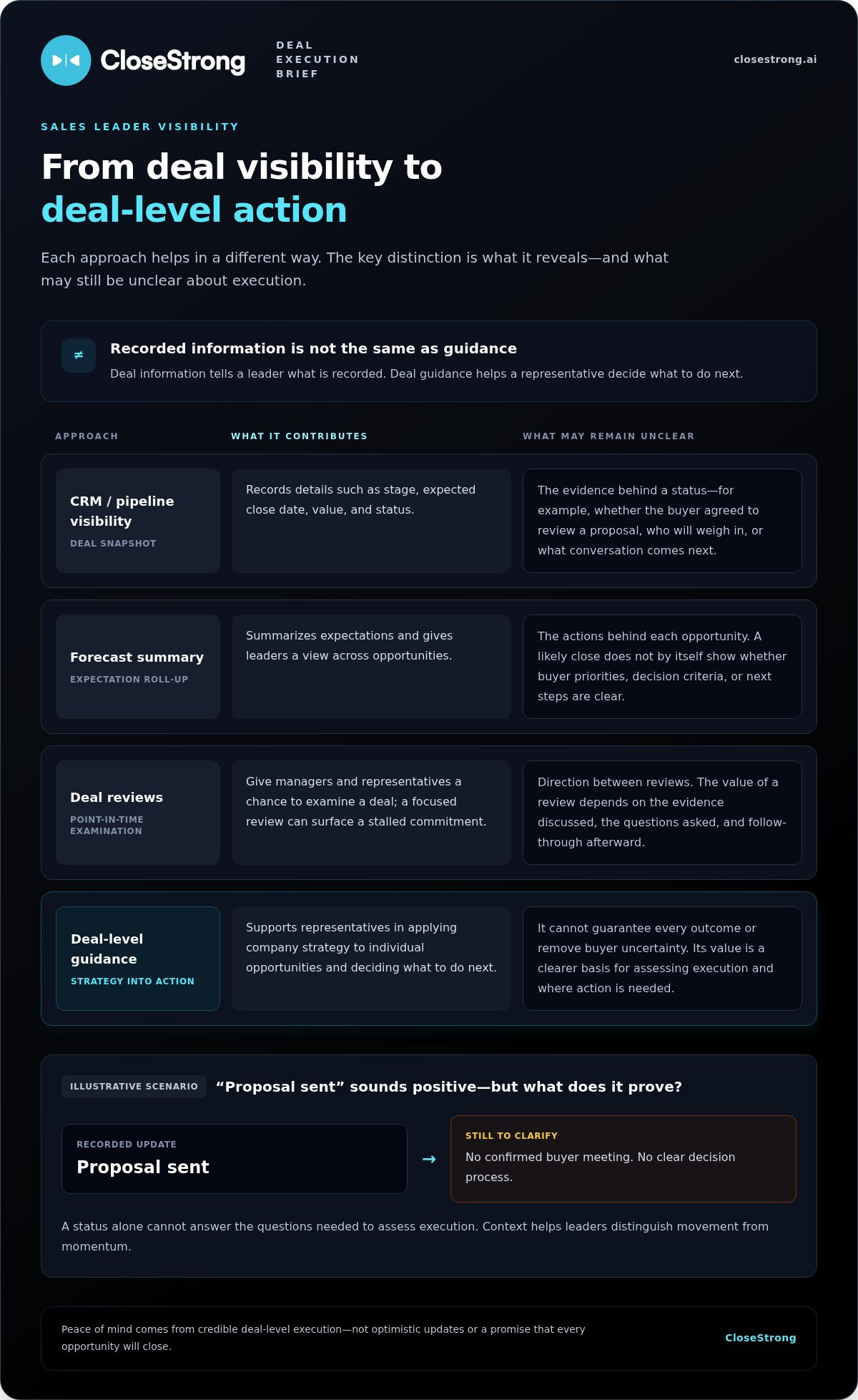
Deal information tells a leader what is recorded; deal guidance helps a representative decide what to do next. More activity data can make a pipeline look busier without clarifying whether actions address the buyer’s needs or move the decision forward.
Pipeline fields can summarize stage, expected close date, value, and other deal details. Those snapshots are useful, but they don’t always show the evidence behind a status. “Proposal sent” may not reveal whether the buyer has agreed to review it, who will weigh in, or what conversation comes next.
Illustrative scenario: A representative marks an opportunity as progressing after sending a proposal. The update sounds positive, but there’s no confirmed buyer meeting or clear decision process. The issue isn’t that the status field is useless. It’s that a status alone can’t answer the questions needed to assess execution. Sales leader peace of mind depends on seeing enough context to tell the difference between movement and momentum.
A review gives managers and representatives a point-in-time opportunity to examine a deal. Its value depends on the evidence brought into the discussion, the questions asked, and whether the conversation leads to clear follow-through. A focused review can surface a stalled commitment. But a meeting by itself doesn’t provide continuous, deal-level direction between reviews.
Look beyond activity counts and status labels. Ask what the buyer has committed to, what remains unresolved, and what action will address the gap. For a deeper look at the limits of relying on health scores alone, read about sales deal health software. A useful sales management approach connects planning and analysis to what teams actually do, as described in Forbes’ overview of the process of leading and directing a sales team.
When that connection is missing, leaders are left interpreting updates after the fact. Custom deal guidance helps representatives apply company strategy within individual opportunities. To explore how CloseStrong approaches that challenge, see its enterprise sales execution platform.
No single approach answers every leadership question. CRM visibility organizes deal information. Forecast reviews test assumptions. Coaching supports people. Deal-level guidance helps connect a sales process to the work in a specific opportunity. Compare what each contributes, then look for gaps between them.
| Approach | Role and support | Limitation to consider |
|---|---|---|
| CRM visibility | Organizes recorded deal details, such as stage, value, and expected close date, for review. | Shows what has been entered, but may not explain the buyer evidence or reasoning behind it. |
| Forecast reviews | Give leaders and representatives a forum to examine assumptions, discuss risks, and agree on follow-up. | Offer a point-in-time discussion. The meeting alone doesn’t guide actions between reviews. |
| Manager coaching | Provides human support to help a representative think through a challenge, develop judgment, and strengthen their approach. | Its reach depends on available time and the quality of the conversation; guidance may not be consistent across every opportunity. |
| Deal-level guidance | Connects the sales process and company priorities to decisions and actions in an active deal. | Supports execution, but doesn’t remove buyer uncertainty or guarantee an outcome. |
CRM reporting can give the team a shared place to organize deal information. Its usefulness depends on what representatives record and how leaders interpret it. A stage or close date can flag where an opportunity sits, but it may not show whether the buyer has confirmed a next step. Reviews give leaders a chance to probe those assumptions and agree on follow-up. Neither a report nor a meeting automatically tells every representative what to do next.
Coaching is human support. A manager can ask questions, help a rep work through a difficult conversation, and build judgment over time. That human element matters: Harvard Business Review discusses two basic qualities that any good salesperson must have, empathy and ego drive. Deal guidance plays a different role: it ties direction to the context of an opportunity, helping the rep apply company strategy as the deal unfolds.
These approaches can work together. Reporting provides a view of recorded information; reviews challenge assumptions; coaching develops the seller; and deal guidance supports strategy execution within opportunities. Visibility shows what’s on the page; execution guidance helps shape what happens next. For a closer look at how enablement differs from execution, explore Precision Guided Selling software. Sales leader peace of mind comes from using the right approach for the question at hand, not expecting one tool or meeting to do everything.
Use these four checks on active opportunities to see whether company strategy is showing up in deal execution. This isn’t a software checklist. It’s a way to identify where your team has a clear operating standard and where representatives or leaders are left filling in the blanks.
Can representatives explain which company priorities matter in a specific opportunity, and what actions those priorities call for? If the strategy stays at the slogan level, reps may interpret it differently from deal to deal.
Do updates include buyer evidence, decisions, and a clear next step, or mainly a rep’s assessment that the deal is “on track”? Look for what the buyer has said or committed to, not just the confidence of the update.
Can a representative tell what to do next when a deal hits a critical moment? Ask whether the guidance fits the buyer’s situation and helps the rep apply company strategy, rather than simply repeating a general sales-process instruction.
Can leaders see whether agreed actions happened and what changed afterward? A next step without an owner or follow-through is an intention, not evidence of execution.
Apply these questions to current opportunities, especially those where the stakes or uncertainty are high: Are reps connecting company strategy to actions in their specific deals? Do updates show buyer evidence, decisions, and a defined next step? Is guidance available while it can still shape execution, or only after an opportunity becomes urgent? Are agreed actions revisited so the team learns from what happened?
Look for patterns, not isolated imperfections. If updates repeatedly lack buyer evidence, the gap may be how the team defines deal progress. If reps understand the strategy but struggle to apply it to live opportunities, they may need clearer deal-level direction. If plans are sound but actions fade, follow-through may be the issue.
Choose the gap that matters most to important deals or a recurring team behavior. Then address that gap directly. Don’t automatically add another meeting, metric, or process document. First decide what needs to change in how representatives make decisions and act within opportunities. For more on connecting company direction to execution, explore CloseStrong’s enterprise sales execution platform.
This framework makes sales leader peace of mind something leaders can evaluate: how clearly strategy is understood, how credibly deals are progressing, and whether reps have useful direction and follow-through. To see how CloseStrong connects strategy with deal-level execution, explore CloseStrong’s enterprise sales execution platform.
Company strategy sets direction. But direction only matters when representatives can apply it in the decisions they make inside active deals. Enterprise opportunities differ: buyers have distinct priorities, decision processes, and concerns. A broad sales principle can be clear to leadership and still leave reps unsure how to put it into practice with a specific buyer.
CloseStrong’s Enterprise Sales Execution Platform uses Precision Guided Selling™ to help representatives execute company strategy on every deal through custom deal guidance. It connects what the company expects with what the rep needs to do as an opportunity moves through the closing process.
Consider a company that prioritizes understanding a buyer’s business needs. That priority is useful, but it doesn’t automatically tell a representative how to handle a live opportunity where the buyer’s decision criteria remain unclear. Custom deal guidance helps bridge that distance by tying direction to the specific deal, so the rep can act on company strategy rather than rely only on memory or interpretation.
That’s the distinction. Strategy explains what matters across the team; deal guidance helps representatives carry it into individual opportunities. CloseStrong’s platform is built around this connection. It supports a more consistent approach to execution without assuming every buyer or deal follows the same path, and without promising that outcomes can be controlled.
Start by identifying where your strategy gets lost. Do representatives understand the priority but struggle to translate it into deal actions? Are updates too thin to show whether those actions are happening? Do leaders see the need for guidance only once an opportunity becomes urgent?
Use those answers to pinpoint the execution gap that matters most. Check whether the strategy is clear, deal updates show evidence and next steps, representatives have usable direction, and agreed actions receive follow-through. Then focus on the gap affecting your important opportunities or recurring team behavior. Don’t treat another meeting, metric, or process document as the automatic fix. Choose an approach that addresses the actual breakdown between expectations and execution.
Sales leader peace of mind isn’t certainty about every deal. It’s stronger confidence in how the team applies strategy, makes decisions, and follows through across opportunities. Explore CloseStrong’s enterprise sales execution platform and Precision Guided Selling™ approach to see how custom deal guidance can support that work.
Sales leader peace of mind doesn’t come from a confident forecast alone. It comes from credible deal evidence, clear next actions, and consistent execution of company strategy across individual opportunities. Visibility and reviews can help surface what’s happening, while coaching and deal-level guidance support representatives in deciding what to do next.
CloseStrong’s Enterprise Sales Execution Platform uses Precision Guided Selling™ to help representatives apply company strategy on individual deals through custom deal guidance. It isn’t a promise that every opportunity will close. It’s an approach to making execution clearer and leadership decisions better informed.
Ready to connect your strategy with the work happening in your deals? Explore how CloseStrong guides enterprise deal execution and take the next step toward more consistent execution across your team.
Peace of mind means having credible insight into how important deals are being executed, not certainty that every opportunity will close. A sales leader can see whether representatives are applying company priorities, what buyer evidence supports deal progress, and where the next action is unclear. This makes sales leader peace of mind an operating outcome: leaders can respond to execution gaps with better information instead of relying only on confident updates.
Build confidence by checking the evidence and actions behind deal updates. For an important opportunity, ask what the buyer has decided, which commitments are confirmed, what remains unresolved, and what happens next. Then assess whether that next action reflects company strategy and has clear ownership. Consistent questions help leaders distinguish supported progress from assumptions. They won’t remove uncertainty, but they can reveal execution gaps earlier and make follow-up more focused.
A CRM can organize recorded deal information and make pipeline details easier to review. That visibility can be useful, but a record alone may not show the buyer evidence behind a status or whether the representative has a sound next action. Leaders can use recorded information alongside reviews, coaching, and execution support to understand both what’s documented and what’s happening in the opportunity.
Deal visibility helps leaders see information about an opportunity, such as its stage, expected close date, or recorded updates. Deal guidance helps a representative decide how to act within that opportunity, based on its context and the company’s strategy. Visibility answers, “What’s recorded?” Guidance addresses, “What should happen next?” Teams may need both: information supports assessment, while relevant direction helps turn expectations into action.
Leaders can reduce avoidable surprises by asking for evidence of buyer decisions, clear next steps, and follow-through on agreed actions. Look beyond activity, such as meetings held or proposals sent, to understand what the buyer has committed to and what could stall progress. Review important opportunities regularly enough to surface unclear assumptions, and provide direction before a gap becomes urgent. Buyer changes and delays can still happen, so the goal is earlier awareness, not perfect prediction.
Sales coaching can support deal execution when it helps representatives examine a real opportunity, challenge assumptions, and choose useful next actions. A manager might help a rep prepare for a conversation when buyer priorities or decision roles are unclear. Coaching is human support and can strengthen judgment, but it doesn’t automatically provide continuous direction across every deal. Clear company priorities and practical deal-level guidance can help reinforce what representatives discuss with managers.
Precision Guided Selling™ is the approach behind CloseStrong’s Enterprise Sales Execution Platform. It provides custom deal guidance designed to help representatives execute company strategy on individual deals and through the closing process. For leaders, the intended value is a stronger connection between team priorities and deal-level actions. It doesn’t promise certain outcomes; it supports more consistent execution so leaders can make better-informed assessments of where opportunities stand and where attention may be needed.


