




A spreadsheet can tell you what’s happening in a deal. It can’t reliably tell a rep what to do next. That’s the real challenge of moving from spreadsheets to a sales playbook: useful deal knowledge is buried across rows, tabs, and individual files, while reps still have to work out how to apply the...
A spreadsheet can tell you what’s happening in a deal. It can’t reliably tell a rep what to do next. That’s the real challenge of moving from spreadsheets to a sales playbook: useful deal knowledge is buried across rows, tabs, and individual files, while reps still have to work out how to apply the strategy. The answer isn’t to discard everything your team has learned or replace it with another document nobody opens.
Spreadsheets are familiar for good reason. They’re flexible, easy to update, and often hold hard-won knowledge about customers and deals. But when that knowledge is scattered or ambiguous, managers can’t easily see whether reps are following the intended approach, and reps can’t quickly turn it into action. More process and more data entry won’t solve that problem. Clearer, more usable guidance can.
This guide shows you how to preserve what’s valuable, remove duplication, and shape deal insights into practical next steps for live enterprise opportunities. You’ll learn how to identify what belongs in a playbook, connect guidance to real deal situations, and improve consistency without adding administrative drag. The goal is simple: move from recording deal information to helping reps act on it.
• Turn spreadsheet information into guidance reps can use to make decisions and take action in live deals.
• Audit existing fields to keep useful deal signals and remove duplicates, outdated assumptions, and reporting-only data.
• Use spreadsheets where they fit, such as analysis or temporary inventories, and playbook guidance where reps need decision support.
• Make moving from spreadsheets to a sales playbook manageable by piloting one meaningful deal situation before expanding.
• When written guidance can’t support consistent execution across individual deals, explore how Precision Guided Selling™ can help put company strategy into action.
Moving from spreadsheets to a sales playbook isn’t a file-format project. It’s a shift in how your team uses deal knowledge. A spreadsheet can hold years of hard-won insight: which buying signals matter, where approvals tend to stall, and what helps a complex deal progress. But that knowledge often sits in scattered notes or in the judgment of the rep who entered it. The goal is to make useful insight clear enough for other reps to apply.
Deal tracking records what’s happening; deal guidance helps reps decide what to do next. A sales playbook turns repeatable lessons into practical direction for specific selling situations. It builds on a standard sales process, but goes beyond naming stages. It helps reps respond to the conditions of an enterprise deal without prescribing a script for every conversation.
Columns can capture stage, owner, target dates, next steps, and notes. That’s useful for organizing and reviewing deals. The trouble starts when the next move depends on context buried in free text: “legal is slow,” “champion seems unsure,” or “need exec alignment.” Those phrases may signal a real risk, but they’re hard to compare across deals and don’t tell another rep what action to take. Spreadsheets aren’t inherently the problem. They stop serving the team when important knowledge can’t be found, understood, or applied consistently.
A working playbook connects deal conditions to useful questions, actions, and decisions. If a buying group has several stakeholders but no clear decision process, for example, guidance might prompt the rep to map who influences approval and clarify how the customer will decide. That’s different from a folder of email templates or policy statements. Those resources can help, but playbook guidance should help reps choose what’s relevant to the live deal and take a considered next step.
The test is simple: can a rep use the guidance while managing an opportunity, without having to translate vague advice into a plan alone? If not, the team has documented knowledge but hasn’t yet turned it into a playbook. The next step is to identify which spreadsheet information is worth keeping and reshape it around decisions reps actually face.
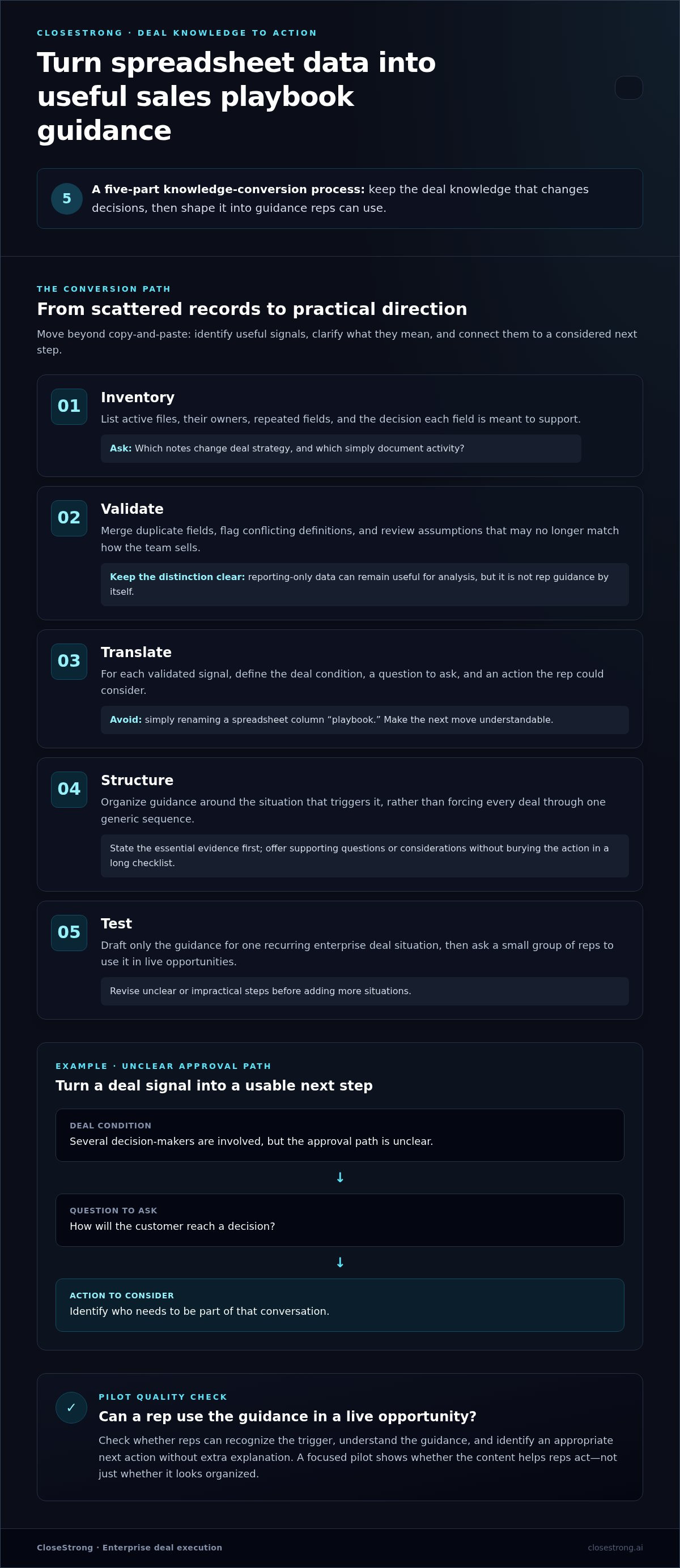
Moving from spreadsheets to a sales playbook works best as a knowledge-conversion process, not a copy-and-paste exercise. A column may show what reps recorded. The work is to determine which details signal a decision, which still matter, and what action they should inform.
Inventory, validate, translate, structure, then test: keep the deal knowledge that changes decisions and turn it into guidance reps can use.
Start by listing active files, who owns them, which fields repeat, and what decision each field is supposed to support. Ask sales leaders and reps which notes change deal strategy and which simply document activity. A note about a missing executive sponsor may affect the next move; a logged meeting date may be useful for tracking, but isn’t playbook guidance by itself.
Then validate what remains. Merge duplicate fields, flag conflicting definitions, and review assumptions that may no longer match how the team sells. Keep reporting-only data available for analysis where it’s useful, but don’t mistake it for rep guidance. A useful reference on data-driven sales plays reinforces the value of turning observed patterns into a repeatable approach.
For every validated signal, define the deal condition, a question to ask, and an action the rep could consider. For example, if several decision-makers are involved but the approval path is unclear, prompt the rep to ask how the customer will reach a decision and identify who needs to be part of that conversation. Don’t just rename a spreadsheet column “playbook.”
Separate essential evidence from optional context. State what the rep needs to establish, then offer supporting questions or considerations without burying the action in a long checklist. Organize guidance around the situation that triggers it, such as an unclear decision process or a change in stakeholder support, rather than forcing every deal through one generic sequence.
Choose one recurring enterprise deal situation and draft only the guidance needed to address it. Ask a small group of reps to use the draft in live opportunities. Look for friction: Can they recognize the trigger, understand the guidance, and identify an appropriate next action without extra explanation? Revise unclear or impractical steps before adding more situations.
A focused pilot reveals whether the content helps reps act, not just whether it looks organized. Once your guidance is grounded in real deal patterns, see how CloseStrong guides enterprise deal execution with an enterprise sales execution platform powered by Precision Guided Selling™.
These tools solve different problems. A spreadsheet is useful for organizing and examining information. A playbook gives reps direction when recurring deal conditions call for a decision or action. Moving from spreadsheets to a sales playbook doesn’t mean every spreadsheet must disappear. It means putting each kind of work in the right place.
| Dimension | Spreadsheet | Sales playbook |
|---|---|---|
| Purpose | Track, organize, or analyze defined information. | Guide decisions and actions in recurring selling situations. |
| Structure | Rows, columns, formulas, and notes that users can adapt. | Guidance organized around deal conditions, questions, and next steps. |
| Decision support | Shows recorded status or patterns; interpretation often falls to the user. | Connects a deal signal to relevant considerations and possible actions. |
| Maintenance | Needs clear ownership, definitions, and version control. | Needs review as strategy and deal lessons change. |
| Rep usability | Works when the task is clear and fields are easy to interpret. | Works when reps need consistent guidance during complex opportunities. |
Keep a spreadsheet for bounded jobs: a one-off analysis, a controlled inventory, or early-stage process discovery. It can help teams see what information they have before deciding what deserves a more lasting home. Set an owner, define each field, and establish a review date so the file doesn’t quietly become an unofficial source of truth.
Watch for warning signs: competing versions, unclear updates, or notes that different reps interpret differently. Those aren’t automatic proof that a spreadsheet has to go. They are reasons to clarify its purpose and decide whether it still serves that purpose.
A spreadsheet can show “no executive sponsor identified.” A playbook can help a rep consider who needs to be involved, what to ask about stakeholder alignment, and what evidence would clarify the risk. That distinction matters when complex deals involve many decision-makers, recurring risks, or strategic choices that should be handled consistently across opportunities.
A playbook doesn’t automatically improve results, and it doesn’t replace every spreadsheet. Its value depends on whether reps can find and apply useful guidance in the situations it was designed for. For a broader look at connecting company strategy with action on individual deals, explore enterprise sales execution platforms.
A playbook doesn’t earn attention just because it’s complete. It earns attention when it helps reps make a real deal decision without adding busywork. Keep the rollout focused: start with one meaningful situation, test whether the guidance is clear and useful, then expand based on what the team learns. Moving from spreadsheets to a sales playbook should change how people act, not create another document to maintain.
Assign someone to make decisions about the guidance, coordinate feedback, and keep the version current.
Pick a recurring deal situation where clearer direction could help, rather than trying to document the entire sales process.
Describe the trigger, the questions a rep should consider, and the possible action. Keep it concise.
Ask a small group to use the draft in relevant live deals.
Use observed confusion and rep feedback to sharpen prompts or remove unnecessary steps.
Add another situation only after the first guidance is usable and has a clear owner.
Choose a representative scenario, such as a deal with several stakeholders and no clear decision path. Before the pilot, define what successful use looks like: reps recognize when the guidance applies, understand its prompts, and use it to inform their next decision. The goal isn’t to prove a predetermined result. It’s to find out whether the guidance works in the flow of a real opportunity.
Gather feedback from reps and managers on clarity, relevance, and fit with existing deal reviews. Notice where users need extra explanation. Rewrite confusing prompts and remove steps that create activity without helping someone assess the deal or choose a next move.
Assign an owner to review the guidance on a regular cadence and collect feedback from the field. Revisit it when strategy, deal patterns, or team practices change. In coaching conversations, connect the playbook to actual deal choices: which signal did the rep see, what guidance applied, and what did they decide? That keeps the playbook tied to execution rather than letting it become a static reference.
Track practical signs of usefulness, such as whether reps can find relevant guidance, understand it without extra explanation, and use it in deal discussions. For more on connecting company plans with individual opportunities, read about sales strategy execution at the deal level. To explore support for applying strategy consistently across enterprise deals, see CloseStrong’s enterprise deal guidance.
A documented playbook is a meaningful step, but it may not close the execution gap. Reps can have access to the same guidance and still apply it differently, especially when a live enterprise deal shifts or several stakeholders raise competing concerns. If the same deal questions keep resurfacing, or company strategy gets diluted as opportunities progress, adding more pages may not help. The challenge isn’t storing more information. It’s helping reps apply relevant guidance in the context of each deal.
Look for patterns. Do managers repeatedly need to explain how strategic priorities apply to specific opportunities? Do reps face familiar deal conditions but make inconsistent choices? Does the playbook describe the intended approach yet leave the rep to work out how it fits the current situation? Those are signs that static guidance may not be enough for consistent execution.
The next step isn’t automatically another template or a larger reference library. It’s to connect company strategy with decisions and actions at the deal level. Learn more about the related approach in this overview of Precision Guided Selling software.
CloseStrong provides an enterprise sales execution platform using Precision Guided Selling™. Its custom deal guidance helps sales representatives apply company strategy to individual opportunities and move through the closing process with direction suited to the deal. The distinction is practical: rather than only recording deal status or asking reps to interpret a static playbook on their own, the platform connects strategy to the choices reps face in active deals.
This is a step to consider when your team has surfaced useful spreadsheet knowledge and shaped it into playbook guidance, but still needs a more consistent way to put that strategy into practice across complex opportunities. The platform focuses on deal execution, not simply documenting the process.
To evaluate how custom deal guidance could support your team’s approach, explore CloseStrong’s enterprise sales execution platform.
Moving from spreadsheets to a sales playbook isn’t about transferring rows into a new document. It’s about finding the deal knowledge that matters, turning it into practical guidance, and testing it in real selling situations. Keep spreadsheets for clearly bounded tracking or analysis. Use a playbook when reps need direction for recurring deal decisions.
Start with a focused use case, assign an owner, and refine the guidance based on whether reps can understand and apply it. That’s how you avoid creating another static resource and give useful strategy a better chance of showing up in live deals.
When your team needs to connect company strategy with execution on individual opportunities, CloseStrong’s enterprise sales execution platform uses proprietary Precision Guided Selling™ technology and custom deal guidance to support that work. Explore CloseStrong’s approach to deal-level sales guidance.
You don’t have to rebuild everything at once. Start with one meaningful deal situation, learn from the team, and build from there.
Moving from spreadsheets to a sales playbook starts with identifying which spreadsheet details influence real deal decisions. Inventory active files, then validate useful patterns with reps and managers. Remove duplicate fields and outdated assumptions. Next, turn relevant signals into clear questions or actions, such as what to investigate when the customer’s approval path is unclear. Pilot guidance for one recurring deal situation before expanding. This keeps the playbook grounded in selling work, rather than copied columns.
A sales spreadsheet stores, organizes, or analyzes information; a playbook helps reps respond to selling situations. A spreadsheet might record a deal’s stage, owner, and next meeting date. Playbook guidance might help a rep decide what to clarify when several stakeholders are involved but no decision process is clear. Teams can use both. Keep spreadsheets for bounded tracking or analysis, and use playbook guidance to make repeatable deal decisions easier to find and apply.
No, a playbook doesn’t need to replace every spreadsheet. Spreadsheets can still fit temporary analysis, controlled lists, or tasks that benefit from a flexible grid. A playbook serves a different job: guiding reps through recurring deal situations. Decide based on what work each tool supports. Don’t move data just to declare a migration complete. Keep a spreadsheet if its purpose is clear, its fields are understood, and someone owns its upkeep.
Involve reps in drafting and testing guidance, then keep the first version focused on a real deal situation. Make it easy to find and specific enough to help with a decision, without adding steps that don’t serve the deal. Managers can reinforce relevant guidance in deal conversations by discussing which signals apply and what options the rep is weighing. Ask users what’s unclear or irrelevant, then revise the playbook instead of expecting adoption through announcement alone.
A useful sales playbook identifies the deal situation it addresses, the signals a rep should notice, relevant questions to ask, and actions or decisions to consider. For example, guidance for an unclear approval process could prompt a rep to clarify how the customer will decide and who needs to be involved. Name an owner and describe how the guidance will be reviewed. Keep reporting fields separate; the playbook should guide decisions, not reproduce every spreadsheet column.
Assign a named owner to review the playbook and gather feedback from reps and managers on a regular cadence. Revisit guidance when company strategy, recurring deal patterns, or team practices change. Remove steps that no longer help a decision, and clarify prompts users interpret differently. When you revise a section, make the change clear to the team so reps and managers know which guidance is current. Maintenance is part of managing execution, not an occasional document cleanup.
Consider a more structured approach when teams rely on competing files, interpret the same fields differently, or repeatedly ask managers how to handle similar deal situations. These are signs that recording status alone may not provide enough direction. First identify which decisions need consistent guidance, then choose a focused migration scope. You don’t need to overhaul every workflow at once. Start with a recurring enterprise deal challenge where clearer guidance could help reps decide what to consider next.
Software alone can’t determine which spreadsheet patterns matter or what reps should do with them. Your team still needs to validate information and shape useful signals into guidance for real deal situations. CloseStrong provides an enterprise sales execution platform using Precision Guided Selling™ and custom deal guidance to help representatives apply company strategy during the closing process. The shift is from simply storing deal information to connecting strategy with actions on individual opportunities.


