





Most sales leaders aren't running a business; they're running an autopsy suite. You spend your Mondays dissecting why a "locked" deal evaporated on Friday. It's a reactive cycle that kills your credibility and your forecast. You've seen the symptoms. CRM data that reads like fiction. Reps who treat...
Most sales leaders aren't running a business; they're running an autopsy suite. You spend your Mondays dissecting why a "locked" deal evaporated on Friday. It's a reactive cycle that kills your credibility and your forecast. You've seen the symptoms. CRM data that reads like fiction. Reps who treat "bad news" like a state secret. Deals that stall because a stakeholder you didn't know existed suddenly has a concern. True sales deal risk mitigation isn't about explaining a loss after the fact. It's about aggressive, real-time intervention.
Stop performing autopsies and start preventing slips with a proactive framework for enterprise sales risk mitigation. Risk management is an autopsy; risk mitigation is Precision Guided Selling™. This 2026 execution checklist will show you how to enforce standardized rigor across your team. You'll gain the real-time visibility needed to secure predictable revenue and drive higher win rates in an environment where thirteen internal stakeholders are now the baseline for every enterprise deal. It's time to stop guessing and start executing.
• Stop relying on CRM health scores that only explain why you've already lost. Learn why real-time sales deal risk mitigation requires a move from post-mortem "autopsies" to proactive execution.
• Uncover "invisible" stakeholders before they stall your deal in the final 10%. Use our 2026 checklist to ensure every solution is tied directly to a board-level priority.
• Move beyond conversation intelligence that records history but doesn't change it. Discover how to close the tech gap with tools that provide leading guidance rather than lagging indicators.
• Eliminate rep bias and "hidden" bad news by standardizing a rigorous Definition of Done for every stage. Replace management friction with automated nudges that keep the deal moving forward.
• Bridge the gap between your sales strategy and actual execution with Precision Guided Selling™. Transform your forecast from a hopeful guess into a predictable reality by designing risk out of the process.
Most enterprise sales organizations are running an autopsy suite. You spend your weekends dissecting why a "sure thing" died on Friday afternoon. You call it forecasting. In reality, it is a post-mortem. The hard truth is that your current process for sales deal risk mitigation is likely failing because it focuses on recording history rather than changing it. You are watching the car crash in slow motion instead of grabbing the steering wheel.
CRM "Health Scores" are the ultimate lagging indicator. They tell you the patient is dead long after the pulse stopped. If your strategy relies on a dashboard turning red to trigger a conversation, you've already lost. You aren't managing risk. You're just documenting failure. This is the Execution Gap: the distance between what your sales methodology says should happen and what actually happens on a Tuesday morning Zoom call.
Identification is passive. Mitigation is aggressive. Identification tells you the deal is sick; mitigation provides the cure. Most sales tech tools stop at identification. They use AI to tell you that sentiment is low or that a stakeholder hasn't replied in ten days. That is just data. It isn't a solution. True sales deal risk mitigation is about intervention, not observation.
The shift to true mitigation requires moving from "What happened?" to "What do we do now?" It means having a playbook that triggers specific actions based on real-time signals. In 2026, with buying committees ballooning to thirteen or more stakeholders, you cannot afford to wait for a rep to "feel" like a deal is slipping. You need precision. You need a system that doesn't just flag a missing stakeholder but guides the rep on exactly how to engage them.
Most enterprise sales deal reviews are pure theater. It is a game of interrogation where managers try to catch reps in a lie, and reps work overtime to polish a turd. This "Forecast Theater" creates a dangerous psychological barrier. Reps fear being "red-flagged," so they hide the bad news until the final 10% of the deal cycle. By then, it is too late to pivot.
It isn't a collaboration; it's a cross-examination. Reps know that if they admit a deal is shaky, they'll be subjected to hours of "strategy sessions" that offer no actual help. So they stay quiet. They hide the risk. They hope the buyer's CFO has a change of heart. Hope is not a strategy; it's a death wish. You don't need more interrogation. You need guided execution that removes the fear of the "red flag" and replaces it with a clear path to "green."
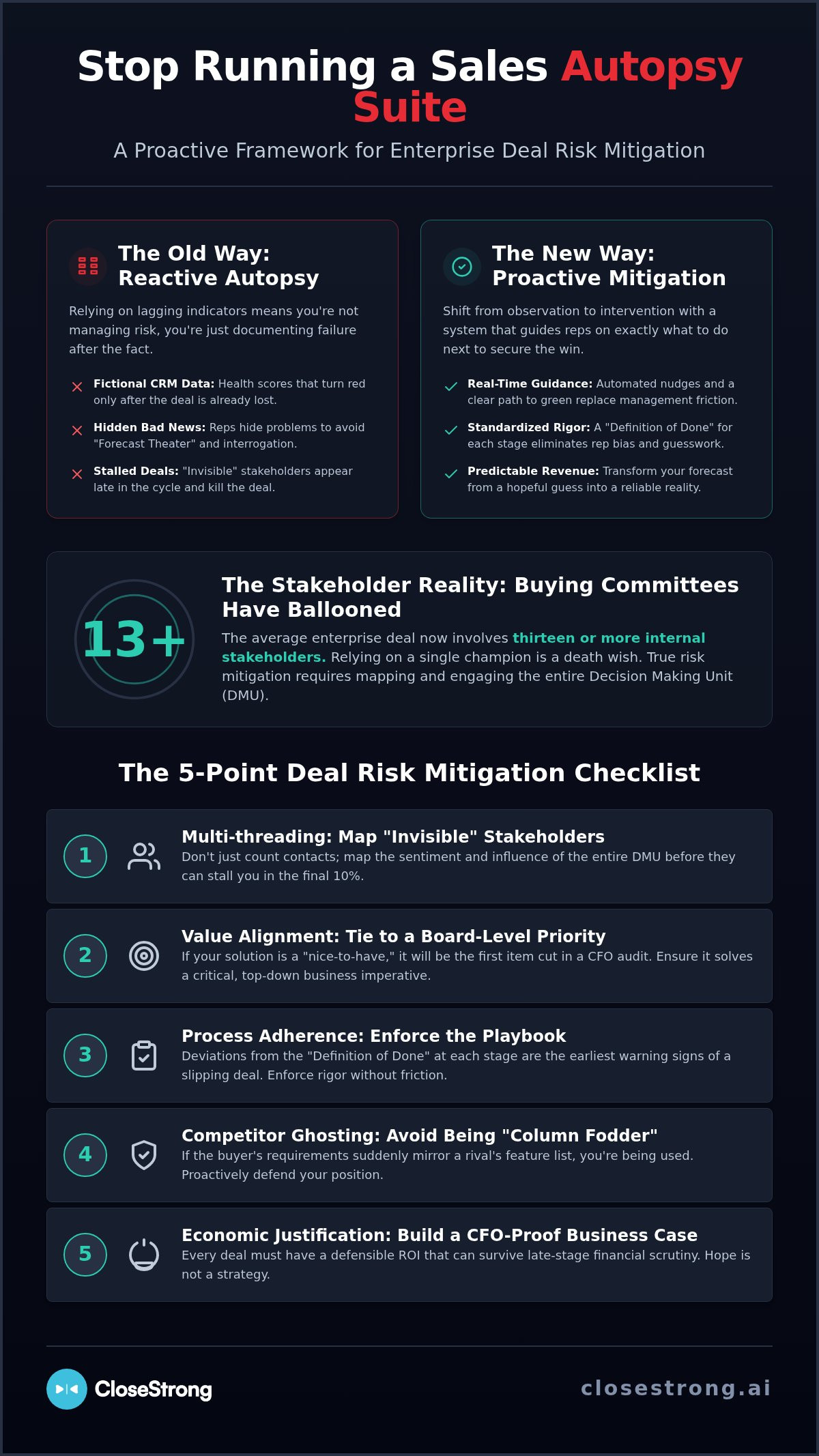
Risk management is not a feeling. It is a rigorous, binary verification of reality. If your reps are relying on "good vibes" or a "strong relationship" with a single champion, they aren't selling. They're gambling with your forecast. Effective sales deal risk mitigation requires a shift from subjective updates to objective proof. In an era where the average enterprise purchase involves thirteen stakeholders, you cannot afford to leave execution to chance. Use this five-point checklist to audit every high-value opportunity in your pipeline.
Have we mapped the "Invisible" stakeholders? Don't just count contacts; map the sentiment of the entire Decision Making Unit (DMU).
Is our solution tied to a "Board-Level" priority? If it's a "nice-to-have" budget item, it will be the first thing cut in a CFO audit.
Has the rep followed the Precision Guided playbook? Deviations from the "Definition of Done" at each stage are early warning signs of a slip.
Are we being "fenced in" by a rival strategy? If the buyer's requirements suddenly mirror a competitor's feature list, you're being set up as the column fodder.
Is the business case solid enough to survive a late-stage scrutiny? Every deal must have a defensible ROI that a CFO can't poke holes in.
Execution doesn't happen by accident. It happens through discipline. If you want to move beyond spreadsheets and start seeing the truth, you need real-time deal guidance that enforces these standards automatically.
Single threading is the fastest way to kill a forecast. But multi-threading isn't just about having more names in the CRM. It's about identifying the "Anti-Champion." This is the person whose influence or budget is threatened by your solution. If you haven't found them, they are currently working behind the scenes to kill your deal. You must gain executive access without alienating your primary contact. Do this by positioning the executive meeting as a "strategic alignment" rather than a "sales pitch."
In enterprise sales, a lack of bad news is often the worst news. Silence doesn't mean the buyer is busy; it means they've lost interest or found a different priority. Test their engagement with "give-to-get" milestones. Ask for a specific internal document or a meeting with legal. If they won't give, they aren't buying. A critical checklist item for sales deal risk mitigation is identifying the last time a buyer-initiated action occurred. If you are the only one pushing the ball forward, the deal is already dead.
Your sales tech stack is likely lying to you. Not because the data is wrong, but because it is too late. Legacy conversation intelligence platforms are excellent for recording the crash. They aren't designed to grab the wheel. They provide a high-definition recording of your rep losing the deal. That isn't sales deal risk mitigation. That is just a more expensive way to feel bad about your forecast. If you are waiting for a recording to tell you a deal is in trouble, the damage is already done.
The CRM is another trap. It is a historical archive, not a management tool. Garbage in, forecast out. Most sales deal health software falls into the same pit. It monitors health scores based on activity, but it lacks deal-level guidance. It tells you the deal is "yellow" or "red" based on engagement. It doesn't tell the rep exactly how to make it "green." Monitoring is passive. Mitigation is active. You don't need more dashboards; you need real-time, deal-specific instructions that change the outcome before the quarter ends.
Why do so many "safe" deals evaporate at the finish line? We need to look at why enterprise deals fail even when they reach the 90% mark. It is usually because of a late-stage risk that was visible weeks ago but ignored. Relying on "gut feel" in a high-stakes 2026 environment is professional negligence. Post-Mortem Sales Analysis is a reactive failure mode where leaders study the wreckage of a lost deal instead of adjusting the flight path in real-time. You don't need a historian to tell you what went wrong. You need a system that prevents the error from happening in the first place.
Imagine driving to a new city with only a static paper map. That is your CRM. Now imagine using a GPS that provides turn-by-turn navigation, reroutes you around traffic, and warns you of hazards ahead. That is Precision Guided Selling™. It doesn't just show you the destination; it scales the manager's expertise across every deal in the pipeline. It turns sales deal risk mitigation into a repeatable process rather than a heroic individual effort.
This is the fundamental shift from Enablement to Execution. Enablement is about training people for a hypothetical future. Execution is about providing the right instruction at the exact moment of need. Real mitigation requires deal-specific instructions that tell a rep exactly what to do when a competitor enters the fray or a key stakeholder goes silent. Stop watching the dashboard. Start guiding the sale.
Most reps hate "rigor" because they confuse it with administration. They think you want them to spend more time in the CRM so you can generate prettier reports. They're wrong. Rigor is not a burden; it is a competitive advantage. The friction comes from asking reps to record history. The flow comes from guiding them to create it. Effective sales deal risk mitigation fails when it feels like a tax on the rep's time. It succeeds when it feels like a shortcut to their commission check.
You must standardize the "Definition of Done" for every sales stage. "The meeting went well" is a subjective opinion. "The buyer confirmed the business case in writing" is an objective fact. You don't need more status updates. You need binary verification of execution. Move from nagging your team about data entry to guiding them toward the next best action. This shift transforms your culture from one that celebrates "Closing" to one that obsesses over "Executing."
Integrating high stakes deal management into the daily workflow ensures that mitigation isn't a separate task. It's the job. When instructions are delivered in real-time, within the context of the deal, the "friction" evaporates. You aren't adding work; you're removing the guesswork that leads to stalled opportunities. If you want to see how this looks in practice, you should see our platform in action.
Managers are the ultimate bottleneck in enterprise sales execution. They can't be in every room, and they can't listen to every call. Most deal reviews are just status updates in disguise. You need to multiply manager impact by using an enterprise sales execution platform that provides automated guidance. This frees up managers to stop being "CRM police" and start being true strategists. Transform your deal reviews from interrogation sessions into high-value strategy sessions that actually move the needle.
By providing real-time, deal-specific instructions, we eliminate the guessing that leads to forecast variance. This is sales deal risk mitigation that happens while the deal is still alive, not during a Friday afternoon post-mortem. If your forecast relies on a rep's subjective confidence score, you aren't running a business. You're running a casino. Precision is the only way to win consistently in a market that no longer tolerates execution gaps. The year 2026 is the year of the Execution Platform. The companies that thrive will be those that move from monitoring their teams to guiding them.
Precision Guided Selling™ provides the specific how-to for every unique deal context. It doesn't offer generic advice or surface-level health scores. Instead, it uses data-driven insights to prevent deal slippage before it starts. When a key stakeholder goes silent or a buyer-initiated action fails to materialize, the platform triggers the exact move the rep needs to make. This level of rigor scales the expertise of your best managers across the entire organization. You aren't just identifying risk; you are designing it out of the process entirely. It's the mechanics of success, automated.
The first step toward predictable revenue is admitting your current checklist is likely a list of suggestions rather than a set of requirements. You need to audit your current sales deal risk mitigation framework. Are your reps actually doing what the playbook says, or are they winging it? Identify the high-stakes deals currently sitting at the 90% mark in your pipeline. If you can't see the binary proof of progress for those deals, they are at risk. You can't afford to wait for the next quarterly review to find out. Close the gap now. Assess your team's execution maturity and move toward a system that guarantees rigor. The truth is in the execution, not the forecast.
The era of the "gut feel" forecast is over. In 2026, enterprise complexity is too high to leave deal execution to chance. True sales deal risk mitigation requires a shift from passive monitoring to active, real-time intervention. You've seen the checklist. You know the gap between your strategy and your team's daily reality. Now, you have a choice. You can keep performing autopsies on failed deals; or you can implement a system that prevents the slip before it starts.
Standardizing your "Definition of Done" and scaling manager coaching through technology aren't just operational updates. They are the mechanics of predictable revenue. By replacing lagging indicators with leading guidance, you turn every rep into a high-performer and every deal into a winnable opportunity. It's time to demand more from your tech stack. It's time to demand precision.
Stop guessing and start guiding with CloseStrong’s Enterprise Sales Execution Platform. Our Precision Guided Selling™ technology provides custom, deal-level guidance built specifically for the complexity of enterprise sales. You have the strategy. Now, get the platform that ensures your team actually executes it. The future of your forecast is in your hands.
Risk management is an autopsy; risk mitigation is an intervention. Management tells you the deal is sick. Mitigation provides the cure. Most leaders confuse watching a dashboard with managing a business. If you are just identifying risks, you are a historian. If you are actively changing the behavior that creates those risks, you are practicing true sales deal risk mitigation. One is about awareness. The other is about outcomes.
You find hidden risks by hunting for the silence. Map every stakeholder in the decision-making unit, especially the "Anti-Champion" who loses if you win. If a stakeholder hasn't engaged in a "give-to-get" milestone, they are a risk. Don't trust a rep's "feeling" about a relationship. Look for buyer-initiated actions. If the buyer isn't doing the work, they aren't buying the solution. Precision requires proof.
Deals fail at the end because of the "Execution Gap." It isn't a product problem; it's a process failure. Late-stage stakeholders like legal, security, or the CFO enter the room and find gaps your team ignored for months. If your solution isn't tied to a board-level priority, it becomes an easy cut. Most deals don't die; they just stall into eternity because the business case wasn't CFO-proof from the start.
Most software is just a historian. It records your failure in high definition. But an Enterprise Sales Execution Platform actually changes the outcome. It provides real-time, deal-specific instructions that guide reps through complex cycles. Tracking tells you where you are. Mitigation tells you what to do next. Precision Guided Selling™ is the difference between a static map and a turn-by-turn navigation system that reroutes you around hazards.
It eliminates rep bias and "Forecast Theater." Most forecasts are based on a rep's optimism rather than objective reality. This technology enforces a binary "Definition of Done" for every sales stage. You stop guessing and start seeing the truth. When every deal follows a rigorous execution playbook, your forecast becomes a reflection of actual behavior rather than hopeful thinking. It turns the forecast from a wish into a calculation.
The loudest killers are easy to spot. The silent ones, like single-threading or "nice-to-have" positioning, are what actually tank your quarter. If you're only talking to one champion, you're one reorganization away from a lost deal. If your ROI isn't defensible in a CFO audit, you're just a line item waiting to be deleted. These risks don't show up on a standard health score until it's too late to pivot.
Stop making it a tax on their time. If your checklist feels like administrative work, they'll ignore it or lie to it. Integrate sales deal risk mitigation into their daily workflow as a shortcut to their commission. Show them that rigor leads to higher win rates and shorter cycles. When execution becomes the path of least resistance, adoption happens naturally. Don't nag them for data. Guide them toward the win.
CRM data is a historical archive. It isn't a crystal ball. In 2026, the average enterprise deal involves thirteen stakeholders and nine external influencers. A CRM can't track that level of complexity or stakeholder sentiment. You need signal-rich intelligence that monitors execution behavior in real-time. If you're relying on a database to predict the future, you've already lost. Data records history. Execution creates it.


