





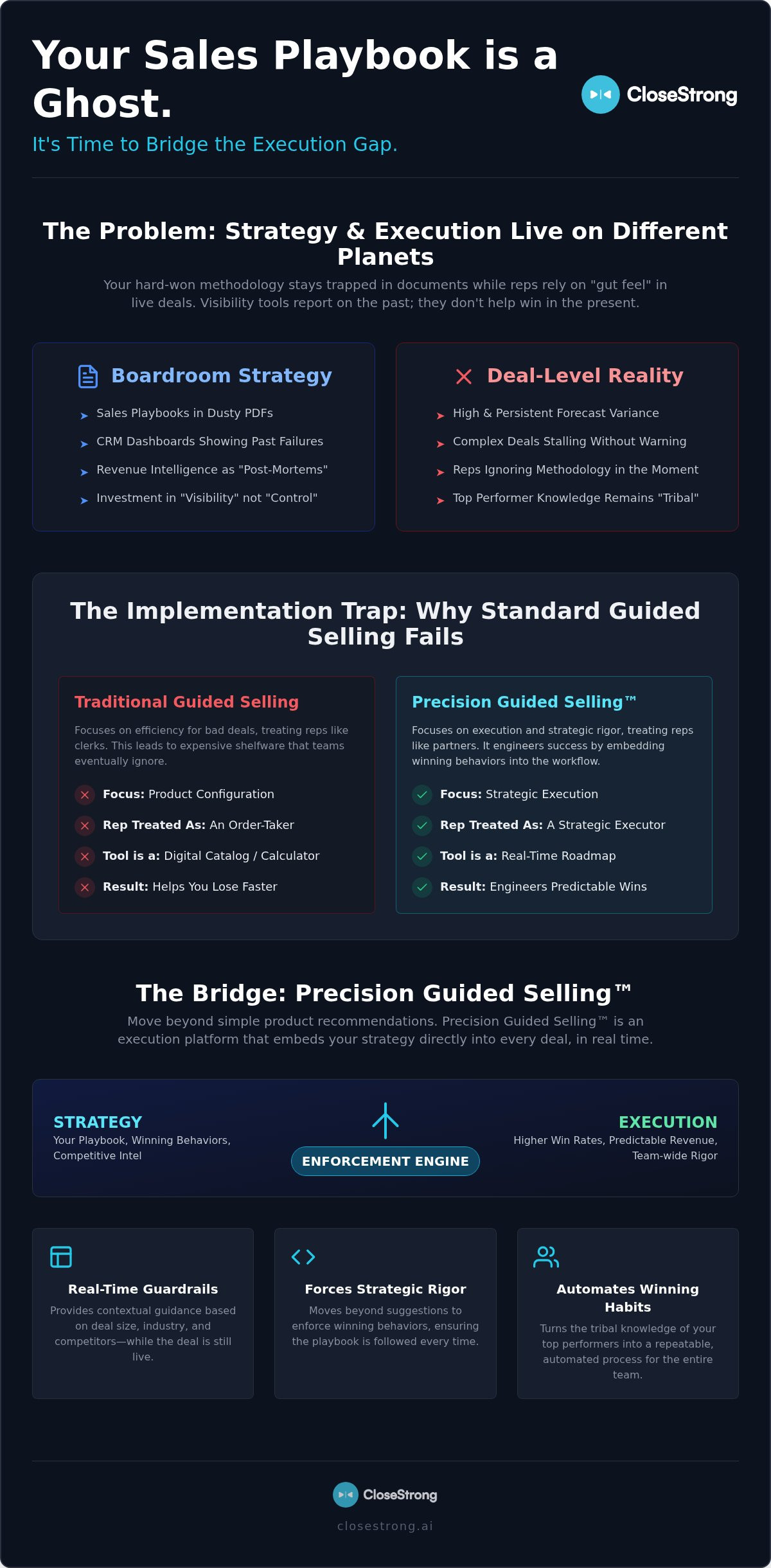
Your sales playbook is a ghost. It exists in a dusty PDF, but it never makes it into the actual deal. You invested in a CRM for visibility, yet you still battle high forecast variance and complex deals that stall without warning. Most leaders assume the fix is more training. It isn't. The reality is...
Your sales playbook is a ghost. It exists in a dusty PDF, but it never makes it into the actual deal. You invested in a CRM for visibility, yet you still battle high forecast variance and complex deals that stall without warning. Most leaders assume the fix is more training. It isn't. The reality is that your strategy and your execution are living on different planets. A standard guided selling implementation usually fails because it treats the rep like a clerk. It focuses on configuring quotes when it should be enforcing strategy.
We agree that watching reps ignore your hard-won methodology is a recipe for missed targets. You don't need more dashboards; you need more rigor. This article teaches you how to implement a system that actually changes rep behavior and closes the gap between your boardroom strategy and deal execution. We'll move beyond basic product picking. You'll learn how to use Precision Guided Selling™ to turn your playbook into a real-time partner that drives predictable revenue growth and higher win rates on enterprise deals.
• Stop treating guided selling as a faster way to quote. It's a mechanism to force strategic rigor into every deal.
• Learn why a standard guided selling implementation often results in expensive shelfware when it fails to prioritize rep behavior over simple data entry.
• Move beyond basic product recommendations by using Precision Guided Selling™ to provide real-time guardrails for complex enterprise sales.
• Identify the specific execution gaps where your strategy dies and bridge them with custom, deal-level guidance that actually lands.
• Audit your team's winning behaviors to turn the tribal knowledge of your top performers into a repeatable, automated process for everyone.
Most sales leaders treat a guided selling implementation like an upgrade to their calculator. They want faster quotes. They want fewer errors. They want efficiency. But efficiency on a bad deal just helps you lose faster. The trap isn't the technology; it's the intent. If your implementation doesn't fundamentally shift how your reps behave in the heat of a deal, you haven't bought a solution. You've bought expensive shelfware that your team will eventually ignore. The cost of this mistake is measured in stalled deals and a forecast variance that keeps you up at night.
We see it constantly. Companies pour millions into "visibility" tools like CRM and revenue intelligence. These platforms are great at telling you how much you're losing and why you're losing it. They're excellent at post-game analysis. But they're useless during the game. Visibility doesn't drive execution. Knowing your forecast is off by 20% doesn't help a rep navigate a multi-stakeholder enterprise deal on a Tuesday afternoon. You don't need more data about the past. You need more control over the present.
The Guided selling process is often misunderstood as a simple product-matching exercise. In the world of complex enterprise sales, picking the right SKU is only 10% of the battle. The other 90% is strategy. Traditional implementations focus on "what we sell." They ignore "how we win." They treat the rep like an order-taker rather than a strategic executor. Real guided selling isn't about making sure the rep doesn't pick a blue widget when the customer needs a red one. It's about ensuring they're asking the right questions, identifying the right stakeholders, and countering the right competitors at the exact moment it matters. It's the difference between a checklist and a roadmap.
How do you know if you've fallen into the trap? Look at your adoption rates. If reps see the tool as "admin work" or another box to check for management, it's broken. When your high-stakes sales playbook stays trapped in a PDF while deals stall in the mid-funnel, your guided selling implementation has failed. You're left with persistent forecast variance and a team that relies on "gut feel" instead of strategic rigor. The missing ingredient is precision. Without deal-level guardrails that reflect your actual winning behavior, your strategy is just a suggestion. It's time to stop configuring quotes and start enforcing the mechanics of success.
Stop thinking about product recommendations. Most tools on the market are just digital catalogs with a search bar. They help your reps pick a part number. They don't help them win a deal. Precision Guided Selling™ is the intersection of high-level strategy and granular, deal-level execution. It isn't a suggestion engine; it is a platform that executes strategy on every deal. This shifts the focus from what you sell to how you win. In a complex market, the "how" is the only thing that matters.
Real-time guidance beats post-game analysis every time. Your CRM reports are essentially post-mortems. They tell you why you lost after the money is gone. To win, you need guidance while the deal is still breathing. This requires an enterprise sales execution platform that embeds your playbook directly into the daily workflow. We aren't talking about enablement. Enablement is training people to do better. Execution is ensuring they actually do it. For a guided selling implementation to stick, the platform must be nearly invisible. It shouldn't feel like admin work. It should feel like the path of least resistance to a closed contract.
Embedding strategy into a rep's workflow means removing the need for them to remember the playbook. If they have to leave their deal to look at a PDF, you've already lost. Precision means the guidance is contextual. It changes based on the deal size, the industry, and the specific competitors involved. This isn't about "support." It is about enforcement. When your guided selling implementation prioritizes execution over simple configuration, you stop hoping for success and start engineering it.
Reps are notoriously optimistic. They think a deal is healthy because the prospect was friendly on a Zoom call. Precision Guided Selling™ replaces that bias with cold, hard rigor. By using precision guided selling software, you move from subjective opinions to objective deal health. Are they talking to the economic buyer? Have they addressed the specific technical hurdles? If the data says no, the deal isn't healthy, regardless of what the rep feels. This eliminates "happy ears" and provides a level of custom deal guidance that standard tools can't touch. If you're tired of "gut feel" forecasting, it's time to look at the mechanics of your sales rigor.
Your boardroom strategy is a fantasy until a rep actually uses it. Most leadership teams spend months crafting a "winning" playbook, only for it to die the moment a rep opens a Zoom call. This is the Strategy Trap. It happens because scaling sales strategy execution is impossible without deal-level guardrails. You can't just hope your team follows the plan. You have to force it. A successful guided selling implementation isn't about giving reps a new tool to ignore. It's about solving for behavior. Even your most experienced sellers, the "Rogue Reps," ignore the playbook because they think their "gut" is better than your process. They aren't being malicious. They're being efficient. If the path of least resistance is to ignore your strategy, they'll take it every time.
Implementation must solve for behavior, not just data entry. If your new system just gives them more fields to fill out, you've already lost. You're adding friction without adding value. The goal is to make the right behavior the easiest behavior. When your guided selling implementation prioritizes the mechanics of the deal over the convenience of the rep, the execution gap begins to close. It isn't about giving them a tool; it's about giving them a path. You stop managing by hope and start managing by design.
High-level objectives are useless if they don't translate into specific rep actions. Visibility isn't the solution. Seeing that a deal is stuck doesn't bridge the gap; it just documents the failure. You need complex B2B sales software that enforces process adherence in real-time. Don't ask reps to remember the strategy. Bake the strategy into the deal itself. If the next step isn't clear, the deal isn't moving. The boardroom defines the "what," but the software must dictate the "how" during every customer interaction.
When execution is optional, your forecast is a lie. Industry data suggests that forecast failure rates can reach 53% because leaders are guessing based on rep sentiment. This is why sales deal health software must do more than just monitor scores. It must focus on execution rigor. You need to identify risk before the deal slips, not during the post-mortem. A rigorous implementation ensures that "health" is a measure of strategic alignment, not a rep's optimism. If the rep hasn't identified the technical buyer or mapped the procurement process, the deal isn't healthy. Period. Stop guessing. Start executing.
Most consultants tell you to start your guided selling implementation by auditing your product catalog. They are wrong. If you start with products, you end up with a glorified calculator. Instead, start with your failures. Audit the strategy-execution gap. Identify exactly where your deals go to die. Is it the discovery phase? Is it the technical validation? Once you know where the bleed is, you can fix it. Next, look at your top 5% of reps. Stop looking at their "personality" and start looking at their mechanics. What questions do they ask? Which stakeholders do they engage? Define that winning behavior. That is your baseline for guidance.
Implementation isn't a one-time event; it's a structural shift. You must embed this guidance directly into the workflow. If a rep has to leave the CRM to find the "how-to," they won't do it. Guidance must be ubiquitous and invisible. Then, shift your management style. Move from "Reporting" (what happened) to "Coaching" (what should happen next). Use real-time data to drive the next steps. Finally, iterate. Your strategy is a living document. If the market shifts, your guidance must shift with it. A rigid guided selling implementation is just another legacy hurdle waiting to happen. Much like how IT departments use NetConverter.ai to automate the migration of complex network configurations and avoid technical debt, sales leaders must automate the migration of their playbooks into the field to avoid strategic stagnation.
Your 2026 enterprise sales tech stack is likely bloated with visibility tools. You have CRM for data and Conversation Intelligence for recording. But visibility is not execution. CRM creates admin friction. Conversation Intelligence tells you what went wrong after the call is over. You need an execution layer that sits between the two. This layer must integrate with your CRM without adding a single second of "Admin Friction." It should provide the answer before the rep even knows they have a question. Stop buying tools that watch your team fail and start implementing an execution platform that helps them win.
Reps hate "Big Brother" tools. They love tools that help them make money. To drive adoption, you must answer the "What is in it for me?" question immediately. Position guided selling as a GPS for deals. A GPS doesn't judge the driver; it just ensures they reach the destination without hitting a dead end. This is about empowerment through rigor. It is a straight-talk approach to accountability. If the rep follows the guidance and the deal still fails, you have a strategy problem. If they ignore the guidance and the deal fails, they have an execution problem. Clarity is the ultimate motivator.
CloseStrong is not another CPQ tool. It is not a "revenue intelligence" platform that records calls and tells you why you lost three weeks ago. CPQ is about the "what." Intelligence is about the "past." CloseStrong is about the "now." It is an Enterprise Sales Execution Platform designed for one purpose: to ensure your strategy survives contact with the customer. A successful guided selling implementation with CloseStrong doesn't just give your reps a product picker. It gives them the custom high quality deal guidance they need to navigate complex enterprise cycles. We don't do suggestions. We do execution.
Precision Guided Selling™ forces your boardroom strategy into the field. It stops being a PDF and starts being the mechanism that drives every interaction. This is the end of forecast guesswork. When every rep is forced to follow a rigorous, data-driven process, the "gut feel" disappears. You aren't hoping they did the discovery correctly. You know they did. This level of execution rigor is the only way to close the gap between your ambitious revenue targets and the reality of the deal floor.
Most tools give you better reports on why you're failing. CloseStrong gives you the mechanics to succeed. By enforcing strategic adherence, our users see a dramatic shift in their middle-of-the-pack performers. Transforming B-players into A-players isn't about more training. It is about providing deal-level guidance that removes the guesswork from their day. When your guided selling implementation focuses on rigor, win rates climb because "Rogue Rep" behavior is replaced by proven, winning tactics. Some industry professionals report that this shift can slash forecast variance significantly by removing the subjective bias that usually plagues sales data.
The status quo is broken. In 2026, "Enablement" is no longer enough. You can't train your way out of a behavior problem. You have to solve it with technology that dictates the path of execution. Your implementation journey with CloseStrong starts by acknowledging that your current playbook is a suggestion, not a rule. It's time to change that. Stop settling for visibility when you could have control. Stop guessing. See how CloseStrong executes your strategy on every deal.
Your sales strategy is currently a suggestion. It lives in a dusty PDF while your reps wing it on every Zoom call. A successful guided selling implementation isn't about faster quotes; it's about closing the execution gap. You don't need more visibility into your losses. You need the structural rigor to prevent them. Most leaders accept forecast variance as a cost of doing business. It isn't. It is a symptom of a strategy that never reaches the deal floor.
Precision Guided Selling™ technology transforms your playbook into a real-time partner. It provides custom deal-level guidance that forces strategic adherence on every interaction. This is how you eliminate forecast variance and turn your B-players into a repeatable engine of growth. The choice is simple. You can keep watching your strategy die at the deal level, or you can start enforcing the mechanics of success. It's time to stop settling for visibility and start demanding execution.
Execute your strategy on every deal with CloseStrong. You have the plan. Now, make sure your team actually lands it.
A sales playbook is a suggestion; guided selling is an enforcement mechanism. The playbook usually lives in a document that reps ignore the moment a call starts. In contrast, a guided selling implementation embeds those strategic rules directly into the deal workflow. You aren't asking reps to remember a "Discovery" chapter from six months ago. You're giving them the next move based on real-time deal data. One is theory; the other is execution.
Most enterprise implementations take 90 to 120 days. This isn't because the software is slow, but because your strategy is likely a mess. We have to audit the gaps, define winning behaviors, and translate your PDF playbook into logic. If someone promises a "one-click" setup, they're selling you a product configurator, not a strategy execution tool. Real rigor takes time to build but pays off in predictable revenue.
It doesn't replace coaching; it makes coaching actually effective. Most managers spend their time asking "What happened?" because they lack visibility into the deal mechanics. With Precision Guided Selling™, the platform handles the basic guardrails. This frees the manager to focus on high-level strategy and nuance. You stop being a forensic investigator and start being a tactical leader. It moves coaching from a post-mortem to a pre-emptive strike.
Reps will use any tool that helps them hit their number faster. If your guided selling implementation feels like "admin work," they'll ignore it. If it acts like a GPS that helps them navigate a complex procurement process without hitting a dead end, they'll live in it. The goal is to make the right behavior the path of least resistance. When the platform helps them win a deal they would have lost, adoption takes care of itself.
It improves accuracy by removing "happy ears" from the equation. Reps are naturally optimistic; they mistake a friendly prospect for a closed deal. Guided selling replaces that sentiment with objective execution data. If the rep hasn't mapped the decision-making unit or cleared the technical hurdles, the deal isn't healthy. The system scores health based on what the rep has done, not what they feel. This eliminates the guesswork common in enterprise sales.
The ROI of Precision Guided Selling™ is found in three places: higher win rates, shorter sales cycles, and reduced forecast variance. By forcing every rep to perform like your top 5%, you raise the floor of the entire team. You stop losing deals to silly mistakes like missing a stakeholder. While we won't quote generic dollar amounts, the bottom-line impact is clear. You get more predictable revenue from the same headcount.
Complex deals are exactly why this exists. Simple deals don't need guidance; complex enterprise deals die because they lack guardrails. When you have multiple stakeholders, technical hurdles, and competing priorities—as seen in the intricate B2B fleet management sector where you can learn more about Alliance Fleet Solutions—a rep can't keep it all in their head. The platform provides custom deal-level guidance tailored to those specific complexities. It ensures that no matter how custom the solution, the strategic rigor of the sales process remains consistent across the team.
CloseStrong integrates natively with your existing CRM to act as an execution layer. We don't want your reps jumping between tabs. The guidance appears where they already work, pulling data from the CRM and pushing updates back in real-time. It isn't a replacement for your CRM; it's the engine that makes the CRM useful. We eliminate the "Admin Friction" that usually kills new sales tech by making the integration nearly invisible to the end user.


