





Your sales strategy is a masterpiece on a whiteboard, but it's a mess in the field. You've built the playbook. You've hired the talent. Yet, your reps are still winging it on complex enterprise deals while your forecast variance swings like a pendulum. It's not a talent problem; it's an execution pr...
Your sales strategy is a masterpiece on a whiteboard, but it's a mess in the field. You've built the playbook. You've hired the talent. Yet, your reps are still winging it on complex enterprise deals while your forecast variance swings like a pendulum. It's not a talent problem; it's an execution problem. If you're ready to learn how to fix sales execution, you have to stop blaming the reps and start fixing the system. You know the pain of a strategy that looks great in a PDF but fails the moment a prospect asks a hard question.
Stop settling for autopsy reports that tell you why you lost a deal three weeks ago. You need to win the deal happening right now. This article reveals how to bridge the gap between high-level strategy and individual deal reality using Precision Guided Selling™. We'll break down how to strip away the tech stack noise and replace it with custom, high-quality deal guidance. You'll discover the path to predictable revenue growth and higher win rates by turning your strategy into a living, breathing execution engine. It's time to stop guessing and start winning.
• Most sales strategies fail because they live on a whiteboard rather than in the deal. Stop assuming your playbook is being followed and start ensuring it is.
• Enablement is a passive Band-Aid that doesn't lead to wins. Discover how to fix sales execution by replacing "just-in-case" training with active, "just-in-time" guidance.
• Visibility is not control. Monitoring a stalling deal is just a slow-motion autopsy; you need a system that triggers real-time course correction.
• Precision Guided Selling™ bridges the gap between corporate strategy and field reality by codifying your best moves into actionable deal-level guidance.
• Transform your sales org from a collection of "rogue" reps into a synchronized engine capable of winning high-stakes enterprise deals predictably.
Your sales strategy is probably a masterpiece. It has the right segments, the right messaging, and a beautiful slide deck to match. But here is the hard truth: most enterprise strategies die the moment a rep opens a new opportunity in the CRM. The gap between what leadership wants and what actually happens in a live deal isn't a crack; it's a canyon. You see it in the high forecast variance. You feel it when high-stakes deals stall for no reason. If you're ready to learn how to fix sales execution, you have to stop blaming the reps and start fixing the system.
Leaders often respond to this gap by demanding more effort. They want more calls, more emails, and more activity. This is a mistake. Trying harder is not the solution to a structural execution gap. You can't work your way out of a broken process. When your reps go rogue, it isn't usually because they're lazy. It's because your strategy is too high-level to survive the friction of a complex enterprise sale. The result is predictable: slipping deals, low win rates, and a forecast that is more fiction than fact.
Let's clear the air. Sales execution isn't about the number of dials your team makes. It's not about how many automated emails they blast into the void. In the modern enterprise landscape, real execution is the relentless adherence to strategy at the individual deal level. It's about executing the right strategy for the right deal at the right time. Sales execution is the bridge between "what to do" and "how to do it" in a live deal.
Most organizations are suffocating under the weight of their own enablement. You have more content, more training modules, and more battle cards than ever before. Yet, your win rates remain stubbornly flat. Why? Because enablement is a passive, "just-in-case" solution. It assumes that if you give a rep enough information, they'll magically know how to use it when a high-stakes deal is on the line. They won't. Enablement is the preparation; execution is the performance. If you're struggling with how to fix sales execution, you must realize that preparation without performance is just expensive overhead.
Enablement provides the tools. Execution provides the results. It's a binary reality that most leaders ignore. Data shows that 53% of forecasted deals fail even when robust enablement programs are in place. Think about that. You've prepared the team, but they're still dropping the ball at the goal line. The problem is the library approach. Enablement builds a massive repository of assets and hopes reps go find them. Real execution requires a GPS approach instead. You don't need a map of the whole city when you're making a turn. You need to know exactly which turn to take right now.
Reps don't need another workshop. They don't need another weekend retreat to talk about value selling or discovery techniques. They need a guide inside their live deals. The decay of training is brutal and fast. By the time your Q1 kickoff energy fades, your team has already forgotten the majority of what they learned. If execution isn't embedded in the daily workflow, it simply doesn't exist. You can tell your team is over-enabled but under-executing when your CRM is full of stalled deals despite a marketing drive full of fresh content. It's a sign that your strategy is failing at the deal level.
The shift in 2026 is moving from general learning to precision guidance. It's about stripping away the noise and giving reps the exact guidance they need to win the specific deal in front of them. If you want to see what this looks like in practice, you should explore an enterprise sales execution platform designed for high-stakes complexity. This isn't about teaching them to fish. It's about making sure they actually catch the whale. When you focus on active, just-in-time guidance, you finally solve the mystery of how to fix sales execution once and for all.
Leaders are obsessed with visibility. They spend millions on dashboards, heat maps, and pipeline reviews. But here's the blunt reality: visibility is not control. Just because you can see a train wreck in slow motion doesn't mean you have the tools to stop it. Most "revenue intelligence" tools are designed to show you that you're losing, not to help you win. If your goal is to understand how to fix sales execution, you have to stop staring at the scoreboard and start influencing the play. Monitoring a stalling deal is just a high-tech autopsy.
The industry has confused seeing a problem with solving one. You don't need more data points telling you that a deal hasn't moved in three weeks. You need a mechanism that forces the right behavior before the deal dies. Revenue intelligence tells you what happened; revenue execution ensures the right things happen next. One is a rearview mirror. The other is a steering wheel. It's time to stop being a spectator in your own pipeline and start driving the outcome.
Legacy recording and tracking tools are fantastic for one thing: telling you why you already lost. Knowing that a discovery call went poorly forty-eight hours ago doesn't help your rep save the deal tomorrow. It's a reactive fix in a proactive world. The burden then falls on managers to listen to hours of recordings just to find a single coaching moment. It's an unscalable model that treats the symptom rather than the disease. Tracking behavior is not the same as changing behavior. If you want to know how to fix sales execution, you need guidance that happens during the sales cycle, not a critique that happens after the damage is done.
Your CRM is a glorified filing cabinet. It was built for reporting and forecasting, not for guiding reps through the brutal reality of a complex enterprise sale. It's where data goes to be stored, not where strategy goes to be executed. This leads to the classic "Garbage In, Garbage Out" problem. Reps view CRM entry as a chore for leadership rather than a tool for their own success. This disconnect is why complex B2B sales software is becoming the essential layer above the CRM. You need a system that actually drives the win, not just one that records the loss.
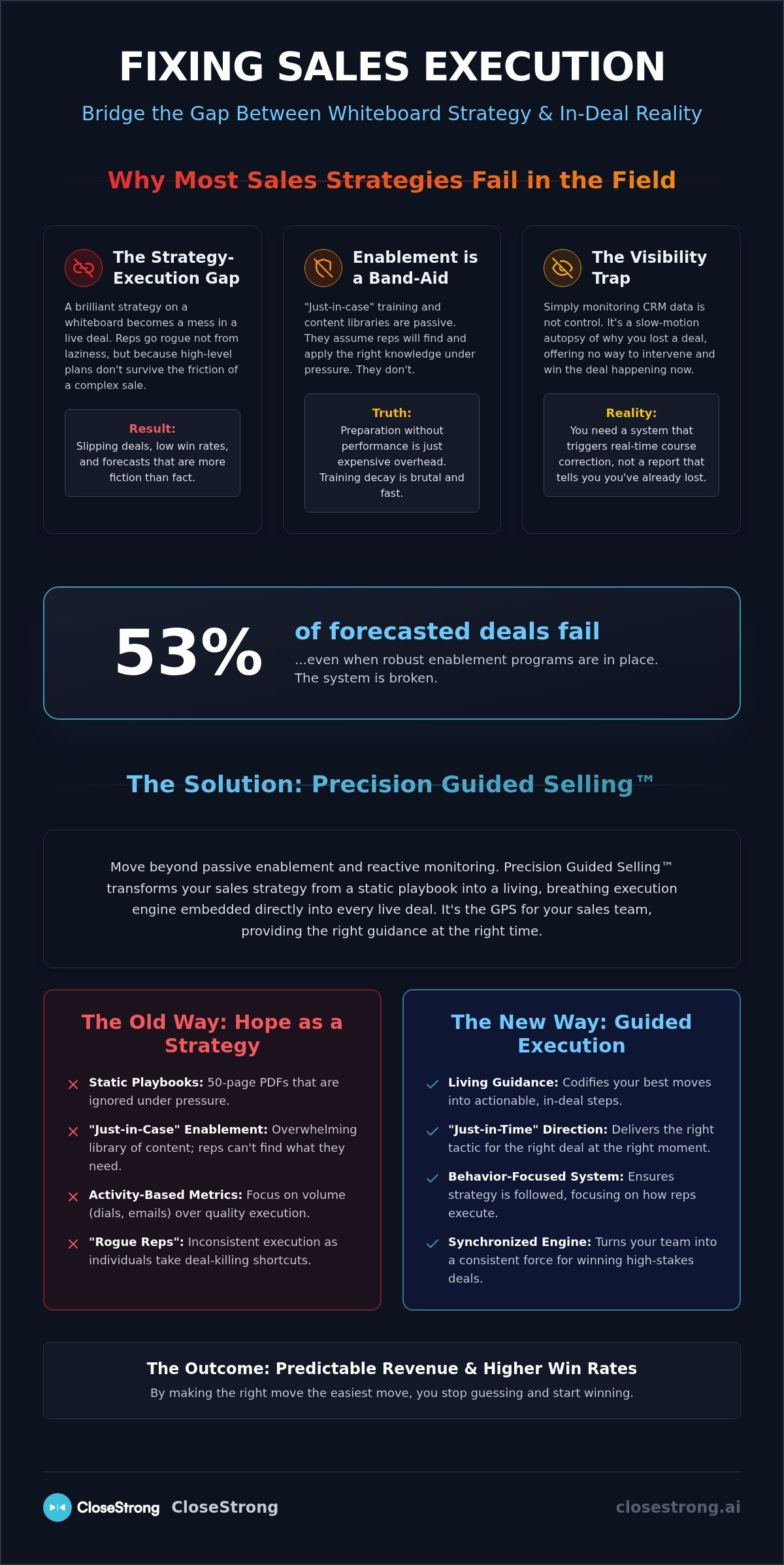
Fixing execution isn't a matter of cracking the whip or demanding more "hustle." It's about building a system that makes failure difficult and success repeatable. If you want to know how to fix sales execution, you have to move beyond the abstract. You need a framework that translates boardroom strategy into frontline tactics without losing anything in translation. Precision Guided Selling™ is that framework. It isn't a theory; it's an execution engine designed for the complexity of 2026 enterprise deals.
Most strategies fail because they're too broad to be useful in a live deal. A rep doesn't need to know the "five-year vision" when they're staring at a skeptical procurement officer. They need the right move, right now. The Precision Guided Selling™ framework forces strategy down to the deal level, ensuring that every opportunity follows the path of your highest-performing reps. It's about moving from hope-based selling to fact-based execution.
Stop telling your reps to "build more value." It's vague. It's useless. Instead, show them the "how" inside the deal. Codifying strategy means turning a high-level initiative into a rep's next best action. Whether it's a specific discovery question or a competitive trap-setting move, it needs to be visible at the deal level. This is where precision guided selling software becomes the critical layer. It ensures that your best strategic thinking is present in every single meeting, not just the ones you attend. It turns your playbook from a static document into a dynamic guide.
Most deals don't die suddenly; they bleed out over weeks of mismanagement. You need to spot deal risk before it turns into a lost opportunity. Real-time course correction allows you to provide custom guidance based on specific buyer signals or missing milestones. You finally discover how to fix sales execution and scale sales strategy execution across the entire org by automating the "adult in the room" perspective. It's about replacing gut-feel coaching with data-driven deal health scores that tell you exactly where to spend your time.
Turn high-level strategy into actionable, deal-specific guidance.
Implement real-time signals that trigger course correction before a deal stalls.
Replace "I feel good about this" with objective deal health scores.
Identify the behaviors of your top 5% and scale that behavior across the rest of the team.
Ready to stop guessing? Explore the Precision Guided Selling™ framework and start winning at the deal level.
You've seen the gap. You've felt the pain of stalling deals and rogue reps. Now, it's time to close the distance between your whiteboard strategy and your field reality. CloseStrong isn't more corporate fluff. It's the missing piece in your 2026 tech stack. While others track engagement or record calls, we drive execution. If you're serious about how to fix sales execution, you need a platform that doesn't just watch the game but calls the plays. CloseStrong is that platform.
Precision Guided Selling™ is the core of our technology. It transforms high-level strategic goals into tangible revenue. It's the difference between a rep who "hopes" they're following the playbook and a rep who is guided by data-driven insights at every turn. We eliminate the guesswork that leads to high forecast variance. By providing custom deal guidance, we ensure that every individual on your team executes with the rigor of your top 1%. You don't need more data; you need better behavior.
Our platform doesn't offer generic advice. It provides surgical precision. Most tools tell you to "follow up." CloseStrong tells you exactly what to say, who to say it to, and why it matters for this specific deal. This is high-quality deal guidance. It's not a library of content; it's an active engine. The enterprise sales execution platform is the future of the CRO's arsenal because it solves the one thing CRM can't: the human variable in complex deals. It replaces the "gut feel" of a manager with the objective reality of the deal.
The market in 2026 doesn't reward effort. It rewards execution. Your competitors are likely still stuck in the "visibility trap," staring at dashboards while their deals slip. You have the opportunity to move faster and close harder. When your team executes with rigor, you don't just win more deals; you win better outcomes. You stop being a victim of your own pipeline and start being the architect of your growth. It's a binary choice: you either control the execution or you accept the variance.
Don't let another quarter slip by while you "evaluate" your enablement. Enablement is a Band-Aid. Execution is the cure. If you want to know how to fix sales execution once and for all, you need to change the mechanics of how your team sells. It's time to strip away the excuses and get back to the bottom line. Ready to fix your sales execution? See CloseStrong in action.
Strategy is just a starting point, not a finish line. If your reps are still winging it on high-stakes opportunities, your revenue is a gamble. You've seen why visibility is a trap and why enablement is a passive distraction that doesn't close deals. Real growth happens when you bridge the gap between boardroom goals and the grit of the field. Learning how to fix sales execution isn't about working harder; it's about working with surgical intent and eliminating the friction that stalls your pipeline.
You can continue to perform autopsies on lost revenue or you can start winning deals in real time. CloseStrong provides the only platform built for Enterprise Sales Execution. By leveraging Precision Guided Selling™ technology, you deliver custom high-quality deal guidance that eliminates guesswork and stabilizes your forecast. It is the definitive difference between a team that hopes to win and a team that is engineered to win. It's time to stop being a spectator and start being the driver of your own success.
Stop guessing and start guiding with CloseStrong. You have the strategy. Now, go execute it.
The primary cause of poor sales execution is the disconnect between high-level corporate strategy and the gritty reality of individual deals. Most strategies look great on paper but fail to account for the dynamic nature of enterprise sales. When reps face complex buyer objections or shifting requirements, they abandon the playbook. This "rogue" behavior isn't a lack of discipline; it's a lack of actionable, deal-specific guidance that survives the friction of the field.
Sales enablement is a passive, "just-in-case" function focused on training and content libraries. Sales execution is an active, "just-in-time" discipline focused on real-time deal performance. Enablement prepares the team for the game; execution ensures they make the right plays during it. While enablement builds the repository of assets, execution provides the surgical guidance needed to apply those assets at the exact moment a deal hangs in the balance.
Execution is a system problem, not a people problem. You can't simply hire your way out of structural inefficiency or demand more "hustle" from a team without guardrails. Software fixes sales execution by codifying your best practices into a repeatable engine that guides every rep. It removes the reliance on gut feel and individual talent, replacing it with a standardized framework that forces strategy into every live opportunity across the entire organization.
Bridging the gap requires translating your high-level vision into specific, actionable behaviors at the deal level. You must move beyond static PDFs and quarterly workshops. To learn how to fix sales execution, you need to embed strategic guidance directly into the sales workflow. This ensures that every discovery call and negotiation move aligns with your broader goals. It turns your strategy from a document into a living, breathing guide that reps actually use to win.
Precision Guided Selling™ is a proprietary technology that provides reps with surgical, deal-specific guidance in real time. Instead of generic advice, it delivers custom high-quality deal guidance based on specific buyer signals and deal milestones. It works by analyzing the unique context of every opportunity and surfacing the next best action for the rep. This eliminates guesswork and ensures that your corporate strategy is executed with rigor on every single enterprise deal.
Your CRM is a database of record, not a driver of wins. It's built for reporting and forecasting, which are lagging indicators of what already happened. It doesn't provide the real-time guidance or guardrails needed to influence a deal while it's still alive. A CRM is a high-tech filing cabinet; it records the "what" but completely ignores the "how" of winning a complex B2B sale. You need an execution layer on top of it.
High forecast variance is a direct result of inconsistent rep behavior. When every rep wings it, every deal outcome is a coin toss. You reduce variance by standardizing how to fix sales execution across the entire team. By implementing objective deal health scores and mandatory strategic milestones, you remove "hope" and "gut feel" from the pipeline. Predictable behavior leads to predictable revenue. If the execution is consistent, the forecast becomes a mathematical certainty.
Look for a platform that prioritizes active guidance over passive reporting. An effective enterprise sales execution platform should offer Precision Guided Selling™ capabilities that integrate into the daily workflow. It must move beyond basic conversation tracking to provide custom, high-quality deal guidance. Avoid tools that just perform an "autopsy" on lost deals. You need a system that acts as the "adult in the room," ensuring your strategy is executed with surgical precision.


