





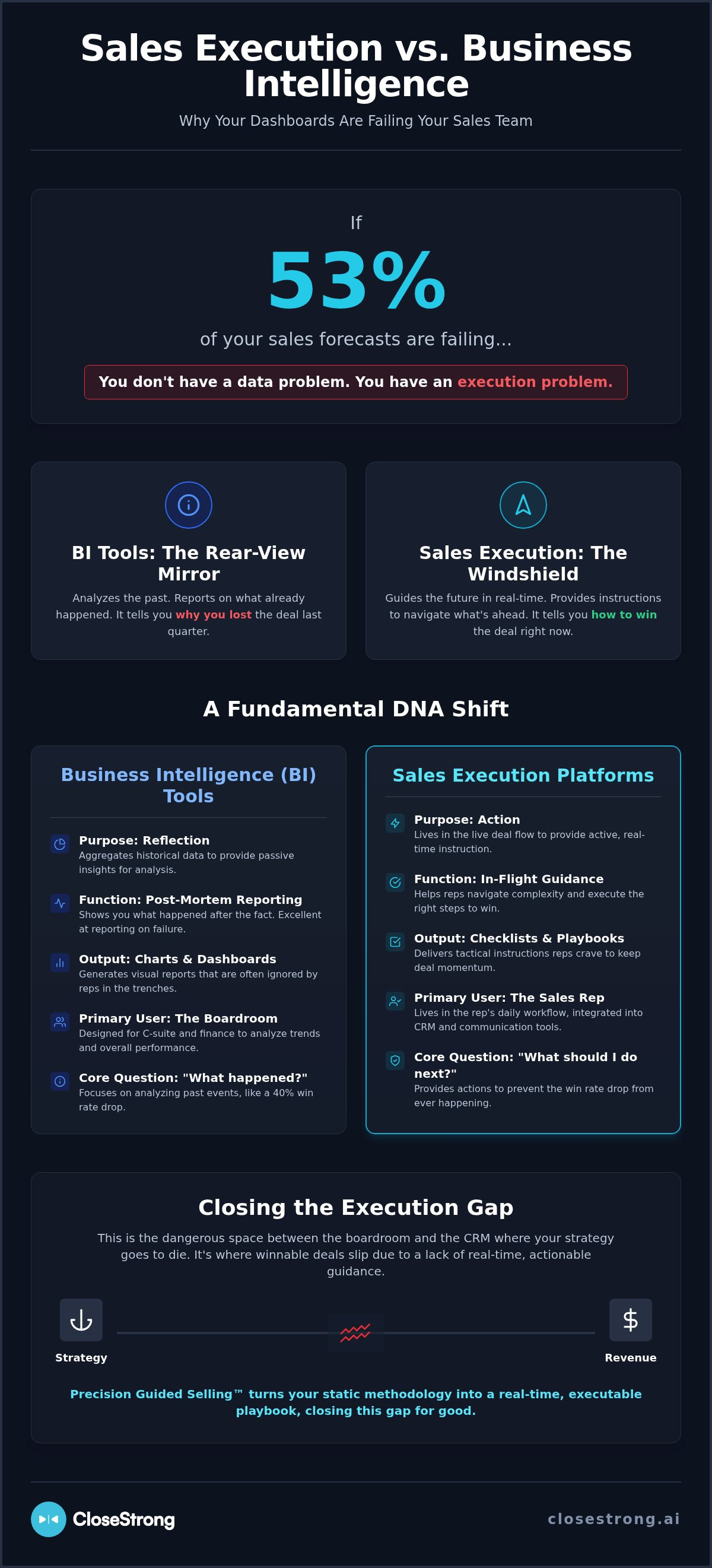
If 53% of your sales forecasts are failing, you don't have a data problem. You have an execution problem. You've likely spent millions on Tableau or Power BI thinking that visibility would somehow translate into revenue. It hasn't. When comparing a sales execution platform vs BI tools, the differenc...
If 53% of your sales forecasts are failing, you don't have a data problem. You have an execution problem. You've likely spent millions on Tableau or Power BI thinking that visibility would somehow translate into revenue. It hasn't. When comparing a sales execution platform vs BI tools, the difference is clear: one analyzes the wreckage while the other guides the flight. Your reps ignore those expensive dashboards because a chart is a rear-view mirror. It tells you why you lost a deal three weeks ago, but it does nothing to help them win the deal they're on right now.
You're tired of seeing strategy die at the deal level and hearing excuses during post-mortem meetings that come far too late to save your quarter. It's time to stop staring at the past and start influencing the future in real-time. We're going to show you exactly how to bridge the gap between corporate strategy and individual action. We'll explore why traditional BI fails your front line and how Precision Guided Selling™ provides the high-quality guidance reps actually use to close deals. It's time to move beyond static reporting and into active, precision-based execution.
• Stop confusing visibility with execution. Most BI tools are post-mortems that arrive too late to save your revenue or your quarter.
• Learn the fundamental DNA shift of a sales execution platform vs BI tools. One offers passive insight while the other provides active, real-time instruction.
• Solve the "Rogue Rep" problem by moving your sales methodology out of a static slide deck and directly into the live deal flow.
• Discover how Precision Guided Selling™ replaces dashboard noise with custom, high-quality guidance designed specifically for enterprise complexity.
• Close the execution gap for good. Turn your sales strategy from a theoretical plan into a real-time reality that actually improves forecast accuracy.
Most enterprise leaders are suffering from a dangerous hallucination. We call it the Dashboard Delusion. It's the false belief that visibility equals execution. You see a pipeline report. You see a win-rate chart. You see a colorful bar graph showing a 20% dip in activity. You think you're managing. You aren't. You're just watching the wreckage pile up in high definition.
BI tools are inherently reactive. They are post-mortem instruments designed for the boardroom, not the trenches. When you look at a dashboard, you are looking at the past. You are analyzing what already happened. You can't influence a deal that's already dead. This is the fundamental friction in the sales execution platform vs BI tools debate. One is a report card; the other is a playbook.
There is also a psychological wall. Your reps don't see BI as a tool for success. They see it as a policing mechanism. It's a "gotcha" device used by management to justify a lecture. A closer wants a tool that helps them navigate a complex procurement cycle, not a tool that flags their lack of CRM notes to a VP. BI is the rear-view mirror. Execution is the windshield.
Dashboards are excellent at telling you that you are losing. They are catastrophically bad at telling you how to win. Observation-only leadership is a luxury you can't afford in enterprise sales. When the stakes are millions of dollars, "seeing the data" isn't enough. You need to drive the behavior. More data doesn't lead to more closes; it leads to analysis paralysis and strategic drift.
Strategy is born in the boardroom but usually dies in the CRM. You can have the most sophisticated "Revenue Intelligence" on the planet, but if it doesn't change what a rep says on a Tuesday morning discovery call, it's worthless. The execution gap is the space where winnable deals slip due to lack of guidance. Choosing a sales execution platform vs BI tools means deciding whether you want to report on the gap or finally close it.
The fundamental DNA of these two systems couldn't be more different. BI tools are built for reflection. They aggregate data to show you the big picture, serving the needs of the boardroom and the finance department. Sales execution platforms are built for action. They live in the trenches, serving the needs of the rep who is currently staring down a skeptical procurement officer. When you weigh a sales execution platform vs BI tools, you're choosing between a map of the territory and a GPS providing turn-by-turn directions.
Rigor replaces reporting in an execution-first environment. A BI dashboard asks: "What is our pipeline coverage?" An execution platform asks: "Has the economic buyer confirmed the business case for this specific deal?" One is a passive observation; the other is an active enforcement of your sales methodology. If you want to know why your strategy isn't sticking, look at your tools. You can't expect reps to follow a complex process when your only way of tracking it is a Friday afternoon post-mortem.
BI tools provide insights. They tell you the "what." They might show you that your win rate drops by 40% when a technical validation takes longer than two weeks. That's a great insight, but it's useless to a rep in the middle of that validation. They don't need to know they're likely to lose; they need to know exactly how to speed the process up. Reps ignore insights because they are academic. They crave instructions because they are tactical. In the heat of a complex sale, a rep doesn't want a chart. They want a checklist of high-quality deal guidance that tells them what to do next to keep the momentum alive.
BI tools are a separate destination. They require a rep to stop selling, log into a different portal, and try to interpret what a bunch of circles and bars mean for their commission check. Execution platforms are the path itself. They integrate into the daily workflow, ensuring that the strategy you set in January is actually being executed in June. This is where complex B2B sales software changes the game. It bridges the gap between static CRM data and rep behavior. Instead of waiting for a quarterly review to find out a deal went rogue, you can intervene the moment a critical milestone is missed. If you're ready to stop watching and start leading, it's time to see how real-time execution works in practice.
Why do 53% of forecasted enterprise deals fail? It isn't a lack of talent. It isn't a lack of market fit. It's a failure of execution. You set a brilliant strategy in the boardroom. You roll out a new methodology. Then, you look at your BI dashboard and see the same stagnant numbers. This is the sales execution platform vs BI tools reality: visibility into a problem doesn't solve the problem. Visibility is just a front-row seat to a slow-motion car crash.
The "Rogue Rep" isn't a myth; it's a symptom of poor tooling. Without real-time guidance, even your best reps revert to what's comfortable rather than what's effective. BI tools can tell you that a rep isn't following the process, but they can't force adherence. They report on the deviation after the deal is already lost. If you want consistency, you need a system that lives inside the deal, not a report that lives in a separate browser tab. You can identify an execution gap by one simple metric: the distance between what your sales playbook says and what actually happens on a discovery call.
Most organizations confuse training with performance. Training is a one-time event; execution is a deal-level requirement. You can't expect a three-day workshop in January to drive a complex negotiation in October. Enablement gives reps the content, but execution gives them the win. This is where precision guided selling software moves the needle. It shifts the focus from "did they watch the video?" to "are they doing the work?" More content doesn't close deals. High-quality, real-time instruction does.
Bad execution creates the dreaded "Hockey Stick" quarter. Your BI dashboard shows a healthy pipeline, but by the last two weeks of the month, those "commit" deals start slipping. Why? Because there was no deal-level rigor. CROs can't trust BI for accurate forecasting because BI only reports what the rep enters. If the rep is "happy-earing" the deal, the dashboard reflects that delusion. A sales execution platform vs BI tools comparison reveals that execution platforms validate the reality of the deal through methodology adherence, giving you a forecast you can actually take to the bank.
Information is a commodity. Instruction is a competitive advantage. Most organizations treat data like it's a solution, but data alone doesn't close deals. When you look at the sales execution platform vs BI tools landscape, the missing link is always the same: what should the rep do right now? Precision Guided Selling™ is the definitive answer to that silence. It moves your team from post-mortem coaching to pre-mortem guidance, forcing strategy execution on every single deal. It doesn't matter if the rep has been there for ten years or ten days. The methodology is no longer a suggestion hidden in a PDF. It is the workflow.
This shift from "what happened" to "what's next" is the only way to save winnable revenue. You've spent years analyzing the wreckage of lost deals through your BI dashboards. You've seen the charts. You've heard the excuses. Precision Guided Selling™ stops the post-mortem cycle by providing the instructions necessary to avoid the crash in the first place. It turns your sales strategy into a real-time reality rather than a theoretical goal.
A dashboard is a map; Precision Guided Selling™ is the GPS. A map shows you the terrain, but it doesn't tell you to turn left when a roadblock appears. When a deal hits a snag in procurement or a new stakeholder enters the room, the system recalculates the route. This is how sales execution tools for enterprise scale top-performer behavior across the entire floor. You no longer rely on "gut feel" or the individual brilliance of a few lone wolves. You provide a repeatable, precision-guided path to the win. It turns your average reps into high-performers by removing the cognitive load of "what's next?"
Generic "next steps" in a CRM are a joke. "Follow up next week" isn't a strategy; it's a placeholder for failure. CloseStrong provides high-quality deal guidance tailored to the specific complexity of enterprise sales. We're talking about tactical instructions that account for the stakes, the personas, and the specific stage of the cycle. Consistent execution isn't about working harder. It's about working with a level of rigor that BI tools simply cannot provide.
When you compare a sales execution platform vs BI tools, you are choosing between observing reality and creating it. The impact is measurable: higher win rates, larger deal sizes, and a forecast you can actually trust. If you're ready to eliminate the guesswork and start guiding your wins, see how CloseStrong bridges the execution gap.
You've seen the data. You've analyzed the trends. You've spent years hoping that visibility would somehow lead to victory. It hasn't. The fundamental conflict in the sales execution platform vs BI tools debate is that one is built for the auditors while the other is built for the closers. CloseStrong is the definitive enterprise sales execution platform designed to stop the bleeding of winnable deals. We don't just show you that you're losing; we provide the high-quality deal guidance required to win.
Our "Straight-Talk" philosophy is built into the software. We strip away the corporate excuses and the "happy-ear" reporting that clogs up traditional BI dashboards. When you implement a rigor-first culture, you aren't adding friction. You're removing the ambiguity that leads to failure. CloseStrong forces a level of deal-level intensity that turns your strategy into a living, breathing reality. The bottom line is simple: you close more deals with better outcomes because you've finally closed the gap between what you planned and what your reps actually do.
Stop hoping your reps remember the playbook. Hope is not a management strategy. By the time a rep realizes they've drifted from the methodology, the deal is already cold. You need to build your strategy directly into the daily workflow. This is how you scale sales strategy execution without bloated headcounts or endless retraining sessions. We move your leadership team from passive monitoring to active guidance. You aren't just watching the scoreboard anymore. You're calling the plays in real-time, ensuring that every rep executes like your top performer.
BI tools are built for the scoreboard; sales execution platforms are built for the game. We've established that visibility is not a strategy. You simply can't report your way to a quota. When you decide between a sales execution platform vs BI tools, you're choosing whether to be a passive observer of failure or an active architect of success. One tracks the wreckage; the other guides the win. Don't settle for high-definition insight into why you're missing your numbers when you could be influencing the outcome in real-time.
You now understand the power of Precision Guided Selling™. It's the fundamental difference between a post-mortem chart and a real-time instruction. By providing custom high-quality deal guidance for every rep, you eliminate forecast variance at the source. No more rogue reps. No more "hockey stick" quarters. Just pure, disciplined execution that scales across your entire enterprise. It's time to stop looking in the rear-view mirror and start looking through the windshield at the revenue you're about to capture.
Stop watching your deals slip. Execute your strategy with CloseStrong.
Your strategy is too valuable to leave to chance. It's time to equip your team with the rigor they need and lead them to the victory they deserve.
BI tools are for observation. Sales execution platforms are for action. A BI tool tells you what happened in the past so the boardroom can feel informed. An execution platform tells your reps what to do right now so they can win the deal. When comparing a sales execution platform vs BI tools, the difference is between a passive report card and an active playbook that drives behavior in real time.
Yes, and you probably should. BI tools like Tableau are excellent for long term strategic analysis and broad organizational trends. They aren't going anywhere. However, they stop where the deal starts. You use BI to identify the problem and an execution platform to solve it. One provides the high level map while the other provides the turn by turn navigation for your sales reps in the trenches.
It provides tactical, deal level instructions based on your specific sales methodology. Precision Guided Selling™ doesn't just show a rep a dashboard; it gives them a checklist of high quality deal guidance. If a critical stakeholder is missing or a procurement hurdle appears, the system flags it immediately. It replaces the rep's gut feel with a repeatable, precision based path to victory that ensures your strategy is actually being executed.
CRMs are databases, not execution engines. They are designed to store contact info and record activity, not to guide the sale. A CRM is a filing cabinet where deals go to be ignored until the Friday forecast call. It lacks the logic to enforce methodology or provide real time guidance. You need a layer on top of the CRM that actually drives rep behavior and ensures the right actions happen at the right time. This requirement for specialized, action-oriented software is universal across professional services; for example, tax preparers can explore TaxSlayer Pro Web to see how Apex Tax Solutions LLC brings a similar level of rigor and efficiency to professional practice management.
No, it makes them feel supported. Reps hate being policed by BI dashboards that highlight their failures after the fact. They love having a tool that helps them win more deals and hit their commission targets faster. A sales execution platform vs BI tools approach shifts the dynamic from management gotchas to high quality deal guidance. It removes the guesswork, allowing them to focus on selling instead of wondering what they missed.
It validates deal health through objective methodology adherence rather than rep sentiment. Traditional BI only reports what a rep chooses to enter, which is often biased by optimism. CloseStrong tracks whether the critical milestones of your sales process have actually been met. If the rigor isn't there, the deal isn't committed. This eliminates the 53% forecast failure rate by basing your numbers on execution reality, not boardroom hope.
The ROI comes from reclaimed revenue and reduced sales cycles. While BI tools are an expense for visibility, an execution platform is an investment in win rates. Organizations typically see a significant reduction in forecast variance and an increase in average deal size. By closing the execution gap, you stop losing winnable deals to simple process errors. You aren't just seeing the data better; you're converting that data into actual revenue.
It is designed for complexity, but rigor works at any scale. While enterprise sales have more stakeholders and longer cycles, any deal where process adherence matters will benefit from Precision Guided Selling™. If you have a specific playbook that leads to success, you need a way to ensure it's followed. Whether your deals are six figures or seven, removing the guesswork and enforcing high quality deal guidance is the only way to scale performance.


