





Your million-dollar sales playbook isn't a strategy. It's a $200,000 paperweight. You've spent months mapping the perfect buyer journey, yet your reps are still winging it in every high-stakes meeting. You see the forecast variance every Monday morning. You feel the sting of inconsistent deal execut...
Your million-dollar sales playbook isn't a strategy. It's a $200,000 paperweight. You've spent months mapping the perfect buyer journey, yet your reps are still winging it in every high-stakes meeting. You see the forecast variance every Monday morning. You feel the sting of inconsistent deal execution. The truth is that most sales process adherence challenges aren't caused by lazy reps. They're caused by static systems that expect humans to be machines. You're frustrated because you've provided the "what," but you haven't fixed the "how."
It's time to stop blaming your people and start fixing your infrastructure. In 2026, visibility tools tell you what went wrong yesterday, but they don't change what happens today. This article reveals the provocative truth about why your current playbook is failing and how to hardcode execution into every deal. We'll explore why traditional training fails, how to bridge the gap between corporate strategy and rep action, and why Precision Guided Selling™ is the only way to drive predictable revenue growth. Stop hoping for compliance. Start engineering execution.
• Ditch the digital dust by understanding why static playbooks can't survive the complexity of 2026 sales cycles.
• Identify the five systemic sales process adherence challenges that turn your forecast into a guessing game.
• Stop confusing reporting with selling; learn why your CRM is a database for managers, not a GPS for reps.
• Bridge the "Execution Gap" by translating high-level strategy into real-time, deal-level guidance.
• Hardcode success into every transaction using Precision Guided Selling™ to eliminate "winging it" forever.
Most sales playbooks are works of fiction. You spent six figures on a consultant to map your "ideal" process, and now it sits in a SharePoint folder, ignored by everyone who actually carries a bag. Adherence isn't about compliance. It's about competitive advantage. In a market where buyers have already done 70% of their research before the first call, you can't afford to have reps guessing their way through a deal. These sales process adherence challenges aren't just annoying; they're expensive. Rogue behavior leads to massive forecast variance and lost enterprise deals that should have been locked down.
The reality is simple. 2026 sales cycles are too complex for static PDF playbooks. These challenges stem from a fundamental mismatch between how we document strategy and how deals actually happen. Knowing the process is a cognitive exercise. Executing the process is a behavioral one. When a rep goes rogue, they aren't just being difficult. They're often trying to survive a system that doesn't actually help them win. The playbook isn't a map; it's a burden.
Adherence is often misidentified as administrative busywork. Managers look at CRM fields and call it "process." That's not adherence; that's reporting. True adherence is tactical execution. It's about ensuring that every rep performs the right action at the right moment. The "Execution Gap" is the space between what your strategy demands and what your reps actually do. This gap is the primary killer of enterprise revenue. It's why your forecast varies every month and why deals stall in Stage 3. Strategic alignment requires moving beyond the checklist and focusing on deal-level rigor.
Why do your top performers ignore the playbook? They suffer from the "Experience Trap." Senior reps believe their intuition is more valuable than your process. They think the playbook is a leash designed to slow them down. In reality, the process should be a tool that accelerates them. We need to flip the script. Stop treating sales process adherence challenges as a lack of discipline. Start treating them as a failure of the system to provide value to the seller. When the process helps a rep close a deal faster, they'll follow it. Until then, they'll keep winging it and hoping for the best.
Strategy is easy. Execution is hard. Most sales organizations fail because they treat their playbook like a static map in a world where the terrain changes every hour. If your team isn't following the process, it's usually because the process has become an obstacle to the paycheck. These sales process adherence challenges aren't just minor friction points. They're systemic failures that bleed revenue every single quarter. You can't fix a systemic problem with a pep talk.
Too many stakeholders, too many steps, and not enough hours in the day to track them all.
Your reps cannot recall a 40-page PDF when they're staring down a skeptical CFO in a high-pressure meeting.
If you only pay for the "what" (closed deals), reps will always ignore the "how" (the process) to get there.
A playbook that doesn't adapt to live deal health is just digital clutter that reps learn to ignore.
Leadership has visibility into what happened last month, but no way to change what is happening right now.
The Memory Gap is particularly lethal in high-pressure environments. You can't expect a rep to navigate a massive playbook while managing a complex negotiation. If the process isn't intuitive, it's invisible. Similarly, incentive misalignment creates a culture of shortcuts. If management only celebrates the final signature, reps will burn the process to get there. This creates a feedback loop failure where leadership has plenty of data on the wreckage but no way to course-correct the deal while it's still alive.
Enterprise deals in 2026 now involve an average of 10 or more stakeholders. Managing a multi-threaded sales process manually is a recipe for disaster. Reps are forced to choose between doing the work or logging the work. They'll choose the work every time. When your process requires manual entry for every stakeholder interaction, adherence drops to zero. The friction isn't just annoying; it's a deal-killer. You need a way to bridge the gap between strategy and deal-level execution without adding administrative weight to your top performers. Precision requires automation, not just more effort.
Sales leaders often mistake CRM data for reality. It's a dangerous hallucination. A CRM tells you what happened last week. It doesn't tell you how to win next week. This is the visibility illusion. You think you're managing the process, but you're actually just auditing history. Passive recording tools provide great post-game tapes. They show you where the rep tripped. But visibility isn't execution. Knowing your rep missed a key discovery question three days ago doesn't help you save the deal today. You need to influence the future, not just record the past. Addressing sales process adherence challenges requires moving from passive observation to active, real-time deal guidance. You shouldn't be looking for what went wrong; you should be guiding what goes right.
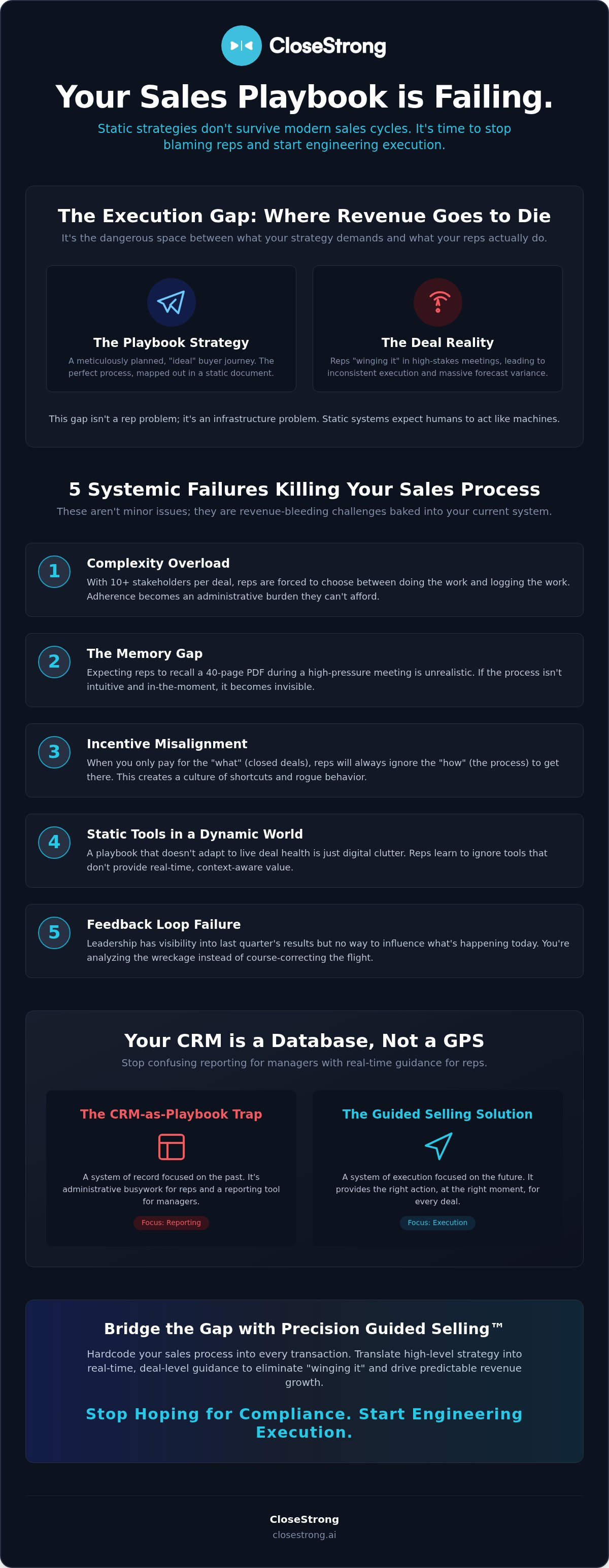
Your CRM is a digital cemetery. It is a place where data goes to die while managers run reports that nobody reads. Sales leaders love these platforms because they provide a sense of control, but for the rep on the front lines, it's just a "CRM tax" they have to pay to keep their job. This fundamental disconnect is exactly why sales process adherence challenges continue to plague enterprise teams. You're asking your reps to spend their time recording the past instead of influencing the future. It is a tool built for audits; it is not a tool built for action.
A CRM tells you a deal is in "Stage 3." It does not tell you how to win it. It does not tell you that the champion is wavering or that the competitor just dropped a predatory discount. It is a passive database. What you need is an active execution engine. Think of it as a binary contrast. A CRM is a map in the glovebox; Precision Guided Selling™ is the GPS on the dashboard. One requires you to stop and look; the other tells you exactly when to turn. One is a filing cabinet; the other is a co-pilot.
Many organizations try to solve their adherence problems with more enablement. They build massive libraries of content and battle cards. They provide the "what," but they completely ignore the "how." Legacy enablement repositories are useless in high-stakes meetings. Reps don't need more PDFs; they need real-time guidance on what to say and do next. To understand the shift required, read more about Precision guided selling software: execution over enablement in 2026. Enablement is a passive resource. Execution is an active behavior. You can't bridge the gap with more content. You need guidance that lives where the rep actually sells.
Winging it is a luxury your revenue targets can't afford. You don't need more training sessions; you need a system that makes failure impossible. Most sales process adherence challenges exist because the "right way" to sell is buried in a document nobody reads. To fix this, you must move from passive playbooks to active, forced adherence. It starts with an audit of the "Execution Gap." Analyze what your top 10% do differently, then translate those winning behaviors into dynamic, deal-level guidance for everyone else. Stop hoping for compliance and start engineering it.
Precision Guided Selling™ is the antidote to the memory gap. It isn't a library of content. It's a system of real-time prompts that tell a rep exactly what to do based on the unique health of a specific deal. If a stakeholder is missing, the system flags it. If a competitor is mentioned, the battle card appears. This isn't about micromanagement; it's about providing the tactical support required to win. However, simply having a score isn't the solution. You can learn more about Sales deal health software: why monitoring health scores isn’t enough. Real adherence requires prompting the right behavior at the exact moment it's needed.
Standard deal reviews are interrogations. Managers ask "What happened?" and reps provide a filtered version of reality colored by "happy ears." This is a waste of time. Strategic coaching requires a shift in focus. Stop asking about the past and start asking "What is next?" Use data-driven guidance to eliminate subjectivity from the forecast. When you have an execution platform, the manager isn't an auditor; they're a tactical advisor. They can see exactly where a rep is deviating from the winning path and course-correct before the deal stalls. This is how you hardcode execution into every deal and turn your sales force into a precision instrument.
Finally, stop measuring adherence through CRM fields. A rep can check a box without actually doing the work. True adherence is measured by deal health. Are the right stakeholders engaged? Is the business case validated? If the health of the deal is trending up, the process is being followed. If it's flatlining, you've found your gap. Move from administrative oversight to tactical superiority. That is the only way to scale enterprise revenue in 2026.
CloseStrong isn't just another addition to your bloated tech stack. It's the structural reinforcement your revenue engine is missing. Most organizations treat strategy as a suggestion and execution as a hope. We treat execution as a mandate. If you're tired of the same sales process adherence challenges sabotaging your quarterly targets, you need a system built for rigor, not just record-keeping. CloseStrong is the only enterprise sales execution platform designed to bridge the gap between what leadership wants and what reps actually do. We don't just watch the deal. We guide it. We don't just report history. We influence the future.
The "Execution Gap" is where your revenue goes to die. It's the space between the playbook you paid for and the reality of what happens on a Tuesday morning discovery call. We close that gap by moving beyond passive visibility. Knowing your rep missed a step doesn't help you win. Preventing them from missing it does. CloseStrong turns corporate strategy into rep-level reality by hardcoding your specific methodology into every interaction. This is the only way to ensure that your best practices are actually practiced.
Precision Guided Selling™ is how you turn a dead playbook into a living force. Instead of a rep trying to remember a training session from six months ago, the platform provides real-time, deal-level guidance. It hardcodes your specific sales methodology directly into the daily workflow. Is the business case missing? The system prompts for it. Is the legal review stalled? The platform identifies the next best action based on live deal health. This turns your "ideal" process into the only path forward. You can see how this works in our guide on The enterprise sales execution platform: closing the gap between strategy and reality. This isn't about micro-management. It's about providing the tactical map your team needs to win in a complex 2026 market. We eliminate the cognitive load so your reps can focus on selling.
The impact of this rigor is immediate and measurable. When execution is hardcoded, forecast variance drops. You stop guessing which deals will close and start knowing. By eliminating the "Execution Gap," enterprise teams can see a significant reduction in forecast variance, often by 30% or more. This isn't magic. It's the result of reps having custom, high-quality deal guidance at their fingertips. They close more deals with higher margins because they aren't "winging it" through the negotiation. Luck is a terrible strategy. Precision is a competitive advantage. If you want predictable revenue growth, you have to stop managing through the rearview mirror and start guiding the driver. CloseStrong doesn't just ask for adherence; it makes it the natural state of your sales organization.
Hope is a terrible business model. If you're still relying on static PDFs and manager interrogations to hit your number, you're already behind. We've seen that sales process adherence challenges aren't people problems; they're system failures. You don't need another training workshop. You need a system that makes the right action the only action. It's time to move from the passive visibility of the CRM to the active precision of an execution platform.
By leveraging Precision Guided Selling™ Technology and enterprise-grade deal health monitoring, you can bridge the gap between corporate strategy and individual rep behavior. Luck shouldn't be the deciding factor in your enterprise deals. Custom strategic deal guidance ensures that every rep executes with the same level of rigor. Stop guessing. Start engineering your revenue.
Stop the rogue behavior. See how CloseStrong hardcodes your strategy into every deal.
The path to predictable growth isn't paved with better intentions. It's built on better execution. You have the strategy. Now, give your team the tools to actually follow it. Success is waiting for those ready to lead with precision.
Complexity and friction are the primary culprits. Reps aren't lazy; they're overwhelmed. When a process feels like an administrative tax rather than a roadmap to a commission check, reps will ignore it. High-stakes enterprise deals in 2026 involve too many moving parts for a static manual. If the "right way" to sell is harder than "winging it," your team will choose the path of least resistance every single time.
Poor adherence turns your forecast into a work of fiction. When reps skip critical steps like multi-threading or business case validation, leadership loses visibility into the true health of the deal. This is why sales process adherence challenges lead to massive forecast variance. You aren't managing a pipeline; you're managing a series of guesses. Precision in execution is the only way to generate numbers you can actually trust.
No. Technology is the engine, but strategy is the fuel. If you automate a broken process, you just fail faster. You need to combine a rigorous strategic framework with an execution platform that hardcodes those behaviors into the daily workflow. Technology should remove friction and provide real-time guidance. It isn't a silver bullet. It is a force multiplier for a methodology that actually works in the field; to learn more about this approach, visit How to 'Sell' The Way People Buy!.
Enablement provides the "what," while execution drives the "how." Enablement is passive; it's a library of content and training videos that reps might look at once. Execution is active; it's the real-time guidance that prompts a rep to take the next best action during a live deal. Think of enablement as the textbook and execution as the GPS. One teaches the theory; the other guides the actual journey.
Stop treating them like children and start giving them an unfair advantage. Senior reps hate "busywork" but they love winning. If your process helps them navigate complex stakeholder maps or identify deal risks before they become fatal, they will follow it. Shift the narrative from "compliance" to "tactical superiority." When the system helps them close larger deals faster, the motivation problem disappears on its own.
The CRM is a database for managers, not a tool for sellers. It records what happened in the past but does almost nothing to influence what happens next. Relying on a CRM to solve sales process adherence challenges is a fundamental mistake. It is a rearview mirror. You need an execution platform that sits on top of the CRM to provide the forward-looking guidance that reps need to stay on track.
Measure deal health, not CRM field completion. Checking a box doesn't mean a rep actually validated the business case with the CFO. Effective measurement looks at objective milestones: Have we mapped the buying committee? Is there a documented mutual action plan? If these indicators are trending up, the process is working. If they aren't, your reps are winging it, regardless of what the CRM dashboard claims.
Precision Guided Selling™ is a technology-driven approach that provides real-time, deal-level guidance to reps. It eliminates the "Execution Gap" by prompting the right behaviors at the exact moment they are needed. Instead of hoping a rep remembers their training, the system guides them through the specific steps required to win a complex enterprise deal. It turns your corporate strategy into a lived, daily reality for every person on the team.


