





Your reps are hitting their numbers in their engagement platform. The activity dashboards are glowing green. The cadences are running on schedule. So why is your forecast accuracy still hovering at a pathetic 47%? It’s because you’re winning the battle of "doing things" while losing the war of "doin...
Your reps are hitting their numbers in their engagement platform. The activity dashboards are glowing green. The cadences are running on schedule. So why is your forecast accuracy still hovering at a pathetic 47%? It’s because you’re winning the battle of "doing things" while losing the war of "doing the right things." The debate of engagement platforms vs sales execution isn't about which tool is better; it's about realizing that engagement platforms manage the rhythm of work while execution platforms manage the rigor of the deal.
You’ve likely spent millions on a system of action only to realize that motion doesn't equal progress. It’s a frustrating reality where strategy is set in the boardroom but dies at the deal level because reps lack specific guidance. In this article, you’ll discover why activity-based engagement is only half the battle and how to bridge the gap to true enterprise sales execution. We’ll break down the engagement trap, explore why your top 5% sell differently, and show you how to turn your sales process from a series of automated tasks into a disciplined machine for winning high-stakes deals.
• Stop confusing motion with progress. High activity scores often mask deals that are fundamentally broken.
• Master the distinction between Salesloft vs sales execution. Separate the volume of your outreach from the actual value of your deals.
• Identify the "Engagement Trap." Learn why green dashboards often hide plummeting win rates and a total lack of strategic alignment.
• Discover how Precision Guided Selling™ provides the real-time deal guidance that standard communication cadences simply can't deliver.
• Learn to build a modern enterprise stack. Layer execution on top of action to ensure every rep sells like your top 5%.
Activity is not achievement. In the high-stakes world of enterprise sales, leaders often confuse the two. They see a dashboard full of sent emails and logged calls and assume the team is winning. They aren't. They're just busy. The fundamental tension in the Salesloft vs sales execution debate is a matter of focus. One prioritizes the rhythm of the workday; the other prioritizes the rigor of the deal. If you're optimizing for volume without optimizing for value, you aren't scaling a business. You're just accelerating your rate of failure.
Salesloft is a world-class "System of Action." It excels at "The How." It tells a rep to send an email, make a call, or connect on social media. It provides the engine that powers communication. But the engine doesn't know where it's going. It misses "The What." It can't tell a rep how to navigate a sudden stakeholder pivot or how to map a complex buying committee. Sales Execution is the tactical implementation of company strategy on every individual deal. Without this layer of guidance, your team is simply performing a series of automated tasks while hoping for a result.
Sales engagement is the orchestration of outreach. It focuses on cadences, sequences, and multi-channel touchpoints. The primary goal is to break through the noise to get the meeting and maintain a steady stream of momentum. In this model, success is measured by top-of-funnel metrics: open rates, reply rates, and sheer activity volume. It's about being present and persistent. It ensures the rep stays active, but it doesn't guarantee the rep is being effective once the prospect actually engages.
Sales execution is the science of the deal. It moves beyond the inbox to focus on deal mechanics, stakeholder alignment, and strict methodology adherence. The goal isn't just to stay busy; it's to close the deal with the best possible outcome. Success metrics here are the ones that actually move the needle: win rates, average deal size, and forecast accuracy. While engagement gets you into the room, execution ensures you're the one who walks out with a signed contract. It turns corporate strategy into rep behavior.
A System of Action without a System of Guidance leads to efficient failure. Your reps might be the most active in the industry, but if they don't know how to handle a mid-stage objection or align with a CFO's specific requirements, that activity is wasted. You don't need more emails. You need better deals. Bridging the gap between Salesloft vs sales execution is the difference between a team that "tries hard" and a team that wins consistently.
Your dashboard is a sea of green. Activity scores are through the roof. Reps are firing off emails like their lives depend on it. Yet, your win rates are in freefall and your forecast accuracy is a coin flip. This is the "Green Dashboard" delusion. It's the most dangerous trap in modern sales. When evaluating Salesloft vs sales execution, understand that activity is a vanity metric; execution is a revenue metric. High volume often masks a total lack of strategic direction. Enterprise deals don't die because of a lack of emails. They die because of a lack of strategic alignment. You're winning the outreach game but losing the actual deal.
Visibility is not victory. Seeing a deal slip is a passive act. Stopping that slip is an execution act. Many leaders confuse Revenue Intelligence with actual guidance. They think that because they can see the deal is failing, they're managing it. They aren't. For a deeper dive into why just "watching" your pipeline isn't enough, read our take on Revenue Intelligence vs Sales Execution: Why Visibility Is Not Victory. To win in 2026, you must bridge the gap between Salesloft vs sales execution by moving from passive observation to active deal-shaping.
Standardized sequences are built for the average, not the exceptional. In a complex enterprise account, a linear cadence is a liability. It encourages reps to "check the box" on tasks rather than thinking critically about the buyer's reality. When your team relies solely on automated engagement, they stop listening to the customer. They start listening to the tool. This creates a distance between the rep and the buyer that no amount of personalization tags can fix. Automation should scale your strategy, not replace it.
Monitoring sentiment or frequency is descriptive. It tells you what happened. It doesn't tell you what to do next. This is the "Post-Mortem" problem. By the time your revenue intelligence tool flags a deal as "at risk," the relationship is often already cold. The best leaders are moving away from simply watching the scoreboard. They're focused on guiding the play. They aren't interested in a post-mortem; they want a prevention plan. If you're ready to turn your strategy into rep behavior, it's time to explore how execution platforms provide the missing link.
Think of Salesloft as the engine. It’s powerful, it’s fast, and it keeps your outreach moving at scale. But an engine without a GPS is just a high-speed way to get lost. In the tactical debate of Salesloft vs sales execution, the missing link isn’t more horsepower; it’s direction. Salesloft manages the rhythm of the outreach. CloseStrong manages the rigor of the deal. You use Salesloft to send the message. You use CloseStrong to dictate the strategy. One manages the volume of your voice; the other ensures you have something worth saying.
Most teams are over-indexed on action and under-indexed on guidance. They have the "System of Action" to fire off thousands of emails, but they lack the "System of Guidance" to ensure those emails actually matter. CloseStrong’s Enterprise Sales Execution Platform bridges this gap. It doesn't replace the engine. It tells the driver exactly how to navigate the terrain. It’s the difference between driving fast and actually arriving at the destination.
Sequences are linear. Enterprise deals are non-linear. A standard sequence follows a rigid timeline: Day 1 email, Day 3 call, Day 5 LinkedIn message. But enterprise buyers don't follow your timeline. They pivot. They bring in new stakeholders. They change requirements mid-stream. Precision Guided Selling™ adapts to these real-time signals. It provides the "Next Best Action" based on the specific health and context of the deal, not just the number of days since the last touchpoint. This is how you ensure methodology, whether it’s MEDDIC, Force Management, or your own custom framework, is actually used in the field. It moves methodology from a dusty binder into the rep’s daily workflow.
Generic task reminders are the death of enterprise sales strategy. A notification that says "Follow up with John" is noise. A notification that says "John is a blocker; here is the specific talk track to align him with the CFO’s new mandate" is a tactical advantage. This is custom deal guidance. It allows leadership to scale their best strategic thinking across the entire floor. Instead of managers drowning in endless deal reviews, the platform provides the coaching automatically. It turns every rep into a strategic thinker by giving them the right move at the right time. This isn't about doing more work. It's about doing the work that actually closes the deal.
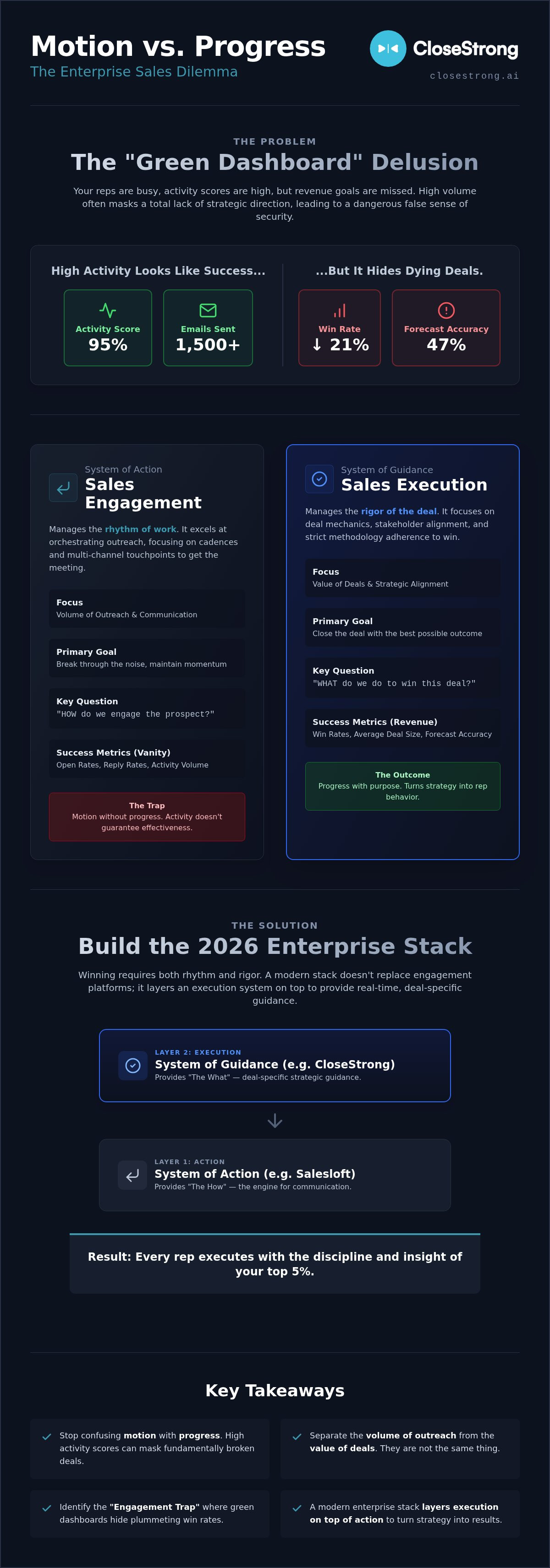
Stop looking for a silver bullet. You don't have to pick a side in the Salesloft vs sales execution debate. You need both. But you must understand the hierarchy of the modern stack. Your CRM is the system of record; it's essentially a digital filing cabinet. Salesloft is your system of action; it's the engine that powers your reach. CloseStrong is your system of execution; it's the brain that ensures those actions align with your enterprise strategy. Without an execution layer, your stack is just a very expensive way to reach the wrong people with the wrong message. To see how these layers integrate, explore our guide on the Best Sales Productivity Software to Close Deals Faster in 2026.
The goal isn't just to have more tools. The goal is to integrate strategy into the daily workflow of every rep. When execution is baked into the platform, strategy stops being a slide deck and starts being a behavior. You move from a culture of "did you send the email?" to "did you move the deal?" This shift is what separates the market leaders from the also-rans in high-stakes enterprise environments.
Strategy decay is the silent killer of enterprise growth. It happens when a brilliant CRO plan is filtered through three layers of management and becomes unrecognizable by the time it reaches a rep's keyboard. An execution platform acts as the "adult in the room." It enforces consistency across global teams by embedding your specific methodology directly into the deal workflow. You aren't just buying another piece of software. You're buying the insurance that your corporate strategy actually happens in the field. It’s about outcomes, not just activity logs.
Most forecasts are built on "happy ears" and gut feelings. With the current success rate for forecasted deals sitting at a dismal 47%, your pipeline is likely a work of fiction. Execution rigor changes the math. By requiring proof of strategic milestones and providing deal-level guidance, you eliminate the guesswork that plagues sales management. Deal-level guidance replaces the vague "gut feeling" with verifiable progress. If a rep can't prove they've aligned with the economic buyer or identified the technical blockers, the deal isn't "committed." It's just a hope. Precision requires proof.
Stop letting gut feelings dictate your revenue. Get a demo of the CloseStrong execution layer today and start selling with precision.
CloseStrong isn’t another tool for your reps to ignore. It’s the digital implementation of your specific strategy. Most enterprise sales tech fails because it focuses on the back office or the manager's report. We focus on the rep's reality. When you weigh Salesloft vs sales execution, you're choosing between a platform that manages the invitation and one that manages the win. Engagement gets you the meeting. Precision Guided Selling™ gets you the contract. It’s time to stop treating your sales process like a suggestion and start treating it like a mandate.
The bottom line is simple: you need to close more deals with better outcomes by removing the guesswork. Visibility into a failing pipeline isn't a solution; it's a warning. For a deeper breakdown of how the modern stack should function, read our pillar piece on The 2026 Enterprise Sales Tech Stack: Why Visibility Is Not Execution. You don't need more data to watch. You need more tools to win.
How many of your deal reviews actually change the outcome? Most are just status updates disguised as coaching. CloseStrong changes that by providing custom high-quality deal guidance in real-time. It’s like having your best manager sitting on every rep's shoulder for every deal. The platform provides deal-specific advice based on the unique blockers and stakeholders in play. It tells the rep what to say, who to align with, and how to pivot when things go sideways. This level of expertise at scale has a massive impact on win rates and deal velocity. You aren't just training your reps; you're augmenting them.
Hope is a terrible strategy. You can't just hope your reps remembered the training from the last kickoff. You can't just hope they're following the MEDDIC framework correctly. You have to guide them. The shift from "Engagement" to Precision Guided Selling™ is the shift from being a spectator to being a player. It’s about taking control of the mechanics of the deal. If you're ready to transform your average reps into enterprise closers, you need an execution layer that doesn't just track activity but drives outcomes. Stop the "Green Dashboard" delusion and start focusing on the only metric that matters: revenue.
The guesswork ends here. Stop the guesswork and start executing with CloseStrong today.
Engagement is the noise. Execution is the result. You've spent years perfecting the rhythm of your outreach. But if that activity isn't tied to a rigorous deal strategy, you're just spinning your wheels at scale. The fundamental reality of Salesloft vs sales execution is that a system of action without a system of guidance is a recipe for efficient failure. You don't need more emails. You need more deals that actually cross the finish line.
By layering an execution platform on top of your existing stack, you bridge the gap between corporate strategy and rep behavior. CloseStrong’s proprietary Precision Guided Selling™ technology is specifically designed for complex enterprise deal cycles. It replaces "happy ears" with hard evidence. It turns every rep into a strategic closer. This isn't just about visibility. It's about victory.
The days of guessing are over. It’s time to move beyond simple engagement and start mastering the mechanics of the win. Stop hoping and start executing-see the CloseStrong platform in action. You already have the engine. Now, give your team the GPS they need to win.
No. Salesloft is a premier sales engagement platform, often called a "System of Action." It excels at automating outreach, managing cadences, and tracking activity volume. However, it lacks the strategic guidance layer required for true sales execution. In the debate of Salesloft vs sales execution, Salesloft provides the engine for your messages while an execution platform provides the tactical GPS for your enterprise deals.
Sales engagement is about the rhythm of work; sales execution is about the rigor of the deal. Engagement platforms focus on "The How," ensuring emails are sent and calls are logged. Execution platforms focus on "The What," ensuring reps navigate complex stakeholder maps and follow corporate strategy. One prioritizes being busy. The other prioritizes being effective. You need both to close complex deals.
No. CloseStrong doesn't replace your engagement tools; it augments them. Think of Salesloft as the engine that powers your communication and CloseStrong as the execution layer that tells the rep exactly what to say and when to pivot. You don't have to choose between them. You need the action of engagement and the strategic direction of execution to win in 2026.
Precision Guided Selling™ improves win rates by removing the guesswork from complex deals. Instead of a generic follow-up task, it provides custom deal guidance based on real-time buyer signals. It identifies potential blockers and provides the specific talk tracks needed to move the deal forward. It ensures every rep on your floor sells with the same strategic depth as your top 5%.
Yes. CloseStrong is designed to turn your methodology from a passive training exercise into an active deal-level behavior. Whether you use MEDDIC, Force Management, or a custom framework, the platform enforces that methodology within the rep's daily workflow. It ensures the rigor of your strategy actually happens on every deal rather than just living in a forgotten slide deck or training manual.
It improves forecast accuracy by replacing "gut feelings" with verifiable deal milestones. Most forecasts fail because reps have "happy ears" and managers lack visibility into actual deal mechanics. A sales execution platform requires proof of strategic alignment before a deal is marked as committed. This added rigor reduces variance and brings your forecast accuracy significantly closer to reality by eliminating guesswork.
Activity volume is a vanity metric that often hides dying deals. You can send 1,000 emails and still lose because you failed to align with the economic buyer. In enterprise sales, the quality of the interaction and the strategic alignment of the deal matter more than the quantity of touchpoints. High activity scores in Salesloft vs sales execution metrics show that busy isn't winning.
The execution gap is the space where corporate strategy goes to die. It's the distance between the high-level plan set by the CRO and the actual tactical behavior of a rep on a Tuesday afternoon. Most organizations have the strategy and the tools, but they lack the guidance layer to ensure the two actually meet at the deal level. Closing this gap is the only way to scale.


