





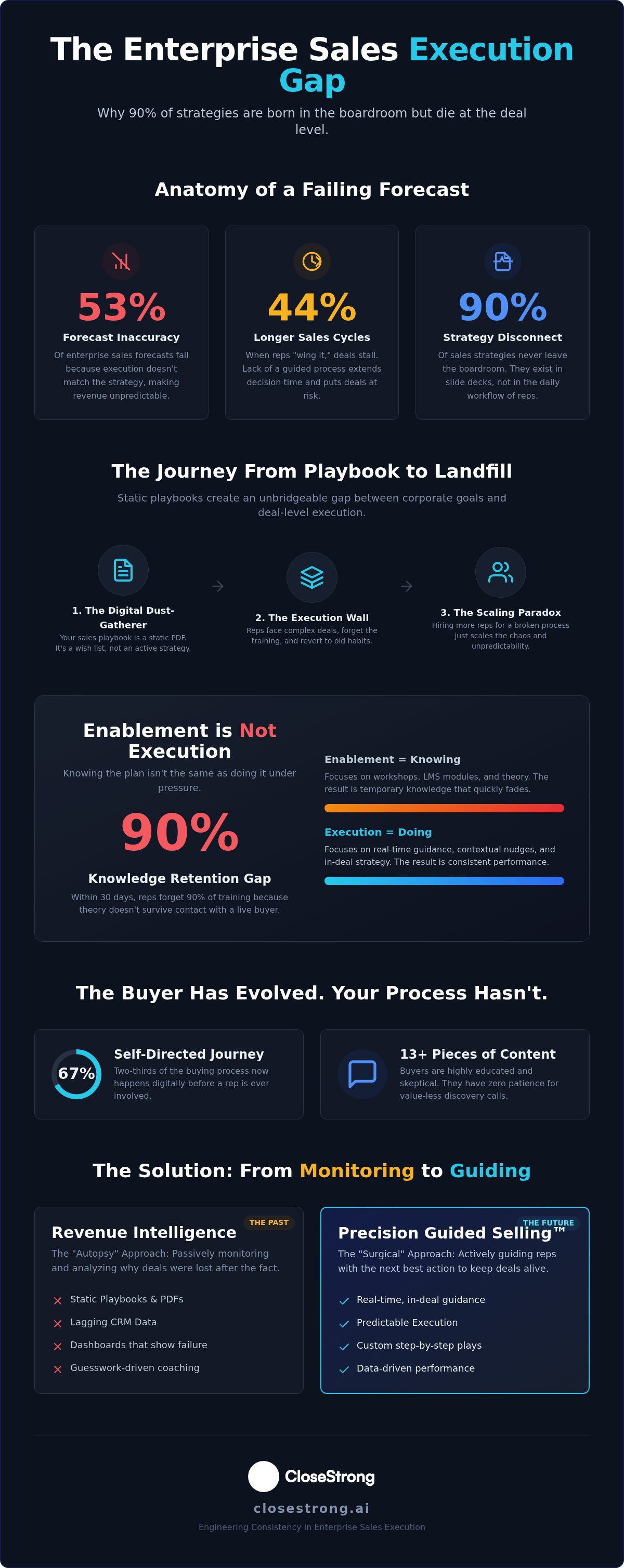
Why do 53% of enterprise sales forecasts fail? It's not because your reps are lazy. It's because your strategy is trapped in a PDF that nobody reads. A playbook is not a strategy; it's a wish list that gathers digital dust while your reps wing it on every call. Scaling enterprise sales execution req...
Why do 53% of enterprise sales forecasts fail? It's not because your reps are lazy. It's because your strategy is trapped in a PDF that nobody reads. A playbook is not a strategy; it's a wish list that gathers digital dust while your reps wing it on every call. Scaling enterprise sales execution requires more than just hiring more bodies or adding another layer of conversation intelligence. It requires moving the strategy out of the boardroom and into the deal itself.
You've seen the inconsistent performance and felt the sting of sales cycles that are now 44% longer than they were just a few years ago. You're tired of CRM data that doesn't reflect reality. This guide will show you how to bridge the gap between corporate goals and deal-level execution to achieve predictable, scalable revenue growth. We'll explore how to move beyond static documents and use Precision Guided Selling™ to ensure your best strategy is executed on every deal, every time. It's time to stop hoping for consistency and start engineering it.
• Most playbooks are just digital paperweights. Learn why true scaling enterprise sales execution requires moving strategy from the boardroom into the actual deal flow.
• Stop confusing training with performance. Discover why enablement is about knowing while execution is about doing; it's the only way to fix the 90% knowledge retention gap.
• Build a foundation on deal-level rigor. We break down the three pillars needed to ensure your field reps actually sell what your C-suite planned.
• End the era of guesswork. See how Precision Guided Selling™ provides custom deal guidance that turns every rep into a top performer.
Scalable sales execution is the systematic ability to replicate your best sales strategy across every rep and every deal. Most leaders think scaling means hiring. It doesn't. Adding headcount to a broken process just scales the chaos. This is the scaling paradox: the more reps you add, the less predictable your revenue becomes. You're diluting the expertise of your top performers across a sea of average talent who don't know how to execute the mission. Success isn't about more people; it's about more precision.
Don't confuse activity with execution. Your reps are busy. They're sending emails, logging calls, and updating CRM fields. But are they winning? "Busy" is a metric of effort; execution is a metric of alignment. Scalable sales execution is the alignment of corporate strategy with deal-level behavior. If the behavior doesn't match the plan, the plan doesn't exist. Effective sales management requires moving beyond managing people to managing the mechanics of the deal itself. Scaling enterprise sales execution is the only way to ensure your strategy survives contact with the customer.
90% of sales strategies never leave the boardroom. They're born in expensive slide decks and die in the field. This "Execution Gap" costs enterprise organizations millions in slipped deals and wasted cycles. You think your CRM tells you what's happening? It doesn't. CRM data is a lagging indicator of execution failure. It tells you that a deal died, but it won't tell you why your rep failed to follow the strategy three weeks ago. The wall between what the C-suite wants and what the field does is thick, and it's built out of static playbooks.
The buying journey has shifted. 67% of the B2B journey is now self-directed, and buyers consume over 13 pieces of content before they ever talk to a human. They're smarter, more skeptical, and have zero patience for discovery calls that add no value. "Winging it" is a death sentence for complex B2B deals. We're seeing a shift from revenue intelligence, which just records what happened, to revenue execution, which dictates what should happen next. Scaling enterprise sales execution in this climate requires a level of rigor that spreadsheets and weekly 1-on-1s simply can't provide. It requires a system that guides the rep through the complexity in real time.
Enablement is a comfort blanket. It feels like progress, but it's often just expensive noise. Enablement is about knowing. Execution is about doing. You spend millions on workshops and LMS modules, yet most sales training has a dismal 10% retention rate after just 30 days. Why? Because theory doesn't survive the battlefield. Your reps aren't stupid; they're just human. They forget the playbook the second a deal gets complex. Scaling enterprise sales execution isn't about how much your reps know. It's about what they actually do when they're alone in the room with a buyer. If your strategy stays in a PDF, it isn't a strategy. It's a suggestion. Most organizations are great at suggesting. Very few are great at executing.
Reps don't fail because they lack information. They fail because they lack context. A standard playbook is a map of yesterday's terrain. In a dynamic market, those maps are useless. When the pressure is on, reps revert to their own habits, not your corporate strategy. This is the fallacy of the "Standard Playbook." It assumes every deal is a straight line. It isn't. To win, you must move from static training to real-time deal guidance. If you're struggling with scale sales strategy execution, the problem isn't your people. It's your delivery mechanism. You need a way to inject strategy into the workflow, not just the classroom.
Your tech stack is likely bloated with "visibility" tools. You have dashboards. You have conversation intelligence tools that transcribe every word. But visibility is a lagging indicator. Knowing a deal is "at risk" doesn't give your rep the specific moves to save it. Passive monitoring software is great at recording the autopsy, but it doesn't prevent the death. It monitors health scores; it doesn't guide outcomes. Following Sales Management Best Practices means moving beyond monitoring to active direction. You don't need another dashboard to tell you you're losing. You need a system that ensures you win. If you're ready to stop watching deals fail and start guiding them to close, it's time to look at an Enterprise Sales Execution Platform that turns visibility into actual results. Stop settling for the autopsy. Start performing the surgery that keeps deals alive.
Scaling isn't a wish. It's a structure. You don't scale by hiring more reps who "have a good feeling" about their pipeline. You scale by building a framework that doesn't rely on luck. To achieve scaling enterprise sales execution, you must move beyond the "art" of the deal and into the science of repeatable outcomes. Most organizations think they have a framework. They don't. They have a collection of habits. A true framework is built on three non-negotiable pillars that turn strategy into a mechanical advantage.
The first pillar is Deal-Level Rigor. This isn't about checking boxes in a CRM. It's about standardizing the "How" for every single transaction. If your best rep wins by doing X, but your new hire is doing Y, you haven't scaled. You've just gambled. The second pillar is Strategic Alignment. Most companies have a massive gap between what the C-suite plans and what the field says. If your strategy says "Value-based selling" but your reps are discounting on day one, your strategy is dead. You need to ensure the field is actually selling what you planned.
The third pillar is Adaptive Guidance. Static playbooks are where strategy goes to die. In a modern sales strategy, guidance must be dynamic. It must change based on real-time deal variables like buyer persona, competitor presence, or deal size. This is why enterprise sales execution platforms are becoming the new standard for high-growth organizations. They don't just record the past; they dictate the future.
Rogue behavior is the enemy of scale. You might love the "personality" of your top reps, but you can't clone a personality. You can, however, codify their behavior. Standardizing doesn't mean turning reps into robots; it means giving them a proven flight path. You need to take the "tribal knowledge" locked in your A-players' heads and make it available to everyone. This is where complex B2B sales software becomes critical. It moves the "How" from a training manual into the live deal flow. It eliminates the guesswork that kills your forecast.
When deals fail, Marketing blames Sales, and Sales blames the Product. This finger-pointing happens because there's no data on execution. You can't prove why a deal died if you don't know what was actually said or done. Strategic alignment closes the loop. It ensures that the value propositions crafted by Marketing are actually delivered in the room. By scaling enterprise sales execution through this pillar, you identify exactly where the strategy is breaking down. It's not a mystery anymore. It's a diagnostic. You stop guessing why deals slip and start seeing the specific points where your strategy and your execution diverged.
Strategy without execution is just hallucination. You've built the playbook. You've done the training. Now, how do you make it stick? Scaling enterprise sales execution isn't a one-time event. It's a closed-loop process that requires moving from passive observation to active intervention. If you want to bridge the gap between the boardroom and the field, you have to stop treating your playbook like a document and start treating it like an operating system. Follow these five steps to turn your plans into predictable revenue.
Identify exactly where the strategy is breaking down in the field.
Isolate the specific behaviors that your top 10% of reps use to win.
Stop making reps leave their workspace to find answers.
Track execution rigor, not just CRM status.
Refine your strategy based on what reps actually do, not just outcomes.
Most managers audit the scoreboard. They look at the revenue and the pipeline. That's a mistake. You need to audit the game tape. Spot where reps are skipping critical steps, like failing to identify a technical buyer before the proposal stage. Use the "Three-Whys" of deal slippage: Why did the timeline move? Why did the champion stop responding? Why was the value prop ignored? Auditing execution is more important than auditing results because you can't change a lost deal, but you can change the behavior that caused it.
Sales training is usually "just-in-case" learning. Reps sit through a workshop and forget most of it by Tuesday. You need "just-in-time" guidance. This means integrating precision guided selling software directly into the daily routine. It reduces friction. It ensures 100% adoption of your methodology. You don't need reps to memorize a playbook; you need them to follow a system that guides them through every turn. Stop hoping they'll remember the training. Start ensuring they execute the strategy. If you're ready to stop guessing and start guiding, explore how CloseStrong embeds execution into every deal.
Guesswork is the silent killer of enterprise revenue. You think you're scaling? You're likely just scaling chaos. Most organizations rely on the "hero rep" model, where success depends on the individual's gut feeling rather than a repeatable system. Precision Guided Selling™ ends that era of uncertainty. It's not another layer of management; it's a layer of execution that ensures every rep, from the new hire to the seasoned vet, performs at their peak. Scaling enterprise sales execution requires a shift from passive observation to active direction. You don't need more data to look at; you need a system that tells your team what to do with the data they already have.
There is a massive difference between recording a call and guiding a deal. Standard conversation intelligence tools are great at recording the autopsy of a lost deal. They show you exactly where the rep went wrong after the damage is done. Precision Guidance is different. It's the surgery that keeps the deal alive. It provides the specific moves needed to navigate complex buying committees and technical hurdles in real time. CloseStrong is the definitive platform for scaling sales strategy execution because it focuses on the "how" of the deal, not just the "what" of the transcript.
Generic playbooks are for generic companies. In the enterprise world, no two deals are the same. CloseStrong provides custom, high-quality deal guidance that adapts to the unique variables of every transaction. It offers specific "next-best-action" advice based on the stage, the persona, and the competitive landscape. This moves your team away from static documents and toward deal-specific execution paths. The result is a massive spike in forecast accuracy and win rates. You stop hoping for a good quarter and start engineering one. When every rep executes like a pro, revenue becomes a predictable outcome rather than a lucky break.
Visibility tools are a commodity. Everyone has a dashboard. Everyone has call recordings. But visibility does not equal victory. An execution platform is a competitive advantage that your rivals can't easily replicate. It's the difference between watching the game from the sidelines and actually calling the plays. Are you ready to stop hallucinating and start executing? The status quo is failing your forecast. It's time to demand more from your sales tech stack. See how Precision Guided Selling™ can scale your execution and turn your corporate strategy into a deal-level reality. Stop settling for the autopsy. Start winning.
A playbook is a map; it's not the journey. You've seen the data. 53% of enterprise forecasts fail because strategy stays in the boardroom while reps wing it in the field. Scaling enterprise sales execution isn't about hope. It's about rigor. It's about moving from passive enablement that reps forget by Tuesday to active guidance that dictates what happens on Friday. You don't need another tool to record the autopsy of your lost deals. You need a system that ensures you win them.
Success in 2026 requires more than just visibility. It requires 100% Strategy-to-Field Alignment. By embedding Precision Guided Selling™ technology into your workflow, you eliminate the guesswork that kills your pipeline. You turn your average reps into elite performers and your elite performers into a scalable engine. The gap between your plan and your revenue is an execution problem. It's time to fix it. If you're ready to eliminate forecast variance and achieve predictable growth, Stop the Execution Gap—Get a CloseStrong Demo. Your future revenue is waiting for you to take control.
Enablement is about knowledge; execution is about action. Most companies spend millions on training that reps forget within 30 days. Enablement gives your team the map. Execution is the actual driving. Scaling enterprise sales execution requires a system that doesn't just tell reps what to know. It tells them what to do. You need to move beyond static playbooks and into real-time deal guidance that ensures the strategy survives contact with the buyer.
You measure it by tracking behavioral alignment, not just revenue outcomes. Revenue is a lagging indicator. It tells you what happened months ago. To measure execution, you must audit the specific steps of your sales methodology on every deal. Are reps identifying the economic buyer? Are they uncovering the pain points your strategy targets? High-performing organizations use execution data to spot where the process is breaking down before the deal is lost.
They fail because they are static documents trapped in a dynamic world. A playbook is often a PDF that gathers digital dust while reps wing it on every call. Scaling fails when the "how" of the deal is left to individual interpretation. When pressure mounts, reps revert to their own habits. To scale, you must move the playbook out of the training manual and directly into the live deal flow.
Software can guide deals if it's designed for execution rather than just visibility. Most sales tech just watches what happens. An execution platform like CloseStrong actually directs the rep. It analyzes the unique variables of a transaction and provides custom deal guidance. It doesn't just record the autopsy of a lost deal. It provides the specific moves needed to keep the deal alive and moving toward a successful close.
It improves accuracy by eliminating the 53% variance caused by "happy ears" and rep guesswork. Precision Guided Selling™ provides a standardized framework for every transaction. This ensures that every rep is following the same high-rigor path. When everyone executes the strategy consistently, your forecast becomes a reflection of reality rather than a wish list. You move from hoping for a good quarter to engineering one with data-backed confidence.
It's a diagnostic audit that compares your corporate strategy to deal-level behavior. You identify the specific points where reps are drifting from the proven path. Are they skipping discovery? Are they failing to validate the business case? A gap analysis reveals the systemic flaws that prevent scaling enterprise sales execution. It gives you the roadmap to move from chaotic, inconsistent performance to a repeatable, high-rigor sales machine.
You don't motivate them with speeches. You motivate them with wins. Reps follow processes that make their lives easier and their commissions larger. If your process is a hurdle, they'll jump over it. If it's a guide that provides custom high-quality deal guidance, they'll embrace it. The key is to embed the strategy into their workflow so that following the process is the fastest way to close the deal.
The 2026 stack focuses on active direction over passive observation. You need a CRM as a system of record. That's just the foundation. You must include an Enterprise Sales Execution Platform that utilizes Precision Guided Selling™ technology. Your stack should prioritize tools that provide real-time intervention and deal-specific guidance. Stop investing in tools that just tell you that you're losing. Start investing in tools that ensure you win.


